1

Ecology Postdoc Jobs (NOW HIRING)

$61K/yr

The postdoc is expected to complete the work and disseminate results via peer-reviewed publications ... D. in entomology, ecology, evolutionary biology, or related fields of study. The successful ...

next page

Showing results 1-20

Ecology Postdoc information

See salary details

$25K

$59K

$83.5K

How much do ecology postdoc jobs pay per year?

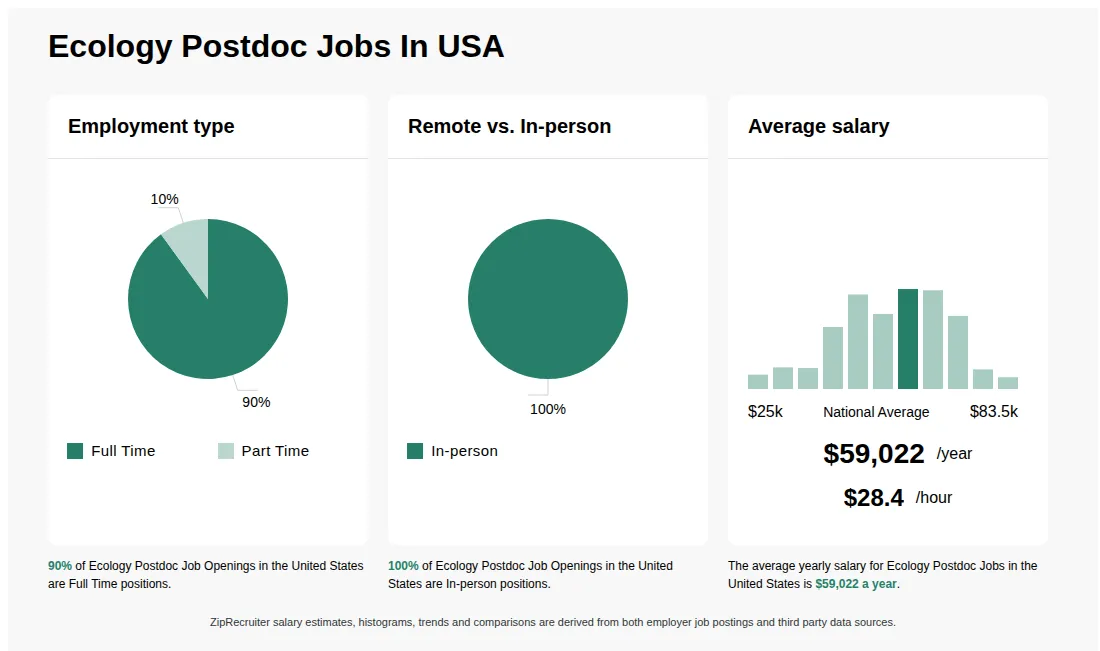
As of Jun 30, 2026, the average yearly pay for ecology postdoc in the United States is $59,022.00, according to ZipRecruiter salary data. Most workers in this role earn between $49,000.00 and $66,500.00 per year, depending on experience, location, and employer.

What are typical collaboration opportunities for an Ecology Postdoc within a research institution?

Ecology Postdocs frequently collaborate with principal investigators, graduate students, and other postdoctoral researchers both within their own lab and across related departments. These collaborations can involve co-designing experiments, sharing fieldwork responsibilities, and contributing to multi-disciplinary projects that require expertise from different scientific backgrounds. Many institutions also offer opportunities to mentor undergraduate students or participate in outreach and educational initiatives. Working closely with diverse teams not only broadens your professional network but also enhances the quality and impact of your research.

What is an Ecology Postdoc job?

An Ecology Postdoc is a temporary research position, typically lasting 1-3 years, for individuals who have recently earned a Ph.D. in ecology or a related field. Postdocs conduct independent or collaborative research, publish scientific papers, and may assist with mentoring students or securing grants. These positions help researchers gain additional expertise, expand their professional network, and prepare for academic, governmental, or industry careers.

What are the key skills and qualifications needed to thrive in the Ecology Postdoc position, and why are they important?

To thrive as an Ecology Postdoc, you need a Ph.D. in ecology or a related field, strong analytical and research skills, and experience with statistical and field methodologies. Proficiency with data analysis software (such as R or Python), GIS tools, and sometimes specialized lab or field equipment is often required. Outstanding written and verbal communication, independence, and collaboration skills are highly valued in this role. These abilities enable effective design and execution of research, dissemination of findings, and contribution to the advancement of ecological knowledge within a research team.

More about Ecology Postdoc jobs
What cities are hiring for Ecology Postdoc jobs? Cities with the most Ecology Postdoc job openings:
What are the most commonly searched types of Ecology Postdoc jobs? The most popular types of Ecology Postdoc jobs are:
What states have the most Ecology Postdoc jobs? States with the most job openings for Ecology Postdoc jobs include:
Infographic showing various Ecology Postdoc job openings in the United States as of June 2026, with employment types broken down into 98% Full Time, and 2% Part Time. Highlights an 96% In-person, and 4% Remote job distribution, with an average salary of $59,022 per year, or $28.4 per hour.
Postdoctoral Associate - Forest Futures Lab/Western Fire and Forest Resilience Collaborative

Postdoctoral Associate - Forest Futures Lab/Western Fire and Forest Resilience Collaborative

Cary Institute of Ecosystem Studies

Millbrook, NY โ€ข Remote

Full-time

Posted 5 days ago


Job description

Salary transparency statement This is a full-time, fully benefitted exempt position with a one-year initial appointment, renewable for an additional year contingent on performance and funding. Annual salary starts at $74,263.00 , based on postdoctoral experience, with a highly competitive benefits and time-off package.

Position Summary

The Cary Institute of Ecosystem Studies seeks a collaborative, synthetic postdoctoral associate to join the Western Fire and Forest Resilience Collaborative and the Forest Futures Lab. The Fire Collaborative includes 12 science teams and a team of boundary spanners working together to advance predictive science in fire ecology and ecosystem resilience in ways that are actionable for western US land managers. The postdoctoral associate will integrate remote sensing and geospatial data to determine how fire regimes affect western US river runoff and the drivers of fire-water relationships. This role offers leadership opportunities and the freedom to pursue independent research within a supportive and nurturing lab environment.

The position is based at the Cary Institute in the beautiful Hudson Valley of New York, a short way north of New York City. The Cary Institute is home to a diverse, vibrant, and supportive community of colleagues. The anticipated start date is on or around January 4th, 2027.

Questions about the position may be directed to Dr. Winslow Hansen at the Cary Institute.

Essential Responsibilities

Present research findings in peer-reviewed papers, at scientific meetings, and in other forums.

Work with colleagues in the Fire Collaborative to develop, lead, and implement independent research that enhances fire ecology and ecosystem resilience strategies.

Leverage remote sensing and geospatial data in AI and Bayesian analytical frameworks to characterize relationships between fire and subsequent river runoff in western US watersheds.

Engage with Collaborative boundary spanners, scientists, policymakers, and stakeholders to ensure research findings effectively inform fire and forest management strategies.

Contribute to a dynamic and interdisciplinary research environment at the Cary Institute.

Required Qualifications

Ph.D. in forest ecology, disturbance ecology, remote sensing, AI, or a related field prior to appointment.

Demonstrated expertise in Earth observation, ecological remote sensing, fire ecology.

Experience working with western US practitioners for producing actionable science.

Strong quantitative and analytical skills, particularly with Bayesian and AI-based analyses.

Ability to work independently.

Proficiency with Google Earth Engine.

Strong written and oral communication skills.

Proficiency in programming languages such as R, Python, Java script.

Preferred Qualifications (Not required in every job description only as needed)

Past postdoctoral experience.

Proven record of successful collaboration in team-science environments.

Past experience linking terrestrial disturbances with outcomes in adjacent freshwater systems.

Past experience using remote sensing to characterize ecological disturbance in western landscapes.

Working Conditions

Full-time, Exempt, fully benefitted position.

Occasional travel for field work or meetings is required.

Will require computer work for 7 hours or more a day.

Closing Date: Review of applications will begin 05/19/2026

To Apply:

Visit our website at https://www.caryinstitute.org/... and complete our online job application. Please submit one document that includes a cover letter (no more than 2 pages) describing research interests, CV, and contact information for three references. The Cary Institute is an Equal Employment Opportunity (EEO) employer. It is the policy of the Institute to provide equal employment opportunities to all qualified applicants without regard to race, color, religion, sex, sexual orientation, gender identity, national origin, age, familial status, protected veteran or disabled status, or genetic information.

Employment Type: FULL_TIME