1

Ecology Postdoc Jobs (NOW HIRING)

The postdoctoral associate will work closely with Dr. Elizabeth Petsios and the Baylor Invertebrate ... D. in paleobiology, ecology, evolutionary biology, geosciences, or related field (by start date)

The postdoctoral associate will work closely with Dr. Elizabeth Petsios and the Baylor Invertebrate ... D. in paleobiology, ecology, evolutionary biology, geosciences, or related field (by start date)

$48.20K - $65.40K/yr

... postdoctoral scholar.The position start dates are flexible, with an ideal start date in Fall 2024. Research in the Bletz Lab liesat the intersection of disease ecology, microbial ecology, and ...

next page

Showing results 1-20

Ecology Postdoc information

See salary details

$25K

$59K

$83.5K

How much do ecology postdoc jobs pay per year?

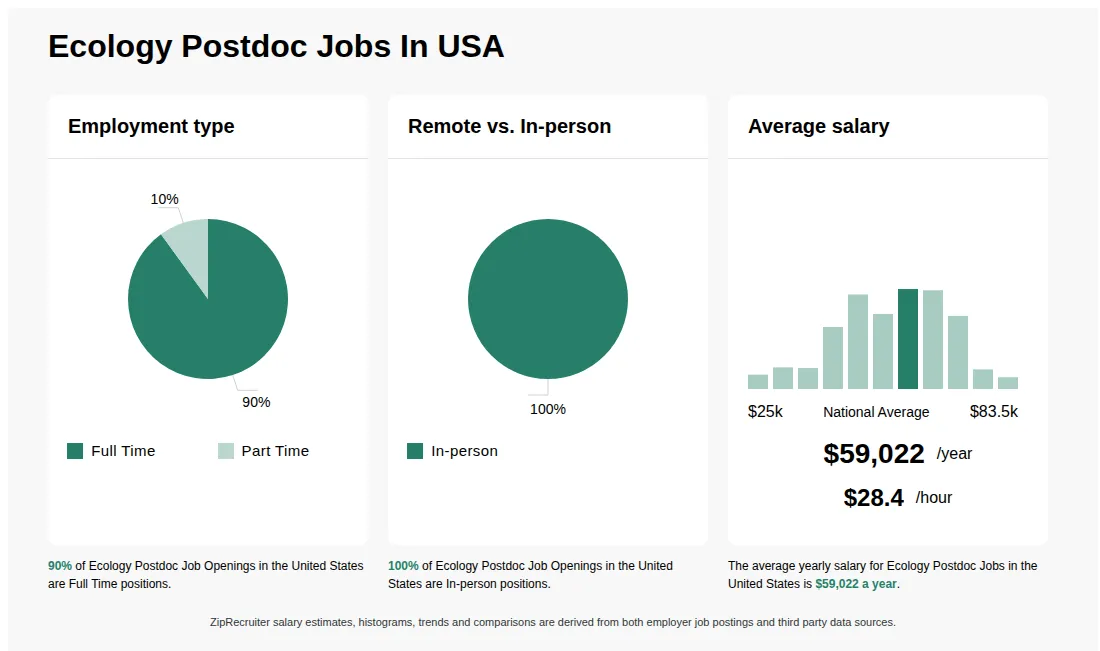
As of May 28, 2026, the average yearly pay for ecology postdoc in the United States is $59,022.00, according to ZipRecruiter salary data. Most workers in this role earn between $49,000.00 and $66,500.00 per year, depending on experience, location, and employer.

What is an Ecology Postdoc job?

An Ecology Postdoc is a temporary research position, typically lasting 1-3 years, for individuals who have recently earned a Ph.D. in ecology or a related field. Postdocs conduct independent or collaborative research, publish scientific papers, and may assist with mentoring students or securing grants. These positions help researchers gain additional expertise, expand their professional network, and prepare for academic, governmental, or industry careers.

What are the key skills and qualifications needed to thrive in the Ecology Postdoc position, and why are they important?

To thrive as an Ecology Postdoc, you need a Ph.D. in ecology or a related field, strong analytical and research skills, and experience with statistical and field methodologies. Proficiency with data analysis software (such as R or Python), GIS tools, and sometimes specialized lab or field equipment is often required. Outstanding written and verbal communication, independence, and collaboration skills are highly valued in this role. These abilities enable effective design and execution of research, dissemination of findings, and contribution to the advancement of ecological knowledge within a research team.

What are typical collaboration opportunities for an Ecology Postdoc within a research institution?

Ecology Postdocs frequently collaborate with principal investigators, graduate students, and other postdoctoral researchers both within their own lab and across related departments. These collaborations can involve co-designing experiments, sharing fieldwork responsibilities, and contributing to multi-disciplinary projects that require expertise from different scientific backgrounds. Many institutions also offer opportunities to mentor undergraduate students or participate in outreach and educational initiatives. Working closely with diverse teams not only broadens your professional network but also enhances the quality and impact of your research.
What cities are hiring for Ecology Postdoc jobs? Cities with the most Ecology Postdoc job openings:
What are the most commonly searched types of Ecology Postdoc jobs? The most popular types of Ecology Postdoc jobs are:
What states have the most Ecology Postdoc jobs? States with the most job openings for Ecology Postdoc jobs include:
Postdoctoral Scholar

Full-time

Posted 6 days ago


Job description

Postdoctoral Scholar

Northern Arizona University (NAU) invites applications for a Postdoctoral Scholar in ecosystem ecology, biogeochemistry, or a closely related field to work on a newly funded, multi-year research project examining the impacts of wildfire and fuel treatments on carbon dynamics in black spruce forests of Interior Alaska. The position is based in Flagstaff, Arizona, with required summer fieldwork in Alaska each year.

The Postdoctoral Scholar will join a highly collaborative research team within the Center for Ecosystem Science and Society (ECOSS) at NAU and will work closely with Dr. Michelle Mack, Dr. Xanthe Walker, and Dr. Ted Schuur. The project integrates field-based measurements, soil biogeochemistry, radiocarbon dating, and quantitative modeling to estimate soil carbon turnover, fluxes, and long-term stability following wildfire and fuel treatments. The Postdoctoral Scholar will play a central role in designing and conducting field research, analyzing and synthesizing complex datasets, and leading peer-reviewed publications.

This is a full-time postdoctoral appointment for 3–4 years, contingent on performance and continued funding, with an anticipated start date in May 2026.

Responsibilities:

  • 65% - Research and Publications
  • Lead and contribute to field-based research in Interior Alaska, including soil sampling, site re-measurement, and experimental implementation of fuel breaks.
  • Analyze and synthesize ecological, biogeochemical, and isotopic datasets to quantify changes in soil carbon pools and turnover.
  • Apply radiocarbon (14C) and isotope-based approaches to estimate soil carbon age, turnover, and fluxes.
  • Develop and apply statistical models.
  • Lead and co-author peer-reviewed publications and present results at scientific conferences and stakeholder workshops.
  • Participate in lab meetings, project meetings, and interdisciplinary scientific discussions.
  • 20% - Data Management and Analysis
  • Curate, manage, and analyze large, multi-source datasets.
  • Develop reproducible analysis workflows using R or similar programming languages and document code using version control (e.g., GitHub).
  • Produce publication-quality figures and data products.
  • 5% - Grant and Project Support
  • Assist with project coordination, reporting requirements, and collaboration with federal and state partners as needed.
  • 5% - Academic and Lab Citizenship
  • Contribute to a collaborative, inclusive, and respectful research environment.
  • Assist with general lab activities related to project goals.
  • 5% - Other
  • Other duties as assigned.

Minimum Qualifications:

  • PhD in Ecology, Soil Science, Environmental Science, Forestry, Earth Science, or a closely related discipline by the start date.
  • *A combination of related education, experience, and training may be used as an equivalent to the above Minimum Qualifications.

Preferred Qualifications:

  • Experience with wildfire ecology.
  • Experience with radiocarbon (14C) or stable isotope analyses.
  • Laboratory and field experience collecting, processing, and analyzing soil and vegetation samples.
  • Record of peer-reviewed scientific publications.
  • Experience working in collaborative, interdisciplinary research teams.
  • Demonstrated experience with quantitative data analysis (e.g., R or similar programming languages).

Knowledge, Skills, and Abilities:

Knowledge:

  • Wildfire ecology and ecosystem science.
  • Field- and laboratory-based research approaches.
  • Data analysis and interpretation in scientific research.
  • Best practices for data management and reproducible research.

Skills:

  • Effective organization, documentation, and management of research activities.
  • Analyze, interpret, and synthesize scientific information.
  • Strong written and oral communication for scientific and professional audiences.
  • Collaboration and teamwork in interdisciplinary research environments.
  • Time management and prioritization across multiple responsibilities.

Abilities:

  • Highly motivated to perform research in a collaborative environment.
  • Establishes and maintains effective working relationships.
  • Communicates effectively.
  • Possesses strong problem solving, organizational, and analytical capabilities.