Postdoctoral Scholar
Portland, OR · On-site
Department Overview A postdoctoral researcher position is available in the Division of Informatics, Clinical Epidemiology and Translational Data Science (DICE) in the OHSU Department of Medicine. The ...
Portland, OR · On-site
Department Overview A postdoctoral researcher position is available in the Division of Informatics, Clinical Epidemiology and Translational Data Science (DICE) in the OHSU Department of Medicine. The ...
Portland, OR · On-site
Department Overview A postdoctoral researcher position is available in the Division of Informatics, Clinical Epidemiology and Translational Data Science (DICE) in the OHSU Department of Medicine. The ...
Portland, OR · On-site
$66K - $81K/yr
Department Overview A postdoctoral researcher position is available in the Division of Informatics, Clinical Epidemiology and Translational Data Science (DICE) in the OHSU Department of Medicine. The ...
Portland, OR · On-site
$66K - $81K/yr
Department Overview A postdoctoral researcher position is available in the Division of Informatics, Clinical Epidemiology and Translational Data Science (DICE) in the OHSU Department of Medicine. The ...
What You Will Do This position is for a postdoctoral researcher in the Space Remote Sensing and Data Science Group (ISR-6) at Los Alamos National Laboratory. You will work closely with ...
What You Will Do This position is for a postdoctoral researcher in the Space Remote Sensing and Data Science Group (ISR-6) at Los Alamos National Laboratory. You will work closely with ...
Portland, OR · On-site
Department Overview A postdoctoral researcher position is available in the Division of Informatics, Clinical Epidemiology and Translational Data Science (DICE) in the OHSU Department of Medicine. The ...
Portland, OR · On-site
Department Overview A postdoctoral researcher position is available in the Division of Informatics, Clinical Epidemiology and Translational Data Science (DICE) in the OHSU Department of Medicine. The ...
Cambridge, MA · On-site
$75K/yr
Position Details Title Postdoctoral Research Position in Data Science/ML for Assessing Societal Impacts of AI Data Centers School Harvard T.H. Chan School of Public Health Department/Area ...
Cambridge, MA · On-site
$75K/yr
Position Details Title Postdoctoral Research Position in Data Science/ML for Assessing Societal Impacts of AI Data Centers School Harvard T.H. Chan School of Public Health Department/Area ...
Chapel Hill, NC · On-site
Research Scientist/Postdoc | Winston Center on Technology and Brain Development Winston Center on ... We use experimental designs, longitudinal methods, and have a lot of data for anyone looking for ...
Chapel Hill, NC · On-site
Research Scientist/Postdoc | Winston Center on Technology and Brain Development Winston Center on ... We use experimental designs, longitudinal methods, and have a lot of data for anyone looking for ...
Chicago, IL · On-site
Job Summary The Data Science Institute is hiring a Program Administrator for the Eric and Wendy Schmidt AI in Science Postdoctoral Fellowship program funded by Schmidt Sciences, a philanthropic ...
Chicago, IL · On-site
Job Summary The Data Science Institute is hiring a Program Administrator for the Eric and Wendy Schmidt AI in Science Postdoctoral Fellowship program funded by Schmidt Sciences, a philanthropic ...
Dallas, TX · On-site
Information on our postdoctoral training program, benefits, and a virtual tour can be found at Qualifications Candidates with a Ph.D. in computer science, bioinformatics, data science, machine ...
Dallas, TX · On-site
Information on our postdoctoral training program, benefits, and a virtual tour can be found at Qualifications Candidates with a Ph.D. in computer science, bioinformatics, data science, machine ...
Description Texas Biomed is searching for an exceptional postdoctoral scientist to study the ... A doctoral degree and demonstrated experience working with next-generation sequencing data ...
Description Texas Biomed is searching for an exceptional postdoctoral scientist to study the ... A doctoral degree and demonstrated experience working with next-generation sequencing data ...
Texas Biomed is searching for an exceptional postdoctoral scientist to study the consequences of ... A doctoral degree and demonstrated experience working with next-generation sequencing data ...
Texas Biomed is searching for an exceptional postdoctoral scientist to study the consequences of ... A doctoral degree and demonstrated experience working with next-generation sequencing data ...
Baltimore, MD · On-site
$48K - $66K/yr
Dr. Sherchan's lab at Morgan State seeks to recruit one postdoc to work in the field of ... data science, computer science, computational biology, microbiology, or a related field.The ...
Baltimore, MD · On-site
$48K - $66K/yr
Dr. Sherchan's lab at Morgan State seeks to recruit one postdoc to work in the field of ... data science, computer science, computational biology, microbiology, or a related field.The ...
Job Type Full-time Description Texas Biomed is searching for an exceptional postdoctoral scientist ... A doctoral degree and demonstrated experience working with next-generation sequencing data ...
Job Type Full-time Description Texas Biomed is searching for an exceptional postdoctoral scientist ... A doctoral degree and demonstrated experience working with next-generation sequencing data ...
Information on our postdoctoral training program, benefits, and a virtual tour can be found at Candidates with a Ph.D. in computer science, bioinformatics, data science, machine learning, or a ...
Information on our postdoctoral training program, benefits, and a virtual tour can be found at Candidates with a Ph.D. in computer science, bioinformatics, data science, machine learning, or a ...
Chicago, IL · On-site
Job Summary The Data Science Institute is hiring a Program Administrator for the Eric and Wendy Schmidt AI in Science Postdoctoral Fellowship program funded by Schmidt Sciences, a philanthropic ...
Chicago, IL · On-site
Job Summary The Data Science Institute is hiring a Program Administrator for the Eric and Wendy Schmidt AI in Science Postdoctoral Fellowship program funded by Schmidt Sciences, a philanthropic ...
Postdoctoral Associate / Research Scientist in Systems Neuroscience and/or Neuroengineering 2026-09 ... Data science, statistics, machine learning, modeling, dynamical systems, orother advanced ...
New
Postdoctoral Associate / Research Scientist in Systems Neuroscience and/or Neuroengineering 2026-09 ... Data science, statistics, machine learning, modeling, dynamical systems, orother advanced ...
New
Providence, RI · On-site
Rebecca Hubbard, Professor of Biostatistics and Data Science at Brown University, invites applications for a postdoctoral research associate with interests in developing and applying statistical and ...
Providence, RI · On-site
Rebecca Hubbard, Professor of Biostatistics and Data Science at Brown University, invites applications for a postdoctoral research associate with interests in developing and applying statistical and ...
... data science. The successful candidate will work at the exciting intersection of computational ... For more information about the Postdoc Program, go to Due to federal restrictions contained in the ...
... data science. The successful candidate will work at the exciting intersection of computational ... For more information about the Postdoc Program, go to Due to federal restrictions contained in the ...
Dallas, TX · On-site
POSTDOCTORAL RESEARCHER -We invite applications for a Postdoctoral Researcher position focused on ... Collaborate with experts in epidemiology, health data science, and computer science. Prepare ...
Dallas, TX · On-site
POSTDOCTORAL RESEARCHER -We invite applications for a Postdoctoral Researcher position focused on ... Collaborate with experts in epidemiology, health data science, and computer science. Prepare ...
Newark, DE · On-site
$47K - $65K/yr
Post Doctoral Fellow, UD Institute for Data Science Job no: 503752 College / VP Area: Research ... Postdoctoral Fellows will actively collaborate across sites and may have joint appointments at UD ...
Newark, DE · On-site
$47K - $65K/yr
Post Doctoral Fellow, UD Institute for Data Science Job no: 503752 College / VP Area: Research ... Postdoctoral Fellows will actively collaborate across sites and may have joint appointments at UD ...
Post Doctoral Fellow, UD Institute for Data Science Apply now Job no: 503752 College / VP Area ... Postdoctoral Fellows will actively collaborate across sites and may have joint appointments at UD ...
Post Doctoral Fellow, UD Institute for Data Science Apply now Job no: 503752 College / VP Area ... Postdoctoral Fellows will actively collaborate across sites and may have joint appointments at UD ...
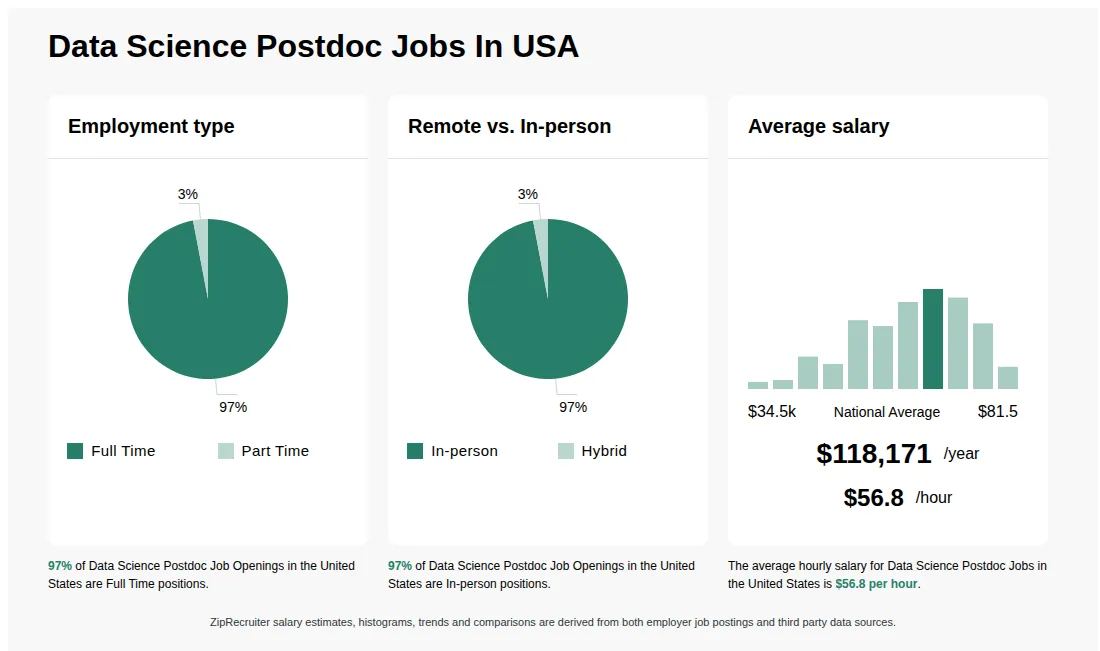
$16.59 - $22.49
1% of jobs
$22.49 - $28.39
1% of jobs
$28.39 - $34.29
5% of jobs
$34.29 - $40.19
4% of jobs
$40.19 - $46.09
13% of jobs
$46.49 is the 25th percentile. Wages below this are outliers.
$46.09 - $51.99
12% of jobs
The median wage is $57.30 / hr.
$51.99 - $57.89
16% of jobs
$57.89 - $63.79
18% of jobs
$65.85 is the 75th percentile. Wages above this are outliers.
$63.79 - $69.69
16% of jobs
$69.69 - $75.59
12% of jobs
$75.59 - $81.49
3% of jobs
$16
$56
$81
A Data Science Postdoc is a temporary research position, typically at a university or research institution, for individuals who have recently completed a PhD. The role focuses on applying advanced data science techniques, such as machine learning, statistical modeling, and big data analysis, to solve complex research problems. Postdocs often work on interdisciplinary projects, collaborate with faculty, publish academic papers, and may also contribute to teaching. The goal is to build expertise, advance knowledge in a specific domain, and prepare for roles in academia, industry, or government.
Data Science Postdocs often spend their days designing and conducting advanced data analyses, developing and testing predictive models, and communicating results through reports or academic publications. They frequently collaborate with faculty, graduate students, and industry partners on interdisciplinary projects, contributing their quantitative expertise. Additionally, Data Science Postdocs may mentor junior researchers, participate in lab meetings, present findings in seminars, and contribute to grant proposals. This dynamic environment provides opportunities to deepen research skills, publish impactful work, and prepare for future career advancement in academia or industry.
To thrive as a Data Science Postdoc, you need advanced analytical skills, expertise in statistical modeling, a doctoral degree in a quantitative field, and proven experience with data-driven research. Proficiency in programming languages like Python or R, along with experience using machine learning libraries, data visualization tools, and version control systems, is typically required. Excellent problem-solving abilities, collaborative teamwork, and effective communication skills help set outstanding candidates apart. These attributes are crucial for advancing knowledge, publishing impactful research, and working effectively within interdisciplinary research teams.
Cities with the most Data Science Postdoc job openings:
The most popular types of Data Science Postdoc jobs are:
States with the most job openings for Data Science Postdoc jobs include:
For Data Science Postdoc jobs, the most frequently searched job titles are:

Portland, OR • On-site
Full-time
Re-posted 22 days ago
8.1
Based on 95 frontline employees who took The Breakroom Quiz
A postdoctoral researcher position is available in the Division of Informatics, Clinical Epidemiology and Translational Data Science (DICE) in the OHSU Department of Medicine. The Medical Informatics Training Grant (T15) is funded by the National Library of Medicine (NLM) and supports learning and research in biomedical informatics and data science. OHSU is one of 16 educational institutions in the United States offering an educational curriculum funded by the T15 grant. By providing a structured research experience under faculty mentorship, the program prepares postdoctoral fellows to undertake independent biomedical informatics research in the academic community or to assume leadership positions in a growing number of hospital and/or commercial efforts in biomedical informatics.
Fellows engage in a rigorous and dynamic program of study - though they survey the field broadly during their fellowship, they also focus on and complete a significant research project that is presented in both oral and written form. The core competency of graduates from the OHSU NLM training program is to use informatics theory and applications to conduct research that utilizes data, information and IT to improve individual health, health care, public health, and/or biomedical research. In addition, graduates should be able to make scientific contributions to fields related to informatics, including, but not limited to, medicine, nursing, public health, other health professions, computer science, data science, library and information science, cognitive science, and organizational and management science.
The postdoctoral fellow will be mentored by the T15 Program Director, Dr. Vishnu Mohan, or his designate.
Initial appointment is for one year; the opportunity to extend by another year will be dependent on successful renewal of the T15 grant. All postdoctoral positions are customized to the level of experience of the trainee and the programmatic work expected of them.
Function/Duties of PositionResearch design and conduct
Data analysis and record keeping
Training and presentations
Grant writing and publications
Get the full story on Breakroom

Sourced by ZipRecruiter
Oregon Health & Science University (OHSU) is a distinguished institution under the industry of higher education and healthcare, specifically in the field of medical science. Based in Portland, Oregon, US, it maintains a reputation for promoting research, teaching, patient care, and outreach. Established in 1887, OHSU has continually sought to redefine the parameters of healthcare delivery and biomedical discovery through its expansive catalog of programs and initiatives. A galvanizing mission drives OHSU: to improve the health and quality of life for all Oregonians through excellence, innovation, and leadership in health care, education, and research.
Colleges, universities, and professional schools
10,000+ Employees
Portland, OR, US
1887