1

Cyber Security Jobs in Texas (NOW HIRING)

CW - Cybersecurity Manager

Houston, TX · On-site

$106K - $143K/yr

The Cybersecurity Manager is a hands-on leadership role responsible for the day-to-day management, execution, and continuous improvement of the company's cybersecurity operations and engineering ...

JOB SUMMARY The Operational Technology (OT) Cybersecurity Architect is responsible for defining, designing, and governing the cybersecurity architecture that protects Delek Logistics' (DKL ...

The Cybersecurity Associate supports the day-to-day operations of the organization's cybersecurity program through monitoring, triage, reporting, service request fulfillment, and security operations ...

The Cybersecurity Associate supports the day-to-day operations of the organization's cybersecurity program through monitoring, triage, reporting, service request fulfillment, and security operations ...

Cybersecurity Team Lead

Irving, TX · On-site

$103K - $139K/yr

Why GMF Cybersecurity? Innovation isn't just a talking point at GM Financial, it's how we operate. By joining our team, you'll work in a mission-focused environment with specialized teams, including ...

Cybersecurity Analyst Location: Austin, TX (Onsite from Day 1) Job Type: Contract Security Consultant * Cyber Security assessment Analyst conducts and supports the cyber security controls risk ...

We're seeking a proactive Cyber Security Specialist to safeguard our digital assets by monitoring threats, managing vulnerabilities, and enforcing robust security policies. Key Responsibilities

Lead Cybersecurity Architect

Plano, TX · On-site

$120 - $160/hr

At JPMorganChase, cybersecurity isn't just a function, it's a strategic priority, and your expertise will directly shape how we design, build, and defend our most critical systems across modern cloud ...

Showing results 41-60

Cyber Security information

See Texas salary details

$53.1K

$123.9K

$173.3K

How much do cyber security jobs pay per year?

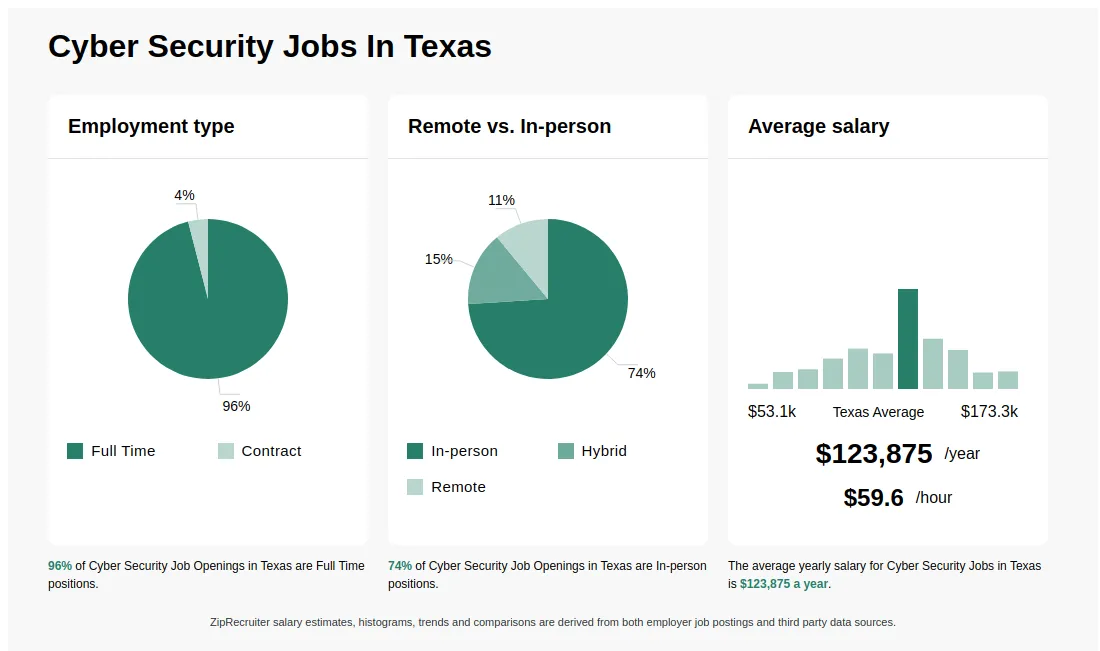
As of Sep 4, 2026, the average yearly pay for cyber security in Texas is $123,875.00, according to ZipRecruiter salary data. Most workers in this role earn between $103,400.00 and $139,700.00 per year, depending on experience, location, and employer.

What is cyber security?

Cyber security refers to the practice of protecting computer systems, networks, and digital data from unauthorized access, attacks, and damage. It involves various technologies, processes, and best practices designed to safeguard sensitive information and ensure the integrity, confidentiality, and availability of data. Cyber security professionals work to prevent cyber threats such as hacking, phishing, malware, and ransomware. With the increasing reliance on digital technologies, cyber security has become essential for individuals, businesses, and governments to protect against cybercrime and data breaches.

What does a cyber security professional do?

As a cybersecurity professional, you help protect sensitive data and information online and on your employer’s servers. You manage firewalls, encryption, and databases, working at all times to stay ahead of whatever security threats might be putting your employer at risk. Cybersecurity is never a completed task; you must continue to assess risks and implement updates to stay ahead of them.

What are the key skills and qualifications needed to thrive as a cyber security professional, and why are they important?

To thrive as a Cyber Security professional, you need a solid understanding of network security, risk assessment, and information systems, typically supported by a degree in computer science or a related field. Familiarity with security tools like firewalls, intrusion detection systems, and certifications such as CISSP or CompTIA Security+ are highly valued. Strong analytical thinking, attention to detail, and effective communication help professionals identify threats and collaborate with teams. These skills and qualifications are crucial for protecting organizations from evolving cyber threats and ensuring the integrity of sensitive data.

How does a cyber security professional typically collaborate with other departments within an organization?

Cyber Security professionals work closely with various departments, such as IT, legal, and compliance, to ensure that security policies are effectively implemented and maintained. They often participate in cross-functional meetings to assess risks, communicate potential threats, and develop incident response plans. Building strong relationships with other teams is crucial, as it helps foster a culture of security awareness and ensures that all employees understand their role in protecting organizational data. Effective collaboration also allows for quicker identification and resolution of security issues.

What is the difference between Cyber Security vs Network Security?

AspectCyber SecurityNetwork Security
CertificationsCompTIA Security+, CISSP, CEHCompTIA Security+, Cisco CCNA Security
Work EnvironmentProtects digital assets across entire organizations, including applications and dataFocuses on securing network infrastructure, devices, and communication channels
Employer & Industry UsageUsed across all industries to safeguard information systemsPrimarily used in IT and networking departments within organizations

Cyber Security encompasses a broad range of practices to protect all digital assets, including networks, applications, and data. Network Security is a subset focused specifically on securing network infrastructure and communication channels. While both roles require similar certifications and are vital in IT, Cyber Security professionals have a wider scope, whereas Network Security specialists concentrate on network-specific threats and defenses.

Is cybersecurity a hard job to learn?

Cybersecurity is a complex field that requires understanding of networks, systems, and security principles, often involving learning programming, threat analysis, and security tools. While it can be challenging initially, gaining certifications like CompTIA Security+ or CISSP and practical experience can help develop skills more effectively.

What jobs can I do with cyber security?

With a background in cyber security, you can pursue roles such as security analyst, penetration tester, security engineer, incident responder, or security consultant. These jobs typically require knowledge of network security, risk management, and tools like firewalls and intrusion detection systems, often supported by certifications such as CISSP or CEH.

What kind of jobs can you do in cyber security?

Cyber security offers a range of roles including security analyst, penetration tester, security engineer, incident responder, and security architect. These jobs typically require knowledge of networks, systems, and security tools, along with certifications like CISSP or CompTIA Security+; work environments can vary from corporate offices to remote settings.

What are the most commonly searched types of Cyber Security jobs in Texas?

The most popular types of Cyber Security jobs in Texas are:

What cities in Texas are hiring for Cyber Security jobs?

Cities in Texas with the most Cyber Security job openings:

Infographic showing various Cyber Security job openings in Texas as of August 2026, with employment types broken down into 60% Full Time, and 40% Contract. Highlights an 100% In-person job distribution, with an average salary of $123,875 per year, or $59.6 per hour.

$65 - $95/hr

Other

Posted 5 days ago


Key responsibilities

  • Monitor security alerts and events across approved security tools and platforms, review potential threats, and assist in identifying false positives.

  • Support incident triage, investigation, and response efforts by gathering evidence, documenting findings, and escalating high-risk events.

  • Manage and respond to cybersecurity-related service requests, coordinate with stakeholders, and track request status to ensure proper closure.


Job description

Crescent is a differentiated U.S. energy company committed to delivering value through a disciplined, returns-driven growth through acquisition strategy and consistent return of capital. Our long-life, balanced portfolio combines significant cash flow from stable production with a deep, high-quality development inventory. Crescent is a top three producer in the Eagle Ford basin and a scaled operator in each of the Permian and Uinta basins. Crescent’s leadership is an experienced team of investment, financial and industry professionals that combines proven investment and operating expertise. For more than a decade, Crescent and our predecessors have executed on a consistent strategy focused on cash flow, risk management and returns. Through disciplined and accretive investments, we have successfully tripled the size of our company since going public in December 2021 while maintaining a strong balance sheet.

The Cybersecurity Associate supports the day-to-day operations of the organization’s cybersecurity program through monitoring, triage, reporting, service request fulfillment, and security operations support. This role plays a key part in protecting the company’s digital assets by helping identify potential threats, supporting response activities, and ensuring security processes are consistently executed across enterprise systems and platforms. This position supports security monitoring, incident triage, vulnerability tracking, logging and SIEM coordination, awareness activities, and operational reporting. The ideal candidate brings foundational cybersecurity knowledge, strong analytical skills, and a proactive mindset, with the ability to work across cybersecurity, infrastructure, applications, and business teams. This individual will contribute to improving cyber resilience, strengthening operational discipline, and supporting the company’s journey toward becoming a secure, technology-enabled, and data-driven enterprise.

Key ResponsibilitiesSecurity Monitoring & Alert Validation

Monitor security alerts and events across approved security tools and platforms. Review and validate potential threats, suspicious activity, and anomalous behavior for appropriate escalation. Assist in identifying false positives, documenting findings, and improving alert handling processes. Support continuous monitoring efforts to improve visibility into enterprise security events and risks.

Incident Triage & Response Support

Support incident triage, investigation, and response efforts in coordination with internal cybersecurity personnel and external partners. Gather initial evidence, document findings, and help track response actions through closure. Escalate confirmed or high-risk events in accordance with established procedures. Assist with post-incident documentation, lessons learned, and follow-up remediation tracking.

Cybersecurity Service Request Management

Manage and respond to cybersecurity-related service requests in a timely and professional manner. Coordinate with users, IT teams, and security stakeholders to fulfill access, policy, logging, and other security-related requests. Track request status, document actions taken, and ensure proper closure and communication. Identify recurring request patterns and suggest process improvements where appropriate.

Logging, SIEM & Security Operations Support

Support proper logging and SIEM integration across systems, platforms, and security tools. Assist with onboarding log sources, validating data flow, and identifying visibility gaps. Help maintain monitoring coverage by working with infrastructure, cloud, application, and security teams. Support security operations processes that strengthen detection, investigation, and response capabilities.

Vulnerability Tracking & Reporting

Track vulnerability remediation efforts across systems and teams to support timely risk reduction. Assist with compiling remediation status, follow-ups, and exception tracking. Support reporting on vulnerabilities, open risks, and remediation progress for cybersecurity leadership. Help coordinate with technical owners to ensure remediation actions are documented and visible.

Security Awareness & Training Support

Deliver security awareness and training support through coordination, communication, and follow-up activities. Assist in preparing awareness content, phishing campaign support, and user education materials. Promote cybersecurity best practices and reinforce awareness of common threats and secure behaviors. Support ongoing efforts to strengthen the organization’s security culture.

Metrics, Reporting & Threat Awareness

Generate security metrics, dashboards, and trend reports to support operational visibility and leadership reporting. Help analyze trends in alerts, incidents, vulnerabilities, and service requests to identify improvement opportunities. Stay informed on emerging threats, techniques, and cyber risks, and apply relevant insights to day-to-day operations. Support documentation and reporting that improves program maturity, consistency, and accountability.

Qualifications & ExperienceEducation

Bachelor’s degree in Information Security, Computer Science, Information Technology, or a related field preferred. Equivalent practical experience will be considered. Relevant certifications such as Security+, Network+, SC-900, or other entry-level cybersecurity certifications are a plus.

Experience

1–3 years of experience in cybersecurity, IT support, security operations, or related technical roles preferred. Exposure to security monitoring, incident response, vulnerability management, or SIEM platforms is preferred. Experience working with ticketing systems, reporting tools, and operational dashboards is a plus. Familiarity with cybersecurity concepts such as phishing, malware, identity security, logging, and vulnerability remediation is preferred. Upstream oil and gas experience is strongly preferred.

Skills & Competencies

Foundational understanding of cybersecurity operations, threat monitoring, incident triage, and risk reduction practices. Strong attention to detail and ability to document findings, actions, and trends accurately. Analytical mindset with the ability to investigate alerts, organize information, and support decision-making. Ability to manage multiple priorities and follow established processes in a fast-paced environment. Strong collaboration skills with the ability to work across cybersecurity, infrastructure, applications, and business teams. Clear communication skills with the ability to explain issues, requests, and findings in a professional and understandable manner.

Crescent Energy is an equal opportunity employer. All qualified applicants will be considered for employment without regard to race, color, religion, gender/pregnancy, gender identity or expression, sexual orientation, national origin, genetics, disability, age, veteran status or any other legally protected status.

Crescent Energy is also committed to compliance with all fair employment practices regarding citizenship and immigration status.

If you require accommodation to complete the application process, please let us know by contacting recruitment@crescentenergyco.com.

Crescent is a differentiated U.S. energy company committed to delivering value through a disciplined, returns-driven growth through acquisition strategy and consistent return of capital. Our long-life, balanced portfolio combines significant cash flow from stable production with a deep, high-quality development inventory. Crescent is a top three producer in the Eagle Ford basin and a scaled operator in each of the Permian and Uinta basins. Crescent’s leadership is an experienced team of investment, financial and industry professionals that combines proven investment and operating expertise. For more than a decade, Crescent and our predecessors have executed on a consistent strategy focused on cash flow, risk management and returns. Through disciplined and accretive investments, we have successfully tripled the size of our company since going public in December 2021 while maintaining a strong balance sheet.

#J-18808-Ljbffr