Cybersecurity Analyst
Irving, TX · Hybrid
Why GM Financial Cybersecurity? Innovation isn't just a talking point at GM Financial, it's how we operate. By joining our team, you'll work in a mission-focused environment with specialized teams ...
Irving, TX · Hybrid
Why GM Financial Cybersecurity? Innovation isn't just a talking point at GM Financial, it's how we operate. By joining our team, you'll work in a mission-focused environment with specialized teams ...
Irving, TX · Hybrid
Why GM Financial Cybersecurity? Innovation isn't just a talking point at GM Financial, it's how we operate. By joining our team, you'll work in a mission-focused environment with specialized teams ...
Plano, TX · On-site
$106K - $144K/yr
Forhyre is seeking a talented individual to provide security architecture support and cybersecurity solutions. The role involves developing security policies, managing training programs, and ensuring ...
Plano, TX · On-site
$106K - $144K/yr
Forhyre is seeking a talented individual to provide security architecture support and cybersecurity solutions. The role involves developing security policies, managing training programs, and ensuring ...
$106K - $143K/yr
We are seeking a Cybersecurity Manager to join our growing team of professionals focused on both evaluating cybersecurity and resilience capabilities and supporting the maturity of programs across ...
$106K - $143K/yr
We are seeking a Cybersecurity Manager to join our growing team of professionals focused on both evaluating cybersecurity and resilience capabilities and supporting the maturity of programs across ...
$106K - $143K/yr
We are seeking a Cybersecurity Manager to join our growing team of professionals focused on both evaluating cybersecurity and resilience capabilities and supporting the maturity of programs across ...
$106K - $143K/yr
We are seeking a Cybersecurity Manager to join our growing team of professionals focused on both evaluating cybersecurity and resilience capabilities and supporting the maturity of programs across ...
$109K - $148K/yr
We are seeking a Cybersecurity Manager to join our growing team of professionals focused on both evaluating cybersecurity and resilience capabilities and supporting the maturity of programs across ...
$109K - $148K/yr
We are seeking a Cybersecurity Manager to join our growing team of professionals focused on both evaluating cybersecurity and resilience capabilities and supporting the maturity of programs across ...
San Antonio, TX · On-site
Conduct cybersecurity assessments, inspections, Security Assistance Visits (SAVs), and compliance reviews in accordance with NIST RMF, AF IC, Department of War (DoW), Department of the Air Force (DAF ...
San Antonio, TX · On-site
Conduct cybersecurity assessments, inspections, Security Assistance Visits (SAVs), and compliance reviews in accordance with NIST RMF, AF IC, Department of War (DoW), Department of the Air Force (DAF ...
$110K - $148K/yr
We are seeking a Cybersecurity Manager to join our growing team of professionals focused on both evaluating cybersecurity and resilience capabilities and supporting the maturity of programs across ...
$110K - $148K/yr
We are seeking a Cybersecurity Manager to join our growing team of professionals focused on both evaluating cybersecurity and resilience capabilities and supporting the maturity of programs across ...
The Woodlands, TX · On-site
$160K/yr
The Cybersecurity Manager leads the organization's cybersecurity, risk, and compliance program, ensuring the protection of enterprise systems and sensitive data in a regulated energy environment.
The Woodlands, TX · On-site
$160K/yr
The Cybersecurity Manager leads the organization's cybersecurity, risk, and compliance program, ensuring the protection of enterprise systems and sensitive data in a regulated energy environment.
Houston, TX · On-site
The Cybersecurity Engineer will: * Conduct cyber threat modeling, identifying critical trust boundaries and correlating them to risk based on adversarial tactics and techniques. * Perform gap ...
Houston, TX · On-site
The Cybersecurity Engineer will: * Conduct cyber threat modeling, identifying critical trust boundaries and correlating them to risk based on adversarial tactics and techniques. * Perform gap ...
Houston, TX · On-site
$100 - $125/hr
The Cybersecurity Engineer will: * Conduct cyber threat modeling, identifying critical trust boundaries and correlating them to risk based on adversarial tactics and techniques. * Perform gap ...
Houston, TX · On-site
$100 - $125/hr
The Cybersecurity Engineer will: * Conduct cyber threat modeling, identifying critical trust boundaries and correlating them to risk based on adversarial tactics and techniques. * Perform gap ...
$99K - $134K/yr
We are seeking a Cybersecurity Manager to join our growing team of professionals focused on both evaluating cybersecurity and resilience capabilities and supporting the maturity of programs across ...
$99K - $134K/yr
We are seeking a Cybersecurity Manager to join our growing team of professionals focused on both evaluating cybersecurity and resilience capabilities and supporting the maturity of programs across ...
Harlingen, TX · On-site
$74K/yr
Provide hands-on leadership for the district's network, cybersecurity, server infrastructure, monitoring, and network-connected operational technology standards. This position supports reliable ...
Harlingen, TX · On-site
$74K/yr
Provide hands-on leadership for the district's network, cybersecurity, server infrastructure, monitoring, and network-connected operational technology standards. This position supports reliable ...
The Cyber Security Engineer will be expected to provide high levels of service for a flagship customer relating to the confidentiality, integrity, and availability of their enterprise infrastructure.
The Cyber Security Engineer will be expected to provide high levels of service for a flagship customer relating to the confidentiality, integrity, and availability of their enterprise infrastructure.
San Antonio, TX · On-site
They are seeking a dedicated and detail-oriented Cybersecurity Analyst to monitor and analyze security events, identify vulnerabilities, and implement measures to protect against cyberattacks.
San Antonio, TX · On-site
They are seeking a dedicated and detail-oriented Cybersecurity Analyst to monitor and analyze security events, identify vulnerabilities, and implement measures to protect against cyberattacks.
Provide hands-on leadership for the district's network, cybersecurity, server infrastructure, monitoring, and network-connected operational technology standards. This position supports reliable ...
Provide hands-on leadership for the district's network, cybersecurity, server infrastructure, monitoring, and network-connected operational technology standards. This position supports reliable ...
Houston, TX · Hybrid
The Cybersecurity Engineer will: * Conduct cyber threat modeling, identifying critical trust boundaries and correlating them to risk based on adversarial tactics and techniques. * Perform gap ...
Houston, TX · Hybrid
The Cybersecurity Engineer will: * Conduct cyber threat modeling, identifying critical trust boundaries and correlating them to risk based on adversarial tactics and techniques. * Perform gap ...
San Antonio, TX · On-site
Cybersecurity Analyst LOCATION San Antonio, TX 78208 CLEARANCE TS/SCI Full Poly (Please note this position requires full U.S. Citizenship) KEY SUMMARY We are seeking a dedicated and detail-oriented ...
San Antonio, TX · On-site
Cybersecurity Analyst LOCATION San Antonio, TX 78208 CLEARANCE TS/SCI Full Poly (Please note this position requires full U.S. Citizenship) KEY SUMMARY We are seeking a dedicated and detail-oriented ...
San Antonio, TX · On-site
$112K - $257K/yr
Cyber Security Architect The Opportunity : Everyone knows security needs to be "baked in" to a system architecture, but you actually know how to bake it in. You can identify and implement ways to ...
San Antonio, TX · On-site
$112K - $257K/yr
Cyber Security Architect The Opportunity : Everyone knows security needs to be "baked in" to a system architecture, but you actually know how to bake it in. You can identify and implement ways to ...
San Antonio, TX · On-site
$80 - $100/hr
Cybersecurity Analyst LOCATION San Antonio, TX 78208 CLEARANCE TS/SCI Full Poly (Please note this position requires full U.S. Citizenship) KEY SUMMARY We are seeking a dedicated and detail-oriented ...
San Antonio, TX · On-site
$80 - $100/hr
Cybersecurity Analyst LOCATION San Antonio, TX 78208 CLEARANCE TS/SCI Full Poly (Please note this position requires full U.S. Citizenship) KEY SUMMARY We are seeking a dedicated and detail-oriented ...
Houston, TX · Hybrid
The Cybersecurity Engineer will: * Conduct cyber threat modeling, identifying critical trust boundaries and correlating them to risk based on adversarial tactics and techniques. * Perform gap ...
Houston, TX · Hybrid
The Cybersecurity Engineer will: * Conduct cyber threat modeling, identifying critical trust boundaries and correlating them to risk based on adversarial tactics and techniques. * Perform gap ...
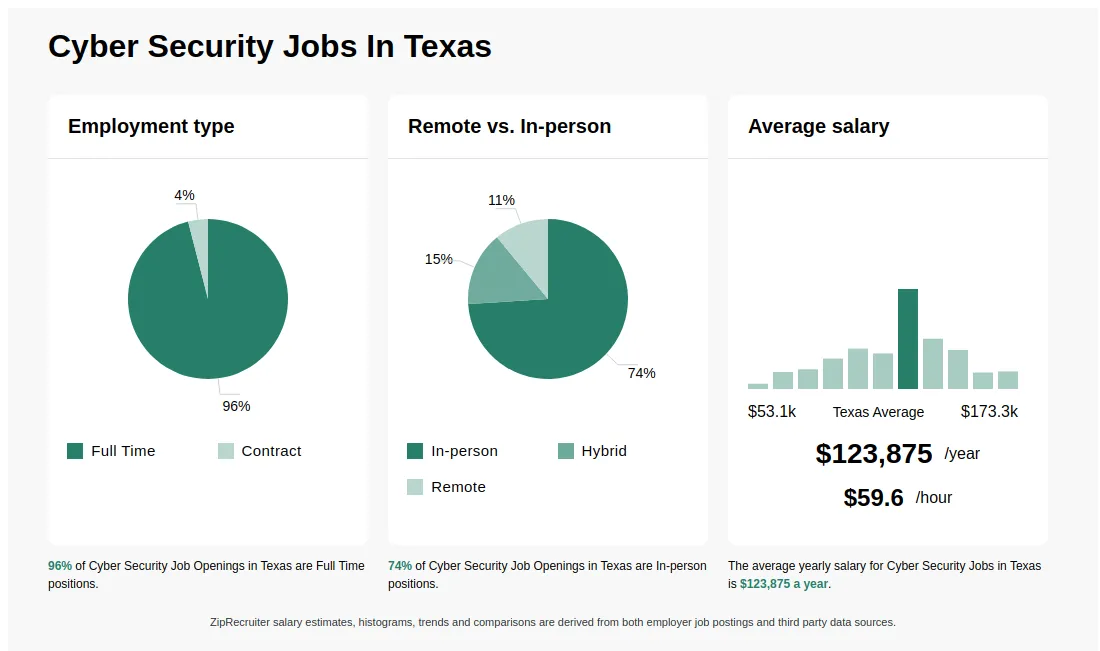
$53.1K - $64K
1% of jobs
$64K - $75K
4% of jobs
$75K - $85.9K
5% of jobs
$85.9K - $96.8K
9% of jobs
$102.8K is the 25th percentile. Wages below this are outliers.
$96.8K - $107.7K
11% of jobs
$107.7K - $118.7K
10% of jobs
The median wage is $122.9K / yr.
$118.7K - $129.6K
28% of jobs
$135.9K is the 75th percentile. Wages above this are outliers.
$129.6K - $140.5K
14% of jobs
$140.5K - $151.4K
11% of jobs
$151.4K - $162.4K
4% of jobs
$162.4K - $173.3K
4% of jobs
$53.1K
$123.9K
$173.3K
As a cybersecurity professional, you help protect sensitive data and information online and on your employer’s servers. You manage firewalls, encryption, and databases, working at all times to stay ahead of whatever security threats might be putting your employer at risk. Cybersecurity is never a completed task; you must continue to assess risks and implement updates to stay ahead of them.
| Aspect | Cyber Security | Network Security |
|---|---|---|
| Certifications | CompTIA Security+, CISSP, CEH | CompTIA Security+, Cisco CCNA Security |
| Work Environment | Protects digital assets across entire organizations, including applications and data | Focuses on securing network infrastructure, devices, and communication channels |
| Employer & Industry Usage | Used across all industries to safeguard information systems | Primarily used in IT and networking departments within organizations |
Cyber Security encompasses a broad range of practices to protect all digital assets, including networks, applications, and data. Network Security is a subset focused specifically on securing network infrastructure and communication channels. While both roles require similar certifications and are vital in IT, Cyber Security professionals have a wider scope, whereas Network Security specialists concentrate on network-specific threats and defenses.
The most popular types of Cyber Security jobs in Texas are:
For Cyber Security jobs in Texas, the most frequently searched job titles are:
The top searched job categories for Cyber Security jobs in Texas are:
Cities in Texas with the most Cyber Security job openings:
8.2
Based on 43 frontline employees who took The Breakroom Quiz
57th of 178 rated vehicle equipment hire
Why GM Financial Cybersecurity?
Innovation isn't just a talking point at GM Financial, it's how we operate. By joining our team, you'll work in a mission-focused environment with specialized teams, including Engineering, Threat Intelligence, Vulnerability Management, Incident Response, Firewall, Governance, Risk, Architecture and Offensive Security. These teams collaborate to identify, manage and respond to threats, all while driving innovation across the environment.
Cybersecurity is central to our strategic vision, so you'll benefit from exceptional leadership visibility, with direct reporting lines to the CEO. This structure ensures your work is recognized and supported at the highest levels, while also enabling bold innovation and the adoption of cutting-edge technologies.
Shape the future of Cybersecurity at GM Financial, with the freedom to explore, the tools to build and the support to thrive.
This position will be posted until filled.
What makes you an ideal candidate?
Experience in remediation management, issues management, vulnerability management, or similar role with direct exposure to tracking and remediating cybersecurity findings.
Working familiarity with common security and reconnaissance tooling sufficient to interpret and validate output, as well as basic scripting ability (PowerShell or Bash preferred).
Foundational understanding of cybersecurity principles, vulnerabilities, threats, and security controls.
Ability to analyze information, identify trends, and evaluate potential business and risk impacts.
Strong organizational skills with demonstrated ability to manage competing priorities and deadlines in a fast-paced environment.
Effective written and verbal communication skills, including the ability to tailor communications for technical and non-technical audiences.
Ability to build collaborative relationships and work effectively across cybersecurity, technology, and business teams.
Knowledge of cybersecurity frameworks and industry standards such as NIST Cybersecurity Framework (CSF), NIST 800-53, ISO 27001, or similar frameworks.
Understanding of common technology domains including networking, infrastructure, cloud, identity and access management, and application security.
Strong analytical, problem-solving, and critical thinking skills.
Experience interpreting technical documentation, issues, vulnerabilities, and remediation evidence.
Experience with issue tracking, workflow management, reporting, or cybersecurity platforms is preferred.
Demonstrated ability to independently investigate technical findings using open-source research to proactively close any gaps in technical understanding.
Experience and Education
Minimum of 1-5 years of experience in large and complex business environment with a successful track record working directly with senior level management preferred
At least 1 year of experience in one or more of the following domains: Access Control, Telecom and Network Security, Cybersecurity Governance, Risk Management, Software Development Security, Cryptography, Security Architecture and Design, Operational Security, Business Continuity & Disaster Recovery, Legal Regulations, Investigations and Compliance, Physical (Environmental) Security, IT or Security Audit, IT or Security Compliance preferred
Experience with UML Design Tools preferred
Experience with alternate management methods using SSH, serial connections, and the command-line interface TMSH preferred
Experience in documentation tools such as Visio and Microsoft Office products preferred
Experience with Network and VLAN segmentation preferred
Experience with technical writing preferred
High School Diploma or equivalent required
Bachelor's Degree in related field or equivalent work experience strongly preferred
Licenses and Certifications
Information Security Certifications strongly preferred
What We Offer: Generous benefits package available on day one to include: 401K matching, bonding leave for new parents (12 weeks, 100% paid), tuition assistance, training, GM employee auto discount, community service pay and nine company holidays.
Our Culture: Our team members define and shape our culture - an environment that welcomes innovative ideas, fosters integrity, and creates a sense of community and belonging. Here we do more than work - we thrive.
Compensation: Competitive pay and bonus eligibility.
Work Life Balance: Hybrid work environment, 4-days a week in office.
NOTE: We are unable to consider candidates who require visa sponsorship for this position
This position is not open to agency submissions
About the role
The Cybersecurity Analyst is responsible for coordinating the Cybersecurity Issues Management process and managing issues through the remediation lifecycle. This role facilitates issue intake activities, identifies and engages accountable owners, documents remediation plans, tracks progress against established milestones, and conducts ongoing follow-up with stakeholders to support timely remediation.
This role requires the ability to coordinate and prioritize multiple remediation efforts simultaneously, communicate effectively with stakeholders at all levels, and interpret technical issues and supporting evidence. The analyst leverages cybersecurity, vulnerability management, reporting, and workflow management tools to track progress, validate supporting evidence, and provide meaningful status reporting to stakeholders and leadership.
In this role you will:
Manage cybersecurity issues throughout the remediation lifecycle, from intake and assignment through remediation validation and closure.
Partner with issue owners and technical stakeholders to document remediation plans, target dates, key milestones, and track progress toward remediation objectives.
Conduct ongoing follow-up activities to monitor remediation efforts, identify obstacles, drive accountability, and escalate risks, delays, and aging issues as appropriate.
Research and interpret technical issues across a variety of domains, including network, Active Directory, web application, cloud, and infrastructure security, to effectively communicate risk and remediation plan with both technical and non-technical stakeholders.
Coordinate regularly with Offensive Security and other Cybersecurity teams on finding statuses and validation requirements.
Maintain accurate documentation, remediation records, status updates, and supporting evidence within designated workflow and tracking systems.
Develop, maintain, and deliver reporting and metrics that provide leadership visibility into remediation progress, issue aging, trends, and overall cybersecurity risk posture.
Identify opportunities to enhance issue management processes, reporting capabilities, and governance practices to improve efficiency, consistency, and stakeholder experience.
Get the full story on Breakroom

Sourced by ZipRecruiter
Finance and insurance
5,001 - 10,000 Employees
Fort Worth, TX, US
1992