
Role: As a Cybersecurity Analyst, you will protect the Credit Union's information assets, systems, and member data through proactive monitoring, risk management, incident response, security ...
Role: As a Cybersecurity Analyst, you will protect the Credit Union's information assets, systems, and member data through proactive monitoring, risk management, incident response, security ...
Cybersecurity Analyst
Houston, TX · On-site
Role: As a Cybersecurity Analyst, you will protect the Credit Union's information assets, systems, and member data through proactive monitoring, risk management, incident response, security ...
Cybersecurity Analyst
Houston, TX · On-site
Role: As a Cybersecurity Analyst, you will protect the Credit Union's information assets, systems, and member data through proactive monitoring, risk management, incident response, security ...
Cybersecurity Analyst
Houston, TX · On-site
Role: As a Cybersecurity Analyst, you will protect the Credit Union's information assets, systems, and member data through proactive monitoring, risk management, incident response, security ...
Quick apply
Cybersecurity Analyst
Houston, TX · On-site
Role: As a Cybersecurity Analyst, you will protect the Credit Union's information assets, systems, and member data through proactive monitoring, risk management, incident response, security ...

Cybersecurity Engineer
Dallas, TX · On-site
The Cyber Security Engineer will support the design, development, and maintenance of secure medical device software systems, ensuring that cybersecurity controls are resilient and compliant with FDA ...
Quick apply
Cybersecurity Engineer
Dallas, TX · On-site
The Cyber Security Engineer will support the design, development, and maintenance of secure medical device software systems, ensuring that cybersecurity controls are resilient and compliant with FDA ...

Cyber Security Technician
Dallas, TX · On-site
One Royal Culture Short Story We have a current opening for a Cyber Security Technician for our Dallas, TX office. Role Summary Royal Electric is seeking a proactive and detail-oriented ...
Quick apply
Cyber Security Technician
Dallas, TX · On-site
One Royal Culture Short Story We have a current opening for a Cyber Security Technician for our Dallas, TX office. Role Summary Royal Electric is seeking a proactive and detail-oriented ...
Cyber Security Technician
Dallas, TX · On-site
One Royal Culture Short Story We have a current opening for a Cyber Security Technician for our Dallas, TX office. Role Summary Royal Electric is seeking a proactive and detail-oriented ...
Cyber Security Technician
Dallas, TX · On-site
One Royal Culture Short Story We have a current opening for a Cyber Security Technician for our Dallas, TX office. Role Summary Royal Electric is seeking a proactive and detail-oriented ...
Cyber Security Technician
Dallas, TX · On-site
One Royal Culture Short Story We have a current opening for a Cyber Security Technician for our Dallas, TX office. Role Summary Royal Electric is seeking a proactive and detail-oriented ...
Cyber Security Technician
Dallas, TX · On-site
One Royal Culture Short Story We have a current opening for a Cyber Security Technician for our Dallas, TX office. Role Summary Royal Electric is seeking a proactive and detail-oriented ...

Cybersecurity Analyst
Irving, TX · On-site
Why GM Financial Cybersecurity? Innovation isn't just a talking point at GM Financial, it's how we operate. By joining our team, you'll work in a mission-focused environment with specialized teams ...
Cybersecurity Analyst
Irving, TX · On-site
Why GM Financial Cybersecurity? Innovation isn't just a talking point at GM Financial, it's how we operate. By joining our team, you'll work in a mission-focused environment with specialized teams ...
Cyber Security Engineer
Texas City, TX · On-site
Cyber Security Engineer Job Title: Cyber Security Engineer Location: USA / On-site Employment Type: Full-Time Experience: 2-3 Years Job Summary We are looking for a skilled and responsible ...
Cyber Security Engineer
Texas City, TX · On-site
Cyber Security Engineer Job Title: Cyber Security Engineer Location: USA / On-site Employment Type: Full-Time Experience: 2-3 Years Job Summary We are looking for a skilled and responsible ...

Cyber Security Analyst
Houston, TX · On-site
$100K - $110K/yr
Houston, Hybrid Cybersecurity Analyst We are seeking a Cybersecurity Analyst to join a growing IT security team and help protect the organization's systems, data, and technology environment. This ...
Quick apply
Cyber Security Analyst
Houston, TX · On-site
$100K - $110K/yr
Houston, Hybrid Cybersecurity Analyst We are seeking a Cybersecurity Analyst to join a growing IT security team and help protect the organization's systems, data, and technology environment. This ...

Cyber Security Architect
Houston, TX · On-site
RIT Solutions, Inc. is seeking a Cyber Security Architect to lead their Cybersecurity Operations Portfolio. The role involves advising on technology selections, developing roadmaps, and creating ...
Cyber Security Architect
Houston, TX · On-site
RIT Solutions, Inc. is seeking a Cyber Security Architect to lead their Cybersecurity Operations Portfolio. The role involves advising on technology selections, developing roadmaps, and creating ...

Cybersecurity Engineer
Houston, TX · On-site
The Cybersecurity Engineer will: * Conduct cyber threat modeling, identifying critical trust boundaries and correlating them to risk based on adversarial tactics and techniques. * Perform gap ...
Cybersecurity Engineer
Houston, TX · On-site
The Cybersecurity Engineer will: * Conduct cyber threat modeling, identifying critical trust boundaries and correlating them to risk based on adversarial tactics and techniques. * Perform gap ...
Cyber Security
Plano, TX · On-site
$106K - $144K/yr
Forhyre is seeking a talented individual to provide security architecture support and cybersecurity solutions. The role involves developing security policies, managing training programs, and ensuring ...
Cyber Security
Plano, TX · On-site
$106K - $144K/yr
Forhyre is seeking a talented individual to provide security architecture support and cybersecurity solutions. The role involves developing security policies, managing training programs, and ensuring ...

Cyber Security
Plano, TX · On-site
This support includes, but is not limited to, cybersecurity solutions, providing technical strategy for solutions, guidance, policy, and implementations. The successful candidate for this position is ...
Quick apply
Cyber Security
Plano, TX · On-site
This support includes, but is not limited to, cybersecurity solutions, providing technical strategy for solutions, guidance, policy, and implementations. The successful candidate for this position is ...
Cybersecurity Specialist
Houston, TX · On-site
The cybersecurity assurance and compliance role provides independent measurement and reporting of the organization's cybersecurity compliance in alignment with corporate cybersecurity policies and ...
Quick apply
Cybersecurity Specialist
Houston, TX · On-site
The cybersecurity assurance and compliance role provides independent measurement and reporting of the organization's cybersecurity compliance in alignment with corporate cybersecurity policies and ...
Cybersecurity Analyst
Irving, TX · Hybrid
Why GM Financial Cybersecurity? Innovation isn't just a talking point at GM Financial, it's how we operate. By joining our team, you'll work in a mission-focused environment with specialized teams ...
Cybersecurity Analyst
Irving, TX · Hybrid
Why GM Financial Cybersecurity? Innovation isn't just a talking point at GM Financial, it's how we operate. By joining our team, you'll work in a mission-focused environment with specialized teams ...

Cybersecurity Manager
The Woodlands, TX · On-site
$160K/yr
The Cybersecurity Manager leads the organization's cybersecurity, risk, and compliance program, ensuring the protection of enterprise systems and sensitive data in a regulated energy environment.
Cybersecurity Manager
The Woodlands, TX · On-site
$160K/yr
The Cybersecurity Manager leads the organization's cybersecurity, risk, and compliance program, ensuring the protection of enterprise systems and sensitive data in a regulated energy environment.

CyberSecurity Architect
Dallas, TX · On-site
Role: Cyber Security Engineer Location: Dallas, TX Contract: 12-24 Months What You Will Do: Implement security improvements by assessing current customer requirements and environment; evaluating ...
CyberSecurity Architect
Dallas, TX · On-site
Role: Cyber Security Engineer Location: Dallas, TX Contract: 12-24 Months What You Will Do: Implement security improvements by assessing current customer requirements and environment; evaluating ...

Cybersecurity Manager
Houston, TX · On-site
$106K - $143K/yr
We are seeking a Cybersecurity Manager to join our growing team of professionals focused on both evaluating cybersecurity and resilience capabilities and supporting the maturity of programs across ...
Cybersecurity Manager
Houston, TX · On-site
$106K - $143K/yr
We are seeking a Cybersecurity Manager to join our growing team of professionals focused on both evaluating cybersecurity and resilience capabilities and supporting the maturity of programs across ...
Cybersecurity Manager
Plano, TX · On-site
$106K - $143K/yr
We are seeking a Cybersecurity Manager to join our growing team of professionals focused on both evaluating cybersecurity and resilience capabilities and supporting the maturity of programs across ...
Cybersecurity Manager
Plano, TX · On-site
$106K - $143K/yr
We are seeking a Cybersecurity Manager to join our growing team of professionals focused on both evaluating cybersecurity and resilience capabilities and supporting the maturity of programs across ...
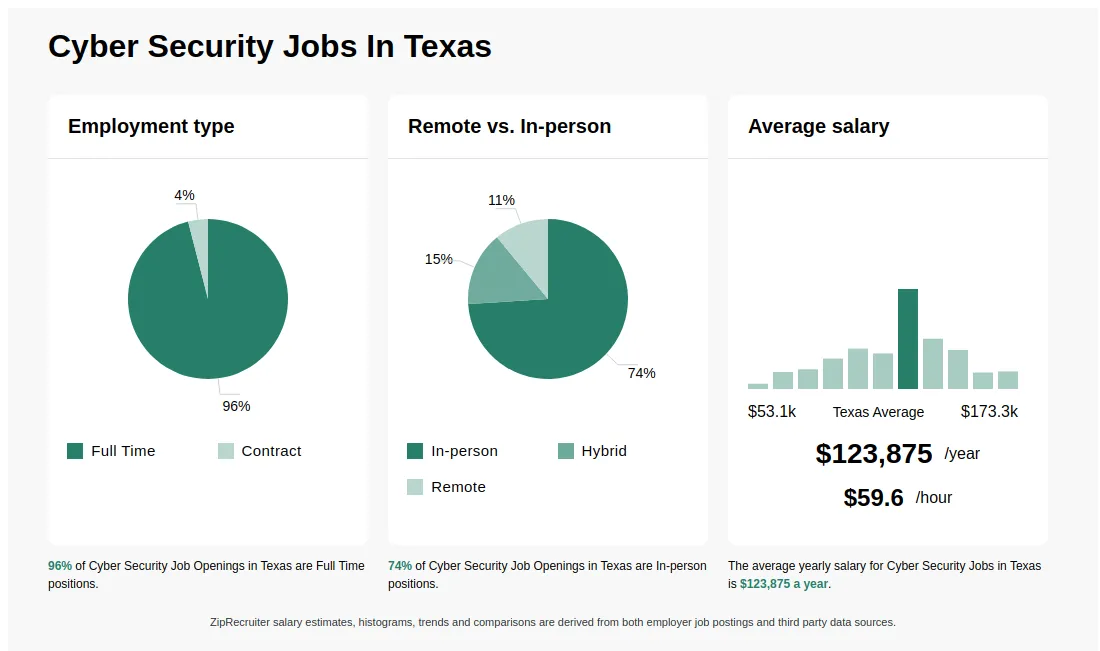
Cyber Security information
See Texas salary details
$53.1K - $64K
1% of jobs
$64K - $75K
4% of jobs
$75K - $85.9K
5% of jobs
$85.9K - $96.8K
9% of jobs
$102.8K is the 25th percentile. Wages below this are outliers.
$96.8K - $107.7K
11% of jobs
$107.7K - $118.7K
10% of jobs
The median wage is $122.9K / yr.
$118.7K - $129.6K
28% of jobs
$135.9K is the 75th percentile. Wages above this are outliers.
$129.6K - $140.5K
14% of jobs
$140.5K - $151.4K
11% of jobs
$151.4K - $162.4K
4% of jobs
$162.4K - $173.3K
4% of jobs
$53.1K
$123.9K
$173.3K
How much do cyber security jobs pay per year?
As of Sep 4, 2026, the average yearly pay for cyber security in Texas is $123,875.00, according to ZipRecruiter salary data. Most workers in this role earn between $103,400.00 and $139,700.00 per year, depending on experience, location, and employer.
What is cyber security?
Cyber security refers to the practice of protecting computer systems, networks, and digital data from unauthorized access, attacks, and damage. It involves various technologies, processes, and best practices designed to safeguard sensitive information and ensure the integrity, confidentiality, and availability of data. Cyber security professionals work to prevent cyber threats such as hacking, phishing, malware, and ransomware. With the increasing reliance on digital technologies, cyber security has become essential for individuals, businesses, and governments to protect against cybercrime and data breaches.
What does a cyber security professional do?
As a cybersecurity professional, you help protect sensitive data and information online and on your employer’s servers. You manage firewalls, encryption, and databases, working at all times to stay ahead of whatever security threats might be putting your employer at risk. Cybersecurity is never a completed task; you must continue to assess risks and implement updates to stay ahead of them.
What are the key skills and qualifications needed to thrive as a cyber security professional, and why are they important?
To thrive as a Cyber Security professional, you need a solid understanding of network security, risk assessment, and information systems, typically supported by a degree in computer science or a related field. Familiarity with security tools like firewalls, intrusion detection systems, and certifications such as CISSP or CompTIA Security+ are highly valued. Strong analytical thinking, attention to detail, and effective communication help professionals identify threats and collaborate with teams. These skills and qualifications are crucial for protecting organizations from evolving cyber threats and ensuring the integrity of sensitive data.
How does a cyber security professional typically collaborate with other departments within an organization?
Cyber Security professionals work closely with various departments, such as IT, legal, and compliance, to ensure that security policies are effectively implemented and maintained. They often participate in cross-functional meetings to assess risks, communicate potential threats, and develop incident response plans. Building strong relationships with other teams is crucial, as it helps foster a culture of security awareness and ensures that all employees understand their role in protecting organizational data. Effective collaboration also allows for quicker identification and resolution of security issues.
What is the difference between Cyber Security vs Network Security?
| Aspect | Cyber Security | Network Security |
|---|---|---|
| Certifications | CompTIA Security+, CISSP, CEH | CompTIA Security+, Cisco CCNA Security |
| Work Environment | Protects digital assets across entire organizations, including applications and data | Focuses on securing network infrastructure, devices, and communication channels |
| Employer & Industry Usage | Used across all industries to safeguard information systems | Primarily used in IT and networking departments within organizations |
Cyber Security encompasses a broad range of practices to protect all digital assets, including networks, applications, and data. Network Security is a subset focused specifically on securing network infrastructure and communication channels. While both roles require similar certifications and are vital in IT, Cyber Security professionals have a wider scope, whereas Network Security specialists concentrate on network-specific threats and defenses.
Is cybersecurity a hard job to learn?
Cybersecurity is a complex field that requires understanding of networks, systems, and security principles, often involving learning programming, threat analysis, and security tools. While it can be challenging initially, gaining certifications like CompTIA Security+ or CISSP and practical experience can help develop skills more effectively.
What jobs can I do with cyber security?
With a background in cyber security, you can pursue roles such as security analyst, penetration tester, security engineer, incident responder, or security consultant. These jobs typically require knowledge of network security, risk management, and tools like firewalls and intrusion detection systems, often supported by certifications such as CISSP or CEH.
What kind of jobs can you do in cyber security?
Cyber security offers a range of roles including security analyst, penetration tester, security engineer, incident responder, and security architect. These jobs typically require knowledge of networks, systems, and security tools, along with certifications like CISSP or CompTIA Security+; work environments can vary from corporate offices to remote settings.
More about Cyber Security jobs
What are the most commonly searched types of Cyber Security jobs in Texas?
The most popular types of Cyber Security jobs in Texas are:
What are popular job titles related to Cyber Security jobs in Texas?
For Cyber Security jobs in Texas, the most frequently searched job titles are:
What job categories do people searching Cyber Security jobs in Texas look for?
The top searched job categories for Cyber Security jobs in Texas are:
What cities in Texas are hiring for Cyber Security jobs?
Cities in Texas with the most Cyber Security job openings:
Job description
Role:
As a Cybersecurity Analyst, you will protect the Credit Union's information assets, systems, and member data through proactive monitoring, risk management, incident response, security governance, and continuous improvement activities. The position supports cybersecurity operations, regulatory compliance, vendor risk management, and cyber resilience initiatives aligned with NIST Cybersecurity Framework (CSF), CIS Controls, FFIEC guidance, and NCUA expectations. The Cybersecurity Analyst partners with technology and business teams to integrate security into all business processes and technology solutions
Essential Functions & Responsibilities:
Monitor and investigate security events, alerts, and anomalous activity. Analyze threats using SIEM, EDR, NGAV, and threat intelligence sources. Participate in detection, containment, eradication, and recovery activities for cybersecurity incidents. Maintain cybersecurity playbooks and incident response procedures. Support cyber investigations and forensic evidence collection activities. Produce incident reports, dashboards, and security metrics.
Coordinate vulnerability identification, assessment, remediation, and validation processes. Assist in managing endpoint security technologies including EDR, NGAV, MDM, and hardening tools. Validate secure configurations for servers, workstations, cloud services, and network infrastructure. Administer and support cybersecurity platforms including Fortinet security products (FortiGate, FortiManager, FortiAnalyzer, FortiAuthenticator, FortiClient, and FortiEMS) to enhance network security, visibility, and threat detection capabilities. Support identity security initiatives including MFA, SSO, PAM, and privileged account governance. Assist with penetration testing activities and remediation of identified security vulnerabilities and assessment findings.
Assist in maintaining cybersecurity policies, standards, procedures, and guidelines. Support risk assessments and cybersecurity control reviews. Assist with NCUA examinations, internal audits, external audits, and regulatory reviews. Track corrective actions and remediation plans resulting from audits and assessments. Maintain cybersecurity documentation and evidence repositories
Participate in security reviews of vendors, fintech partners, and service providers. Review SOC reports, penetration testing reports, SIG questionnaires, and security attestations. Assist with third-party due diligence and ongoing monitoring activities. Identify and document vendor-related cybersecurity risks.
Support cybersecurity awareness and phishing simulation programs. Participate in incident response tabletop exercises. Assist with disaster recovery and business continuity testing activities. Research emerging threats and communicate relevant risks to management. Recommend improvements to strengthen the Credit Union's cybersecurity maturity.
Maintain effective detection and response capabilities for security incidents.
Performance Measurements:
- To identify opportunities to improve services to the company and/or its customers through use of new products and technologies.
- Support successful completion of internal audits, external audits, and NCUA examinations.
- Improve cybersecurity maturity through measurable control enhancements.
- Deliver accurate and timely reporting of cybersecurity metrics and risks.
- Maintain positive relationships with internal departments, members, auditors, and vendors.
- Contribute to cybersecurity awareness and employee engagement initiatives.
Knowledge and Skills
Experience: 3-5 years of cybersecurity, information security, or related IT experience. Financial services or credit union experience preferred. Experience working with security technologies and security operations processes.
Education: College degree in Computer Science, Information Security, Cyber Security, or equivalent.
Interpersonal Skills: Strong verbal and written communication skills are required. Must be able to build effective working relationships with employees, management, vendors, auditors, and regulators. Ability to communicate technical and cybersecurity-related concepts to both technical and non-technical audiences. Requires professionalism, sound judgment, discretion, and the ability to handle sensitive and confidential information.
Other Skills: SIEM platforms, Vulnerability Management Platforms, IAM/PAM Technologies, Email Security Solutions, Data Loss Prevention (DLP), Security Awareness Platforms, Security Automation & Orchestration (SOAR).

About First Service Credit Union
Sourced by ZipRecruiter
Industry
Finance and insurance
Company size
201 - 500 Employees
Headquarters location
Houston, TX, US
Year founded
1977