Bachelor's degree or higher in Business, Business Administration, Information Systems, Computer Science, Artificial Intelligence, Data Science, Analytics, or a related field * At least 4 years of ...
Bachelor's degree or higher in Business, Business Administration, Information Systems, Computer Science, Artificial Intelligence, Data Science, Analytics, or a related field * At least 4 years of ...

... science, catalysis, or electrochemistry. The successful candidate will contribute to the ... a computer terminal; extensive reading. The conditions the worker will be subject to in this ...
... science, catalysis, or electrochemistry. The successful candidate will contribute to the ... a computer terminal; extensive reading. The conditions the worker will be subject to in this ...
Be a part of a computer science institution that focuses on creating software engineers that can DO, not just theorize. * Develop your teaching/mentoring skills. Faculty at Neumont University are ...
Quick apply
Be a part of a computer science institution that focuses on creating software engineers that can DO, not just theorize. * Develop your teaching/mentoring skills. Faculty at Neumont University are ...
Be a part of a computer science institution that focuses on creating software engineers that can DO, not just theorize. * Develop your teaching/mentoring skills. Faculty at Neumont University are ...
Be a part of a computer science institution that focuses on creating software engineers that can DO, not just theorize. * Develop your teaching/mentoring skills. Faculty at Neumont University are ...
Bachelor's or higher degree in computer science or a related field AND 4 years of CS related experience (or 8 years of CS related experience without a CS degree) * Teaching experience preferred, but ...
Bachelor's or higher degree in computer science or a related field AND 4 years of CS related experience (or 8 years of CS related experience without a CS degree) * Teaching experience preferred, but ...
Bachelor's or higher degree in computer science or a related field AND 4 years of CS related experience (or 8 years of CS related experience without a CS degree) * Teaching experience preferred, but ...
Bachelor's or higher degree in computer science or a related field AND 4 years of CS related experience (or 8 years of CS related experience without a CS degree) * Teaching experience preferred, but ...
... science, catalysis, or electrochemistry. The successful candidate will contribute to the development and integration of computational approaches throughout the undergraduate chemistry and ...
... science, catalysis, or electrochemistry. The successful candidate will contribute to the development and integration of computational approaches throughout the undergraduate chemistry and ...
Bachelor's or higher degree in computer science or a related field AND 4 years of CS related experience (or 8 years of CS related experience without a CS degree) * Teaching experience preferred, but ...
Bachelor's or higher degree in computer science or a related field AND 4 years of CS related experience (or 8 years of CS related experience without a CS degree) * Teaching experience preferred, but ...
Bachelor's or higher degree in computer science or a related field AND 4 years of CS related experience (or 8 years of CS related experience without a CS degree) * Teaching experience preferred, but ...
Quick apply
Bachelor's or higher degree in computer science or a related field AND 4 years of CS related experience (or 8 years of CS related experience without a CS degree) * Teaching experience preferred, but ...
Bachelor's or higher degree in computer science or a related field AND 4 years of CS related experience (or 8 years of CS related experience without a CS degree) * Teaching experience preferred, but ...
Quick apply
Bachelor's or higher degree in computer science or a related field AND 4 years of CS related experience (or 8 years of CS related experience without a CS degree) * Teaching experience preferred, but ...
Bachelor's or higher degree in computer science or a related field AND 4 years of CS related experience (or 8 years of CS related experience without a CS degree) * Teaching experience preferred, but ...
Bachelor's or higher degree in computer science or a related field AND 4 years of CS related experience (or 8 years of CS related experience without a CS degree) * Teaching experience preferred, but ...
Bachelor's or higher degree in computer science or a related field AND 4 years of CS related experience (or 8 years of CS related experience without a CS degree) * Teaching experience preferred, but ...
Quick apply
Bachelor's or higher degree in computer science or a related field AND 4 years of CS related experience (or 8 years of CS related experience without a CS degree) * Teaching experience preferred, but ...

Computer Systems Architect - Experienced Level (Utah)
Draper, UT · On-site
$132K/yr
If you have background in computer science and a passion for working with emerging technology and driving IT projects, join our team at NSA. Our experts work on cutting-edge innovations that solve ...
Computer Systems Architect - Experienced Level (Utah)
Draper, UT · On-site
$132K/yr
If you have background in computer science and a passion for working with emerging technology and driving IT projects, join our team at NSA. Our experts work on cutting-edge innovations that solve ...

Comp Science & Info Systems Opening Date: 10/29/2025 Closing Date: 10/31/2026 11:59 PM Mountain ... The Computer Sciences and Information Systems Division (CSIS) prepares students to enter the ...
Comp Science & Info Systems Opening Date: 10/29/2025 Closing Date: 10/31/2026 11:59 PM Mountain ... The Computer Sciences and Information Systems Division (CSIS) prepares students to enter the ...
Be a part of a computer science institution that focuses on creating software engineers that can DO, not just theorize. * Develop your teaching/mentoring skills. Faculty at Neumont University are ...
Be a part of a computer science institution that focuses on creating software engineers that can DO, not just theorize. * Develop your teaching/mentoring skills. Faculty at Neumont University are ...
Accounting Manager
Salt Lake City, UT · On-site
We are "Improving Lives through Education" by creating tomorrow's computer scientists! We are tirelessly passionate about education, innovative and inclusive. Employees at Neumont love their jobs ...
Quick apply
Accounting Manager
Salt Lake City, UT · On-site
We are "Improving Lives through Education" by creating tomorrow's computer scientists! We are tirelessly passionate about education, innovative and inclusive. Employees at Neumont love their jobs ...
Be a part of a computer science institution that focuses on creating software engineers that can DO, not just theorize. * Develop your teaching/mentoring skills. Faculty at Neumont University are ...
Quick apply
Be a part of a computer science institution that focuses on creating software engineers that can DO, not just theorize. * Develop your teaching/mentoring skills. Faculty at Neumont University are ...

UU Student - Computer
Salt Lake City, UT · On-site
$15/hr
... in Computer Science, Information Systems, or other relevant areas of study to help support data governance within the University Analytics and Institutional Reporting (UAIR) department. This ...
UU Student - Computer
Salt Lake City, UT · On-site
$15/hr
... in Computer Science, Information Systems, or other relevant areas of study to help support data governance within the University Analytics and Institutional Reporting (UAIR) department. This ...
UU Student - Computer
Salt Lake City, UT · On-site
$15/hr
... in Computer Science, Information Systems, or other relevant areas of study to help support data governance within the University Analytics and Institutional Reporting (UAIR) department. This ...
UU Student - Computer
Salt Lake City, UT · On-site
$15/hr
... in Computer Science, Information Systems, or other relevant areas of study to help support data governance within the University Analytics and Institutional Reporting (UAIR) department. This ...
Degree must be in Mathematics, Applied Mathematics, Statistics, Applied Statistics, Machine Learning, Data Science, Operations Research, or Computer Science. A degree in a related field, a degree in ...
Degree must be in Mathematics, Applied Mathematics, Statistics, Applied Statistics, Machine Learning, Data Science, Operations Research, or Computer Science. A degree in a related field, a degree in ...
Computer Science information
See Utah salary details
$51.4K - $54.9K
7% of jobs
$54.9K - $58.3K
7% of jobs
$58.3K - $61.7K
2% of jobs
$61.7K - $65.2K
0% of jobs
$65.2K - $68.6K
2% of jobs
$70.1K is the 25th percentile. Wages below this are outliers.
$68.6K - $72K
15% of jobs
$72K - $75.5K
16% of jobs
The median wage is $75.8K / yr.
$75.5K - $78.9K
13% of jobs
$78.9K - $82.3K
6% of jobs
$83.9K is the 75th percentile. Wages above this are outliers.
$82.3K - $85.8K
16% of jobs
$85.8K - $89.2K
17% of jobs
$51.4K
$75.7K
$89.2K
How much do computer science jobs pay per year?
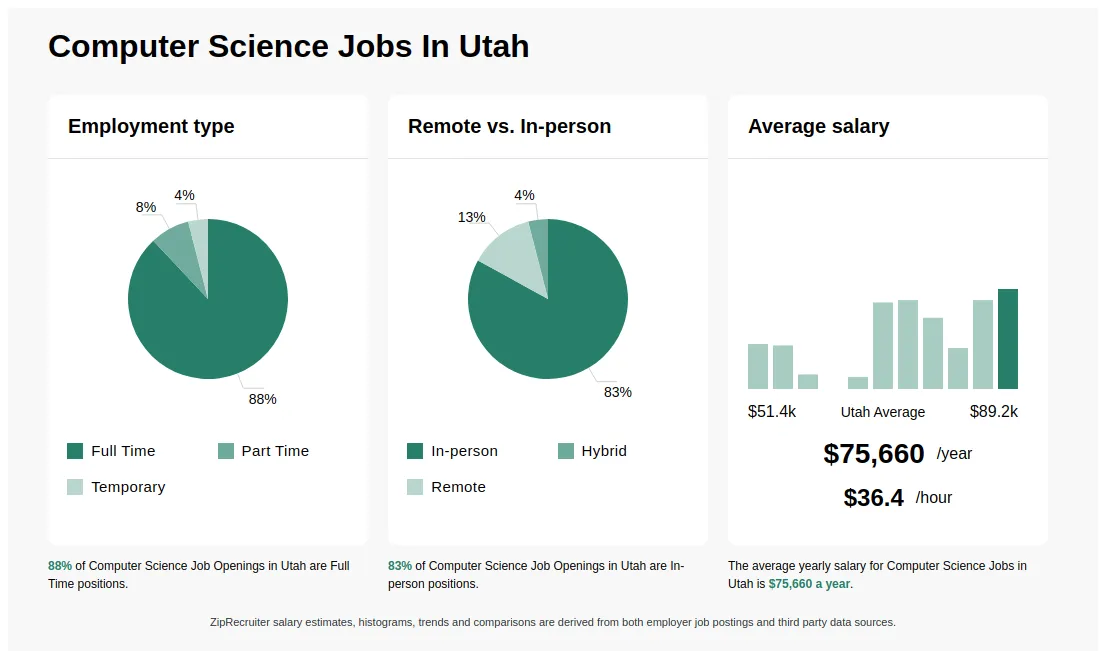
As of Sep 14, 2026, the average yearly pay for computer science in Utah is $75,660.00, according to ZipRecruiter salary data. Most workers in this role earn between $70,600.00 and $85,100.00 per year, depending on experience, location, and employer.
What is computer science?
Computer science is the study of computers, computational systems, and how they process information. It covers a wide range of topics, including programming, algorithms, data structures, artificial intelligence, and software engineering. Computer scientists design and analyze software and hardware to solve problems and improve technology. The field is essential in many industries, from finance and healthcare to entertainment and research.
What are computer science jobs?
The computer science field provides a wide range of opportunities for technically talented individuals. Depending on your skills and interests, you can find computer science jobs as a software developer, hardware engineer, database administrator, computer systems analyst, network architect, information security analyst, or web developer. You need an analytical mind and strong technical skills to perform your job duties, which may be to develop, maintain, and troubleshoot computer systems, applications, or networks. Your responsibilities in a computer science job are often directly related to the business goals and outcomes of your employer.
What are the key skills and qualifications needed to thrive in a computer science role, and why are they important?
To thrive in a Computer Science role, you need strong programming skills, problem-solving abilities, and a degree in computer science or a related field. Familiarity with languages like Python, Java, C++, version control systems such as Git, and software development methodologies is often required. Analytical thinking, attention to detail, and effective teamwork are valuable soft skills that set candidates apart. These skills ensure you can design efficient solutions, collaborate on complex projects, and adapt to rapidly evolving technologies.
What are some common challenges computer science professionals face when working on collaborative software projects?
Computer science professionals often encounter challenges such as coordinating with team members across different disciplines, managing version control in shared codebases, and ensuring clear communication of technical concepts to non-technical stakeholders. Navigating conflicting priorities and integrating diverse components can also be demanding, especially in agile environments with tight deadlines. Strong collaboration skills, openness to feedback, and familiarity with team tools like Git and project management platforms can help address these challenges effectively.
What is the difference between Computer Science vs Software Developer?
| Aspect | Computer Science | Software Developer |
|---|---|---|
| Required Credentials | Bachelor's or higher in CS or related field | Bachelor's in CS, Software Engineering, or related field often preferred |
| Work Environment | Research labs, academia, tech companies, startups | Tech companies, software firms, freelance projects |
| Industry Usage | Academic research, algorithm development, theoretical work | Building, coding, testing software applications |
| Common Search/Comparison | Focuses on theoretical foundations and algorithms | Focuses on practical software creation and deployment |
Computer Science and Software Developer roles often overlap, but Computer Science emphasizes theoretical foundations, algorithms, and research, while Software Developers focus on designing, coding, and maintaining software applications. Both roles require programming skills, but their primary focus and work environments differ.
Are computer science majors still in demand?
Computer science majors are currently in high demand due to the growth of technology, software development, cybersecurity, and data analysis fields. Employers seek candidates with programming skills, knowledge of algorithms, and experience with tools like Python, Java, and cloud platforms, making it a strong career choice with good job prospects.
What are careers in computer science?
Careers in computer science include roles such as software developer, systems analyst, cybersecurity analyst, data scientist, and network administrator. These jobs typically require strong programming skills, knowledge of algorithms, and familiarity with tools like programming languages, databases, and operating systems.
What can you do with a computer science degree?
A computer science degree prepares individuals for a variety of roles such as software developer, systems analyst, cybersecurity analyst, data scientist, and network administrator. It provides skills in programming, algorithms, and systems design, often requiring knowledge of programming languages, databases, and problem-solving. Graduates can work in technology companies, finance, healthcare, or government agencies, often with opportunities for certification and ongoing learning.
What jobs can I do with computer science?
A degree in computer science opens opportunities for roles such as software developer, systems analyst, cybersecurity analyst, data scientist, and network administrator. These jobs typically require programming skills, knowledge of algorithms, and familiarity with tools like databases and operating systems.
More about Computer Science jobs
What are the most commonly searched types of Computer Science jobs in Utah?
The most popular types of Computer Science jobs in Utah are:
What are popular job titles related to Computer Science jobs in Utah?
For Computer Science jobs in Utah, the most frequently searched job titles are:
What job categories do people searching Computer Science jobs in Utah look for?
The top searched job categories for Computer Science jobs in Utah are:
What cities in Utah are hiring for Computer Science jobs?
Cities in Utah with the most Computer Science job openings:

Adjunct Instrutor (Artificial Intelligence for Business)
Salt Lake City, UT • On-site
Neumont College of Computer Science
• Colleges, Universities, and Professional Schools • 51 - 200 employees51 - 200 employees
Other
Posted 13 days ago
Job description
Career Opportunities with Neumont College
Adjunct Instrutor (Artificial Intelligence for Business)As a Neumont instructor you will develop leadership and mentoring skills that will enhance your career. It can be a very rewarding experience as you see students start to understand complex subjects and gain confidence in their abilities.
Neumont University is looking to build our adjunct faculty team for our new Bachelor of Science in Artificial Intelligence for Business program.
The program combines business, technology, and applied artificial intelligence. Students learn how to use AI tools and technologies to solve business problems, automate processes, analyze data, build products and services, and identify new business opportunities.
We are looking for professionals with industry experience in one or more of the following areas:
- Applied AI & Automation
- Generative AI and large language models
- AI agents and AI-enabled business solutions
- Business process automation and workflow design
- Low-code/no-code AI and development tools
- Systems integration and APIs
- Data & Technology
- Data analytics and visualization
- Data-driven decision-making
- Applied machine learning
- Databases and data modeling
- Programming and scripting
- Business & Management
- Business strategy and operations
- Finance and accounting
- Sales, marketing, and customer success
- Talent management and HR
- Project management and agile methodologies
- Technology strategy and digital transformation
- Leading AI-augmented teams
- Entrepreneurship and startup development
- AI product development and product management
- Business model design and monetization
- SaaS, e-commerce, and digital businesses
- Growth and customer acquisition
- Venture capital and fundraising
- AI Governance & Industry Applications
- AI governance, compliance, ethics, and responsible AI
- AI implementation within industries such as healthcare, financial services, manufacturing, retail, government, or education
TIME COMMITMENT:
- Courses are 5 to 10 weeks long, depending on the course.
- We make classes work around full-time work schedules as we offer AM and PM classes.
- Adjuncts may spend up to 10 hours a week outside of class doing grading and familiarizing themselves with the curriculum. This time commitment lessens once they get the hang of teaching.
QUALIFICATIONS:
- Bachelor’s degree or higher in Business, Business Administration, Information Systems, Computer Science, Artificial Intelligence, Data Science, Analytics, or a related field
- At least 4 years of relevant professional experience
- Teaching experience preferred, but not required
- Ability to work within the U.S. without sponsorship
ADVANTAGES TO BEING A NEUMONT FACULTY MEMBER:
- Improve the lives of students from across the nation through the power of education.
- Opportunity to give back through educating the next generation of tech experts.
- Experience the \

About Neumont College of Computer Science
Sourced by ZipRecruiter
Industry
Colleges, universities, and professional schools
Company size
51 - 200 Employees
Headquarters location
Salt Lake City, UT, US
Year founded
2003