1

Computational Physicist Jobs (NOW HIRING)

About the Role We are seeking a talented and motivated Computational Physicist to join our team. In this role, you will leverage your expertise in physics, mathematics, and computational methods to ...

Senior Director of Physics Analysis Your role in the mission: Type One Energy is seeking Computational Physicists to contribute to the development of high-fidelity models and simulations supporting ...

Computational Plasma Physicist

Kearny, NJ ยท On-site

$120K - $140K/yr

The ideal candidate will possess a strong background in computational physics, with a particular emphasis on MHD stability in stellarators and stellarator optimization. You will work with minimal ...

The ideal candidate will possess a strong background in computational physics, with a particular emphasis on MHD stability in stellarators and stellarator optimization. You will work with minimal ...

Computational Physics/Aerosciences Engineer Support on-going projects in aerodynamics, aeroelasticity, computational fluid dynamics (CFD), flight vehicle analysis and numerical methods supporting ...

Be Seen First

Computational Physicist (Early, Mid-Career, or Senior Level) I-Pulse Albuquerque LLC We are seeking an innovative physicist to conduct hydrodynamic and 3D electromagnetic simulations for commercial ...

Responsibilities The physicist will perform scientific analysis and computational modeling to evaluate intrinsic, normal, hostile, and fratricide radiation environments and their effect on the SWS ...

next page

Showing results 1-20

Computational Physicist information

What Does a Computational Physicist Do?

A computational physicist applies numerical analysis to solve problems or support theories in physics. In this career, you use knowledge from numerous disciplines, including physics, statistics, mathematics, and computer science, to test a theory. You use algorithms and other methodological tools to crunch large datasets using powerful computers, which helps in solving differential equations and other statistical problems. This can include Monte Carlo calculations and eigenvalue problems. Some people consider computational physics a branch of theoretical physics or its own discipline with specific duties and responsibilities.

What is the difference between Computational Physicist vs Data Scientist?

AspectComputational PhysicistData Scientist
Required CredentialsPhysics degree, often PhD, strong math and programming skillsStatistics, computer science, or related degree, often with a master's or PhD
Work EnvironmentResearch labs, academia, government agencies, scientific institutionsTech companies, finance, healthcare, consulting firms
Industry UsageScientific research, simulations, modeling physical systemsData analysis, predictive modeling, business insights

While both roles require strong programming and analytical skills, Computational Physicists focus on physical systems and scientific research, whereas Data Scientists analyze data to inform business decisions. The choice depends on your interest in scientific research versus data-driven applications.

What are some typical challenges computational physicists face when working on collaborative research projects?

Computational physicists often collaborate with experimentalists, engineers, and other researchers, which can present challenges such as bridging communication gaps between disciplines and integrating diverse data formats or methodologies. Coordinating project timelines to ensure that simulations align with experimental milestones is also common. Additionally, managing large datasets and ensuring reproducibility of results across different computing environments can require careful planning and documentation. Effective teamwork and adaptability are essential to overcome these hurdles and drive successful research outcomes.

What are the key skills and qualifications needed to thrive as a Computational Physicist, and why are they important?

To thrive as a Computational Physicist, you need a strong background in physics, mathematics, and computer science, typically supported by at least a master's or Ph.D. in physics or a related field. Proficiency in programming languages such as Python, C++, and MATLAB, as well as experience with simulation software and high-performance computing systems, is essential. Strong analytical thinking, problem-solving abilities, and effective teamwork skills help you tackle complex scientific challenges and collaborate on interdisciplinary projects. These skills are crucial for developing accurate models, efficiently solving intricate problems, and advancing scientific research through computational methods.

What is a computational physicist?

A computational physicist is a scientist who uses computer simulations, numerical analysis, and algorithms to solve complex physical problems that are difficult or impossible to address analytically. They work in fields like condensed matter physics, astrophysics, and materials science, modeling phenomena such as atomic interactions or galaxy formation. Their work often involves writing code, analyzing large datasets, and collaborating with experimental and theoretical physicists. Computational physicists play a key role in advancing scientific knowledge by providing insights where traditional methods fall short.
What cities are hiring for Computational Physicist jobs? Cities with the most Computational Physicist job openings:
What are the most commonly searched types of Computational Physicist jobs? The most popular types of Computational Physicist jobs are:
Who are the top companies hiring for Computational Physicist jobs? The top employers for Computational Physicist jobs are:
What states have the most Computational Physicist jobs? States with the most job openings for Computational Physicist jobs include:
What are popular job titles related to Computational Physicist jobs? For Computational Physicist jobs, the most frequently searched job titles are:
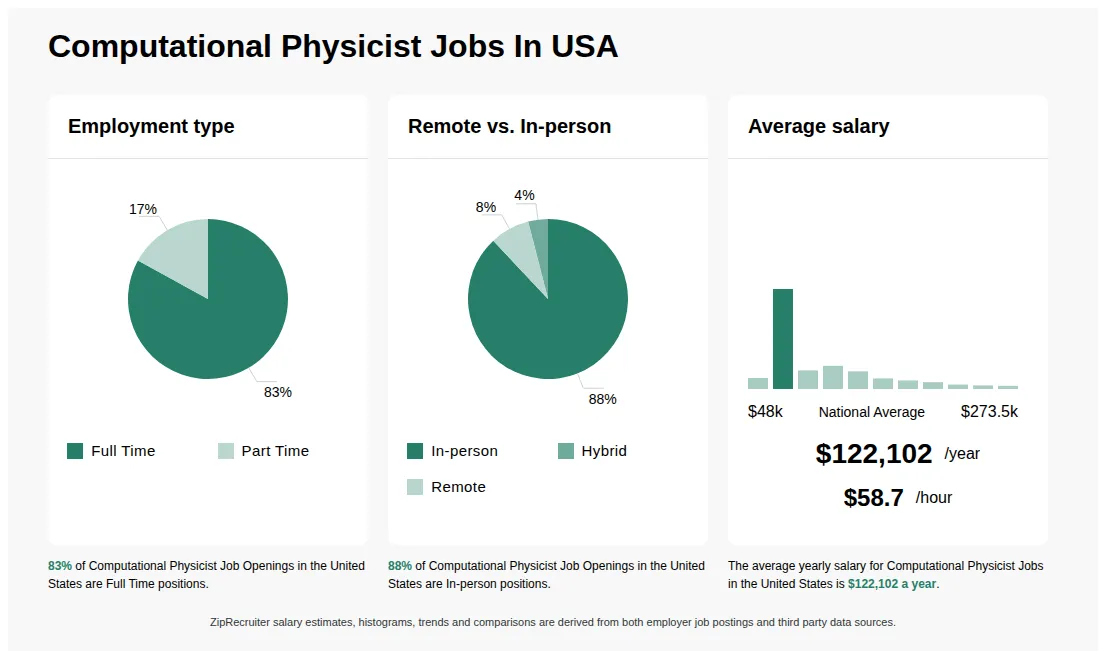
Infographic showing various Computational Physicist job openings in the United States as of June 2026, with employment types broken down into 100% Full Time. Highlights an 50% In-person, and 50% Remote job distribution.

Computational Physicist

Fuse

San Leandro, CA โ€ข On-site

Full-time

Posted 16 days ago


Job description

About Fuse
Fuse is on a mission to accelerate the worldโ€™s transition to fusion energy. Our core product is TITAN: an Impedance Matched Marx Generator (IMG). TITAN is the most efficient and powerful (TW) machine of its kind. Fusers have built and licensed Magical Unicorn and FAETON I, 2 novel pulsed power generators.
You are joining an early-stage fusion company. Please expect to wear different hats and take 0 to 1 ownership of objectives. Changing the world is hard but honorable and fulfilling. You should expect to work extremely hard to make a dent. This is not a regular job. Fusers are on a mission to change the world and get shit done.
About the Role
We are seeking a talented and motivated Computational Physicist to join our team. In this role, you will leverage your expertise in physics, mathematics, and computational methods to develop models and simulations that explore complex physical systems and phenomena. Your work will contribute to advancements in areas such as materials science, energy, aerospace, or quantum computing, depending on the companyโ€™s focus.
Key Responsibilities

  • Develop and run simulations for pulsed power systems using MHD, PIC, and circuit models.ย 

  • Utilize and modify Screamer circuit code for modeling high-voltage pulse generation and delivery.ย 

  • Conduct magnetohydrodynamic (MHD) simulations to study plasma dynamics in fusion and Z-pinch configurations.ย 

  • Implement and analyze particle-in-cell (PIC) simulations for plasma interactions and beam dynamics.ย 

  • Model impedance matching in Marx generators and analyze energy coupling in plasma loads.ย 

  • Collaborate with experimentalists to validate models and optimize system performance.ย 

  • Develop custom computational tools and optimize existing codes for high-performance computing (HPC).ย 

  • Analyze and interpret large data sets, extracting meaningful insights and presenting findings in clear, concise reports.ย 

  • Develop software tools and algorithms to optimize simulation processes and improve computational efficiency.ย 

  • Stay up to date with advancements in computational techniques, programming languages, and physical theories to apply state-of-the-art methodologies to projects.ย 

  • Contribute to academic papers, technical reports, and presentations, sharing results with both internal teams and external collaborators.ย 

  • Provide technical mentorship and guidance to junior team members, fostering a collaborative and innovative research environment.ย 

Minimum Requirements

  • Ph.D. or M.S. in Physics, Electrical Engineering, Applied Mathematics, or a related field.ย 

  • Strong background in computational plasma physics and high-energy-density physics.ย 

  • Experience with Screamer, MAGIC, HYDRA, or similar circuit and plasma codes.ย 

  • Proficiency in MHD and PIC simulation techniques.ย 

  • Solid understanding of pulsed power systems, high-voltage engineering, and plasma diagnostics.ย 

  • Strong programming skills in Python, Fortran, C++, or MATLAB for numerical modeling.ย 

  • Experience with HPC environments and parallel computingย 

  • Strong foundation in theoretical physics, including knowledge of quantum mechanics, classical mechanics, electromagnetism, or statistical mechanics.ย 

  • Strong problem-solving abilities, analytical skills, and attention to detail.ย 

  • Excellent communication skills, including the ability to present complex results to both technical and non-technical audiences.

Preferred Skills

  • Familiarity with Z-pinch, MagLIF, dense plasma focus devices, and fusion energy concepts.ย 

  • Experience in finite element analysis (FEA) or finite difference time domain (FDTD) methods.ย 

  • Knowledge of electromagnetic wave propagation and plasma-material interactions.ย 

  • Experience working in experimental plasma physics or fusion research.ย 

  • Strong publication record in computational physics or related fields.ย 

  • Background in developing custom software tools for physical simulations.ย 

  • Familiarity with version control tools (e.g., Git) and collaboration platforms.ย 

  • Prior experience publishing research or contributing to academic journals and conferences.ย 

Additional Requirements

  • Must be able to travel and work extended hours/weekends as needed.

ITAR Requirements
To conform to U.S. Government technology export regulations, including the International Traffic in Arms Regulations (ITAR) you must be a U.S. citizen, lawful permanent resident of the U.S., protected individual as defined by 8 U.S.C. 1324b(a)(3), or eligible to obtain the required authorizations from the U.S. Department of State. Learn more about the ITAR here.

Fuse is an Equal Opportunity Employer; employment with Fuse is governed on the basis of merit, competence, and qualifications and will not be influenced in any manner by race, color, religion, gender, national origin/ethnicity, veteran status, disability status, age, sexual orientation, gender identity, marital status, mental or physical disability, or any other legally protected status.

Applicants wishing to view a copy of Fuse's Affirmative Action Plan for veterans and individuals with disabilities, or applicants requiring reasonable accommodation to the application/interview process should notify the Human Resources Department at info@f.energy.