1

Clinical Informatics Jobs in Seattle, WA (NOW HIRING)

Undergraduate or graduate level educational in clinical research, data analysis, clinical informatics or related field. * Experience is working with large database consisting of millions of patients ...

Showing results 41-60

Clinical Informatics information

See Seattle, WA salary details

$59.2K

$117.9K

$186.6K

How much do clinical informatics jobs pay per year?

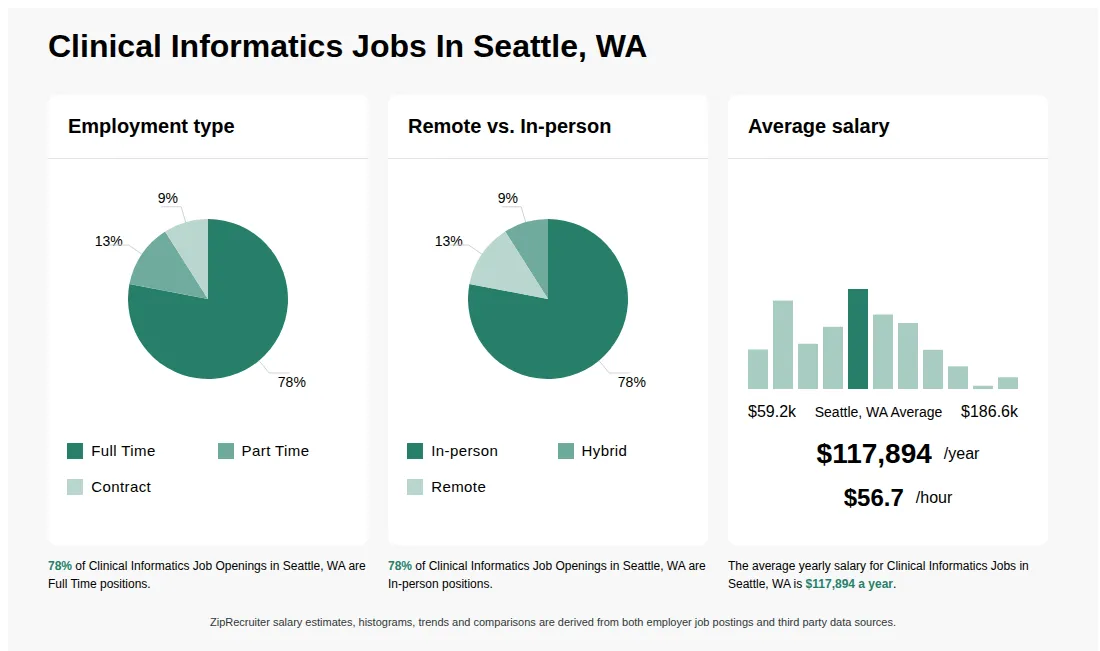
As of Sep 4, 2026, the average yearly pay for clinical informatics in Seattle, WA is $117,894.00, according to ZipRecruiter salary data. Most workers in this role earn between $85,400.00 and $131,400.00 per year, depending on experience, location, and employer.

What is clinical informatics?

Clinical informatics is a field within the discipline of information technology. The purpose of clinical informatics is to implement technology and theories in order to collect, store, and modify clinical information and electronic records to improve patient care and information sharing among healthcare professionals. Clinical informatics investigates the most efficient and user-friendly ways data can be organized, structured, shared, and accessed. It has practical implications for healthcare provision throughout the industry, including at hospitals, clinics, and military and research facilities.

What is clinical informatics?

Clinical informatics is a field that focuses on the use of information technology and data to improve patient care and healthcare outcomes. Professionals in this area work at the intersection of healthcare, computer science, and information management to design, implement, and optimize electronic health records, clinical decision support systems, and other digital tools. Their goal is to streamline healthcare processes, enhance patient safety, and ensure that clinicians have access to accurate and timely information. Clinical informaticists often collaborate with physicians, nurses, IT professionals, and administrators to bridge the gap between clinical practice and technology.

What are the key skills and qualifications needed to thrive as a clinical informatics specialist, and why are they important?

To thrive as a Clinical Informatics specialist, you need a solid background in healthcare, information technology, and data analysis, often supported by a degree in health informatics or a related field. Familiarity with electronic health record (EHR) systems, clinical decision support tools, and certifications such as Certified Professional in Healthcare Information and Management Systems (CPHIMS) are commonly required. Strong problem-solving abilities, effective communication, and the capacity to bridge clinical and technical teams are standout soft skills. These competencies are essential for optimizing healthcare delivery, ensuring data accuracy, and facilitating the adoption of technology in clinical environments.

How does a clinical informatics professional typically collaborate with healthcare providers and IT teams?

Clinical Informatics professionals play a key bridging role between healthcare providers and IT departments. They work closely with clinicians to understand workflow needs and translate those requirements into technical solutions, such as optimizing electronic health records (EHR) or implementing new clinical decision support tools. Regular collaboration involves facilitating training sessions, gathering feedback, and troubleshooting system issues to ensure that technology effectively supports patient care. This cross-functional teamwork is essential for successful adoption and ongoing improvement of health information systems.

What is the difference between Clinical Informatics vs Medical Informatics?

AspectClinical InformaticsMedical Informatics
CredentialsOften requires certifications like CAHIMS or CPHIMSSimilar certifications, with additional focus on broader healthcare data
Work EnvironmentHospitals, clinics, healthcare systemsResearch institutions, healthcare IT companies, academia
Employer & IndustryHealthcare providers, hospitalsHealthcare technology firms, research organizations
Search & Comparison IntentFocuses on clinical settings and patient careEncompasses broader healthcare data management and policy

Clinical Informatics primarily concentrates on applying informatics to improve patient care within clinical settings. Medical Informatics has a broader scope, including healthcare data management, research, and policy. Both roles require similar certifications and often overlap in skills, but their focus areas differ based on work environment and industry applications.

What do you do in clinical informatics?

A clinical informatics professional designs, implements, and manages health information systems to improve patient care and healthcare operations. They analyze data, optimize electronic health records (EHR) systems, and collaborate with healthcare providers to ensure technology supports clinical workflows effectively.

What is the best degree for clinical informatics?

A master's degree in health informatics, healthcare administration, or a related field is typically preferred for clinical informatics roles. Relevant skills include knowledge of healthcare systems, data management, and proficiency with electronic health records (EHR) systems, often supported by certifications like Certified Health Data Analyst (CHDA) or Certified Professional in Healthcare Information and Management Systems (CPHIMS).

What are the most commonly searched types of Clinical Informatics jobs in Seattle, WA?

The most popular types of Clinical Informatics jobs in Seattle, WA are:

What job categories do people searching Clinical Informatics jobs in Seattle, WA look for?

The top searched job categories for Clinical Informatics jobs in Seattle, WA are:

What cities near Seattle, WA are hiring for Clinical Informatics jobs?

Cities near Seattle, WA with the most Clinical Informatics job openings:

Infographic showing various Clinical Informatics job openings in Seattle, WA as of August 2026, with employment types broken down into 3% As Needed, 72% Full Time, 17% Part Time, and 8% Contract. Highlights an 95% Physical, 1% Hybrid, and 4% Remote job distribution, with an average salary of $117,894 per year, or $56.7 per hour.

Assistant Professor - Psychiatric and Behavioral Health

University of Washington

Seattle, WA • On-site

$10K - $12K/mo

Full-time

Re-posted 11 days ago


University Of Washington School Of Medicine rating

8.5

Company rating: 8.5 out of 10

Based on 12 frontline employees who took The Breakroom Quiz

82nd of 629 rated colleges and universities


Job description

Description
The Department of Biobehavioral Nursing and Health Informatics in the School of Nursing at the University of Washington invites applications for a tenure-track faculty position at the rank of Assistant Professor with an anticipated start date of September 16, 2027. We seek applicants who demonstrate commitment to excellence in research, teaching, and service in a diverse and inclusive academic community. The successful candidate will join our faculty on a full-time basis for a nine-month academic appointment, 3-year term, renewable beginning September 16, 2027.
The base salary range for this position will be $10,815 - $12,240 per month commensurate with experience and qualifications, or as mandated by a U.S. Department of Labor prevailing wage determination.
The successful candidate will be expected to:
  • Establish and maintain an active research program, supported by external funding, in the area of psychiatric and behavioral health
  • Teach across undergraduate and graduate programs - with particular emphasis on psychiatric and mental health courses - to a student population representing a diversity of backgrounds and learning styles
  • Collaborate effectively across a range of disciplines, cultures, funding sources, and learning environments
  • Participate in faculty service to the department, School, University, and broader profession
  • Approach teaching and research through a clinical lens.

Positive factors for consideration include, but are not limited to, candidates with experience practicing as a Psychiatric and Mental Health Nurse Practioner (PMHNP).
The UW School of Nursing excels at supporting research and fostering academic and professional growth among faculty and students. The nationally ranked University of Washington School of Nursing offers Bachelor of Science in Nursing (BSN), Master of Science in Clinical Informatics and Patient-centered Technology (MS-CIPCT), Doctor of Nursing Practice (DNP; covering a range of practice specialties), and Doctor of Philosophy (PhD) degree programs. The UW School of Nursing is ranked #1 among public institutions with Doctor of Nursing Practice programs by the U.S. News and World Report in 2026, and is globally ranked as #6 School of Nursing by the QS World University Rankings in 2025. Together, our students, faculty and staff work boundlessly to turn ideas into impact and improve the health of people and communities locally and globally. Our seven centers of excellence provide infrastructure support, leadership, and collaborative mentoring for faculty, clinicians, and students.
The School of Nursing and the Department of Biobehavioral Nursing and Health Informatics fosters mutually enriching community/academic partnerships within and beyond the UW campuses. Faculty with the rank of Assistant Professor are offered a wide range of networking, development, and mentoring opportunities. The School's Office for Nursing Research provides an in-depth research infrastructure as well as prospects for interdisciplinary/interprofessional research and educational initiatives. More information about the UW School of Nursing, including criteria for promotion and tenure can be found at https://nursing.uw.edu/hr/.
All University of Washington faculty are expected to engage in teaching, research, and service.
Qualifications
Applicants for this position must meet the following minimum qualifications by the time of appointment:
  • PhD (or foreign equivalent) in Nursing Science or related field
  • RN licensure (Washington or Multistate Compact)

Application Instructions
To ensure full consideration of your application, please submit all materials no later than October 1, 2026. Priority consideration will be given to applications received by September 15, 2026. Applications will only be accepted via Interfolio: apply.interfolio.com/188391. The position will remain open until filled.
Applications should include the following materials:
  • A cover letter of no more than 3 pages detailing your interest in the position and qualifications and experiences that position you well to meet the expectations of the position
  • A curriculum vitae
  • A research statement that speaks to past and planned effort in the areas of psychiatric and behavioral health as evidenced by high-quality publications, funded work and/or submitted research proposals, and a clear research program vision for the next 5 years
  • A teaching statement that speaks to your pedagogical approach

Across the application materials listed above, applicants should articulate how their past experiences and/or future plans in research, teaching, mentoring, and/or service promote a sense of belonging and foster a welcoming and inclusive environment.
Please also include contact information for at least three references who are prepared to provide letters of recommendation upon request. No formal letters are requested at time of initial application.

What University Of Washington School Of Medicine employees say

Pay

Benefits

Hours and flexibility

Workplace

Get the full story on Breakroom