1

Civilian Overseas Jobs (NOW HIRING)

next page

Showing results 1-20

Civilian Overseas information

See salary details

$42.5K

$113.8K

$164K

How much do civilian overseas jobs pay per year?

As of Aug 15, 2026, the average yearly pay for civilian overseas in the United States is $113,821.00, according to ZipRecruiter salary data. Most workers in this role earn between $90,500.00 and $132,500.00 per year, depending on experience, location, and employer.

What are the key skills and qualifications needed to thrive as a civilian overseas, and why are they important?

To thrive as a Civilian Overseas, you generally need cultural adaptability, language skills, and relevant professional qualifications or experience in your field. Familiarity with international project management tools, communication platforms, and, depending on the sector, security or compliance certifications can be important. Strong interpersonal skills, resilience, and the ability to work independently help individuals succeed in diverse and often challenging environments. These abilities ensure effective collaboration, personal well-being, and successful mission or project outcomes while living and working abroad.

What are the qualifications to get a job as a civilian overseas?

The primary qualifications for getting a job as a civilian overseas vary depending on the position but typically require a bachelor's degree and several years of experience or the completion of a technical training program. Overseas sites often have limited supplies and might have to wait days to get someone else in who can help, so employers—including the government and independent contractors—strongly prefer people who have already demonstrated that they know their job and can be trusted to perform it. Meeting the responsibilities and duties of this job requires attention to detail, memorization skills, and the ability to follow safety instructions and work in a variety of environmental conditions. It’s common that you must obtain and maintain a security clearance.

What are some common challenges faced by civilians working overseas and how can they prepare for them?

Civilians working overseas often encounter challenges such as cultural differences, language barriers, and adapting to new living and working environments. Additionally, navigating local laws, securing housing, and understanding safety protocols can require extra attention. To prepare, prospective candidates should research their destination thoroughly, seek employer-provided orientation or cultural training, and connect with current or former overseas employees for insights. Building flexibility and open communication skills will also help ease the transition and foster successful collaboration within diverse international teams.

What is the difference between Civilian Overseas vs Civilian Domestic?

AspectCivilian OverseasCivilian Domestic
Work EnvironmentInternational locations, often in remote or developing areasWithin the home country, urban or suburban settings
Required CredentialsRelevant certifications, sometimes security clearances, language skillsStandard certifications, local licensing as needed
Employer & Industry UsageGovernment agencies, NGOs, multinational corporationsLocal government, private sector, non-profits
Work ConditionsTravel, cultural adaptation, sometimes challenging environmentsStable, familiar settings, regular hours

In summary, Civilian Overseas roles involve working internationally with unique cultural and environmental factors, often requiring additional certifications and adaptability. Civilian Domestic positions are based within the home country, offering more stability and familiar work conditions. The choice depends on your career goals and preferences for work environment.

What is a civilian overseas?

Civilian overseas jobs refer to employment opportunities for non-military individuals working in foreign countries, often supporting government agencies, military operations, or private companies. These roles can include administrative support, engineering, teaching, healthcare, logistics, and more. Civilian overseas jobs may be with the U.S. government, international organizations, or private sector employers, and often come with unique benefits and challenges such as relocation assistance, cultural adaptation, and security considerations. Applicants typically need specific qualifications or clearances depending on the employer and location.

What cities are hiring for Civilian Overseas jobs?

Cities with the most Civilian Overseas job openings:

What are the most commonly searched types of Civilian Overseas jobs?

The most popular types of Civilian Overseas jobs are:

What states have the most Civilian Overseas jobs?

States with the most job openings for Civilian Overseas jobs include:

What job categories do people searching Civilian Overseas jobs look for?

The top searched job categories for Civilian Overseas jobs are:

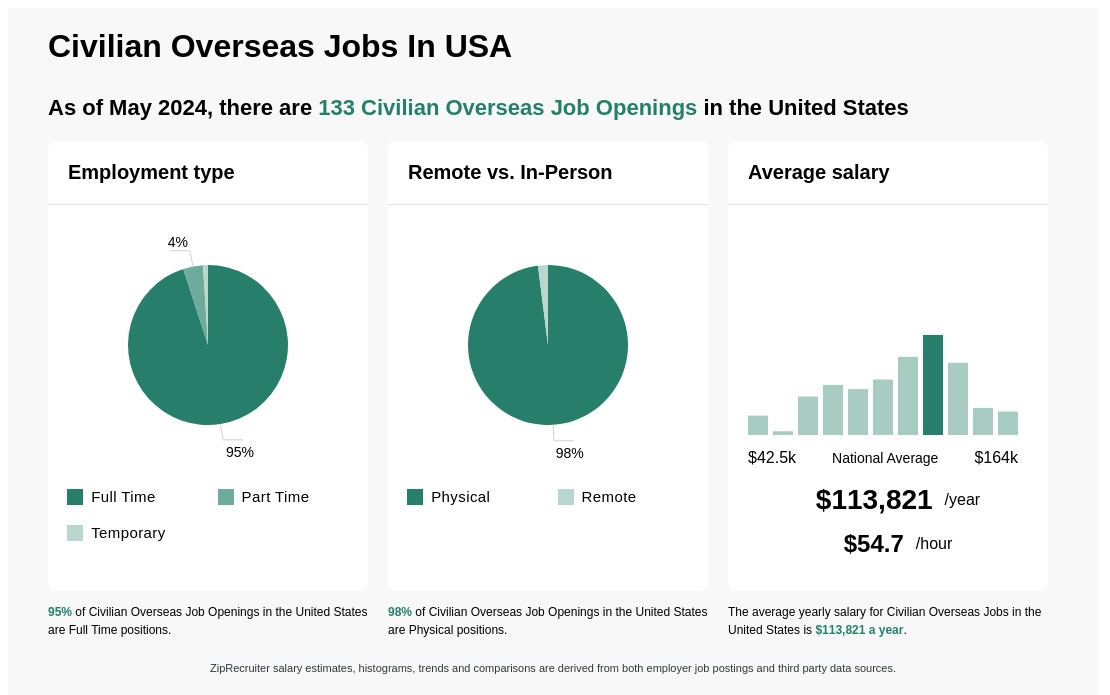
Infographic showing various Civilian Overseas job openings in the United States as of August 2026, with employment types broken down into 81% Full Time, and 19% Part Time. Highlights an 95% In-person, and 5% Remote job distribution, with an average salary of $113,821 per year, or $54.7 per hour.

Human Resources Specialist (Recruitment & Placement)

Defense Logistics Agency

Whitehall, OH • On-site

Full-time

Re-posted 20 days ago


Defense Logistics Agency rating

8.3

Company rating: 8.3 out of 10

Based on 35 frontline employees who took The Breakroom Quiz

276th of 846 rated public administrative organizations


Job description

Telework Eligible

Yes

Major Duties

  • As a Human Resources Specialist (Recruitment & Placement) you will be responsible for the following duties: (If selected at the GS-9 or GS-11 grade levels, duties will be performed in a developmental capacity)
  • Serves as senior specialist providing advice and counsel to managers and employees on the processes and procedures for both CONUS and OCONUS entitlements-
  • -such as living quarters allowance (LQA), post differential, post allowance, separate maintenance allowance, as well as other less frequently authorized allowances.
  • Provides consultation to associates regarding the coordination of tour of duty and round trip renewal agreements in connection with home leave travel.
  • Troubleshoots the most complex and controversial overseas servicing issues, including evacuation procedures and entitlements for employees and dependents required to leave an overseas area.
  • Provides management with the widest range of hiring flexibility and providing comprehensive staffing and placement services utilizing innovative methods in locating qualified applicants to complete position fill actions for a variety of positions.
  • Responsible for troubleshooting and resolving the most difficult and complex problems associated with comprehensive recruitment and placement services.
  • Facilitates placement programs to include priority placement program (PPP), Reemployment Priority List (RPL) program, and the interagency career transition assistance plan (ICTAP).
  • Applies laws, regulations, policies, and practices to provide advice and guidance to officials, supervisors, and employees on a wide variety of pay actions and application of single agency compensation authorities where applicable.

Qualification Summary

To qualify for a Human Resources Specialist (Recruitment & Placement), your resume and supporting documentation must support: A. Specialized Experience: One year of specialized experience that equipped you with the particular competencies to successfully perform the duties of the position, and that is typically in or related to the position to be filled. To qualify at the GS-9 level, applicants must possess one year of specialized experience equivalent to the GS-07 level or equivalent under other pay systems in the Federal service, military or private sector. To qualify at the GS-11 level, applicants must possess one year of specialized experience equivalent to the GS-09 level or equivalent under other pay systems in the Federal service, military or private sector. To qualify at the GS-12 level, applicants must possess one year of specialized experience equivalent to the GS-11 level or equivalent under other pay systems in the Federal service, military or private sector. Applicants must meet eligibility requirements including time-in-grade (General Schedule (GS) positions only), time-after-competitive appointment, minimum qualifications, and any other regulatory requirements by the cut-off/closing date of the announcement. Creditable specialized experience includes: GS-9: Conducting job analyses, preparing Job Opportunity Announcements, and determining applicants' qualifications using OPM Qualification Standards, for Federal civilian positions. Completing a full range of personnel actions relating to Federal civilian staffing to include making pay determinations. Applying specific rules, regulations, or procedures to complete human resources related assignments. Maintaining relationships with internal and/or external customers or associates. GS-11: Conducting job analyses, preparing Job Opportunity Announcements, and determining applicants' qualifications using OPM Qualification Standards for Federal civilian positions. Completing a full range of personnel actions relating to Federal civilian staffing and overseas allowances to include making pay determinations. Providing support on Federal civilian overseas entitlements and allowances. Assisting in the resolution of problems and issues associated with Federal civilian overseas entitlements and allowances. GS-12: Conducting and reviewing job analyses, provide training on preparation of Job Opportunity Announcements, and determining applicants' qualifications using OPM Qualification Standards for Federal civilian positions. Completing and reviewing a full range of personnel actions relating to Federal civilian staffing and overseas allowances to include making pay determinations. Providing advice and guidance to management and employees on Federal civilian overseas entitlements and allowances. Resolving problems and issues associated with Federal civilian overseas entitlements and allowances. Reviewing Federal civilian overseas entitlement claims and ensuring management/employees meet legal and regulatory requirements, while providing detailed instructions to management officials on processes and procedures involved. B. Education Substitution: Such education must demonstrate the knowledge, skills, and abilities necessary to do the work. Education must be from a college or university accredited by an organization approved by the U.S. Department of Education. See http://ope.ed.gov/accreditation/Search.aspx. If using education to meet basic qualifications, YOU MUST SUBMIT A TRANSCRIPT as supplemental documentation. To qualify based on education in lieu of specialized experience, you must possess: GS-9: Master's or equivalent graduate degree or 2 full years of progressively higher-level graduate education leading to such a degree. GS-11: A Ph.D. or equivalent doctoral degree or 3 full years of progressively higher level graduate education leading to such a degree. GS-12: There is no education substitution at this grade level. C. Combination: Combinations of successfully completed post-high school education and experience may be used to meet total qualification requirements for grade levels GS-09 and GS-11 and may be computed by first determining the applicant's total qualifying experience as a percentage of the experience required for the grade level; then determining the applicant's education as a percentage of the education required for the grade level; and then adding the two percentages. The total percentages must equal at least 100 percent to qualify an applicant for that grade level. Only graduate education in excess of the amount required for the next lower grade level may be used to qualify applicants for positions at grade GS-09 and GS-11. Experience refers to paid and unpaid experience, including volunteer work done through National Service programs (e.g., Peace Corps, AmeriCorps) and other organizations (e.g., professional, philanthropic, religious, spiritual, community, student, social). Volunteer work helps build critical competencies, knowledge, and skills and can provide valuable training and experience that translates directly to paid employment. You will receive credit for all qualifying experience, including volunteer experience.


What Defense Logistics Agency employees say

Pay

Benefits

Hours and flexibility

Workplace

Get the full story on Breakroom