This position provides expert technical support for mechanical circulatory support systems managed by the Center for Circulatory Support, i.e., HeartMate II and III, VAS, HeartWare VAS, Syncardia TAH ...
This position provides expert technical support for mechanical circulatory support systems managed by the Center for Circulatory Support, i.e., HeartMate II and III, VAS, HeartWare VAS, Syncardia TAH ...

The Nebraska Medicine Cardiovascular Imaging team is devoted to diagnosing, treating, and managing the circulatory system disease with the most advanced medical equipment, procedures, and nationally ...
The Nebraska Medicine Cardiovascular Imaging team is devoted to diagnosing, treating, and managing the circulatory system disease with the most advanced medical equipment, procedures, and nationally ...

... circulatory system within Cardiac Catheter, CTO and Structural Heart procedure rooms. They must also be proficient in the functions of Monitoring, Circulating and Scrubbing. * Demonstrates ...
... circulatory system within Cardiac Catheter, CTO and Structural Heart procedure rooms. They must also be proficient in the functions of Monitoring, Circulating and Scrubbing. * Demonstrates ...
This position provides expert technical support for mechanical circulatory support systems managed by the Center for Circulatory Support, i.e., HeartMate II and III, VAS, HeartWare VAS, Syncardia TAH ...
This position provides expert technical support for mechanical circulatory support systems managed by the Center for Circulatory Support, i.e., HeartMate II and III, VAS, HeartWare VAS, Syncardia TAH ...
Sonographer - Cardiac
Omaha, NE · On-site
The Nebraska Medicine Cardiovascular Imaging teamis devoted to diagnosing, treating, and managing the circulatory system disease with the most advanced medical equipment, procedures, and nationally ...
Sonographer - Cardiac
Omaha, NE · On-site
The Nebraska Medicine Cardiovascular Imaging teamis devoted to diagnosing, treating, and managing the circulatory system disease with the most advanced medical equipment, procedures, and nationally ...

Perfusionist ARRMC (Surgery)
Medford, OR · On-site
$67.26 - $92.49/hr
... circulatory system of a patient, including the safe monitoring, analysis, and treatment of physiologic conditions under an order and under the supervision of a physician. Position Qualifications ...
Perfusionist ARRMC (Surgery)
Medford, OR · On-site
$67.26 - $92.49/hr
... circulatory system of a patient, including the safe monitoring, analysis, and treatment of physiologic conditions under an order and under the supervision of a physician. Position Qualifications ...

Massage Therapist (Full Time)
Stateline, NV · On-site
$14/hr
Stimulates the circulatory system. * Provides release of muscle tightness caused by stressed and shortens recovery time for injuries. * Works with various agents to complement massage, including but ...
Massage Therapist (Full Time)
Stateline, NV · On-site
$14/hr
Stimulates the circulatory system. * Provides release of muscle tightness caused by stressed and shortens recovery time for injuries. * Works with various agents to complement massage, including but ...
Massage Therapist (Part Time)
Stateline, NV · On-site
$14/hr
Stimulates the circulatory system. * Provides release of muscle tightness caused by stressed and shortens recovery time for injuries. * Works with various agents to complement massage, including but ...
Massage Therapist (Part Time)
Stateline, NV · On-site
$14/hr
Stimulates the circulatory system. * Provides release of muscle tightness caused by stressed and shortens recovery time for injuries. * Works with various agents to complement massage, including but ...
Perfusionist ARRMC (Surgery)
Medford, OR · On-site
$67.26/hr
... circulatory system of a patient, including the safe monitoring, analysis, and treatment of physiologic conditions under an order and under the supervision of a physician. Position Qualifications ...
Perfusionist ARRMC (Surgery)
Medford, OR · On-site
$67.26/hr
... circulatory system of a patient, including the safe monitoring, analysis, and treatment of physiologic conditions under an order and under the supervision of a physician. Position Qualifications ...
The Nebraska Medicine Cardiovascular Imaging team is devoted to diagnosing, treating, and managing the circulatory system disease with the most advanced medical equipment, procedures, and nationally ...
The Nebraska Medicine Cardiovascular Imaging team is devoted to diagnosing, treating, and managing the circulatory system disease with the most advanced medical equipment, procedures, and nationally ...
Sonographer - Cardiac
Omaha, NE · On-site
The Nebraska Medicine Cardiovascular Imaging team is devoted to diagnosing, treating, and managing the circulatory system disease with the most advanced medical equipment, procedures, and nationally ...
Sonographer - Cardiac
Omaha, NE · On-site
The Nebraska Medicine Cardiovascular Imaging team is devoted to diagnosing, treating, and managing the circulatory system disease with the most advanced medical equipment, procedures, and nationally ...
Sonographer - Cardiac
Omaha, NE · On-site
The Nebraska Medicine Cardiovascular Imaging team is devoted to diagnosing, treating, and managing the circulatory system disease with the most advanced medical equipment, procedures, and nationally ...
Sonographer - Cardiac
Omaha, NE · On-site
The Nebraska Medicine Cardiovascular Imaging team is devoted to diagnosing, treating, and managing the circulatory system disease with the most advanced medical equipment, procedures, and nationally ...
The Cardiac Cath Lab Tech II is responsible to assist in the performance of invasive testing and interventional procedures used in the detection and treatment of the heart and circulatory system ...
The Cardiac Cath Lab Tech II is responsible to assist in the performance of invasive testing and interventional procedures used in the detection and treatment of the heart and circulatory system ...
The Cardiac Cath Lab Tech II is responsible to assist in the performance of invasive testing and interventional procedures used in the detection and treatment of the heart and circulatory system ...
The Cardiac Cath Lab Tech II is responsible to assist in the performance of invasive testing and interventional procedures used in the detection and treatment of the heart and circulatory system ...
Sonographer - Cardiac
Omaha, NE · On-site
The Nebraska Medicine Cardiovascular Imaging team is devoted to diagnosing, treating, and managing the circulatory system disease with the most advanced medical equipment, procedures, and nationally ...
Sonographer - Cardiac
Omaha, NE · On-site
The Nebraska Medicine Cardiovascular Imaging team is devoted to diagnosing, treating, and managing the circulatory system disease with the most advanced medical equipment, procedures, and nationally ...
Sonographer - Cardiac
Omaha, NE · On-site
The Nebraska Medicine Cardiovascular Imaging teamis devoted to diagnosing, treating, and managing the circulatory system disease with the most advanced medical equipment, procedures, and nationally ...
Sonographer - Cardiac
Omaha, NE · On-site
The Nebraska Medicine Cardiovascular Imaging teamis devoted to diagnosing, treating, and managing the circulatory system disease with the most advanced medical equipment, procedures, and nationally ...
The Nebraska Medicine Cardiovascular Imaging teamis devoted to diagnosing, treating, and managing the circulatory system disease with the most advanced medical equipment, procedures, and nationally ...
The Nebraska Medicine Cardiovascular Imaging teamis devoted to diagnosing, treating, and managing the circulatory system disease with the most advanced medical equipment, procedures, and nationally ...
The Cardiac Cath Lab Tech II is responsible to assist in the performance of invasive testing and interventional procedures used in the detection and treatment of the heart and circulatory system ...
The Cardiac Cath Lab Tech II is responsible to assist in the performance of invasive testing and interventional procedures used in the detection and treatment of the heart and circulatory system ...
Massage Therapist (On Call)
Stateline, NV · On-site
$14/hr
Stimulates the circulatory system. * Provides release of muscle tightness caused by stressed and shortens recovery time for injuries. * Works with various agents to complement massage, including but ...
Massage Therapist (On Call)
Stateline, NV · On-site
$14/hr
Stimulates the circulatory system. * Provides release of muscle tightness caused by stressed and shortens recovery time for injuries. * Works with various agents to complement massage, including but ...

Includes anatomy and physiology of the endocrine system, circulatory system, immune system, respiratory system, digestive system, excretory system, and reproductive system. Other topics covered ...
Quick apply
Includes anatomy and physiology of the endocrine system, circulatory system, immune system, respiratory system, digestive system, excretory system, and reproductive system. Other topics covered ...
Circulatory System information
See salary details
$29K - $39.5K
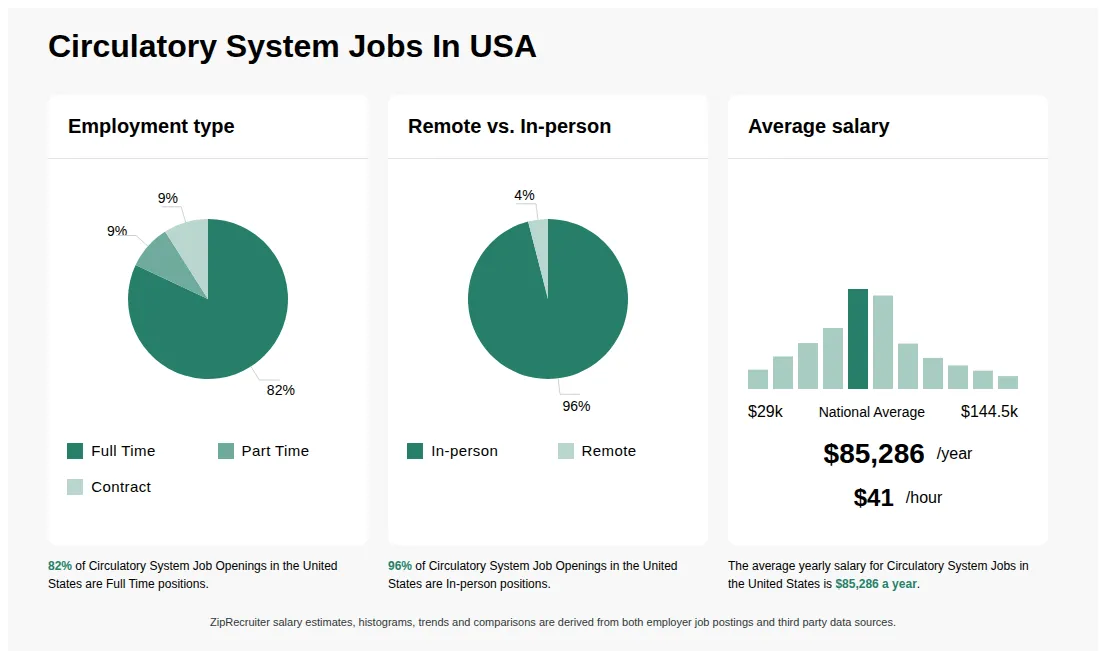
4% of jobs
$39.5K - $50K
6% of jobs
$50K - $60.5K
10% of jobs
$64.4K is the 25th percentile. Wages below this are outliers.
$60.5K - $71K
13% of jobs
The median wage is $79.4K / yr.
$71K - $81.5K
21% of jobs
$81.5K - $92K
20% of jobs
$92.6K is the 75th percentile. Wages above this are outliers.
$92K - $102.5K
10% of jobs
$102.5K - $113K
6% of jobs
$113K - $123.5K
4% of jobs
$123.5K - $134K
3% of jobs
$134K - $144.5K
2% of jobs
$29K
$85.3K
$144.5K
How much do circulatory system jobs pay per year?
As of Jul 13, 2026, the average yearly pay for circulatory system in the United States is $85,286.00, according to ZipRecruiter salary data. Most workers in this role earn between $65,000.00 and $98,000.00 per year, depending on experience, location, and employer.
What are the key skills and qualifications needed to thrive as a Cardiovascular Technologist, and why are they important?
To thrive as a Cardiovascular Technologist, you need a strong understanding of human anatomy, physiology, and cardiovascular procedures, usually supported by an associate's degree or certification in cardiovascular technology. Familiarity with diagnostic imaging equipment, EKG machines, and electronic health record systems is typically required. Attention to detail, communication skills, and the ability to work under pressure are valuable soft skills in this role. These skills and qualities are essential for accurately diagnosing and assisting in the treatment of cardiac conditions, ensuring patient safety and effective clinical outcomes.
What is a Circulatory System job?
A Circulatory System job does not refer to a conventional profession but rather describes roles in healthcare and medical sciences that involve studying, diagnosing, or treating the circulatory system. This includes cardiologists, cardiovascular surgeons, and medical researchers who specialize in blood flow, heart health, and vascular diseases. These professionals work in hospitals, clinics, and research facilities to improve circulation-related medical treatments.
What is the circulatory system?
The circulatory system is a network of organs and vessels that transports blood, nutrients, oxygen, carbon dioxide, and hormones throughout the body. It consists mainly of the heart, blood, and blood vessels (arteries, veins, and capillaries). The main function of the circulatory system is to maintain homeostasis by delivering essential substances to cells and removing waste products. This system is crucial for sustaining life, supporting immune function, and regulating body temperature.
What jobs are related to the circulatory system?
Jobs related to the circulatory system include cardiologists, cardiovascular technologists, cardiac nurses, and vascular surgeons. These roles involve diagnosing, treating, and managing heart and blood vessel conditions, often requiring specialized medical training and certifications. Other related careers include medical researchers and biomedical engineers working on cardiovascular devices and treatments.
What are some common challenges faced by cardiovascular technologists in a hospital setting?
Cardiovascular technologists often work in fast-paced environments where they must be prepared to handle emergency situations and adapt to evolving technologies. A common challenge is maintaining accuracy and composure during high-pressure procedures, such as cardiac catheterizations or stress tests. Additionally, technologists frequently collaborate with cardiologists, nurses, and other healthcare professionals, requiring strong communication and teamwork skills. Keeping up with ongoing education and certification requirements is also essential for career advancement in this field.
What is the difference between Circulatory System vs Cardiovascular Technologist?
| Aspect | Circulatory System | Cardiovascular Technologist |
|---|---|---|
| Credentials | Biology or health sciences background | Certification (e.g., RCIS), specialized training |
| Work Environment | Human body, medical settings | Hospitals, clinics, diagnostic labs |
| Industry Usage | Medical and biological sciences | Healthcare, diagnostic imaging |
| Job Focus | Body system functions and anatomy | Performing diagnostic procedures on the cardiovascular system |
The Circulatory System refers to the biological system responsible for blood circulation in the body, while a Cardiovascular Technologist is a healthcare professional specializing in diagnostic procedures related to the cardiovascular system. The technologist's role involves hands-on work in medical settings, whereas the circulatory system is a biological concept. Understanding both helps clarify their distinct roles in health and medicine.
Which jobs does the circulatory system have?
Jobs related to the circulatory system include cardiologists, cardiovascular surgeons, nurses, medical technicians, and researchers. These roles involve diagnosing, treating, and studying heart and blood vessel conditions, often requiring medical degrees, certifications, and knowledge of anatomy and physiology.
What jobs pay 4000 a week without a degree?
High-paying jobs that can reach $4,000 a week without a degree often include roles such as commercial pilot, real estate broker, or skilled trades like electricians and plumbers with experience. These positions typically require specialized training, certifications, or licenses, and often involve physically demanding work or irregular schedules.
What jobs make $1,000,000 a year?
High-earning jobs related to the circulatory system typically include specialized medical professionals such as cardiovascular surgeons and interventional cardiologists, who can earn over a million dollars annually with extensive experience, advanced skills, and often working in private practices or high-volume hospitals. These roles require advanced degrees, board certifications, and often long hours or high-risk procedures.
More about Circulatory System jobs
What cities are hiring for Circulatory System jobs? Cities with the most Circulatory System job openings:
What are the most commonly searched types of Circulatory System jobs? The most popular types of Circulatory System jobs are:
What states have the most Circulatory System jobs? States with the most job openings for Circulatory System jobs include:
What job categories do people searching Circulatory System jobs look for? The top searched job categories for Circulatory System jobs are:

Full-time
Posted 17 days ago
Houston Methodist rating

8.1
Based on 296 frontline employees who took The Breakroom Quiz
68th of 882 rated healthcare providers
Job description
At Houston Methodist, the Mechanical Circulatory Support Technician is responsible for assisting with Mechanical Circulatory Support (MCS) equipment management, which includes operation, distribution and tracking of mechanical circulatory support systems. This position provides expert technical support for mechanical circulatory support systems managed by the Center for Circulatory Support, i.e., HeartMate II and III, VAS, HeartWare VAS, Syncardia TAH and IABP. The Mechanical Circulatory Support Technician position will lend technical expertise in the area of complex VAD equipment and supplies and help resolve problems based on clinical and technical observations. This position would interface with VAD Coordinators, Mechanical Circulatory Support Specialists, Perfusionists, nursing and patients in the use, monitoring, and troubleshooting of the multiple mechanical circulatory support systems that are available at Houston Methodist (HM). This position will assist in transportation of VAD patients to diagnostic testing and procedures and provides support in staying with patients during inpatient and outpatient procedures as a trained MCS healthcare provider and monitor VAD parameters.
QUALIFICATIONS
EDUCATION
Join our surgical patient care team as a VAD Technician (Mechanical Circulatory Support, MCS) supporting advanced heart failure patients. Provide hands-on technical support for ventricular assist devices (VAD, LVAD) and cardiac circulatory support systems including HeartMate II/III, Syncardia TAH, and IABP. Assist with OR/procedural patient transport, monitor device parameters, and troubleshoot complex equipment. Ideal for candidates with experience in surgical tech, anesthesia tech, biomedical equipment (BMET), perfusion support, or cardiac/critical care environments.
FLSA STATUS
Non-exempt
QUALIFICATIONS
EDUCATION
- • Must have one of the following:
◦ Associates degree in Biomedical Technology with four years of experience OR
◦ Two years of related Military BMET training/experience in lieu of degree OR
◦ Completion of an intra-operative blood salvage training program or anesthesia technologist, with two years of college (60 hours) including courses such as biology, physiology, anatomy, or related scientific fields AND two years of related experience
EXPERIENCE
- One year of related experience
LICENSES AND CERTIFICATIONS
Required
- BLS - Basic Life Support or Instructor (AHA) - American Heart Association
SKILLS AND ABILITIES
- Demonstrates the skills and competencies necessary to safely perform the assigned job, determined through on-going skills, competency assessments, and performance evaluations
- Sufficient proficiency in speaking, reading, and writing the English language necessary to perform the essential functions of this job, especially with regard to activities impacting patient or employee safety or security
- Ability to effectively communicate with patients, physicians, family members and co-workers in a manner consistent with a customer service focus and application of positive language principles
- Basic understanding of cardiovascular physiology and anatomy
- Ability to organize, prioritize and schedule work assignments
- Demonstrated ability to collaborate effectively in an interprofessional team
- Demonstrated organizational, problem-solving, and critical thinking skills
- Ability to function as a team member
- Ability to manage a varied and busy work environment
- Must reflect a professional appearance and demeanor
- Must possess excellent customer service skills
ESSENTIAL FUNCTIONS
PEOPLE ESSENTIAL FUNCTIONS
- Provides VAD patient transport services, coordinates with team, units, and diagnostic areas to facilitate coordinated care.
- Collaborates with patient care units, ancillary departments who participate in the care or support of VAD patients/program.
- Participates in daily rounds on all VAD in-patients. Applies knowledge and policies to resolve a variety of issues.
- Fosters a teamwork approach in all interactions with peers and team members to promote individual staff member accountability and responsibility. Contributes towards improvement of department score for employee engagement.
SERVICE ESSENTIAL FUNCTIONS
- Consults with VAD patients in the Outpatient Clinic and in-patient settings to evaluate, analyze, and ensures VAD equipment is properly working. Communicates any findings or analysis that are of concern to the appropriate experts and clinicians.
- Records patient data and prepares documentation as required by the FDA and/or device manufacturer. Coordinates with VAD vendors regarding all equipment issues.
- Assists with distribution and tracking of equipment, new and hospital owned per protocol.
QUALITY/SAFETY ESSENTIAL FUNCTIONS
- Communicates with Manager or Coordinator all critical department activities to allow for the proper coordination of research activities and personnel resources.
- Assists in transportation of durable and temporary VAD support patients to diagnostic testing and procedures. Provides support for patients during inpatient and outpatient procedures as a trained MCS healthcare provider and monitor VAD parameters.
- In collaboration with operating room, pathology and VAD Team, tracks and returns removed pumps per policy to vendor for evaluation. Monitors problem analysis reports and disseminates information to appropriate staff.
- Reports equipment problems and completes patient safety report as necessary. Evaluates and assists with education for proper use and training when needed.
FINANCE ESSENTIAL FUNCTIONS
- Good steward of hospital owned equipment and appropriately manages par levels for new and hospital owned equipment. Maintains tracking of hospital owned equipment.
- Submits charges in timely manner of patient issued equipment.
GROWTH/INNOVATION ESSENTIAL FUNCTIONS
- Coordinates special projects and performs specialized technical tasks to improve patient throughput and efficiency of care.
- Maintains current knowledge of regulations, laws, and standards, which apply to medical instrumentation. Stays abreast of current applications of technology through personal study, and/or professional organizations, and attending biomedical workshops for new equipment training. Ensures own career discussions occur with appropriate management. Completes and updates the My Development Plan on an on-going basis.
SUPPLEMENTAL REQUIREMENTS
- WORK ATTIRE
- Uniform: No
- Scrubs: Yes
- Business professional: Yes
- Other (department approved): No
ON-CALL*
*Note that employees may be required to be on-call during emergencies (ie. Disaster, Severe Weather Events, etc) regardless of selection below.- On Call* No
TRAVEL**
**Travel specifications may vary by department**- May require travel within the Houston Metropolitan area No
- May require travel outside Houston Metropolitan area No
EDUCATION
- • Must have one of the following:
◦ Associates degree in Biomedical Technology with four years of experience OR
◦ Two years of related Military BMET training/experience in lieu of degree OR
◦ Completion of an intra-operative blood salvage training program or anesthesia technologist, with two years of college (60 hours) including courses such as biology, physiology, anatomy, or related scientific fields AND two years of related experience
EXPERIENCE
- One year of related experience
LICENSES AND CERTIFICATIONS
Required
- BLS - Basic Life Support or Instructor (AHA) - American Heart Association
Company Profile:
Houston Methodist Hospital is recognized by U.S. News & World Report as the No. 1 hospital in Texas and one of America’s “Best Hospitals.” As a full-service, acute-care hospital located in the Texas Medical Center and the flagship hospital of Houston Methodist, it has evolved into one of the nation’s largest nonprofit teaching hospitals and a leader in innovative medical research with a comprehensive residency program. Two of Houston Methodist’s primary academic affiliates are among the nation’s leading health care organizations: Weill Cornell Medicine and New York-Presbyterian Hospital. Houston Methodist also has affiliations with Texas A&M University and the University of Houston. Houston Methodist Hospital offers unparalleled care for thousands of patients from around the world.
Houston Methodist is an Equal Opportunity Employer.
What Houston Methodist employees say
Pay
Benefits
Hours and flexibility
Workplace
Get the full story on Breakroom