1

Chartered Economist Jobs (NOW HIRING)

ECONOMICS - Preferred * FINANCE - Preferred Certificate/License (one of): * ACCOUNTANT (CPA) - Preferred * CERT MGMT ACCT (CMA) - Preferred * CERTIFIED INTERNAL AUDITOR (CIA) - Preferred * CHARTERED ...

New

next page

Showing results 1-20

Chartered Economist information

See salary details

$46K

$82.1K

$122.5K

How much do chartered economist jobs pay per year?

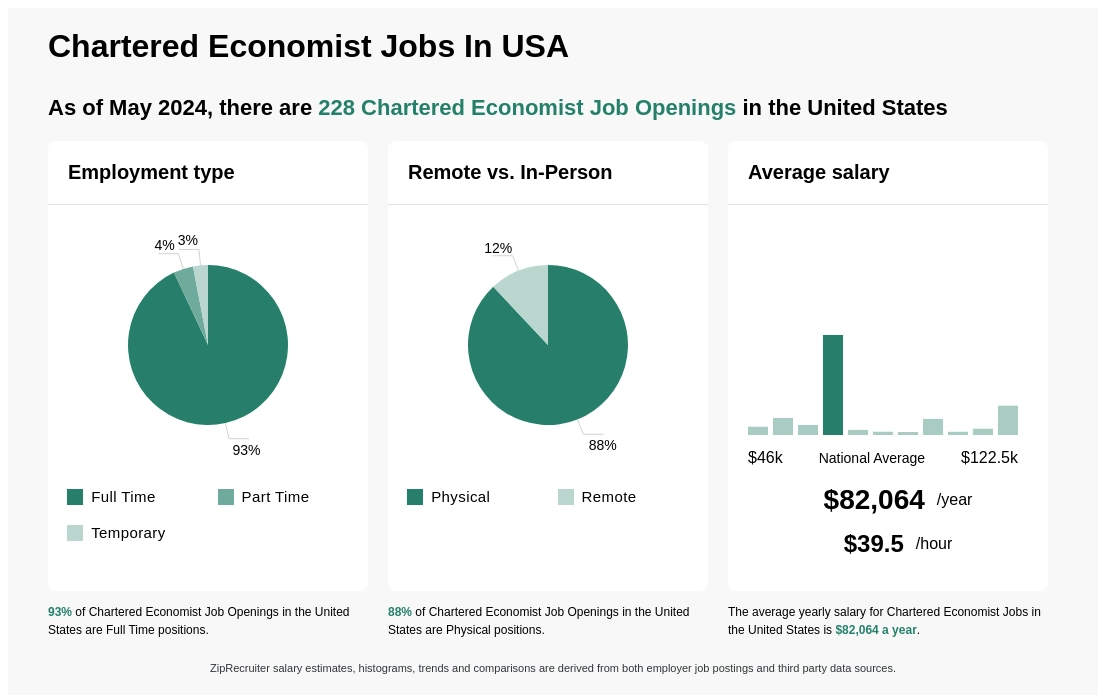
As of Jun 10, 2026, the average yearly pay for chartered economist in the United States is $82,064.00, according to ZipRecruiter salary data. Most workers in this role earn between $69,000.00 and $98,500.00 per year, depending on experience, location, and employer.

What is a Chartered Economist job?

A Chartered Economist is a professional who has obtained a recognized certification in economics, demonstrating expertise in economic analysis, policy-making, and financial decision-making. They apply economic theories and models to assess market trends, guide businesses, and advise governments on economic strategies. Chartered Economists often work in industries such as finance, consulting, policy research, and academia. Their role involves interpreting economic data, evaluating fiscal policies, and providing strategic recommendations for economic growth and stability. Earning the Chartered Economist designation typically requires completing specific academic qualifications, gaining relevant work experience, and passing professional examinations.


What are the key skills and qualifications needed to thrive in the Chartered Economist position, and why are they important?

To thrive as a Chartered Economist, you need a deep understanding of economic theory, quantitative analysis, and advanced statistical modeling, typically supported by a degree in economics and professional accreditation such as the Chartered Economist designation. Familiarity with econometric software (like Stata or EViews), data visualization tools, and financial databases is often required. Strong presentation, critical thinking, and report-writing abilities set standout candidates apart. These competencies enable Chartered Economists to provide accurate economic insights and actionable recommendations in complex, data-driven environments.

What are the typical daily responsibilities of a Chartered Economist?

As a Chartered Economist, your daily responsibilities often include gathering and analyzing economic data, building forecasts, preparing detailed reports, and presenting findings to stakeholders or clients. You may also be involved in advising organizations on macroeconomic trends, developing economic models, and evaluating the impact of policy changes or market developments. Collaboration with fellow economists, policy analysts, or business leaders is common, especially for large-scale projects or strategic planning. Staying updated with the latest research and developments in the field is also a key part of your role.

More about Chartered Economist jobs
Portfolio Manager - Trust INVM

Portfolio Manager - Trust INVM

WesBanco Bank, Inc.

Fort Thomas, KY • On-site

Full-time

Posted 6 days ago


WesBanco rating

7.4

Company rating: 7.4 out of 10

Based on 14 frontline employees who took The Breakroom Quiz

91st of 141 rated banks


Job description

SUMMARY:
In this role, you will participate in portfolio construction and ongoing portfolio management. You will also maintain a current body of knowledge of economic and financial market trends and conditions and their impact on portfolio construction. You will be responsible for preparing presentations and compiling supporting information for current clients and for developing new business by promoting investment management services.
INTERPERSONAL SKILLS:
Strong written and verbal communication skills.
Ability to communicate effectively.
ESSENTIAL DUTIES AND RESPONSIBILITIES:
Possess a working knowledge of investment management.
Prepares and maintains data on current and prospective investments.
Maintains a current body of knowledge of economic trends and conditions.
Familiarity with fiduciary principals and prudent investing concepts.
Participates in the preparation and presentation of reports to existing clients and new business proposals.
OTHER REQUIREMENTS:
Banking is a highly regulated industry and you will be expected to acquire and maintain a proficiency in the bank's policies and procedures, and adhere to all laws, rules and regulations that are applicable to your conduct and the work you will be performing. You will also be expected to complete all assigned compliance training in a timely manner.
Knowledge of fixed income securities and their inclusion in an investment portfolio.
Proficiency in mathematics, accounting, finance, and economics.
Strong business development tools
Skills in relevant information technology to support portfolio management and business development responsibilities.
Certified Financial Planner (CFP) or Chartered Financial Analyst (CFA) designation is preferred.
Bachelor's Degree in Business and/or Finance or related discipline.
Minimum of five years of Portfolio Management experience with a Trust Department or Asset Management Company.
Certified Financial Planner (CFP) or Chartered Financial Analyst (CFA) designation is preferred.

What WesBanco employees say

Pay

Hours and flexibility

Workplace

Get the full story on Breakroom