1

Ceilings Partitions Jobs (NOW HIRING)

Carpenter

Hampden Sydney, VA · On-site

$17.50 - $21.78/hr

... partitions, bookshelves, wooden structures and fixtures; prepare materials and labor costs as required. Perform repairs to windows, doors, walls, ceilings, floors, and repair furniture as needed.

Carpenter

Hampden Sydney, VA

$17.50 - $21.78/hr

... partitions, bookshelves, wooden structures and fixtures; prepare materials and labor costs as required. Perform repairs to windows, doors, walls, ceilings, floors, and repair furniture as needed.

... ceilings, roofs, doors, and windows, including all trim and finishes in all buildings on the hospital grounds. * The Carpenter constructs new drywall partitions and other temporary structures of wood ...

... ceilings, roofs, doors, and windows, including all trim and finishes in all buildings on the hospital grounds. * The Carpenter constructs new drywall partitions and other temporary structures of wood ...

The Carpenters construct, repair or modify building systems to include metal framed partitions ... Measure, cut, install metal studs, drywall, wood blocking, ceilings, flooring, formwork, and other ...

Carpenter

Marlborough, MA · On-site

$30 - $38/hr

The Carpenters construct, repair or modify building systems to include metal framed partitions ... Measure, cut, install metal studs, drywall, wood blocking, ceilings, flooring, formwork, and other ...

Measure, cut, and assemble metal or wood framing for walls, ceilings, and partitions according to blueprints and specifications. * Install drywall panels , ensuring precise alignment, proper ...

next page

Showing results 1-20

Ceilings Partitions information

See salary details

$17

$25

$32

How much do ceilings partitions jobs pay per hour?

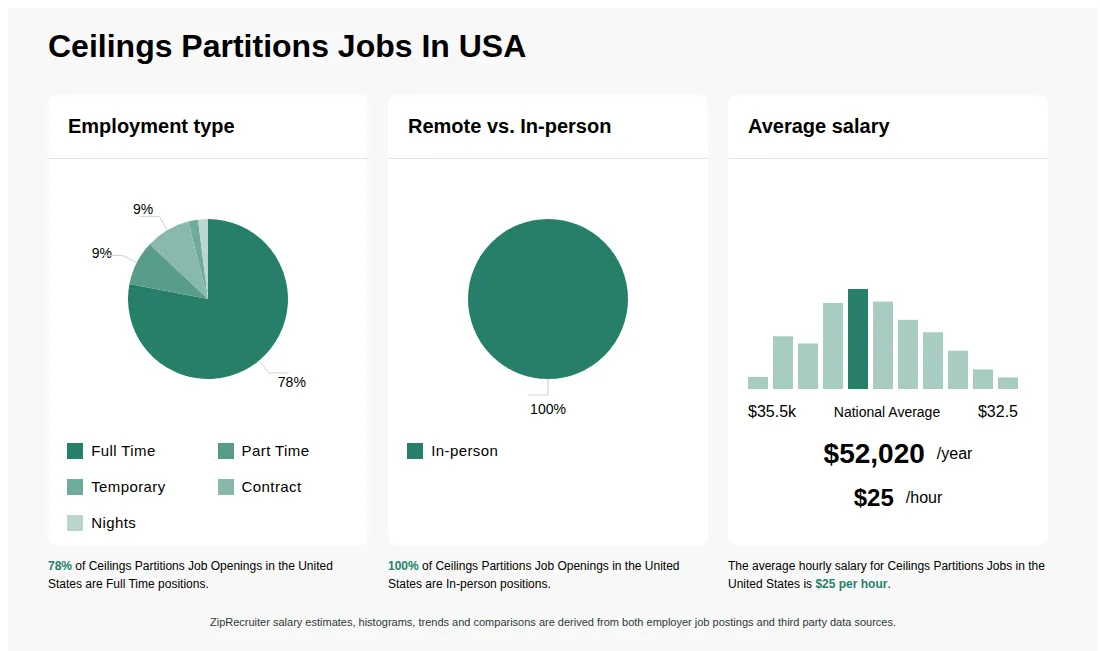
As of Jul 22, 2026, the average hourly pay for ceilings partitions in the United States is $25.01, according to ZipRecruiter salary data. Most workers in this role earn between $21.63 and $26.92 per hour, depending on experience, location, and employer.

What are the key skills and qualifications needed to thrive as a Ceilings and Partitions Installer, and why are they important?

To excel as a Ceilings and Partitions Installer, you need strong skills in construction techniques, blueprint reading, and measuring, typically supported by a high school diploma or equivalent and on-the-job training or apprenticeships. Familiarity with hand and power tools, laser levels, and materials like drywall and suspended ceiling systems is crucial. Attention to detail, problem-solving abilities, and effective teamwork are important soft skills in this role. These skills ensure precise installation, safety, and efficient collaboration on construction sites.

What is the difference between Ceilings Partitions vs Drywall Installers?

AspectCeilings PartitionsDrywall Installers
CredentialsTypically require carpentry or construction experience, certifications varyRequire drywall installation skills, often with apprenticeship or training programs
Work EnvironmentCommercial and residential construction sites, interior finishingInterior walls and ceilings, residential and commercial projects
Industry UsageUsed for creating separate spaces with suspended or partitioned ceilingsUsed for finishing interior walls and ceilings with drywall panels

Ceilings Partitions focus on installing partition walls and suspended ceilings, while Drywall Installers specialize in attaching drywall panels to interior walls and ceilings. Both roles are essential in interior construction but differ in scope and specific skills required.

What are some common challenges faced by professionals working in ceilings and partitions installation, and how can they be managed?

Professionals in ceilings and partitions often encounter challenges such as working in tight or awkward spaces, adhering to strict building codes, and coordinating with other trades like electricians and HVAC installers. Effective communication and detailed planning are crucial to ensure installations align with project schedules and meet safety standards. Staying updated on the latest materials and techniques can also help address unexpected site issues and improve efficiency, making adaptability an important skill in this field.

What are ceilings and partitions in construction?

Ceilings and partitions are essential components in building construction used to divide spaces and enhance functionality. Ceilings are the overhead interior surfaces that cover the upper limits of rooms, often providing insulation, soundproofing, and aesthetic appeal. Partitions are non-load-bearing walls installed to separate spaces within a building, offering flexibility in interior layout and privacy. Both ceilings and partitions can be constructed from materials like drywall, plaster, metal, or glass depending on design and performance requirements.
More about Ceilings Partitions jobs
Infographic showing various Ceilings Partitions job openings in the United States as of July 2026, with employment types broken down into 1% As Needed, 82% Full Time, 16% Part Time, and 1% Contract. Highlights an 96% Physical, and 4% Remote job distribution, with an average salary of $52,020 per year, or $25 per hour.
Carpentry & Acoustical Ceiling Installer

Carpentry & Acoustical Ceiling Installer

Acoustics Associates

Brooklyn Park, MN

$22.75 - $30.75/hr

Full-time

Re-posted 29 days ago


Job description

Carpenters are some of the first workers on a jobsite, and some of the last to leave.
They assist in site preparation; build concrete forms and decks; frame walls and roofs; hang interior and exterior walls; install windows, doors, acoustical ceilings, cabinetry, countertops and trim; and install locks, hardware and specialty furniture.


Carpenters work on almost any construction site imaginable, including new construction and remodeling, such as single-family homes; condominium and apartment projects; office towers, corporate and industrial buildings; new and remodeled hospitals, malls, stores and offices; and public projects such as stadiums, arenas, roads, bridges, schools and university buildings.


Carpenters need more than just good math and geometry skills; they have to be tough and flexible, able to work indoors or out, in the summer heat and humidity or in the bitter cold and snow of winter.


KEY AREAS:

Wood Framing, including residential framing layout, residential wall framing, stairs, roof framing, roof trusses and floor trusses
Interior Systems, including wood-and metal-framed wall partitions, framed soffits, metal jamb installation, suspended ceilings and soffits, clean rooms, demountable partitions, and raised floors
Concrete Form Work, including footings, column pads, column forms, wall forms, slab and deck forms, beam and girder forms, deck and edge forms for bridges, and stair forms
Exterior Finish, including siding, wood and vinyl soffits, asphalt shingles, doors, and window units
Interior Finish, including basic cabinet installation, countertops, shelving, paneling, trim, door hanging, and commercial hardware (door closers, panic devices, latch and lock sets, including low-voltage applications)

Requirements for Both Roles:

Ability to lift and carry 50+ pounds regularly
Prolonged periods of standing, kneeling, squatting, bending, and working on scaffolds
Strong math and measuring skills for accurate layout and cuts
Keen eye for detail, symmetry, and quality craftsmanship
Ability to follow safety protocols and use personal protective equipment (PPE)
Basic knowledge of industry materials and tools
Reliable transportation and punctuality