1

Catastrophe Modeling Jobs (NOW HIRING)

Apply expertise in catastrophe risk modeling research and development. Develop internal models and support solution development for Tokio Marine Holdings and Tokio Marine Group Companies' initiatives.

Apply expertise in catastrophe risk modeling research and development. Develop internal models and support solution development for Tokio Marine Holdings and Tokio Marine Group Companies' initiatives.

Apply expertise in catastrophe risk modeling research and development. Develop internal models and support solution development for Tokio Marine Holdings and Tokio Marine Group Companies' initiatives.

next page

Showing results 1-20

Catastrophe Modeling information

See salary details

$22

$40

$76

How much do catastrophe modeling jobs pay per hour?

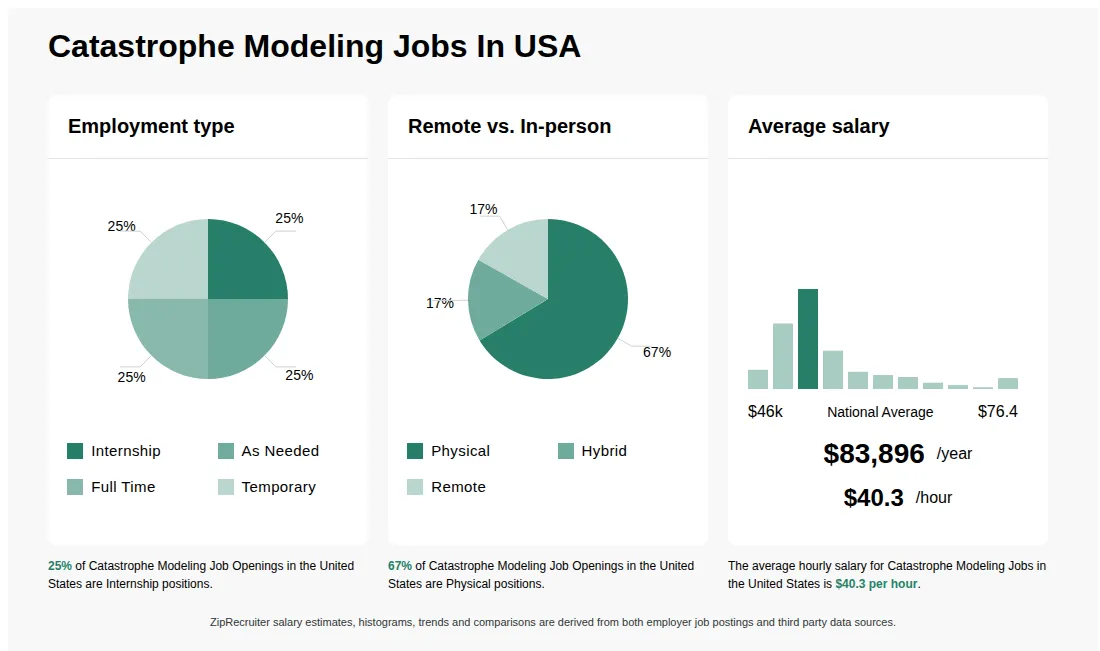
As of Jun 19, 2026, the average hourly pay for catastrophe modeling in the United States is $40.33, according to ZipRecruiter salary data. Most workers in this role earn between $31.25 and $43.51 per hour, depending on experience, location, and employer.

What are some common challenges faced by professionals in catastrophe modeling, and how can they be addressed?

Professionals in catastrophe modeling often encounter challenges such as managing large and complex datasets, staying current with emerging risks (like climate change), and communicating technical findings to non-technical stakeholders. Addressing these requires strong analytical skills, ongoing professional development, and effective collaboration with underwriters, actuaries, and risk managers. Building expertise in specialized software and maintaining open communication channels with other teams can help overcome these obstacles and contribute to successful risk assessments.

What is catastrophe modeling?

Catastrophe modeling is the process of using computer models to estimate the potential losses that could result from natural or man-made disasters, such as hurricanes, earthquakes, floods, or terrorist attacks. These models analyze historical data, scientific research, and current exposure information to predict the likelihood and potential severity of catastrophic events. Insurers, reinsurers, and other organizations use catastrophe modeling to assess risk, price insurance policies, and prepare for possible large-scale losses.

How to Get a Job in Catastrophe Modeling

The qualifications you need to obtain a job in catastrophe modeling include a bachelor’s degree in a science field related to catastrophes, such as geology, meteorology, or environmental science. Insurance-specific degrees, such as actuarial sciences, are also acceptable. Advanced degrees in actuarial science, math, or another catastrophe-related field may help you stand out in the job market. Practice using industry software to run data analysis to become proficient with the application. Some start their careers in entry-level positions in the insurance industry to learn about risk evaluation before moving into catastrophe modeling.

Do cat models get paid?

Catastrophe modeling is a specialized field within insurance and risk management, and professionals in this area typically receive salaries based on experience, education, and the employer. Compensation can vary widely but generally includes a base salary, and some roles may offer bonuses or benefits. Skills in data analysis, modeling software, and industry certifications can influence earning potential.

How to get into catastrophe modelling?

To enter catastrophe modeling, candidates typically need a background in fields such as actuarial science, engineering, or mathematics, along with strong analytical and programming skills in tools like Python or R. Gaining experience through internships, certifications in risk management, or specialized training in catastrophe modeling software can improve job prospects in this field.

What is the difference between Catastrophe Modeling vs Actuary?

AspectCatastrophe ModelingActuary
Required CredentialsTypically requires degrees in risk management, insurance, or related fields; certifications like CPCU or ARM are commonRequires a degree in mathematics, statistics, or actuarial science; professional actuarial certifications (e.g., ASA, FSA) are essential
Work EnvironmentPrimarily in insurance, reinsurance, or risk management firms; involves data analysis and modelingIn insurance companies, consulting firms, or government agencies; involves data analysis, financial modeling, and risk assessment
Industry UsageUsed to assess and quantify natural disaster risks for insurance underwriting and risk managementUsed to evaluate financial risks, reserve calculations, and pricing in insurance and pension industries

While both roles involve risk analysis and data modeling, catastrophe modeling focuses specifically on natural disaster risks, whereas actuaries assess a broader range of financial risks. Both careers require strong quantitative skills and work within the insurance industry, but their specific applications and certifications differ.

What are the key skills and qualifications needed to thrive as a Catastrophe Modeler, and why are they important?

To thrive as a Catastrophe Modeler, you need a strong background in mathematics, statistics, and data analysis, typically supported by a degree in engineering, actuarial science, or a related field. Proficiency in modeling software (such as RMS or AIR), programming languages (like Python or R), and familiarity with GIS systems are commonly required. Critical thinking, attention to detail, and effective communication are valuable soft skills for interpreting data and conveying risk insights to stakeholders. These skills and qualifications are crucial for producing accurate risk assessments that inform insurance, reinsurance, and disaster preparedness strategies.

What does a catastrophe modeler do?

A catastrophe modeler analyzes and develops models to predict the financial impact of natural disasters such as hurricanes, earthquakes, and floods. They use statistical tools, geographic data, and industry software to assess risk and help insurance companies and other organizations prepare for catastrophic events.

How much do catastrophe modeling analysts make?

Catastrophe modeling analysts typically earn a median annual salary between $70,000 and $100,000, depending on experience, location, and industry. Entry-level analysts may start lower, while those with advanced skills or certifications can earn higher salaries, especially in major financial or insurance hubs.
What cities are hiring for Catastrophe Modeling jobs? Cities with the most Catastrophe Modeling job openings:
What are the most commonly searched types of Catastrophe Modeling jobs? The most popular types of Catastrophe Modeling jobs are:
What states have the most Catastrophe Modeling jobs? States with the most job openings for Catastrophe Modeling jobs include:
What job categories do people searching Catastrophe Modeling jobs look for? The top searched job categories for Catastrophe Modeling jobs are:
Infographic showing various Catastrophe Modeling job openings in the United States as of June 2026, with employment types broken down into 100% Full Time. Highlights an 67% In-person, and 33% Remote job distribution, with an average salary of $83,896 per year, or $40.3 per hour.

Catastrophe Modeling Specialist

MSIG Holdings USA, Inc.

Warren, NJ • On-site

$95K - $125K/yr

Full-time

Posted 2 hours ago


Job description

MSIG USA continues to grow!
Company Overview:
MSIG USA is the US-based subsidiary of MS&AD Insurance Group Holdings, Inc., one of the world's top P&C carriers and a global Class 15 insurer, with A+ ratings and a reach that spans 40+ countries and regions. Leveraging our 350-year heritage, MSIG USA brings the financial strength, expertise, and global footprint to offer commercial insurance solutions that address your business's unique risks.
Location
Location: Hybrid role; Atlanta, GA preferred. Warren, NJ or NY considered. Other MSMM office locations may be possible.
Position Overview:
As an expanding and critical area in the insurance industry, catastrophe modeling plays a key role in protecting insureds from the impacts of climate change. MSMM is seeking a motivated individual with strong analytical skills and an interest in quantitative analysis to join our Catastrophe Modeling team.
The Catastrophe Modeling Analyst will work closely with experienced modelers to perform account-level modeling for the company's property portfolio using vendor software (AIR) and internal tools. This role involves collecting, analyzing, and ensuring the quality of property data, as well as supporting underwriters with outputs needed for informed risk decisions. Additional responsibilities include portfolio-level analysis for PML calculations, property aggregations, profitability, and trend indications.
Essential Functions:
  • Perform account-level property catastrophe modeling and assist underwriters with day-to-day requests.
  • Review and validate high-impact account modeling results; support initiatives to improve modeling efficiency.
  • Identify and monitor aggregate exposures to mitigate potential losses from extreme events (e.g., hurricanes, earthquakes, wildfires).
  • Track and analyze underwriting data to manage MSMM's property portfolio.
  • Maintain data quality through regular file and portfolio reviews and completion of QC checklists.
  • Collaborate with underwriting, reinsurance, and management teams to implement best practices for data integrity.
  • Provide modeling support for field underwriters and resolve related issues.
  • Deliver data and modeling results for Ceded Re, Actuarial, and Finance teams; complete ad hoc projects as needed.
  • Support monthly and quarterly modeling processes.
  • Assist in developing internal/external training programs related to catastrophe management.
  • Enhance reporting capabilities and create new reports for senior leadership.

Education & Experience:
  • 2-3 years of experience in catastrophe modeling, preferably in commercial lines with portfolio modeling focus.
  • Proficiency in Verisk CAT modeling; Moody's experience is a plus.
  • Strong understanding of commercial property insurance terms and ability to accurately model complex structures.
  • Advanced skills in Excel and SQL; experience with Python, VBA, or R is beneficial.
  • Excellent communication skills to present complex analyses to business stakeholders.
  • Highly organized with attention to detail; ability to manage multiple priorities and deliver high-quality work on time.
  • Bachelor's degree in a quantitative field (mathematics, data science, computer science, or physical sciences).

Salary: In New York City, and New Jersey the base pay range is $95,000.00 - 125,000.00. Salary determinations are based on various factors, including but not limited to, relevant work experience, skills, certifications and location.
It's an exciting time for our company and a great opportunity to join a financially sound and growing global insurance group!
It is the policy of MSIG USA to provide equal employment opportunity (EEO) to all persons regardless of age, color, national origin, citizenship status, physical or mental disability, race, religion, creed, gender, sex, sexual orientation, gender identity and/or expression, genetic information, marital status, status with regard to public assistance, veteran status, or any other characteristic protected by federal, state or local law. In addition, MSIG USA will provide reasonable accommodations for qualified individuals with disabilities.