1

Cargo Ship Captain Jobs (NOW HIRING)

Captain

Bayonne, NJ · On-site

Overview Responsible for the safe transportation of the assigned barge(s) and for the safety of the cargo, vessel(s) and crew. Responsible for safe docking of ships, (when applicable). Required to ...

Captain

Seattle, WA

$780 - $1.0K/day

Responsible for the safe transportation of the assigned barge(s) and for the safety of the cargo, vessel(s) and crew. Responsible for safe docking of ships, (when applicable). Required to perform ...

Captain

Seattle, WA · On-site

$1.0K/day

Overview Responsible for the safe transportation of the assigned barge(s) and for the safety of the cargo, vessel(s) and crew. Responsible for safe docking of ships, (when applicable). Required to ...

Showing results 41-60

Cargo Ship Captain information

See salary details

$5

$25

$48

How much do cargo ship captain jobs pay per hour?

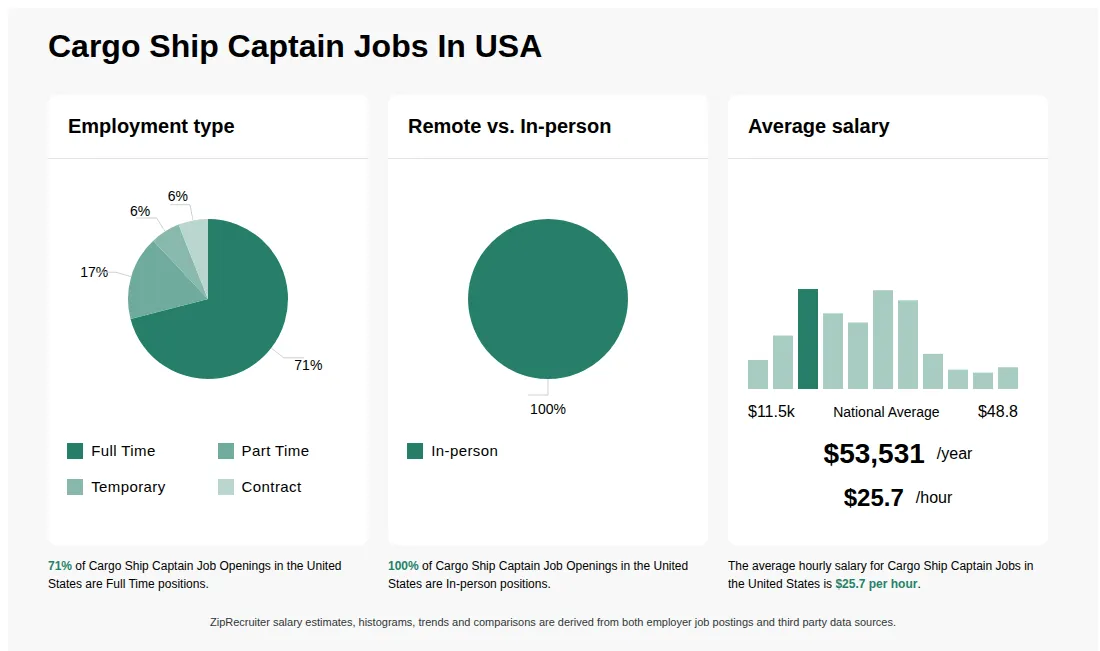
As of Aug 8, 2026, the average hourly pay for cargo ship captain in the United States is $25.74, according to ZipRecruiter salary data. Most workers in this role earn between $16.11 and $30.53 per hour, depending on experience, location, and employer.

How much do cargo ship captains make?

Cargo ship captains typically earn between $80,000 and $150,000 annually, depending on experience, vessel size, and the shipping company. They often work long hours at sea and require certifications such as a Merchant Marine license.

Are cargo ship captains in demand?

Cargo ship captains are in steady demand due to global trade and the need for experienced maritime leaders. The profession requires certifications such as a Master Mariner license and familiarity with navigation and safety protocols, which contribute to job stability in the shipping industry.

Is it hard to be a cargo ship captain?

Being a cargo ship captain requires extensive training, including obtaining a maritime license and gaining experience at sea. The job involves long hours, responsibility for crew and cargo safety, and navigating complex maritime conditions, making it a challenging profession. Strong leadership, decision-making skills, and knowledge of navigation tools are essential for success in this role.

What challenges do cargo ship captains face while managing international voyages?

Cargo Ship Captains often encounter challenges such as navigating through adverse weather conditions, managing diverse multicultural crews, and dealing with strict international maritime regulations. They are also responsible for ensuring cargo is safely loaded, transported, and delivered on time, while maintaining the ship’s operational efficiency. Communication with port authorities, adapting to shifting schedules, and troubleshooting mechanical issues are frequent parts of the job. Successfully managing these challenges requires a calm demeanor, strong organizational skills, and the ability to lead by example to maintain safety and efficiency throughout the voyage.

What does a cargo ship captain do?

A Cargo Ship Captain is responsible for overseeing the safe navigation and operation of a cargo vessel. They manage the crew, ensure compliance with maritime regulations, and oversee cargo loading and unloading. Captains also monitor weather conditions, plan efficient routes, and communicate with port authorities. Their role is critical in ensuring timely and secure delivery of goods across international waters.

What skills and qualifications are needed to be a cargo ship captain?

To thrive as a Cargo Ship Captain, you need extensive maritime knowledge, navigational expertise, and a valid captain's license, often requiring years of seafaring experience. Familiarity with electronic navigation systems, ship management software, and international shipping regulations is crucial. Strong leadership, decision-making abilities, and effective communication skills help manage the crew and coordinate with port authorities. These skills and qualities are essential to ensure the safe, efficient, and lawful operation of vessels during international voyages.


How do you become a cargo ship captain?

To become a cargo ship captain, one must typically start as a deck officer by obtaining a maritime license such as an Officer of the Watch certification, gain experience at sea, and then advance through ranks by accumulating sailing hours and passing additional exams to earn a Master Mariner license. Strong leadership, navigation skills, and knowledge of safety regulations are essential for this role.
More about Cargo Ship Captain jobs
What cities are hiring for Cargo Ship Captain jobs? Cities with the most Cargo Ship Captain job openings:
What are the most commonly searched types of Cargo Ship Captain jobs? The most popular types of Cargo Ship Captain jobs are:
What states have the most Cargo Ship Captain jobs? States with the most job openings for Cargo Ship Captain jobs include:
What job categories do people searching Cargo Ship Captain jobs look for? The top searched job categories for Cargo Ship Captain jobs are:
Infographic showing various Cargo Ship Captain job openings in the United States as of August 2026, with employment types broken down into 85% Full Time, 13% Part Time, 1% Temporary, and 1% Contract. Highlights an 95% Physical, 1% Hybrid, and 4% Remote job distribution, with an average salary of $53,531 per year, or $25.7 per hour.

Full-time

Re-posted 14 days ago


Job description

Company Description: John W. Stone Oil Distributor, LLC is the local leader in dockside, mid-streaming, and offshore fueling along the Mississippi River, from Baton Rouge, Louisiana,to Venice, Louisiana, and into the Gulf of Mexico.

Position: Captain.

Worksite: Inland Tug and Barges.

Work Schedule: 14 days on/ 7 days off.

Home Port: Located in Channel View or Galveston, Texas.

Essential Job Duties:

  • Steer, navigate, maneuver, and operatetug and barges, together their appurtenances, in a safe and efficient manner.
  • Set courses and determine voyage plans.
  • Monitordeck operations, including theloading and unloading of equipment, goods, and cargo.
  • Complete, manage, and maintain shipboard documents, including vessel logs, voyage plans, daily checklists, JSA's, incident reports, and the like.
  • Ensure that the vessel is fully stocked with all necessary equipment, supplies, stores,and the like.
  • Create and submit requisitions for equipment, supplies, stores, and the like.
  • Record and report daily inventories of product and stores.
  • Manage, train, direct, assess, evaluate, anddisciplinethe vessel's crew, including Deckhands, Tankerman,Appreciate Mates, and the like.
  • Perform basic first aid as needed.
  • Monitorandensurethe vessel'sseaworthiness.
  • Use a computer and various computer programs.
  • Order groceries.
  • Drive crew changes vans.
  • Complete and submit various forms of paperwork.
  • Work, communicate, and interface with crewmembers, customers, office personnel, contractors,inspectors, auditors, government agencies, and other entities and people, some of which may speak a foreign language.
  • Perform drills.
  • Handle emergencies.
  • Conduct Job Safety Analysis' (JSA).
  • Undertake action to ensure the overall safety and protection of people, property, and the environment.
  • Report incidents, including illnesses, injuries, property damage, and pollution.
  • Inspectthe tug andbarges, their appurtenances, and other equipment.
  • Ensure thatthetug andbarges, theirappurtenances, and all other equipmentismaintained in every way.
  • Ensure that the tug andbarges, their appurtenances, and all other equipment iskept ingood working order and condition.
  • Ensure thatsanitary living and working conditions are maintained.
  • Communicate via a VHF radio.
  • Cook and prepare meals.
  • Troubleshoot problems.
  • Live and work in close quarters onboard a vessel in harsh weather conditions for weeks at a time.
  • Adhere to, comply with, and enforcecompany policies and all applicable laws, rules, and regulations, including United States Coast Guard Regulations, thecompany'sSafety Management System (SMS), and the vessel's Certificate of Inspection (COI).

Physical Requirements: All offers of employment are conditioned on passing a drug screen and a fit-for-duty physical examination.

John W. Stone Oil Distributor, LLC is an EOE, including disability/vets.

Notice:For an application to be taken into consideration, all required fields-including the signature at the end-must be completed.

Minimum Qualifications:

  • High School Diploma (or Equivalent).
  • Reliable Transportation to and from Work.
  • Basic Computer Skills.
  • Valid Driver's License.
  • Acceptable Driving Record.
  • Valid Transportation Worker Identification Credential (TWIC).
  • ValidUnited States Coast Guard Medical Certificate.
  • ValidMerchant Mariner Credential (MMC) withMaster of TowingUponGreat Lakes, Inland Watersand Western Rivers.
  • At Least Five Years of Work Experience as a MasterofTowingon a Vessel of No Less than 200 Gross Tons.