1

Brain Computer Interface Phd Jobs (NOW HIRING)

Be Seen First

Orbit is a brain-computer interface company working on improving humans. We've developed non-invasive brain stimulation devices which help humans sleep, reason, and improve their mood. We're a team ...

Company Description Neurable is a funded brain-computer interface (BCI) startup spun out of the ... expert and PhD neuroscience, enables people to control hardware and software in real-time with ...

Company Description Neurable is a funded brain-computer interface (BCI) startup spun out of the ... expert and PhD neuroscience, enables people to control hardware and software in real-time with ...

About the Role As a Research Intern , you will contribute to building the computational infrastructure that powers our breakthrough brain-computer interface research. You'll work at the intersection ...

Company Description Neurable is a funded brain-computer interface (BCI) startup spun out of the ... expert and PhD neuroscience, enables people to control hardware and software in real-time with ...

Company Description Neurable is a funded brain-computer interface (BCI) startup spun out of the ... expert and PhD neuroscience, enables people to control hardware and software in real-time with ...

Research Scientist, BCI-New York

Brooklyn, NY ยท On-site

$150K - $220K/yr

About Synchron Synchron's vision is to build non-surgical brain-computer interfaces at global scale ... Bachelor's, Master's, or PhD in Neuroscience, Computer Science, Biomedical Engineering, or a ...

next page

Showing results 1-20

Brain Computer Interface Phd information

See salary details

$11

$54

$77

How much do brain computer interface phd jobs pay per hour?

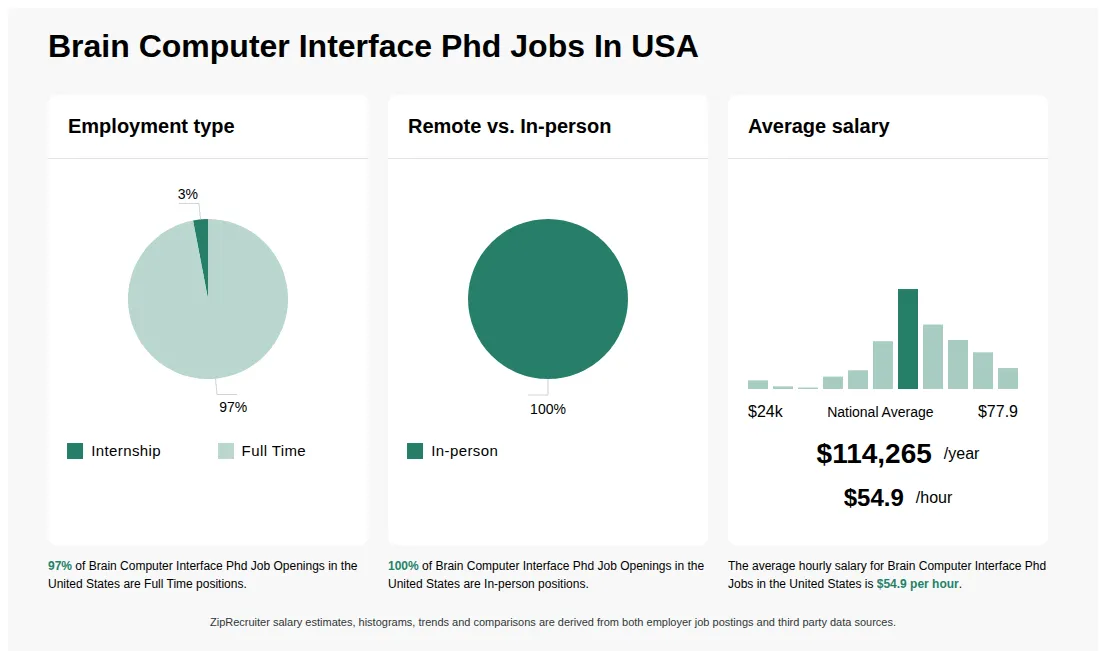
As of May 30, 2026, the average hourly pay for brain computer interface phd in the United States is $54.94, according to ZipRecruiter salary data. Most workers in this role earn between $48.08 and $62.50 per hour, depending on experience, location, and employer.

What are the key skills and qualifications needed to thrive as a Brain Computer Interface PhD, and why are they important?

To thrive as a Brain Computer Interface (BCI) PhD, you need a solid background in neuroscience, computer science, and engineering, typically supported by a doctoral degree in a related field. Expertise in programming languages (such as Python or MATLAB), signal processing, machine learning, and familiarity with neuroimaging or electrophysiological data analysis tools is vital. Strong analytical thinking, problem-solving abilities, and effective communication skills set top candidates apart in this interdisciplinary area. These competencies are crucial for advancing research, collaborating across disciplines, and developing innovative BCI technologies.

What collaborative opportunities are typically available for Brain Computer Interface PhD professionals within interdisciplinary research teams?

Brain Computer Interface (BCI) PhD professionals often collaborate closely with experts in neuroscience, computer science, engineering, and clinical disciplines. This collaboration is essential for developing advanced BCI systems, as it combines insights from brain signal processing, hardware development, and user application testing. Working in such interdisciplinary teams not only enhances the quality of research but also provides PhD professionals with exposure to diverse methodologies and problem-solving approaches. These collaborations can lead to joint publications, grant opportunities, and the development of innovative real-world applications for BCIs.

What is a Brain Computer Interface PhD?

A Brain Computer Interface (BCI) PhD is a doctoral-level research degree focused on developing technologies that enable direct communication between the brain and external devices. This field combines neuroscience, engineering, computer science, and machine learning to create systems that can interpret neural signals and translate them into commands for computers or prosthetic devices. Students in this program conduct original research, often working on innovations that may help restore movement or communication abilities in individuals with disabilities. They typically work in academic, medical, or technology research settings after graduation.

What is the difference between Brain Computer Interface Phd vs Neuroscientist?

AspectBrain Computer Interface PhdNeuroscientist
Required CredentialsPhD in neuroscience, engineering, or related fieldsPhD in neuroscience or psychology
Work EnvironmentResearch labs, tech companies, healthcare settingsAcademic institutions, research labs, hospitals
Industry UsageDeveloping BCI devices, algorithms, and applicationsStudying brain functions, disease mechanisms
Common Search/ComparisonYesYes

The main difference between a Brain Computer Interface Phd and a Neuroscientist lies in their focus. A Brain Computer Interface Phd specializes in developing and applying BCI technologies, often working in engineering or tech environments. In contrast, a Neuroscientist primarily studies brain functions and neurological processes, typically within academic or medical research settings. Both roles require advanced degrees, but their career paths and industry applications differ significantly.

Infographic showing various Brain Computer Interface Phd job openings in the United States as of May 2026, with employment types broken down into 100% Full Time. Highlights an 74% In-person, 13% Hybrid, and 13% Remote job distribution, with an average salary of $114,265 per year, or $54.9 per hour.
XR Brain-Computer Interface Research Intern

XR Brain-Computer Interface Research Intern

Cognixion

Santa Barbara, CA โ€ข On-site

$30/hr

Full-time

Posted 21 days ago


Job description

XR Brain-Computer Interface Research Intern
Cognixion Inc. is seeking a motivated research intern to support our cutting-edge XR/AR brain-computer interface platform development. This hands-on role offers unique exposure to clinical neurotechnology applications and rapid prototyping in an innovative startup environment.
This position will be based in Cognixion's Santa Barbara, CA office and follows a hybrid work schedule with 3 days/week in the office.
Primary Responsibilities:
  • Rapidly prototype and iterate software solutions for EEG-based brain-computer interface systems
  • Support clinical study activities including participant coordination, data collection, and site visits
  • Process and analyze EEG data to inform product development and clinical validation

Required Qualifications:
  • Strong Python programming skills with experience in data processing pipelines
  • Working knowledge of EEG signal processing and analysis techniques
  • Foundational understanding of neuroscience and/or neurology principles
  • Ability to work in fast-paced environment with quick iteration cycles
  • Comfortable with participant-facing activities and occasional travel for site visits

Preferred Qualifications:
  • Experience with machine learning libraries (scikit-learn, TensorFlow, PyTorch)
  • Familiarity with Unity development for XR
  • Background in assistive technology or accessibility applications
  • Understanding of clinical research protocols and IRB compliance
  • Hands on experience with multiple XR devices

This position offers hands-on experience at the intersection of neurotechnology, augmented reality, and assistive communication devices. Ideal for students pursuing careers in biomedical engineering, neuroscience, or human-computer interaction.