1

Brain Computer Interface Phd Jobs (NOW HIRING)

Head of PR

Palo Alto, CA ยท On-site

$180K - $260K/yr

The Opportunity Subsense is building a category-defining Brain-Computer Interface - and we're looking for a Marketing Lead who will make sure the world knows it . In this role, you will own how our ...

The Next Gen team at Neuralink is developing the next generation of brain-computer interfaces. We are laying the groundwork for intuitive, high-dimensional, and bidirectional interfaces between ...

Internship Program

New York, NY

$18.25 - $23.75/hr

Synaptrix is on a mission to revolutionize brain-computer interfaces through non-invasive approaches. We believe that the power to diagnose and treat neurological conditions safely, and to expand ...

Internship Program

New York, NY

$18.25 - $23.75/hr

Synaptrix is on a mission to revolutionize brain-computer interfaces through non-invasive approaches. We believe that the power to diagnose and treat neurological conditions safely, and to expand ...

Internship Program

New York, NY ยท On-site

$18.25 - $23.75/hr

Synaptrix is on a mission to revolutionize brain-computer interfaces through non-invasive approaches. We believe that the power to diagnose and treat neurological conditions safely, and to expand ...

Synaptrix is building the future of non-invasive brain-computer interfaces. We believe the next ... We're looking for a full-time Grant Writer (PhD) to lead and support high-quality grant submissions ...

Team Description The Next Gen team at Neuralink is developing the next generation of brain-computer interfaces. We are laying the groundwork for intuitive, high-dimensional, and bidirectional ...

The Brain Interfaces Soc Department delivers chip architecture and silicon implementation of neural recording and stimulation system-on-chip (SoC) for high-bandwidth brain-computer interfaces. We ...

Synaptrix is building the future of non-invasive brain-computer interfaces. We believe the next ... We're looking for a full-time Grant Writer (PhD) to lead and support high-quality grant submissions ...

Synaptrix is building the future of non-invasive brain-computer interfaces. We believe the next ... We're looking for a full-time Grant Writer (PhD) to lead and support high-quality grant submissions ...

Director of Market Development

Palo Alto, CA ยท On-site

$180K - $260K/yr

The Opportunity Subsense is building a category-defining Brain-Computer Interface - and we're looking for a Marketing Lead who will make sure the world knows it . In this role, you will own how our ...

next page

Showing results 1-20

Brain Computer Interface Phd information

See salary details

$11

$54

$77

How much do brain computer interface phd jobs pay per hour?

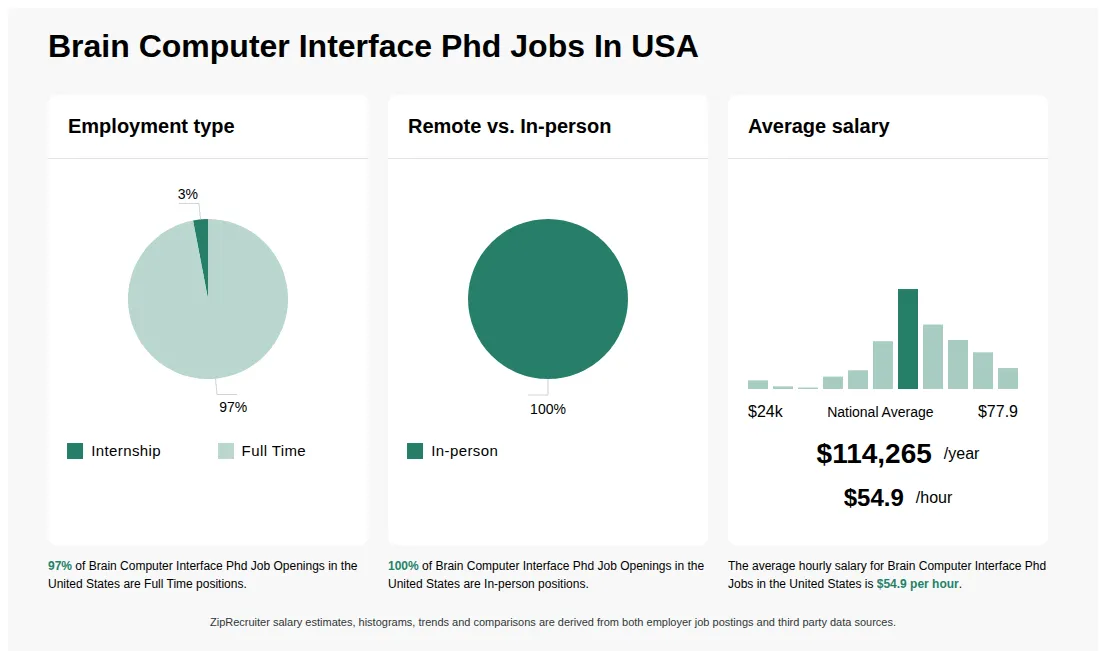
As of May 30, 2026, the average hourly pay for brain computer interface phd in the United States is $54.94, according to ZipRecruiter salary data. Most workers in this role earn between $48.08 and $62.50 per hour, depending on experience, location, and employer.

What are the key skills and qualifications needed to thrive as a Brain Computer Interface PhD, and why are they important?

To thrive as a Brain Computer Interface (BCI) PhD, you need a solid background in neuroscience, computer science, and engineering, typically supported by a doctoral degree in a related field. Expertise in programming languages (such as Python or MATLAB), signal processing, machine learning, and familiarity with neuroimaging or electrophysiological data analysis tools is vital. Strong analytical thinking, problem-solving abilities, and effective communication skills set top candidates apart in this interdisciplinary area. These competencies are crucial for advancing research, collaborating across disciplines, and developing innovative BCI technologies.

What collaborative opportunities are typically available for Brain Computer Interface PhD professionals within interdisciplinary research teams?

Brain Computer Interface (BCI) PhD professionals often collaborate closely with experts in neuroscience, computer science, engineering, and clinical disciplines. This collaboration is essential for developing advanced BCI systems, as it combines insights from brain signal processing, hardware development, and user application testing. Working in such interdisciplinary teams not only enhances the quality of research but also provides PhD professionals with exposure to diverse methodologies and problem-solving approaches. These collaborations can lead to joint publications, grant opportunities, and the development of innovative real-world applications for BCIs.

What is a Brain Computer Interface PhD?

A Brain Computer Interface (BCI) PhD is a doctoral-level research degree focused on developing technologies that enable direct communication between the brain and external devices. This field combines neuroscience, engineering, computer science, and machine learning to create systems that can interpret neural signals and translate them into commands for computers or prosthetic devices. Students in this program conduct original research, often working on innovations that may help restore movement or communication abilities in individuals with disabilities. They typically work in academic, medical, or technology research settings after graduation.

What is the difference between Brain Computer Interface Phd vs Neuroscientist?

AspectBrain Computer Interface PhdNeuroscientist
Required CredentialsPhD in neuroscience, engineering, or related fieldsPhD in neuroscience or psychology
Work EnvironmentResearch labs, tech companies, healthcare settingsAcademic institutions, research labs, hospitals
Industry UsageDeveloping BCI devices, algorithms, and applicationsStudying brain functions, disease mechanisms
Common Search/ComparisonYesYes

The main difference between a Brain Computer Interface Phd and a Neuroscientist lies in their focus. A Brain Computer Interface Phd specializes in developing and applying BCI technologies, often working in engineering or tech environments. In contrast, a Neuroscientist primarily studies brain functions and neurological processes, typically within academic or medical research settings. Both roles require advanced degrees, but their career paths and industry applications differ significantly.

Infographic showing various Brain Computer Interface Phd job openings in the United States as of May 2026, with employment types broken down into 100% Full Time. Highlights an 74% In-person, 13% Hybrid, and 13% Remote job distribution, with an average salary of $114,265 per year, or $54.9 per hour.

Head of PR

Subsense

Palo Alto, CA โ€ข On-site

$180K - $260K/yr

Full-time

Posted 9 days ago


Job description

About Subsense
Subsense is a deep-tech company developing the world's first non-surgical, bidirectional brain-computer interface powered by plasmonic and magnetoelectric nanoparticles. Our mission is to unlock direct communication between the human brain and AI - starting with medical applications such as stroke recovery and moving toward cognitive enhancement for healthy users. Headquartered in Palo Alto, Subsense brings together leading scientists and engineers to redefine the future of human-machine interaction.
The Opportunity
Subsense is building a category-defining Brain-Computer Interface - and we're looking for a Marketing Lead who will make sure the world knows it.
In this role, you will own how our company is seen, talked about, and remembered. Your responsibilities will include:
We're looking for a Head of PR who doesn't just promote a product - but helps define an entire industry.
This is not a "comms manager" role. This is a senior leadership position at a company building one of the most ambitious Brain-Computer Interface technologies in the world.
Your mission: build the strategic narrative and communications infrastructure that makes Subsense impossible to ignore.
You will own how the world understands us - shaping our positioning, driving our external voice, and ensuring our story reaches the right audiences with clarity, credibility, and force.
Key Responsibilities
  • Develop and lead Subsense's end-to-end communications and positioning strategy, ensuring alignment across all external channels and stakeholders
  • Define the company narrative - translating deep, complex neurotechnology into a clear, compelling story for media, investors, partners, and the broader scientific and tech communities
  • Own brand voice, thought leadership, and content strategy across digital, social, events, and press
  • Set the category narrative for BCI, positioning Subsense as the field's defining voice - not a follower of it
  • Partner closely with founders, scientists, and business leads to align communications with company milestones and scientific progress
  • Lead media relations and build high-value relationships with journalists, editors, and influencers across tech, science, and healthcare
  • Monitor the competitive and market landscape to ensure our positioning stays ahead
  • Manage external agencies and partners to amplify reach and execution quality
  • Own the communications budget and measure impact with rigor
  • Build and scale a world-class communications and strategy team as the company grows

What You'll Bring
We're not looking for someone who "does marketing."
We're looking for someone who builds leadership, momentum, and reputation.
You bring:
  • Proven experience in a senior communications, strategy, or marketing leadership role - ideally in deep tech, biotech, or complex science-driven industries
  • A track record of building narratives for technologies without an existing playbook
  • Exceptional ability to translate highly technical concepts into confident, world-class storytelling
  • Strong relationships with or experience engaging media, investors, and scientific communities
  • Experience in early-stage or high-growth environments where speed, ambiguity, and ownership are the norm
  • Strategic thinking paired with a hands-on builder mindset
  • Comfort operating at the frontier - high-stakes, high-reward, and genuinely unprecedented
  • Fluent spoken and written English

$180,000 - $260,000 a year
Subsense is an equal-opportunity employer. We celebrate diversity and are committed to creating an inclusive environment for all employees.
We may use artificial intelligence (AI) tools to support parts of the hiring process, such as reviewing applications, analyzing resumes, or assessing responses. These tools assist our recruitment team but do not replace human judgment. Final hiring decisions are ultimately made by humans. If you would like more information about how your data is processed, please contact us.