1

Brain Computer Interface Phd Jobs (NOW HIRING)

Neuroengineer, Next Gen

Fremont, CA ยท On-site

$122K - $226K/yr

The Next Gen team at Neuralink is developing the next generation of brain-computer interfaces. We are laying the groundwork for intuitive, high-dimensional, and bidirectional interfaces between ...

... brain-computer interfaces and neural signal processing, or agentic AI systems * A PhD in machine learning, computer science, neuroscience or a closely related field is strongly preferred; exceptional ...

Research Engineer

Palo Alto, CA ยท On-site

$120K - $140K/yr

... surgical, bidirectional brain-computer interface powered by plasmonic and magnetoelectric ... MS or PhD in Electrical Engineering, Physics, Mechanical Engineering, Bioengineering, or related ...

The Brain Interfaces Soc Department delivers chip architecture and silicon implementation of neural recording and stimulation system-on-chip (SoC) for high-bandwidth brain-computer interfaces. We ...

Research Engineer

Oakland, CA ยท On-site

$120K - $150K/yr

Paradromics is building a brain-computer interface (BCI) platform that records brain activity at the highest possible resolution: the individual neuron. AI algorithms then decode this massive amount ...

Software Engineer

Oakland, CA ยท On-site

$120K - $150K/yr

Paradromics is building a brain-computer interface (BCI) platform that records brain activity at the highest possible resolution: the individual neuron. AI algorithms then decode this massive amount ...

Paradromics is building a brain-computer interface (BCI) platform that records brain activity at the highest possible resolution: the individual neuron. AI algorithms then decode this massive amount ...

Paradromics is building a brain-computer interface (BCI) platform that records brain activity at the highest possible resolution: the individual neuron. AI algorithms then decode this massive amount ...

The Next Gen team at Neuralink is developing the next generation of brain-computer interfaces. We are laying the groundwork for intuitive, high-dimensional, and bidirectional interfaces between ...

Analog IC Layout Engineer

Fremont, CA ยท On-site

$83K - $139K/yr

The Brain Interfaces Soc Department delivers chip architecture and silicon implementation of neural recording and stimulation system-on-chip (SoC) for high-bandwidth brain-computer interfaces. We ...

The Brain Interfaces Soc Department delivers chip architecture and silicon implementation of neural recording and stimulation system-on-chip (SoC) for high-bandwidth brain-computer interfaces. We ...

Field BCI Specialist-Buffalo, NY

Buffalo, NY ยท Remote

$90K - $120K/yr

About Synchron Synchron's vision is to build non-surgical brain-computer interfaces at global scale that protect the fundamental human rights of freedom of expression and autonomy. Our first mission ...

next page

Showing results 1-20

Brain Computer Interface Phd information

See salary details

$11

$54

$77

How much do brain computer interface phd jobs pay per hour?

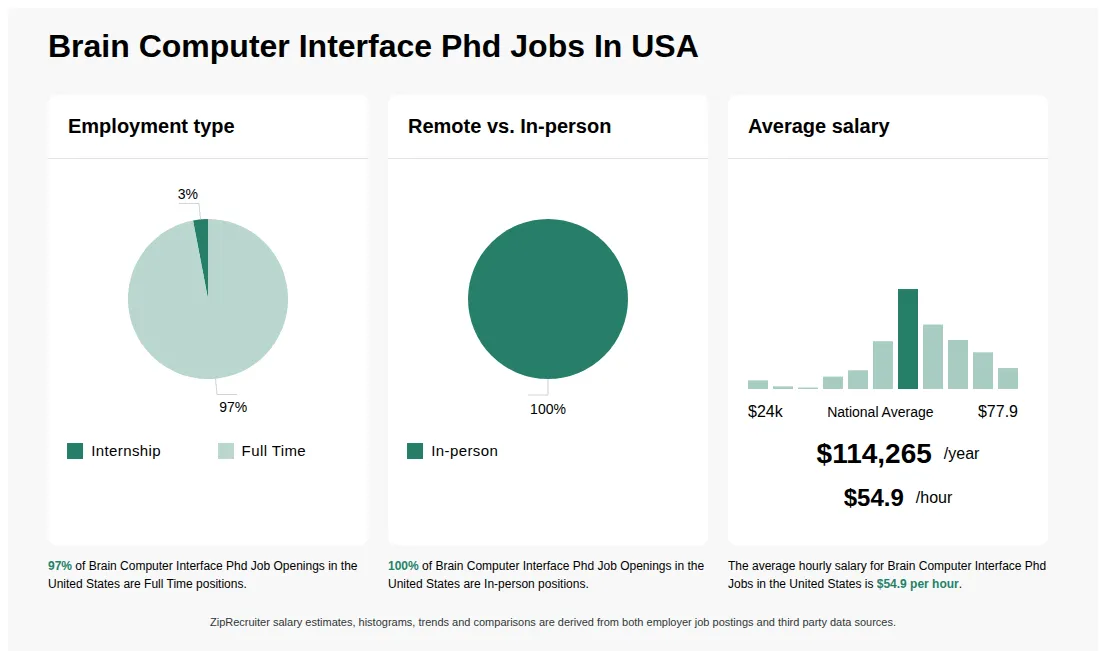
As of May 30, 2026, the average hourly pay for brain computer interface phd in the United States is $54.94, according to ZipRecruiter salary data. Most workers in this role earn between $48.08 and $62.50 per hour, depending on experience, location, and employer.

What are the key skills and qualifications needed to thrive as a Brain Computer Interface PhD, and why are they important?

To thrive as a Brain Computer Interface (BCI) PhD, you need a solid background in neuroscience, computer science, and engineering, typically supported by a doctoral degree in a related field. Expertise in programming languages (such as Python or MATLAB), signal processing, machine learning, and familiarity with neuroimaging or electrophysiological data analysis tools is vital. Strong analytical thinking, problem-solving abilities, and effective communication skills set top candidates apart in this interdisciplinary area. These competencies are crucial for advancing research, collaborating across disciplines, and developing innovative BCI technologies.

What collaborative opportunities are typically available for Brain Computer Interface PhD professionals within interdisciplinary research teams?

Brain Computer Interface (BCI) PhD professionals often collaborate closely with experts in neuroscience, computer science, engineering, and clinical disciplines. This collaboration is essential for developing advanced BCI systems, as it combines insights from brain signal processing, hardware development, and user application testing. Working in such interdisciplinary teams not only enhances the quality of research but also provides PhD professionals with exposure to diverse methodologies and problem-solving approaches. These collaborations can lead to joint publications, grant opportunities, and the development of innovative real-world applications for BCIs.

What is a Brain Computer Interface PhD?

A Brain Computer Interface (BCI) PhD is a doctoral-level research degree focused on developing technologies that enable direct communication between the brain and external devices. This field combines neuroscience, engineering, computer science, and machine learning to create systems that can interpret neural signals and translate them into commands for computers or prosthetic devices. Students in this program conduct original research, often working on innovations that may help restore movement or communication abilities in individuals with disabilities. They typically work in academic, medical, or technology research settings after graduation.

What is the difference between Brain Computer Interface Phd vs Neuroscientist?

AspectBrain Computer Interface PhdNeuroscientist
Required CredentialsPhD in neuroscience, engineering, or related fieldsPhD in neuroscience or psychology
Work EnvironmentResearch labs, tech companies, healthcare settingsAcademic institutions, research labs, hospitals
Industry UsageDeveloping BCI devices, algorithms, and applicationsStudying brain functions, disease mechanisms
Common Search/ComparisonYesYes

The main difference between a Brain Computer Interface Phd and a Neuroscientist lies in their focus. A Brain Computer Interface Phd specializes in developing and applying BCI technologies, often working in engineering or tech environments. In contrast, a Neuroscientist primarily studies brain functions and neurological processes, typically within academic or medical research settings. Both roles require advanced degrees, but their career paths and industry applications differ significantly.

Infographic showing various Brain Computer Interface Phd job openings in the United States as of May 2026, with employment types broken down into 100% Full Time. Highlights an 74% In-person, 13% Hybrid, and 13% Remote job distribution, with an average salary of $114,265 per year, or $54.9 per hour.
Neuroengineer, Next Gen

Neuroengineer, Next Gen

Neuralink

Fremont, CA โ€ข On-site

$122K - $226K/yr

Full-time

Medical, Dental, Vision, Retirement

Posted 7 days ago


Job description

About Neuralink:
We are creating devices that enable a bi-directional interface with the brain. These devices allow us to restore movement to the paralyzed, restore sight to the blind, and revolutionize how humans interact with their digital world.
Team Description:
The Next Gen team at Neuralink is developing the next generation of brain-computer interfaces. We are laying the groundwork for intuitive, high-dimensional, and bidirectional interfaces between brains and machines, with the goal of helping people challenged by a variety of neurological disorders and conditions. Our team consists of scientists and engineers, working closely together to define the engineering requirements for these future products. As a Neuroengineer on this team, you will contribute across a wide range of projects, from designing novel experimental preparations, to interpreting neural signals and behavioral data, to developing novel BCI paradigms. Successful candidates will be highly adaptable, able to deploy their core technical and creative skills to tackle a wide range of problems, and have a keen sense of urgency.
Job Description and Responsibilities:
  • Develop computational models of, and design encoding strategies for, electrical stimulation
  • Design, execute, interpret, and communicate the results of neural recording and stimulation experiments
  • Implement end-to-end hardware and software solutions for prosthetic vision, including machine vision algorithms, smart glasses, and eye tracking technology
  • Run and support research sessions in coordination with software engineers, field engineers, and animal specialists
  • Present results in a collaborative setting

Required Qualifications:
  • Evidence of exceptional ability in neuroscience, biomedical engineering, electrical engineering, machine learning, or a related field
  • 4+ years of academic or industry experience
  • A strong understanding of the scientific method and engineering first principles
  • Fluency with Python for data analysis

Preferred Qualifications:
  • Experience with modern statistical inference and machine learning, including for machine vision applications
  • Experience with neural stimulation
  • Experience modeling the influence of electrical stimulation on neural activity, for example using the NEURON modeling environment
  • Experience modeling electric fields using finite element modeling (FEM)
  • Experience building and programming experimental instrumentation
  • Experience with in-vivo electrophysiology, awake behaving recordings, and in particular, closed-loop brain-computer interface

Expected Compensation:
The anticipated base salary for this position is expected to be within the following range. Your actual base pay will be determined by your job-related skills, experience, and relevant education or training. We also believe in aligning our employees' success with the company's long-term growth. As such, in addition to base salary, Neuralink offers equity compensation (in the form of Restricted Stock Units (RSU)) for all full-time employees.
Base Salary Range:
$122,000-$226,000 USD
What We Offer:
Full-time employees are eligible for the following benefits listed below.
  • An opportunity to change the world and work with some of the smartest and most talented experts from different fields
  • Growth potential; we rapidly advance team members who have an outsized impact
  • Excellent medical, dental, and vision insurance through a PPO plan
  • Paid holidays
  • Commuter benefits
  • Meals provided
  • Equity (RSUs) *Temporary Employees & Interns excluded
  • 401(k) plan *Interns initially excluded until they work 1,000 hours
  • Parental leave *Temporary Employees & Interns excluded
  • Flexible time off *Temporary Employees & Interns excluded