... bounty hunters, in consultancies, internal security teams, or independently. Both traditional offensive security experience and experience probing AI systems are relevant, and you do not need both.
... bounty hunters, in consultancies, internal security teams, or independently. Both traditional offensive security experience and experience probing AI systems are relevant, and you do not need both.
... bounty hunters, whether from consultancies, internal security teams, or independent practice. You do not need prior experience in data annotation or AI research. What matters is that you can find and ...
... bounty hunters, whether from consultancies, internal security teams, or independent practice. You do not need prior experience in data annotation or AI research. What matters is that you can find and ...
... bounty hunters, whether from consultancies, internal security teams, or independent practice. You do not need prior experience in data annotation or AI research. What matters is that you can find and ...
... bounty hunters, whether from consultancies, internal security teams, or independent practice. You do not need prior experience in data annotation or AI research. What matters is that you can find and ...
... bounty hunters, whether from consultancies, internal security teams, or independent practice. You do not need prior experience in data annotation or AI research. What matters is that you can find and ...
... bounty hunters, whether from consultancies, internal security teams, or independent practice. You do not need prior experience in data annotation or AI research. What matters is that you can find and ...
This opportunity is suited to people who test systems for a living or have done so: penetration testers, red team operators, and serious bug bounty hunters, whether from consultancies, internal ...
This opportunity is suited to people who test systems for a living or have done so: penetration testers, red team operators, and serious bug bounty hunters, whether from consultancies, internal ...
... bounty hunters, whether from consultancies, internal security teams, or independent practice. You do not need prior experience in data annotation or AI research. What matters is that you can find and ...
... bounty hunters, whether from consultancies, internal security teams, or independent practice. You do not need prior experience in data annotation or AI research. What matters is that you can find and ...

Space Electromagnetic Warfare Systems Engineer (Project Engineer / Sr. Project Engineer)
Colorado Springs, CO · Hybrid
... Bounty Hunter. As part of the space EW community, this critical position will work to support operational activities and influence future capability needs. The selected candidate will be required to ...
Space Electromagnetic Warfare Systems Engineer (Project Engineer / Sr. Project Engineer)
Colorado Springs, CO · Hybrid
... Bounty Hunter. As part of the space EW community, this critical position will work to support operational activities and influence future capability needs. The selected candidate will be required to ...

Integration Engineer with Security Clearance
Colorado Springs, CO · On-site
$100K - $135K/yr
Experience supporting SEW, EW, RMT, Bounty Hunter, or Meadowlands ecosystem integration * Experience in modeling, simulation, Linux environments, configuration management, for mission-critical ...
Integration Engineer with Security Clearance
Colorado Springs, CO · On-site
$100K - $135K/yr
Experience supporting SEW, EW, RMT, Bounty Hunter, or Meadowlands ecosystem integration * Experience in modeling, simulation, Linux environments, configuration management, for mission-critical ...
Space Electromagnetic Warfare Systems Integration Lead
El Segundo, CA · On-site
$177K/yr
You'll integrate space EW systems such as the Counter Communications System (CCS), the Remote Modular Terminals (RMTs), and Bounty Hunter with cloud operating environments such as the Space ...
Space Electromagnetic Warfare Systems Integration Lead
El Segundo, CA · On-site
$177K/yr
You'll integrate space EW systems such as the Counter Communications System (CCS), the Remote Modular Terminals (RMTs), and Bounty Hunter with cloud operating environments such as the Space ...
Integration Engineer
Colorado Springs, CO · On-site
$125 - $150/hr
Experience supporting SEW, EW, RMT, Bounty Hunter, or Meadowlands ecosystem integration * Experience in modeling, simulation, Linux environments, configuration management, for mission-critical ...
Integration Engineer
Colorado Springs, CO · On-site
$125 - $150/hr
Experience supporting SEW, EW, RMT, Bounty Hunter, or Meadowlands ecosystem integration * Experience in modeling, simulation, Linux environments, configuration management, for mission-critical ...
You'll work with space EW systems such as the Counter Communications System (CCS), the Space Electromagnetic Warfare Operating Location (SEWOL), the Remote Modular Terminals (RMTs), and Bounty Hunter.
You'll work with space EW systems such as the Counter Communications System (CCS), the Space Electromagnetic Warfare Operating Location (SEWOL), the Remote Modular Terminals (RMTs), and Bounty Hunter.
Electromagnetic Warfare Systems Engineer
Colorado Springs, CO · On-site
$150 - $200/hr
You'll work with space EW systems such as the Counter Communications System (CCS), the Space Electromagnetic Warfare Operating Location (SEWOL), the Remote Modular Terminals (RMTs), and Bounty Hunter.
Electromagnetic Warfare Systems Engineer
Colorado Springs, CO · On-site
$150 - $200/hr
You'll work with space EW systems such as the Counter Communications System (CCS), the Space Electromagnetic Warfare Operating Location (SEWOL), the Remote Modular Terminals (RMTs), and Bounty Hunter.
You'll work with space EW systems such as the Counter Communications System (CCS), the Space Electromagnetic Warfare Operating Location (SEWOL), the Remote Modular Terminals (RMTs), and Bounty Hunter.
You'll work with space EW systems such as the Counter Communications System (CCS), the Space Electromagnetic Warfare Operating Location (SEWOL), the Remote Modular Terminals (RMTs), and Bounty Hunter.
Space Electromagnetic Warfare Systems Engineer (Project Engineer / Sr. Project Engineer)
El Segundo, CA · Hybrid
... Bounty Hunter. As part of the space EW community, this critical position will work to support operational activities and influence future capability needs. The selected candidate will be required to ...
Space Electromagnetic Warfare Systems Engineer (Project Engineer / Sr. Project Engineer)
El Segundo, CA · Hybrid
... Bounty Hunter. As part of the space EW community, this critical position will work to support operational activities and influence future capability needs. The selected candidate will be required to ...
Senior Software Engineer
San Francisco, CA · On-site
$200K - $300K/yr
About Our Leadership * CEO Jack Cable is a top-ranked bug bounty hunter who previously led Secure by Design at CISA. * CTO Ashwin Ramaswami is an engineer who has built large-scale systems at Skiff ...
Senior Software Engineer
San Francisco, CA · On-site
$200K - $300K/yr
About Our Leadership * CEO Jack Cable is a top-ranked bug bounty hunter who previously led Secure by Design at CISA. * CTO Ashwin Ramaswami is an engineer who has built large-scale systems at Skiff ...
This opportunity is suited to people who test systems for a living or have done so: penetration testers, red team operators, and serious bug bounty hunters, whether from consultancies, internal ...
This opportunity is suited to people who test systems for a living or have done so: penetration testers, red team operators, and serious bug bounty hunters, whether from consultancies, internal ...
This opportunity is suited to people who test systems for a living or have done so: penetration testers, red team operators, and serious bug bounty hunters, whether from consultancies, internal ...
This opportunity is suited to people who test systems for a living or have done so: penetration testers, red team operators, and serious bug bounty hunters, whether from consultancies, internal ...
... bounty hunters, whether from consultancies, internal security teams, or independent practice. You do not need prior experience in data annotation or AI research. What matters is that you can find and ...
... bounty hunters, whether from consultancies, internal security teams, or independent practice. You do not need prior experience in data annotation or AI research. What matters is that you can find and ...
... bounty hunters, whether from consultancies, internal security teams, or independent practice. You do not need prior experience in data annotation or AI research. What matters is that you can find and ...
... bounty hunters, whether from consultancies, internal security teams, or independent practice. You do not need prior experience in data annotation or AI research. What matters is that you can find and ...
This opportunity is suited to people who test systems for a living or have done so: penetration testers, red team operators, and serious bug bounty hunters, whether from consultancies, internal ...
This opportunity is suited to people who test systems for a living or have done so: penetration testers, red team operators, and serious bug bounty hunters, whether from consultancies, internal ...
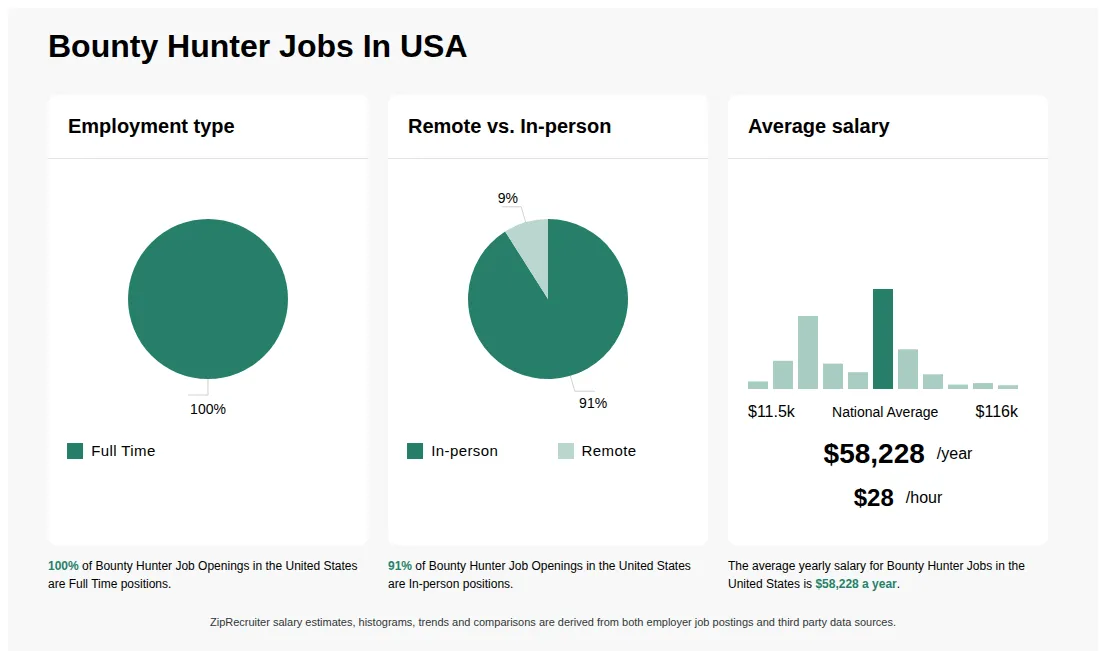
Bounty Hunter information
See salary details
$11.5K - $21K
2% of jobs
$21K - $30.5K
9% of jobs
$36.3K is the 25th percentile. Wages below this are outliers.
$30.5K - $40K
23% of jobs
$40K - $49.5K
7% of jobs
$49.5K - $59K
5% of jobs
The median wage is $59.9K / yr.
$59K - $68.5K
33% of jobs
$68.5K - $78K
13% of jobs
$78K - $87.5K
4% of jobs
$87.5K - $97K
1% of jobs
$97K - $106.5K
1% of jobs
$106.5K - $116K
1% of jobs
$11.5K
$58.2K
$116K
How much do bounty hunter jobs pay per year?
As of Sep 9, 2026, the average yearly pay for bounty hunter in the United States is $58,228.00, according to ZipRecruiter salary data. Most workers in this role earn between $36,000.00 and $68,500.00 per year, depending on experience, location, and employer.
What skills and qualifications are needed to be a bounty hunter?
To thrive as a Bounty Hunter, you need strong investigative skills, knowledge of local and federal laws, and experience in apprehending fugitives, often supported by law enforcement or private investigator backgrounds. Proficiency in surveillance technology, tracking software, and in some states, licensure or bondsman certification is important. Excellent communication, negotiation, and conflict resolution abilities set top professionals apart. These skills ensure bounty hunters can safely and legally locate and detain fugitives while minimizing risks to themselves and others.
What does a typical workweek look like for a bounty hunter?
A typical workweek for a Bounty Hunter often involves conducting background research on fugitives, coordinating with bail bond agencies, and performing surveillance or field operations to locate individuals who have skipped bail. While some days may be spent preparing case files and liaising with law enforcement, other days can require stakeouts or making arrests at various hours, including nights and weekends. Flexibility and preparedness are key, as the work can be unpredictable and demand rapid response to new leads. Additionally, bounty hunters frequently work independently but may collaborate with legal professionals, bail agents, and occasionally local authorities when executing successful apprehensions.
How do you become a bounty hunter?
To become a bounty hunter, individuals typically need to meet state licensing requirements, which often include background checks and completing a training course. They should also develop skills in investigation, negotiation, and firearms handling, and may need to work for a licensed bail bondsman or agency to gain experience.
How much money do bounty hunters get paid?
Bounty hunters typically earn between $50,000 and $100,000 annually, with income often based on a percentage of the bail amount collected. Pay can vary depending on experience, location, and the number of cases handled, and they may also receive additional incentives or fees for successful captures.
Is bounty hunting still a career?
Bounty hunting is still a recognized profession in some regions, primarily involving the capture of individuals with outstanding warrants. It often requires licensing, knowledge of legal procedures, and skills in tracking and negotiation. However, regulations and demand vary by location, and the job can be risky and physically demanding.
More about Bounty Hunter jobs
What cities are hiring for Bounty Hunter jobs?
Cities with the most Bounty Hunter job openings:
What are the most commonly searched types of Bounty Hunter jobs?
The most popular types of Bounty Hunter jobs are:
What states have the most Bounty Hunter jobs?
States with the most job openings for Bounty Hunter jobs include:
What are popular job titles related to Bounty Hunter jobs?
For Bounty Hunter jobs, the most frequently searched job titles are:

Offensive Security Contributor: AI Red Teaming and Penetration Testing
Fremont, CA • On-site
Cobalt
Other
Posted 9 days ago
Job description
About the role:
Cobalt is seeking experienced offensive security practitioners to contribute expert reasoning, adversarial testing, and evaluation data used to train and assess frontier AI models.
This opportunity is suited to people who have worked as penetration testers, red team operators, security researchers, vulnerability researchers, exploit developers, application security engineers, or bug bounty hunters, in consultancies, internal security teams, or independently. Both traditional offensive security experience and experience probing AI systems are relevant, and you do not need both.
You do not need prior experience in data annotation or AI research. You must, however, be able to find and reason about real weaknesses in software or in model behavior unaided, and you must be comfortable documenting your approach clearly in writing.
All work is performed against sandboxed environments, purpose-built targets, and model endpoints supplied by us or by the lab. We do not accept work performed against systems you are not authorized to test, and we do not accept material obtained without authorization.
What you'll do:
Depending on the project, you may:
- Produce written attack traces on security tasks, capturing how you form and test hypotheses, what you rule out and why, and how you arrive at a working approach, rather than only the end result
- Adversarially test model behavior, probing for prompt injection, unsafe tool use, data exfiltration paths, and failures of refusal or policy adherence, and document reproducible cases
- Author novel security problems, capture-the-flag style challenges, and evaluation scenarios with verifiable success criteria
- Evaluate model-generated security content and code: rank responses, explain what makes the stronger one stronger, and identify the specific step at which the reasoning or the exploit logic breaks down
- Design rubrics and partial-credit criteria for scoring multistep offensive and defensive tasks
Projects follow their own guidelines, scope rules, and quality standards, and you will work with feedback from reviewers and lab research teams.
Required qualifications:
- Demonstrable offensive security experience, evidenced by professional penetration testing or red team engagements, published vulnerability research or CVEs, a substantive bug bounty record, competitive CTF results, or comparable work
- Strong hands-on coding ability in at least one of Python, C, C++, Go, Rust, or JavaScript, sufficient to read unfamiliar codebases and write your own tooling
- Depth in at least one area, for example web and API security, cloud and container security, network and infrastructure testing, binary exploitation and reverse engineering, or AI and LLM security
- Ability to explain each step of your reasoning clearly in writing, and to produce documentation another practitioner could reproduce
- Willingness to work strictly within defined scope and authorization, and to sign a confidentiality agreement covering project materials
Certifications such as OSCP, OSWE, OSEP, GPEN, or GXPN are useful but not required, as is prior experience with AI red teaming, model evaluation, or safety research.
Why Join Cobalt AI:
- Advance frontier AI where it counts. Apply your offensive expertise to data that frontier labs cannot obtain any other way, where your judgment directly shapes how the next generation of models handles security reasoning and resists misuse.
- Grow professionally. Expand your influence through evaluation projects, advisory roles, and research collaborations, while developing a working understanding of how frontier models are trained and assessed.
- Work with a top-tier network. Collaborate with security researchers and practitioners from leading organizations on high-impact, flexible work.
- Set your own schedule. Flexible 10 to 40 hour weeks that fit around your existing engagements and your life.
- Competitive pay. Rates vary by project and are determined by a number of factors, including scope, skillset, and experience.