JR101446 Adjunct Faculty in Biotechnology (Open) Department: BSU Natural Sciences, JM Position Type: Temporary (Fixed Term) Open Date: 12-12-2025 Close Date: $4,800 per course, subject to change ...
JR101446 Adjunct Faculty in Biotechnology (Open) Department: BSU Natural Sciences, JM Position Type: Temporary (Fixed Term) Open Date: 12-12-2025 Close Date: $4,800 per course, subject to change ...

Assistant Professor of Biotechnology
Bowie, MD · On-site
$85 - $115/hr
Posting Details Job Posting Information Posting Number F174 Position Title Assistant Professor of Biotechnology Rank Assistant Professor 9115 Regular (PIN) or Long Term Contractual Faculty Regular ...
Assistant Professor of Biotechnology
Bowie, MD · On-site
$85 - $115/hr
Posting Details Job Posting Information Posting Number F174 Position Title Assistant Professor of Biotechnology Rank Assistant Professor 9115 Regular (PIN) or Long Term Contractual Faculty Regular ...

Adjunct, Biotechnology
Frederick, MD · On-site
Posting Details Position Information Adjunct Job Title Adjunct, Biotechnology Discipline(s) Adjunct Position Summary: Adjunct faculty teach courses as assigned based on disciplinary needs ...
Adjunct, Biotechnology
Frederick, MD · On-site
Posting Details Position Information Adjunct Job Title Adjunct, Biotechnology Discipline(s) Adjunct Position Summary: Adjunct faculty teach courses as assigned based on disciplinary needs ...
Chief Scientific Officer: Global Health Biotech Strategy
Gaithersburg, MD · On-site
$150 - $220/hr
ATCC Biotechnology located in Gaithersburg, Maryland is seeking a Chief Scientific Officer (CSO) to lead its scientific initiatives. This role involves developing and executing ATCC's scientific ...
Chief Scientific Officer: Global Health Biotech Strategy
Gaithersburg, MD · On-site
$150 - $220/hr
ATCC Biotechnology located in Gaithersburg, Maryland is seeking a Chief Scientific Officer (CSO) to lead its scientific initiatives. This role involves developing and executing ATCC's scientific ...
ATCC Biotechnology located in Gaithersburg, Maryland is seeking a Chief Scientific Officer (CSO) to lead its scientific initiatives. This role involves developing and executing ATCC's scientific ...
ATCC Biotechnology located in Gaithersburg, Maryland is seeking a Chief Scientific Officer (CSO) to lead its scientific initiatives. This role involves developing and executing ATCC's scientific ...

Biotechnology Opening Date: 08/20/2026 FLSA: Exempt Job Vacancy Details Position Start Date January 2026; Position is Open Until Filled Under limited supervision, the Instructor for Biotechnology ...
Biotechnology Opening Date: 08/20/2026 FLSA: Exempt Job Vacancy Details Position Start Date January 2026; Position is Open Until Filled Under limited supervision, the Instructor for Biotechnology ...

Adjunct Faculty, Biotechnology - Oakland
Oakland, CA · On-site
$2.3K/wk
About the Opportunity Job Summary The Biotechnology Program in the Department of Chemistry and Chemical Biology, College of Science, at Northeastern University is seeking Adjunct Faculty to teach on ...
Adjunct Faculty, Biotechnology - Oakland
Oakland, CA · On-site
$2.3K/wk
About the Opportunity Job Summary The Biotechnology Program in the Department of Chemistry and Chemical Biology, College of Science, at Northeastern University is seeking Adjunct Faculty to teach on ...
Life Sciences & Biotechnology, Researchers and Research Support Who we are Why Rensselaer? Join Rensselaer Polytechnic Institute's dynamic global community of changemaker including some of the world ...
Life Sciences & Biotechnology, Researchers and Research Support Who we are Why Rensselaer? Join Rensselaer Polytechnic Institute's dynamic global community of changemaker including some of the world ...
Teaching Biotechnology and Biomanufacturing Courses Applications for part-time faculty positions are accepted on a continuous basis and reviewed if openings become available. These positions are not ...
Teaching Biotechnology and Biomanufacturing Courses Applications for part-time faculty positions are accepted on a continuous basis and reviewed if openings become available. These positions are not ...

About the Opportunity Job Summary The Biotechnology Program in the Department of Chemistry and Chemical Biology, College of Science, at Northeastern University is seeking Adjunct Faculty to teach on ...
About the Opportunity Job Summary The Biotechnology Program in the Department of Chemistry and Chemical Biology, College of Science, at Northeastern University is seeking Adjunct Faculty to teach on ...

Teaching Biotechnology and Biomanufacturing Courses Applications for part-time faculty positions are accepted on a continuous basis and reviewed if openings become available. These positions are not ...
Teaching Biotechnology and Biomanufacturing Courses Applications for part-time faculty positions are accepted on a continuous basis and reviewed if openings become available. These positions are not ...
Biotechnology Research Analyst
Manhattan, NY · On-site
$120K - $210K/yr
Position Summary Tang Capital is seeking an entry-level Biotechnology Research Analyst to join its New York office. The Analyst will support scientific, clinical, and strategic analyses across ...
Biotechnology Research Analyst
Manhattan, NY · On-site
$120K - $210K/yr
Position Summary Tang Capital is seeking an entry-level Biotechnology Research Analyst to join its New York office. The Analyst will support scientific, clinical, and strategic analyses across ...

Adjunct Instructor in Sustainable Biotechnology
Brandeis, CA · On-site
$6.2K/mo
Sustainable Biotechnology This course examines the development and implementation of environmentally sustainable technologies in biotechnology. Topics include renewable bioproducts, green ...
Adjunct Instructor in Sustainable Biotechnology
Brandeis, CA · On-site
$6.2K/mo
Sustainable Biotechnology This course examines the development and implementation of environmentally sustainable technologies in biotechnology. Topics include renewable bioproducts, green ...

Aseptic Processing and Biotechnology Instructor
Monroe, NC · On-site
$52K - $69K/yr
Posting Details Position Information Job Title Aseptic Processing and Biotechnology Instructor The Aseptic Processing and Biotechnology Instructor is a full-time, 12-month instructional staff ...
Aseptic Processing and Biotechnology Instructor
Monroe, NC · On-site
$52K - $69K/yr
Posting Details Position Information Job Title Aseptic Processing and Biotechnology Instructor The Aseptic Processing and Biotechnology Instructor is a full-time, 12-month instructional staff ...

Role Summary Perform fundamental analysis of the biotech sector to identify the key trends and the best-positioned companies. The analyst will work closely with the biotech team and will be ...
Role Summary Perform fundamental analysis of the biotech sector to identify the key trends and the best-positioned companies. The analyst will work closely with the biotech team and will be ...

Director / Managing Director - Biotechnology/Pharma
Boston, MA · On-site
$130 - $200/hr
Outcome Capital is seeking an exceptional candidate to join as a Vice President to help its growing Biotechnology practice. This person will be responsible for following the progress of public ...
Director / Managing Director - Biotechnology/Pharma
Boston, MA · On-site
$130 - $200/hr
Outcome Capital is seeking an exceptional candidate to join as a Vice President to help its growing Biotechnology practice. This person will be responsible for following the progress of public ...
Life Sciences & Biotechnology Researchers
Troy, NY · On-site
$17.75 - $24.25/hr
Life Sciences & Biotechnology Researchers Job no: 495984 Work type: Full Time, Part Time, Seasonal or Temporary Location: Troy, NY Categories: Research: Life Sciences & Biotechnology, Researchers and ...
Life Sciences & Biotechnology Researchers
Troy, NY · On-site
$17.75 - $24.25/hr
Life Sciences & Biotechnology Researchers Job no: 495984 Work type: Full Time, Part Time, Seasonal or Temporary Location: Troy, NY Categories: Research: Life Sciences & Biotechnology, Researchers and ...

Biotechnology Principal Investigator
Woburn, MA · On-site
$220K - $280K/yr
About the Team STR is seeking a Biotechnology Principal Investigator (PI) to develop cutting-edge biotechnologies with significant and immediate impact on health R&D and national security. We believe ...
Biotechnology Principal Investigator
Woburn, MA · On-site
$220K - $280K/yr
About the Team STR is seeking a Biotechnology Principal Investigator (PI) to develop cutting-edge biotechnologies with significant and immediate impact on health R&D and national security. We believe ...

Executive Assistant (Temporary)
San Francisco, CA · On-site
$58 - $82/hr
Vir Biotechnology, Inc. is a clinical-stage biopharmaceutical company focused on powering the immune system to transform lives by discovering and developing medicines for serious infectious diseases ...
Executive Assistant (Temporary)
San Francisco, CA · On-site
$58 - $82/hr
Vir Biotechnology, Inc. is a clinical-stage biopharmaceutical company focused on powering the immune system to transform lives by discovering and developing medicines for serious infectious diseases ...
Biomanufacturing and Biotechnology Expert
Washington, DC · On-site
$120 - $180/hr
Biomanufacturing and Biotechnology Expert Job Location: Work remotely from home, with some travel required. Customers are primarily in Washington, DC, and Dayton, OH. Background The Department of ...
Biomanufacturing and Biotechnology Expert
Washington, DC · On-site
$120 - $180/hr
Biomanufacturing and Biotechnology Expert Job Location: Work remotely from home, with some travel required. Customers are primarily in Washington, DC, and Dayton, OH. Background The Department of ...
Biotechnology information
See salary details
$33K - $45.5K
13% of jobs
$53.7K is the 25th percentile. Wages below this are outliers.
$45.5K - $58K
19% of jobs
$58K - $70.5K
13% of jobs
The median wage is $75.8K / yr.
$70.5K - $83K
14% of jobs
$83K - $95.5K
11% of jobs
$101.5K is the 75th percentile. Wages above this are outliers.
$95.5K - $108K
14% of jobs
$108K - $120.5K
5% of jobs
$120.5K - $133K
5% of jobs
$133K - $145.5K
3% of jobs
$145.5K - $158K
2% of jobs
$158K - $170.5K
2% of jobs
$33K
$87.4K
$170.5K
How much do biotechnology jobs pay per year?
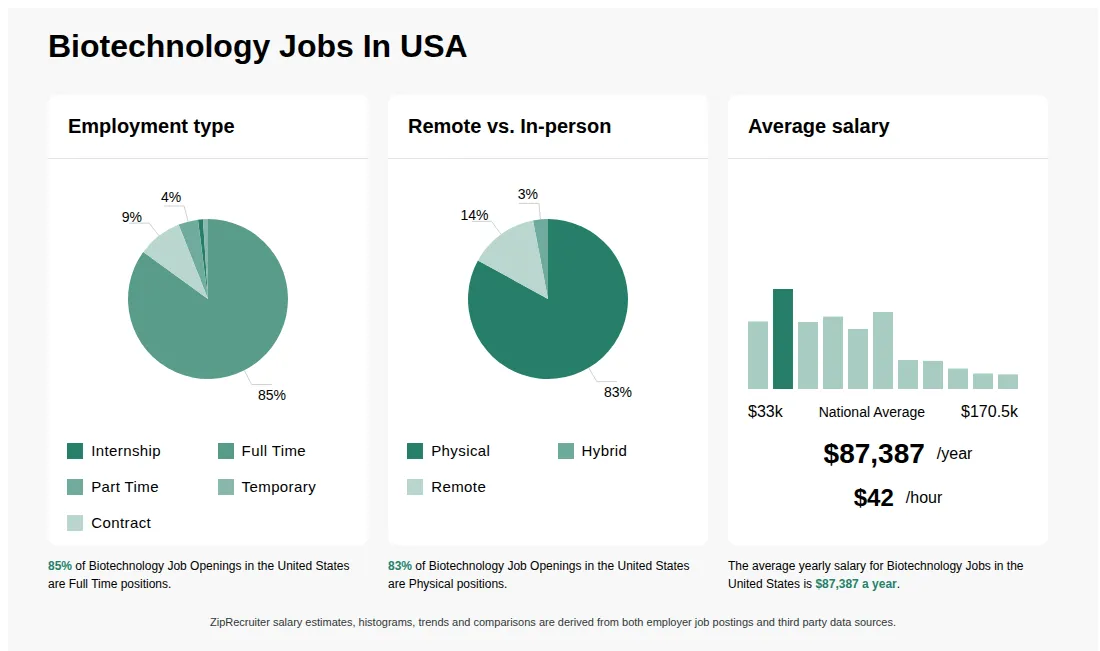
As of Sep 5, 2026, the average yearly pay for biotechnology in the United States is $87,387.00, according to ZipRecruiter salary data. Most workers in this role earn between $54,500.00 and $104,000.00 per year, depending on experience, location, and employer.
What is biotechnology?
Biotechnology is a field that combines biology, technology, and engineering to develop products and processes based on living organisms or their components. It plays a crucial role in areas such as medicine, agriculture, environmental management, and industrial production. Biotechnology professionals work on innovations like developing new pharmaceuticals, improving crop yields, and creating sustainable biofuels. The field is interdisciplinary, drawing from biology, chemistry, genetics, and computer science.
What are the qualifications to get a job in biotechnology?
The qualifications that you need to start working in biotechnology include a degree and demonstrable research and analysis skills. Most positions require a bachelor’s degree in biology or a related science subject like chemistry. Research positions may require a postgraduate degree, such as a master's or Ph.D. in biochemistry, biotechnology, or biophysics. Technical support employees and lab technicians may find employment with an associate or bachelor’s degree in biology or another science-related field.
What are the key skills and qualifications needed to thrive in biotechnology, and why are they important?
To thrive in Biotechnology, you need a solid background in biology, chemistry, and laboratory techniques, usually supported by a degree in biotechnology or a related field. Familiarity with tools such as PCR, spectrophotometers, CRISPR gene-editing systems, and data analysis software is highly valued, and certifications in laboratory safety or quality management can be advantageous. Strong analytical thinking, problem-solving skills, and effective teamwork set outstanding professionals apart in this field. These competencies are crucial for driving innovation, ensuring accurate research outcomes, and translating discoveries into real-world applications.
What are some common challenges faced by professionals working in biotechnology research and development teams?
Professionals in biotechnology R&D often encounter challenges such as keeping up with rapidly evolving technologies, navigating complex regulatory requirements, and managing interdisciplinary collaboration between scientists, engineers, and business teams. Balancing innovation with strict compliance standards can be demanding, and project timelines may shift due to unexpected experimental results. However, these challenges also foster a dynamic work environment that encourages continuous learning and problem-solving.
What is the difference between Biotechnology vs Biomedical Engineer?
| Aspect | Biotechnology | Biomedical Engineer |
|---|---|---|
| Required Credentials | Bachelor's or Master's in Biotechnology, Biology, or related fields | Bachelor's or Master's in Biomedical Engineering or related fields |
| Work Environment | Labs, research facilities, biotech companies | Hospitals, medical device companies, research labs |
| Industry Usage | Pharmaceuticals, agriculture, environmental biotech | Medical devices, healthcare, prosthetics |
Biotechnology and Biomedical Engineering share overlapping credentials and work environments, but biotechnology focuses on developing products like drugs and genetically modified organisms, while biomedical engineering emphasizes designing medical devices and equipment. Both careers are vital in healthcare and research sectors, often collaborating but with distinct specializations.
What can you do with a biotechnology degree?
A biotechnology degree prepares individuals for roles such as research scientist, lab technician, quality control analyst, or bioprocess engineer. Graduates can work in pharmaceuticals, healthcare, agriculture, or environmental sectors, often utilizing laboratory skills, data analysis, and knowledge of biological systems.
What jobs do you get in biotechnology?
Biotechnology offers a range of jobs including research scientist, bioprocess engineer, quality control analyst, laboratory technician, and regulatory affairs specialist. These roles often require knowledge of laboratory techniques, data analysis, and sometimes advanced degrees or certifications in biology, chemistry, or related fields.
More about Biotechnology jobs
What cities are hiring for Biotechnology jobs?
Cities with the most Biotechnology job openings:
What are the most commonly searched types of Biotechnology jobs?
The most popular types of Biotechnology jobs are:
What states have the most Biotechnology jobs?
States with the most job openings for Biotechnology jobs include:
What job categories do people searching Biotechnology jobs look for?
The top searched job categories for Biotechnology jobs are:
Part-time
Medical, Dental, Life, Retirement
Re-posted 26 days ago
Job description
Job Posting:
JR101446 Adjunct Faculty in Biotechnology (Open)Department:
BSU Natural Sciences, JMPosition Type:
Temporary (Fixed Term)Open Date:
12-12-2025Close Date:
$4,800 per course, subject to changeJob Description:
Responsibilities:
- Responsible for teaching undergraduate level coursework and the associated lab components in the field of Biotechnology. This introductory class will cover the definitions and scope of Biotechnology; principles and application of Biotechnology in medical, pharmaceutical, agricultural, industrial, and environmental fields; molecular biology and application of molecular techniques in various field; forensic applications of Biotechnology; future roles of Biotechnology in human welfare; biosafety and ethical issues in the study and applications of Biotechnology.
- Students will be introduced to nucleic acids and basic information provided on their extraction and manipulation through laboratory experiences.
- This is not an exhaustive list of all responsibilities, duties, and/or skills required for this position. The University reserves the right to amend and change responsibilities to meet organizational needs.
Minimum Qualifications:
- Master's degree or higher with at least 15 graduate credits in Biology, Applied Biology, or related fields, with specialization in Molecular Biology, Genetic Engineering, Biotechnology, or related field; Completion of 30 hours in an accredited doctoral program is acceptable.
- Teaching experience at the college level in area of concentration preferred. Describe the extent of teaching experience.
Preferred Qualifications:
- Not Currently Available
Conditions of Employment:
- Please include resume, cover letter, unofficial transcripts, letter of reference.
Additional Job Information:
Benefits include medical, dental, prescription, long-term disability, accidental death and dismemberment insurance and life insurance; supplemental retirement accounts.
Bowie State University shall not discriminate against any individual on the basis of race, color, religion, age, ancestry or national origin, sex, sexual orientation, disability, marital status or veteran status. All policies, programs, and activities of Bowie State University are and shall be in conformity with all pertinent Federal and state laws of nondiscrimination including, but not limited to: Title VII of the Civil Rights Act of 1964, as amended, Title IX of the Education Amendments of 1972, the Equal Pay Act of 1963, the Age Discrimination Act, Sections 503 and 504 of the Rehabilitation Act of 1973, the Americans with Disabilities Act of 1990, Federal Executive Order No. 11375, and Article 49B of the Annotated Code of Maryland. This commitment applies in all areas and embraces faculty, staff, and students.
Equal opportunity of access to academic and related programs shall be extended to all persons. Bowie State University shall have as its firm objective equal opportunity in recruitment and hiring, rate of pay, all other promotions, training, retention and dismissals, for all employees and applicants for employment. The University will stress equal access for employees and applicants for employment to all programs and services provided by the University both on and off campus. The University will also provide equal opportunity and an atmosphere of nondiscrimination with respect to women and members of minority groups in all its operations. In addition, the University shall promote equal opportunity and equal treatment through a positive and continuing Affirmative Action Program.
The University makes, and will continue to make, reasonable accommodations to promote the employment of qualified individuals with disabilities and disabled veterans, unless such accommodations would impose an undue hardship on the University's business.
In addition, employees and applicants will not be subjected to harassment, intimidation, threats, coercion, or discrimination because they have engaged in, or may have engaged in, activities such as filing a complaint, assisting or participating in an investigation, compliance review or hearing, or opposing any act or practice made unlawful, or exercising any other right protected by Section 503 of the Rehabilitation Act of 1973, as amended or the Vietnam Era Veterans Readjustment Assistance Act of 1974, as amended.