The School of Sciences offers a bachelor's degree in Biology with concentrations in Premedical Studies, Wildlife and Natural Resource Conservation, Evolution & Ecology, and Molecular Biology ...
The School of Sciences offers a bachelor's degree in Biology with concentrations in Premedical Studies, Wildlife and Natural Resource Conservation, Evolution & Ecology, and Molecular Biology ...
Assistant Professor of Biology
Monroe, LA · On-site
The School of Sciences offers a bachelor's degree in Biology with concentrations in Premedical Studies, Wildlife and Natural Resource Conservation, Evolution & Ecology, and Molecular Biology ...
Assistant Professor of Biology
Monroe, LA · On-site
The School of Sciences offers a bachelor's degree in Biology with concentrations in Premedical Studies, Wildlife and Natural Resource Conservation, Evolution & Ecology, and Molecular Biology ...
Assistant Professor of Biology
$55K - $64K/yr
Actively participate in recruitment and retention for the Biology degree program. Assist in all areas of program improvement, including participation in curriculum development, evaluation, and ...
Assistant Professor of Biology
$55K - $64K/yr
Actively participate in recruitment and retention for the Biology degree program. Assist in all areas of program improvement, including participation in curriculum development, evaluation, and ...
Assistant Professor of Biology
Monroe, LA · On-site
... degree program. • Assist in all areas of program improvement, including participation in curriculum development, evaluation, and assessment. • Pursue a program of scholarly research and ...
Assistant Professor of Biology
Monroe, LA · On-site
... degree program. • Assist in all areas of program improvement, including participation in curriculum development, evaluation, and assessment. • Pursue a program of scholarly research and ...

Master's degree in a medical field or closely related biology degree with at least 18 hours of Biology coursework in anatomy and physiology * Experience teaching college level biology courses ...
Master's degree in a medical field or closely related biology degree with at least 18 hours of Biology coursework in anatomy and physiology * Experience teaching college level biology courses ...
What does a Biology Professor do
Madison, WI · On-site
$80 - $100/hr
As such, he is typically qualified to teach not only individuals who are just beginning to pursue an undergraduate biology degree or complete course requirements for another major, but also those who ...
What does a Biology Professor do
Madison, WI · On-site
$80 - $100/hr
As such, he is typically qualified to teach not only individuals who are just beginning to pursue an undergraduate biology degree or complete course requirements for another major, but also those who ...

Assistant Professor of Biology
Lexington, KY · On-site
$60 - $80/hr
Our biology degree graduates actively engage these issues, both as researchers in the laboratory and as medical personnel on the front lines. Why Join Transylvania University? Founded in 1780 ...
Assistant Professor of Biology
Lexington, KY · On-site
$60 - $80/hr
Our biology degree graduates actively engage these issues, both as researchers in the laboratory and as medical personnel on the front lines. Why Join Transylvania University? Founded in 1780 ...

Qualifications include a PhD degree in a related field (e.g., computational biology, computer science, mathematics, statistics, biochemistry, computational biochemistry) and strong research ...
Qualifications include a PhD degree in a related field (e.g., computational biology, computer science, mathematics, statistics, biochemistry, computational biochemistry) and strong research ...
Our biology degree graduates actively engage these issues, both as researchers in the laboratory and as medical personnel on the front lines. Why Join Transylvania University? Founded in 1780 ...
Our biology degree graduates actively engage these issues, both as researchers in the laboratory and as medical personnel on the front lines. Why Join Transylvania University? Founded in 1780 ...

... degree students. The successful candidate will demonstrate expertise in both lecture and laboratory ... Doctorate in biology, anatomy and physiology, or biology-related field preferred; master's degree ...
... degree students. The successful candidate will demonstrate expertise in both lecture and laboratory ... Doctorate in biology, anatomy and physiology, or biology-related field preferred; master's degree ...

Faculty 9 month Biology
Nelsonville, OH · On-site
Faculty 9 month Biology Salary: Commensurate with Experience I. Position Purpose Under the guidance ... Degree must be from a regionally or nationally accredited institution recognized by the U.S.
Faculty 9 month Biology
Nelsonville, OH · On-site
Faculty 9 month Biology Salary: Commensurate with Experience I. Position Purpose Under the guidance ... Degree must be from a regionally or nationally accredited institution recognized by the U.S.

Master's Degree from an accredited institution in any biological science with preference in Biomedical Sciences, Microbiology, Immunology, Cell or Molecular Biology, Genetics, Histology, or ...
Master's Degree from an accredited institution in any biological science with preference in Biomedical Sciences, Microbiology, Immunology, Cell or Molecular Biology, Genetics, Histology, or ...
Our biology degree graduates actively engage these issues, both as researchers in the laboratory and as medical personnel on the front lines. Why Join Transylvania University? Founded in 1780 ...
Our biology degree graduates actively engage these issues, both as researchers in the laboratory and as medical personnel on the front lines. Why Join Transylvania University? Founded in 1780 ...
Faculty 9 month Biology
Nelsonville, OH · On-site
Faculty 9 month Biology Salary: Commensurate with Experience I. Position Purpose Under the guidance ... Degree must be from a regionally or nationally accredited institution recognized by the U.S.
Faculty 9 month Biology
Nelsonville, OH · On-site
Faculty 9 month Biology Salary: Commensurate with Experience I. Position Purpose Under the guidance ... Degree must be from a regionally or nationally accredited institution recognized by the U.S.

Teaching undergraduate lectures and labs in General Biology and/or other courses such as Ecology and Environmental Science, in support of the Applied Biology and Forensic Biology degree programs.
Teaching undergraduate lectures and labs in General Biology and/or other courses such as Ecology and Environmental Science, in support of the Applied Biology and Forensic Biology degree programs.
... degree students. The successful candidate will demonstrate expertise in both lecture and laboratory ... Doctorate in biology, anatomy and physiology, or biology-related field preferred; master's degree ...
... degree students. The successful candidate will demonstrate expertise in both lecture and laboratory ... Doctorate in biology, anatomy and physiology, or biology-related field preferred; master's degree ...
Teaching undergraduate lectures and labs in General Biology and/or other courses such as Ecology and Environmental Science, in support of the Applied Biology and Forensic Biology degree programs.
Teaching undergraduate lectures and labs in General Biology and/or other courses such as Ecology and Environmental Science, in support of the Applied Biology and Forensic Biology degree programs.

Bachelor's degree in a Life Science or related field with strong attention to detail, excellent communication skills, ability to prioritize and multitask effectively, and experience with Excel and ...
Bachelor's degree in a Life Science or related field with strong attention to detail, excellent communication skills, ability to prioritize and multitask effectively, and experience with Excel and ...
Bachelor's degree in a Life Science or related field with strong attention to detail, excellent communication skills, ability to prioritize and multitask effectively, and experience with Excel and ...
Bachelor's degree in a Life Science or related field with strong attention to detail, excellent communication skills, ability to prioritize and multitask effectively, and experience with Excel and ...

Master's degree in Biology, Biological Sciences, or a deeply related discipline from an accredited institution. * OR A Master's degree in a different discipline with a minimum of 18 graduate credit ...
Master's degree in Biology, Biological Sciences, or a deeply related discipline from an accredited institution. * OR A Master's degree in a different discipline with a minimum of 18 graduate credit ...
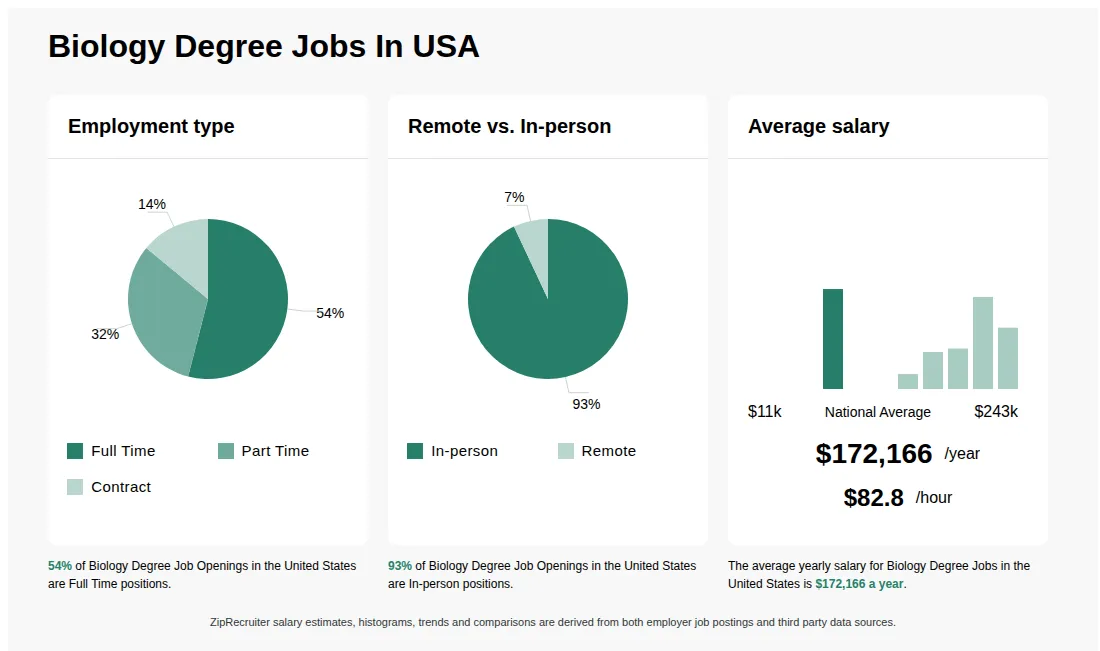
Biology Degree information
See salary details
$11K - $32.1K
0% of jobs
$32.1K - $53.2K
0% of jobs
$53.2K - $74.3K
0% of jobs
$92.4K is the 25th percentile. Wages below this are outliers.
$74.3K - $95.4K
29% of jobs
$95.4K - $116.5K
0% of jobs
$116.5K - $137.5K
0% of jobs
$137.5K - $158.6K
4% of jobs
$158.6K - $179.7K
10% of jobs
The median wage is $191.2K / yr.
$179.7K - $200.8K
11% of jobs
$216.2K is the 75th percentile. Wages above this are outliers.
$200.8K - $221.9K
27% of jobs
$221.9K - $243K
18% of jobs
$11K
$172.2K
$243K
How much do biology degree jobs pay per year?
As of Sep 8, 2026, the average yearly pay for biology degree in the United States is $172,166.00, according to ZipRecruiter salary data. Most workers in this role earn between $82,000.00 and $219,500.00 per year, depending on experience, location, and employer.
What can you do with a biology degree?
A biology degree opens up a wide range of career opportunities in fields such as healthcare, research, education, biotechnology, and environmental science. Graduates can work as laboratory technicians, research scientists, healthcare professionals, or educators, among other roles. Many also pursue further education in medicine, dentistry, veterinary science, or graduate studies in specialized areas of biology. The skills gained from a biology degree, such as analytical thinking, laboratory techniques, and data analysis, are valuable in both scientific and non-scientific careers.
What are the key skills and qualifications needed to thrive with a biology degree, and why are they important?
A Biology degree requires solid knowledge of biological concepts, laboratory techniques, and data analysis, typically supported by a bachelor's degree in biology or a related field. Familiarity with lab equipment, statistical software like SPSS or R, and sometimes certifications in laboratory safety are valuable technical assets. Strong analytical thinking, attention to detail, and effective communication are important soft skills for collaborating on research and presenting findings. These skills and qualifications are crucial for conducting accurate research, interpreting scientific data, and succeeding in diverse biology-related careers.
What types of entry-level roles are commonly available to recent graduates with a biology degree, and how can one stand out in the hiring process?
Recent biology graduates often find entry-level opportunities in research labs, environmental agencies, healthcare organizations, or biotech companies. Common roles include laboratory technician, research assistant, quality control analyst, and environmental consultant. To stand out, it's beneficial to showcase hands-on experience from internships, research projects, or relevant coursework. Highlighting skills such as data analysis, scientific communication, and proficiency with lab equipment can also make your application more competitive. Networking with professionals in your field and tailoring your resume to each specific job are also effective strategies.
What is the difference between Biology Degree vs Biological Technician?
| Aspect | Biology Degree | Biological Technician |
|---|---|---|
| Required Credentials | Bachelor's degree in biology or related field | Associate's or bachelor's degree in biology or related field |
| Work Environment | Research labs, educational institutions, healthcare | Laboratories, research facilities, field sites |
| Employer & Industry Usage | Universities, research institutes, biotech companies | Research labs, government agencies, biotech firms |
In summary, a Biology Degree provides a broad educational foundation suitable for various roles, including research, education, and healthcare. A Biological Technician typically has more specialized training for supporting laboratory research and experiments. Both roles often work in similar environments, but the degree offers more versatility and advancement opportunities.
More about Biology Degree jobs
What cities are hiring for Biology Degree jobs?
Cities with the most Biology Degree job openings:
What are the most commonly searched types of Biology Degree jobs?
The most popular types of Biology Degree jobs are:
What states have the most Biology Degree jobs?
States with the most job openings for Biology Degree jobs include:
What job categories do people searching Biology Degree jobs look for?
The top searched job categories for Biology Degree jobs are:

$58K/yr
Full-time
Re-posted 18 hours ago
Job description
Job Summary The Biology Program within the School of Sciences at the University of Louisiana at Monroe (ULM) is seeking an Assistant Professor of Biology for Fall 2025 or Spring 2026. The School of Sciences offers a bachelor's degree in Biology with concentrations in Premedical Studies, Wildlife and Natural Resource Conservation, Evolution & Ecology, and Molecular Biology & Biotechnology. The School of Sciences also offers a master's degree in Biology.
Duties and Responsibilities Teach undergraduate and graduate courses during the fall and spring semesters. Mentor graduate students and graduate student research projects. Pursue a program of scholarly research and publication.
Advise students and maintain records of student progress. Actively participate in recruitment and retention for the Biology degree program. Perform other job-related duties as assigned.
Minimum Qualifications Candidates must be passionate about teaching and mentoring students. Candidates should have a doctoral degree in biology. ABD candidates in late stages of dissertation will also be considered.
Qualifications include: Innovative pedagogical approaches to teaching undergraduates from diverse backgrounds Coursework and/or experience in Biology Ability to teach a diverse set of undergraduate or graduate level molecular biology classes including genetics Effective oral and written communication skills A research agenda or demonstration of scholarly activity Supplemental Information N/A

About University of Louisiana at Monroe
Sourced by ZipRecruiter
Industry
Education
Company size
201 - 500 Employees
Headquarters location
Monroe, LA, US
Year founded
1931