1

Audio Music Production Jobs (NOW HIRING)

Music Teacher

Broomfield, CO · On-site

$21.50 - $27/hr

In addition to music lessons and performance band coaching, Riff Music School also teaches songwriting, audio engineering, music production, and band management. * Inspire students by teaching ...

In addition to music lessons and performance band coaching, Riff Music School also teaches songwriting, audio engineering, music production, and band management. * Inspire students by teaching ...

Music Teacher

Westminster, CO · On-site

$21.50 - $27/hr

In addition to music lessons and performance band coaching, Riff Music School also teaches songwriting, audio engineering, music production, and band management. * Inspire students by teaching ...

Showing results 21-40

Audio Music Production information

See salary details

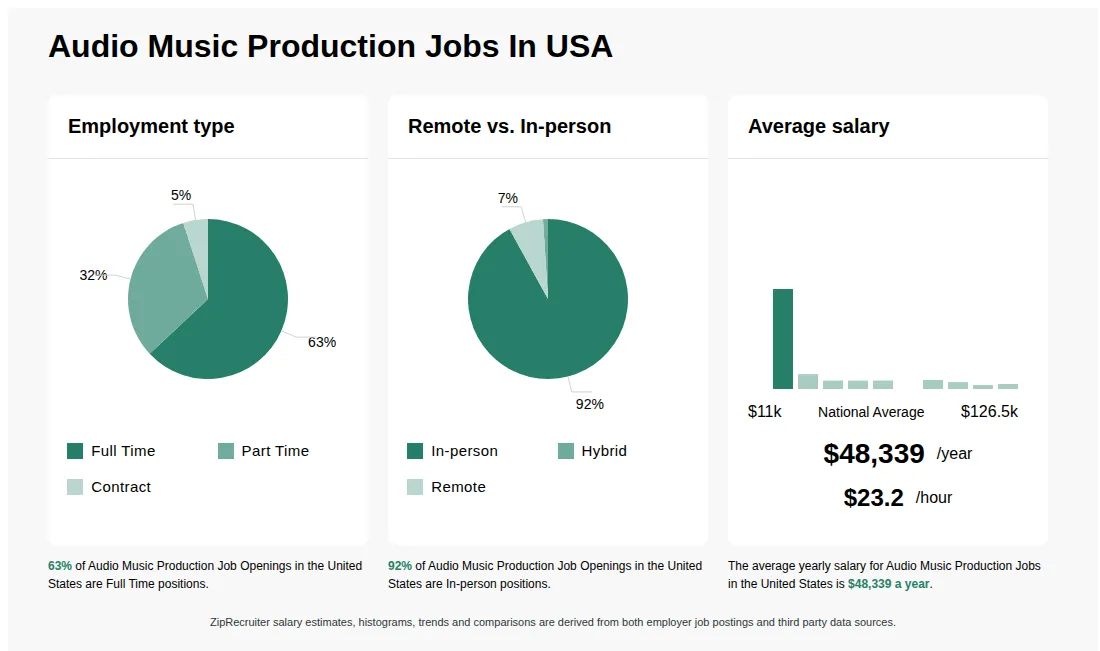
$11K

$48.3K

$126.5K

How much do audio music production jobs pay per year?

As of Aug 6, 2026, the average yearly pay for audio music production in the United States is $48,339.00, according to ZipRecruiter salary data. Most workers in this role earn between $26,500.00 and $61,000.00 per year, depending on experience, location, and employer.

What are some of the main challenges faced by professionals in audio music production, and how can they be overcome?

One of the main challenges in audio music production is managing tight deadlines while maintaining high-quality sound. Producers often juggle multiple projects and must adapt quickly to changing client or artist feedback. Collaboration is key, as producers frequently work with artists, engineers, and other creative professionals, requiring strong communication and teamwork skills. Staying updated with evolving technology and software is also essential for success in the field. Building a solid workflow and continuously learning new tools can help overcome these challenges.

What is the difference between Audio Music Production vs Audio Engineering?

AspectAudio Music ProductionAudio Engineering
Primary FocusCreating, composing, and arranging music tracksRecording, mixing, and mastering audio
Skills & CertificationsMusic theory, production software, creativitySound engineering, technical skills, certifications like Avid Pro Tools
Work EnvironmentStudios, production houses, home studiosRecording studios, live venues, broadcast facilities
Industry UsageMusic labels, artists, production companiesRecording studios, broadcasting, live sound

While both roles involve working with audio, Audio Music Production focuses on creating and arranging music, whereas Audio Engineering emphasizes technical aspects like recording and mixing. Professionals often collaborate, but their core responsibilities differ based on the production stage.

How much do audio music producers make?

Audio music producers' salaries vary widely based on experience, location, and project scope. Entry-level producers may earn around $30,000 to $50,000 annually, while experienced professionals can make $70,000 or more, especially if they work on high-profile projects or own their own studios. Many producers supplement income through freelance work, royalties, or licensing deals.

What is audio music production?

Audio music production is the process of creating, recording, editing, mixing, and mastering music using various equipment and software tools. It involves everything from capturing live performances or digital instruments to shaping and refining the sound to achieve the desired artistic vision. Producers work closely with artists, engineers, and other professionals to bring together all elements of a track or album. The field blends creativity with technical skills and often requires knowledge of music theory, sound engineering, and digital audio workstations.

What are the key skills and qualifications needed to thrive as an audio music producer?

To thrive as an Audio Music Producer, you need a solid understanding of music theory, audio engineering, and sound design, often supported by relevant education or experience. Mastery of digital audio workstations (DAWs) such as Ableton Live, Logic Pro, or Pro Tools, along with knowledge of mixing and mastering techniques, is essential. Creativity, attention to detail, and strong collaborative skills help producers bring out the best in artists and projects. These abilities are crucial for creating high-quality tracks, ensuring professional standards, and succeeding in a competitive industry.

What jobs can I get with an audio music production degree?

With an audio music production degree, you can pursue roles such as music producer, sound engineer, recording engineer, mixing engineer, or audio technician. These jobs typically require skills in digital audio workstations (DAWs), sound editing, and acoustics, often involving work in recording studios, broadcast environments, or live events.
More about Audio Music Production jobs
What cities are hiring for Audio Music Production jobs? Cities with the most Audio Music Production job openings:
What states have the most Audio Music Production jobs? States with the most job openings for Audio Music Production jobs include:
Infographic showing various Audio Music Production job openings in the United States as of July 2026, with employment types broken down into 76% Full Time, 21% Part Time, 1% Temporary, and 2% Contract. Highlights an 89% Physical, 1% Hybrid, and 10% Remote job distribution, with an average salary of $48,339 per year, or $23.2 per hour.

Digital Music Production Teaching Opportunities

Concorde Education

Sierra Madre, CA • On-site

$50/hr

Contractor

Posted 27 days ago


Job description

Location: On-site at partner schools; varies by assignment

Teaching Mode: In Person

Grade Levels: Elementary, Middle, and High School; varies by assignment

Schedule: Typically 1–4 instructional service hours per week after school

Program Length: Commonly approximately 10 weeks per assignment

Start Dates: Opportunities become available throughout the school year

Compensation: Typical compensation of $50+ per completed instructional service hour, depending on assignment scope, experience, location, schedule, and agreed compensation

ABOUT THE OPPORTUNITY

Concorde Education is seeking independent instructional contractors to provide digital music production enrichment services for K–12 students.

This is a potential independent contractor assignment, not an employee position. Contractors may choose whether to apply for, accept, decline, or ignore available opportunities.

Assignments vary by school, grade level, schedule, available technology, software platforms, curriculum, student experience levels, and program objectives.

Concorde may provide curriculum guidance, lesson-plan suggestions, instructional resources, project ideas, or program objectives. Contractors may use their professional judgment to adapt instruction within the assignment scope and applicable site requirements.

ASSIGNMENT SCOPE

Depending on the accepted assignment, contractors may:

• Plan and facilitate engaging, age-appropriate digital music production sessions;

• Introduce students to beat-making, digital recording, music composition, and audio production through project-based learning;

• Adapt instruction based on student experience levels, available technology, software platforms, site requirements, and assignment objectives;

• Guide students in creating original beats, songs, podcasts, soundtracks, remixes, or other digital audio projects, where applicable;

• Introduce students to digital audio workstations (DAWs) such as BandLab, Soundtrap, GarageBand, or similar platforms;

• Support students in recording, editing, arranging, mixing, and exporting audio projects appropriate to the assignment;

• Maintain a safe, respectful, inclusive, and age-appropriate learning environment;

• Exercise professional judgment when adapting instruction based on available equipment, student ability, technology limitations, school policies, copyright considerations, and assignment requirements;

• Communicate assignment-related needs or significant concerns with Concorde and school staff, as appropriate;

• Complete a brief session completion form after each scheduled session; and

• Follow applicable site safety, visitor, technology, internet-use, emergency, and student-protection procedures.

EXAMPLE PROGRAM TOPICS

Assignments may include topics such as:

• Beat-making and rhythm fundamentals;

• Looping, sampling, and layering sounds using approved resources;

• Melody, harmony, chord progressions, and song structure;

• Recording vocals or instruments where equipment and assignment scope permit;

• Audio editing, arranging, and sequencing;

• Basic mixing concepts, including levels, balance, panning, and effects;

• Exporting, sharing, and presenting completed music projects; and

• Creativity, collaboration, digital citizenship, and responsible use of music technology.

Specific software platforms, recording equipment, curriculum, and project requirements vary by assignment.

QUALIFICATIONS

Preferred qualifications include:

• At least 60 college credits, where required by the applicable assignment or site;

• Experience using BandLab, Soundtrap, GarageBand, Ableton Live, FL Studio, Logic Pro, Pro Tools, or similar digital audio software;

• Experience teaching, tutoring, coaching, mentoring, or leading activities with school-age students;

• Strong communication, organization, classroom facilitation, and technology troubleshooting skills;

• Availability to provide services for the accepted assignment schedule and communicate schedule issues as soon as reasonably practicable; and

• Familiarity with Chromebooks, laptops, web-based applications, audio equipment, headphones, microphones, MIDI controllers, or related music-production technology.

Preferred backgrounds may include musicians, producers, audio engineers, DJs, composers, teaching artists, music technology students, recording professionals, music educators, and others with relevant instructional or creative experience.

MATERIALS AND RESOURCES

Assignments may utilize school-provided computers, Chromebooks, headphones, microphones, MIDI devices, digital audio workstations, curriculum resources, lesson plans, project guidelines, and other instructional technology where available.

Contractors may use their own instructional methods and materials when appropriate, safe, age-appropriate, lawful, properly licensed, and consistent with the assignment scope and site requirements.

Contractors are responsible for ensuring that any music, samples, loops, software, or instructional materials they introduce are appropriately licensed or otherwise authorized for educational use and comply with applicable copyright laws, platform terms of use, and school policies.

Purchases requiring reimbursement must be approved in writing by Concorde before they are incurred.

COMPENSATION

Compensation varies by assignment and agreed contractor terms. Many opportunities pay $50+ per completed instructional service hour with students.

Contractors may propose their desired compensation rate when applying. When proposing a rate, contractors should consider the overall assignment scope, including anticipated preparation, planning, commute, materials, schedule, and other business considerations.

Concorde may accept the proposed rate, decline the application, or provide a counteroffer based on the budget for the specific assignment.

Unless otherwise approved in writing, compensation is based on completed instructional service hours with students.

Payment for completed services is generally made by direct deposit on the fifteenth day of the month following the month in which services were completed, unless otherwise stated in the accepted assignment terms or required by applicable law.

APPLICATION AND ONBOARDING

Applicants selected to move forward may be invited to create a contractor profile and complete any required onboarding steps.

Applying, interviewing, receiving an invitation to create a profile, creating a profile, or completing onboarding does not guarantee selection, placement, or future assignment opportunities.

Potential assignments are subject to assignment fit, agreed compensation, completion of required onboarding, applicable background-check review, Fair Chance or pre-adverse action procedures where required, site-specific clearance requirements, and final written confirmation from Concorde Education.

Some assignments may require background-check authorization, fingerprinting, agency clearance, site-specific documentation, identification badges, or other compliance steps before services may begin.

Applicants should not provide criminal-history information unless and until requested through the appropriate legally compliant process.

EQUAL OPPORTUNITY

Concorde Education considers contractor applicants without regard to any status protected by applicable federal, state, or local law and is committed to respectful, inclusive, and student-centered programming.