$123 - $154/hr
National Radio Astronomy Observatory Title: Software Engineer Group Lead, Common Domain Software Location: 800 Bradbury Dr SE, Albuquerque, NM 87106, USA, 155 Observatory Rd, Green Bank, WV 24944 ...
$123 - $154/hr
National Radio Astronomy Observatory Title: Software Engineer Group Lead, Common Domain Software Location: 800 Bradbury Dr SE, Albuquerque, NM 87106, USA, 155 Observatory Rd, Green Bank, WV 24944 ...
$123 - $154/hr
National Radio Astronomy Observatory Title: Software Engineer Group Lead, Common Domain Software Location: 800 Bradbury Dr SE, Albuquerque, NM 87106, USA, 155 Observatory Rd, Green Bank, WV 24944 ...
Albuquerque, NM · On-site
$85K - $138K/yr
Position Summary The National Radio Astronomy Observatory (NRAO) is a prestigious research and development organization that plays a vital role in the study of the universe. Associated Universities ...
Albuquerque, NM · On-site
$85K - $138K/yr
Position Summary The National Radio Astronomy Observatory (NRAO) is a prestigious research and development organization that plays a vital role in the study of the universe. Associated Universities ...
Albuquerque, NM · On-site +1
$79K - $120K/yr
Position Summary The National Radio Astronomy Observatory (NRAO) is a prestigious research and development organization that plays a vital role in the study of the universe. Associated Universities ...
Albuquerque, NM · On-site +1
$79K - $120K/yr
Position Summary The National Radio Astronomy Observatory (NRAO) is a prestigious research and development organization that plays a vital role in the study of the universe. Associated Universities ...
Charlottesville, VA · On-site +1
$251K/yr
Position Summary The National Radio Astronomy Observatory (NRAO) is a prestigious research and development organization that plays a vital role in the study of the universe. Associated Universities ...
Charlottesville, VA · On-site +1
$251K/yr
Position Summary The National Radio Astronomy Observatory (NRAO) is a prestigious research and development organization that plays a vital role in the study of the universe. Associated Universities ...
Charlottesville, VA · On-site +1
$251K/yr
Position Summary The National Radio Astronomy Observatory (NRAO) is a prestigious research and development organization that plays a vital role in the study of the universe. Associated Universities ...
Charlottesville, VA · On-site +1
$251K/yr
Position Summary The National Radio Astronomy Observatory (NRAO) is a prestigious research and development organization that plays a vital role in the study of the universe. Associated Universities ...
McDonald Observatory ---- Position Open To: All Applicants ---- Weekly Scheduled Hours: 40 ... This position reports to the Chief Astronomer. Responsibilities * Designs and develops scientific ...
McDonald Observatory ---- Position Open To: All Applicants ---- Weekly Scheduled Hours: 40 ... This position reports to the Chief Astronomer. Responsibilities * Designs and develops scientific ...
Albuquerque, NM · On-site
$75K/yr
Position Description The NSF National Radio Astronomy Observatory (NRAO) invites applications for the 2027 Jansky Fellowship Program. The Jansky Fellowships support outstanding early career ...
Albuquerque, NM · On-site
$75K/yr
Position Description The NSF National Radio Astronomy Observatory (NRAO) invites applications for the 2027 Jansky Fellowship Program. The Jansky Fellowships support outstanding early career ...
$114K - $138K/yr
Position Summary The National Radio Astronomy Observatory (NRAO) is a prestigious research and development organization that plays a vital role in the study of the universe. Associated Universities ...
$114K - $138K/yr
Position Summary The National Radio Astronomy Observatory (NRAO) is a prestigious research and development organization that plays a vital role in the study of the universe. Associated Universities ...
Green Bank, WV · On-site +1
$79K - $120K/yr
Position Summary The National Radio Astronomy Observatory (NRAO) is a prestigious research and development organization that plays a vital role in the study of the universe. Associated Universities ...
Green Bank, WV · On-site +1
$79K - $120K/yr
Position Summary The National Radio Astronomy Observatory (NRAO) is a prestigious research and development organization that plays a vital role in the study of the universe. Associated Universities ...
Charlottesville, VA · On-site
$114K - $138K/yr
Position Summary The National Radio Astronomy Observatory (NRAO) is a prestigious research and development organization that plays a vital role in the study of the universe. Associated Universities ...
Charlottesville, VA · On-site
$114K - $138K/yr
Position Summary The National Radio Astronomy Observatory (NRAO) is a prestigious research and development organization that plays a vital role in the study of the universe. Associated Universities ...
Charlottesville, VA · On-site
$114K - $138K/yr
Position Summary The National Radio Astronomy Observatory (NRAO) is a prestigious research and development organization that plays a vital role in the study of the universe. Associated Universities ...
Charlottesville, VA · On-site
$114K - $138K/yr
Position Summary The National Radio Astronomy Observatory (NRAO) is a prestigious research and development organization that plays a vital role in the study of the universe. Associated Universities ...
Albuquerque, NM · On-site
$86K - $121K/yr
Position Summary The National Radio Astronomy Observatory (NRAO) is a prestigious research and development organization that plays a vital role in the study of the universe. Associated Universities ...
Albuquerque, NM · On-site
$86K - $121K/yr
Position Summary The National Radio Astronomy Observatory (NRAO) is a prestigious research and development organization that plays a vital role in the study of the universe. Associated Universities ...
Charlottesville, VA · On-site
$90K - $138K/yr
The National Radio Astronomy Observatory (NRAO) is a prestigious research and development organization that plays a vital role in the study of the universe. Associated Universities, Inc. (AUI) is a ...
Charlottesville, VA · On-site
$90K - $138K/yr
The National Radio Astronomy Observatory (NRAO) is a prestigious research and development organization that plays a vital role in the study of the universe. Associated Universities, Inc. (AUI) is a ...
Charlottesville, VA · On-site
$90K - $138K/yr
The National Radio Astronomy Observatory (NRAO) is a prestigious research and development organization that plays a vital role in the study of the universe. Associated Universities, Inc. (AUI) is a ...
Charlottesville, VA · On-site
$90K - $138K/yr
The National Radio Astronomy Observatory (NRAO) is a prestigious research and development organization that plays a vital role in the study of the universe. Associated Universities, Inc. (AUI) is a ...
Charlottesville, VA · On-site
$90K - $138K/yr
The National Radio Astronomy Observatory (NRAO) is a prestigious research and development organization that plays a vital role in the study of the universe. Associated Universities, Inc. (AUI) is a ...
Charlottesville, VA · On-site
$90K - $138K/yr
The National Radio Astronomy Observatory (NRAO) is a prestigious research and development organization that plays a vital role in the study of the universe. Associated Universities, Inc. (AUI) is a ...
Albuquerque, NM · On-site
$86K - $121K/yr
Position Summary The National Radio Astronomy Observatory (NRAO) is a prestigious research and development organization that plays a vital role in the study of the universe. Associated Universities ...
Albuquerque, NM · On-site
$86K - $121K/yr
Position Summary The National Radio Astronomy Observatory (NRAO) is a prestigious research and development organization that plays a vital role in the study of the universe. Associated Universities ...
Socorro, NM · On-site
$76K - $106K/yr
Position Summary The National Radio Astronomy Observatory (NRAO) is a prestigious research and development organization that plays a vital role in the study of the universe. Associated Universities ...
Socorro, NM · On-site
$76K - $106K/yr
Position Summary The National Radio Astronomy Observatory (NRAO) is a prestigious research and development organization that plays a vital role in the study of the universe. Associated Universities ...
Charlottesville, VA · On-site
$85 - $138/hr
SCI Position Description The National Radio Astronomy Observatory (NRAO) is an exciting and prestigious research and development organization that plays a vital role in the study of the universe.
Charlottesville, VA · On-site
$85 - $138/hr
SCI Position Description The National Radio Astronomy Observatory (NRAO) is an exciting and prestigious research and development organization that plays a vital role in the study of the universe.
Tucson, AZ · On-site
$15.75 - $17.75/hr
The Observatory features a sophisticated suite of instruments for optical and infrared imaging and ... Bachelor's degree in Astronomy, Astrophysics, Optics, Physics, Engineering, or a related field, or ...
Tucson, AZ · On-site
$15.75 - $17.75/hr
The Observatory features a sophisticated suite of instruments for optical and infrared imaging and ... Bachelor's degree in Astronomy, Astrophysics, Optics, Physics, Engineering, or a related field, or ...
Green Bank, WV · On-site +1
Position Summary The National Radio Astronomy Observatory (NRAO) is a prestigious research and development organization that plays a vital role in the study of the universe. Associated Universities ...
Green Bank, WV · On-site +1
Position Summary The National Radio Astronomy Observatory (NRAO) is a prestigious research and development organization that plays a vital role in the study of the universe. Associated Universities ...
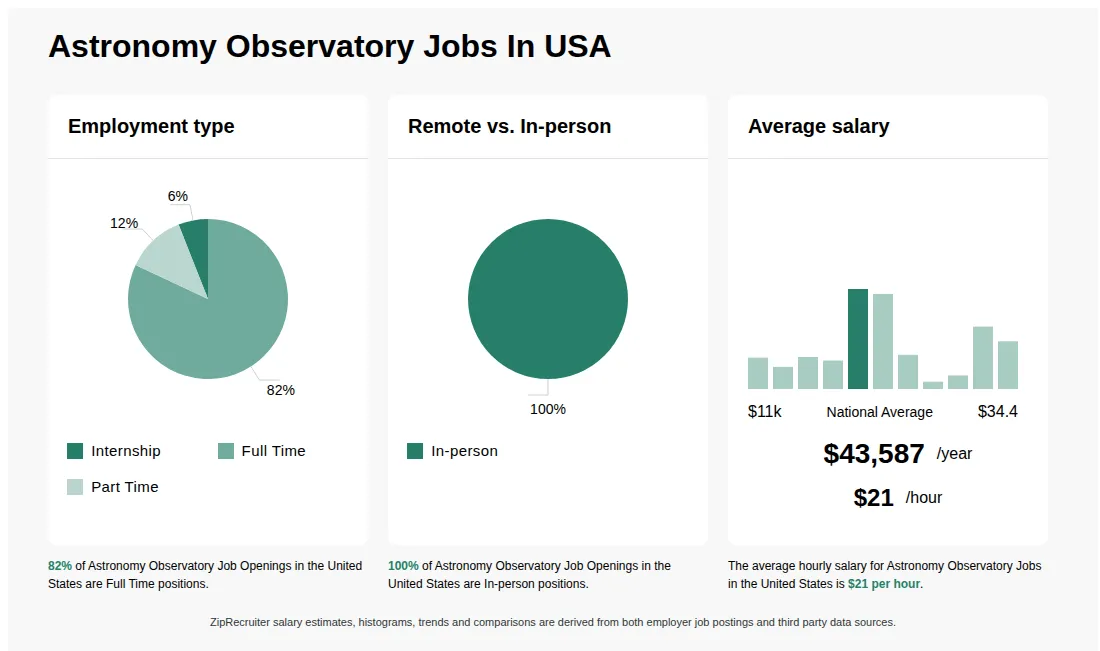
$5.29 - $7.93
6% of jobs
$7.93 - $10.58
4% of jobs
$10.58 - $13.22
6% of jobs
$13.22 - $15.87
6% of jobs
$16.12 is the 25th percentile. Wages below this are outliers.
$15.87 - $18.51
22% of jobs
The median wage is $19.17 / hr.
$18.51 - $21.15
21% of jobs
$21.15 - $23.80
7% of jobs
$23.80 - $26.44
1% of jobs
$27.76 is the 75th percentile. Wages above this are outliers.
$26.44 - $29.09
2% of jobs
$29.09 - $31.73
14% of jobs
$31.73 - $34.38
10% of jobs
$5
$20
$34
| Aspect | Astronomy Observatory | Astronomer |
|---|---|---|
| Credentials | Typically requires a degree in astronomy, physics, or related field; may involve technical certifications for equipment | Requires advanced degrees (Master's or Ph.D.) in astronomy or astrophysics |
| Work Environment | Facilities such as telescopes, research labs, and public outreach spaces | Research institutions, universities, observatories, or field sites |
| Employer & Industry Usage | Research institutions, universities, government agencies, planetariums | Academic, research, government agencies, space agencies |
While an astronomy observatory is a facility used for astronomical research and public education, an astronomer is a professional scientist who conducts research, analyzes data, and publishes findings in the field of astronomy. The observatory provides the tools and environment for astronomers to perform their work.
Cities with the most Astronomy Observatory job openings:
States with the most job openings for Astronomy Observatory jobs include:
The top searched job categories for Astronomy Observatory jobs are:
On-site
$123 - $154/hr
Other
Medical, Dental, Vision, PTO
Posted 11 days ago
National Radio Astronomy Observatory
Title: Software Engineer Group Lead, Common Domain Software
Location: 800 Bradbury Dr SE, Albuquerque, NM 87106, USA, 155 Observatory Rd, Green Bank, WV 24944, USA, 1011 Lopezville Rd, Socorro, NM 87801, USA, NRAO Headquarters, 520 Edgemont Rd, CHARLOTTESVILLE, Virginia, United States of America
Requisition Number: 221
Job Family: Software Engineer
Pay Type: Salary
Required Education: ENG
Position DescriptionPosition SummaryAt NRAO, we are recruiting a full-time Software Engineering Group Lead to provide technical leadership, planning, and management for software products and shared software infrastructure that support radio astronomy data acquisition, data movement, processing, and analysis. The group, known as the Common Domain Software Group, will be responsible for developing and maintaining reusable software capabilities, common services, integration patterns, and infrastructure components that can be applied across multiple NRAO systems and projects.
The Software Engineering Group Lead will guide short- and long-term planning, coordinate development activities, and help establish engineering practices that improve interoperability, reliability, maintainability, and operational effectiveness. The role includes leading work related to shared software models, system integration, messaging and communication mechanisms, data transport, workflow support, data repositories, service interfaces, deployment approaches, and other software infrastructure needed to support distributed scientific computing environments.
The Common Domain Software Group is also responsible for frontline support of existing telescope operations and for the timely and appropriate resolution of real time issues that impede scientific operations at all NRAO sites. In support of operational responsibilities, this group will work to enhance diagnostic and monitoring tools and report on key performance indicators (KPIs) to maintain operational performance. The combination of operations and common software under a single Common Domain Software Group Lead allows for the development of foundational software that is efficient and reliable in operations.
This position requires close collaboration with scientists, software engineers, systems engineers, operations staff, and project stakeholders to ensure that common software infrastructure is aligned with current operational needs and future observatory capabilities. The group will help identify opportunities to standardize reusable components, reduce duplication, improve system consistency, and support the evolution of NRAO software systems over time.
This position can be based at any of our NRAO locations, including Albuquerque, NM, Socorro, NM, Charlottesville, VA, or Green Bank, WV. For well-qualified candidates, a remote work arrangement may be considered.
What you will be doingAs the Common Domain Software Engineer Group Lead, you will be responsible for the overall personnel and technical management of software teams responsible for 1) standardized data repositories, 2) system communications, 3) data transport, and 4) frontline 24x7 operational support and integration. You will also be responsible for regular reporting on management status and compliance with deadlines to senior management at NRAO and other participating organizations, and you may be asked to present that status to other stakeholders or advisory bodies in formal or informal reviews.
Personnel management involves building and maintaining a culture of trust, mutual collaboration, accountability, and excellence within the Common Domain Software group and with its stakeholders. This includes:
Programmatic management involves oversight of all aspects of the lifecycle of software for which the group is responsible, including:
Technical management involves interacting directly with all group members:
Work is typically performed in a research and development office environment. Occasional travel (domestic and international) may be required.
Who You AreEducationAs a Software Engineer Group Lead, you are expected to have demonstrated experience leading software development groups, preferably within the domain of astronomy. To be successful, you shall also have experience leading a distributed team of developers and be familiar with management, planning, and reporting aspects. You should be prepared to deal with already ongoing activities, while also having the ability to formulate a long-term direction. You should have experience balancing the maintenance, improvement, and enhancement of operational software. Planning skills and appropriate management of a team of expert developers and scientists are essential. Competency and experience dealing with the development process from requirements gathering, to development, testing and the formalism needed to achieve an orderly process is also expected. You must be able to build strong and productive relationships with stakeholders who have complex and sometimes conflicting requirements, such as scientists, development partners, and operations organizations. Strong decision-making, consensus building, and communication skills are essential.
Additional RequirementObservatory employees must be authorized to work in the United States.
Total RewardsCompensationThe starting salary rate of this position is between $123,000-$154,000 per year. Factors which may affect starting pay within this range may include; education, experience, skills, competencies, other qualifications of the successful candidate, as well as internal equity and labor market conditions.
BenefitsAUI is an equal opportunity employer. To view our complete statement, please visit https://public.nrao.edu/careers/. If you require reasonable accommodation for any part of the application or hiring process, you may submit your request by sending an email to resumes@nrao.edu. PM20
Compensation details: 123000-154000 Yearly Salary


