1

Asset Engineer Jobs (NOW HIRING)

Asset Reliability Engineer

Houston, TX · On-site

$110 - $140/hr

Job SummaryThe Asset Reliability Engineer supports the reliability, performance, and long‑term health of PROPWR power generation assets. This role applies reliability engineering principles, data ...

Asset Reliability Engineer

Houston, TX · On-site

$97K - $123K/yr

Job Summary The Asset Reliability Engineer supports the reliability, performance, and longterm health of PROPWR power generation assets. This role applies reliability engineering principles, data ...

Description The Asset Reservoir Engineer will be responsible for leading asset development planning and performing reservoir engineering analysis to support Fervo Energy's geothermal development ...

New

Perform and carry out duties as instructed/ directed by the Engineering & Asset Engineer * Ensure a culture of customer service excellence and continuous improvement is delivered across the ...

The Asset Manager-T&D is the liaison between Asset Management, distribution operations, distribution engineering, ECPM, business planning, and financial performance functions driving data-driven ...

Showing results 41-60

Asset Engineer information

See salary details

$37K

$87.2K

$136.5K

How much do asset engineer jobs pay per year?

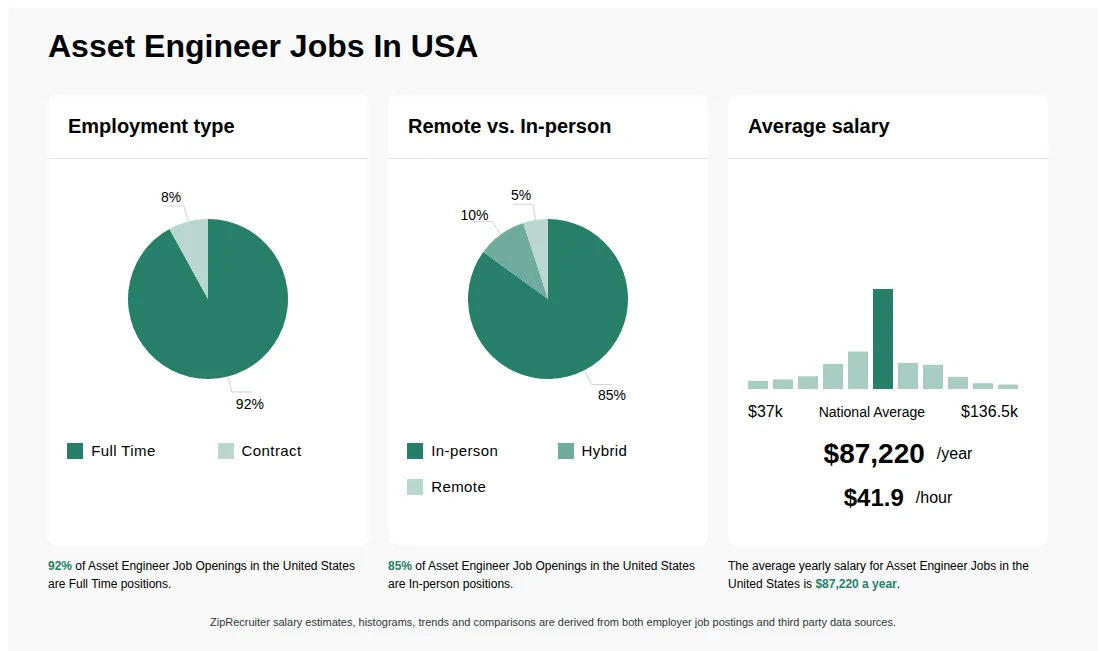
As of Aug 22, 2026, the average yearly pay for asset engineer in the United States is $87,220.00, according to ZipRecruiter salary data. Most workers in this role earn between $76,500.00 and $97,500.00 per year, depending on experience, location, and employer.

What is an asset engineer?

Asset Engineers are professionals responsible for managing, maintaining, and optimizing physical assets such as infrastructure, equipment, or facilities. They ensure that these assets operate efficiently and reliably throughout their lifecycle by planning maintenance, assessing performance, and recommending upgrades or replacements. Asset Engineers often work in industries like transportation, utilities, manufacturing, and construction, where they play a key role in minimizing downtime and maximizing return on investment.

What are the key skills and qualifications needed to thrive as an asset engineer?

To thrive as an Asset Engineer, you need a solid background in engineering principles, asset management, and data analysis, typically supported by a relevant engineering degree. Familiarity with asset management software such as IBM Maximo or SAP, and certifications like IAM (Institute of Asset Management) are commonly required. Strong problem-solving skills, attention to detail, and effective communication help Asset Engineers excel at optimizing asset performance and collaborating across teams. These competencies are critical for ensuring asset reliability, maximizing operational efficiency, and minimizing lifecycle costs.

How does an asset engineer typically collaborate with other departments to optimize asset performance?

Asset Engineers work closely with operations, maintenance, and reliability teams to ensure that assets such as machinery, infrastructure, or equipment are performing efficiently and safely. They often participate in cross-functional meetings to analyze data, address potential risks, and develop maintenance strategies. Effective communication and teamwork are crucial, as Asset Engineers frequently translate technical findings into actionable plans for non-engineering staff and help prioritize asset investments based on business needs.

What is the difference between Asset Engineer vs Maintenance Engineer?

AspectAsset EngineerMaintenance Engineer
CredentialsBachelor's in engineering or related field, certifications like PMP or asset management certificationsBachelor's in engineering, technical diploma, certifications in maintenance or equipment repair
Work EnvironmentProject sites, asset management offices, industrial facilitiesManufacturing plants, industrial facilities, equipment repair workshops
Industry UsageOil & gas, utilities, manufacturing, infrastructureManufacturing, facilities management, industrial sectors
Primary FocusManaging and optimizing physical assets throughout their lifecycleMaintaining and repairing equipment to ensure operational efficiency

While both roles involve working with industrial assets, Asset Engineers focus on asset management, lifecycle optimization, and strategic planning. Maintenance Engineers concentrate on equipment repair, troubleshooting, and ensuring machinery operates efficiently. Understanding these differences helps employers and professionals identify the right role for specific operational needs.

What does an asset engineer do?

An asset engineer is responsible for managing and maintaining physical assets such as equipment, infrastructure, or facilities within an organization. They analyze asset performance, ensure safety and compliance, and optimize asset lifecycle and reliability, often using tools like maintenance management systems. The role typically requires technical knowledge, problem-solving skills, and relevant certifications or experience in engineering or asset management.
More about Asset Engineer jobs

What cities are hiring for Asset Engineer jobs?

Cities with the most Asset Engineer job openings:

What states have the most Asset Engineer jobs?

States with the most job openings for Asset Engineer jobs include:

Infographic showing various Asset Engineer job openings in the United States as of August 2026, with employment types broken down into 94% Full Time, 2% Part Time, and 4% Contract. Highlights an 85% Physical, 6% Hybrid, and 9% Remote job distribution, with an average salary of $87,220 per year, or $41.9 per hour.

Principal Digital Assets Engineer

Fidelity Investments

Durham, NC • On-site

$130K - $174K/yr

Full-time

Posted 10 days ago


Fidelity Investments rating

8.7

Company rating: 8.7 out of 10

Based on 272 frontline employees who took The Breakroom Quiz

16th of 151 rated financial services


Job description

Job Description:

Note: Fidelity will not provide immigration sponsorship for this position.

Position Description:

Builds secure, scalable, resilient cloud-based microservices using modern software development practices. Designs and implements REST API clients and services, exchanges asynchronous messages between services, and maintain data, using PostgreSQL. Writes automated unit and integration tests, packages software using containers, coordinates builds using Continuous Integration (CI) pipelines, and prepares services for deployment on Amazon Web Services (AWS). Performs independent and complex technical and functional analysis for divisional initiatives.

Primary Responsibilities:

  • Defines enterprise-level digital architecture strategies.

  • Develops applications on complex projects, components, and subsystems for the division.

  • Writes and executes unit tests necessary to ensure an application or technical environment meets requirements.

  • Performs unit and integration tests.

  • Builds reliable software that can withstand unreliable environments.

  • Builds scalable, resilient, Cloud-based systems aligned with the company's long-term strategy.

  • Provides technology solutions to daily issues and technical evaluation estimates on digital technology initiatives.

  • Analyzes information to determine, recommend, and plan installation of a new system or modification of an existing system.

  • Confers with data processes or project managers to obtain information on limitations or capabilities for data process projects.

  • Develops and oversees software system tests and validation procedures, programs, and documentation.

  • Advises senior management on technical strategy.

  • Mentors junior team members.

  • Develops original and creative technical solutions to on-going development efforts.

Education and Experience:

Bachelor's degree in Computer Science, Engineering, Information Technology, Information Systems, or a closely related field (or foreign education equivalent) and five (5) years of experience as a Principal Digital Assets Engineer (or closely related occupation) developing scalable and resilient back-end solutions for RESTful microservices or asynchronous mechanisms, using SNS/SQS, Apache Kafka, and Spring Boot framework.

Or, alternatively, Master's degree in Computer Science, Engineering, Information Technology, Information Systems, or a closely related field (or foreign education equivalent) and three (3) years of experience as a Principal Digital Assets Engineer (or closely related occupation) developing scalable and resilient back-end solutions for RESTful microservices or asynchronous mechanisms, using SNS/SQS, Apache Kafka, and Spring Boot framework.

Skills and Knowledge:

Candidate must also possess:

  • Demonstrated Expertise ("DE") designing and developing Java RESTful Web services for enterprise applications using Java, Spring Boot, J2EE frameworks, and Messaging services -- JMS or Apache Kafka; delivering solutions on Cloud based Amazon Web Services (AWS) platforms and incorporating CI Continuous Integration/Continuous Delivery (CI/CD) pipelines for consistent deployment across development, QA, staging, and production environments using Jenkins pipeline.

  • DE testing frameworks (JUnit and Mockito) and performing integration testing using Spring; and ensuring adherence to coding standards and improving overall code maintainability using Sonar and SonarQube frameworks.

  • DE collaborating with enterprise Cloud, architecture, and product teams, to build enterprise-standard Java applications on the Cloud using AWS, Kubernetes, Helm, Docker, GIT, and Jenkins.

  • DE writing and optimizing queries and performing operations in relational and non-relational databases (Oracle and PostgreSQL) using migration tools (Liquibase); and ensuring seamless integration into application development processes, using Java within development, test environments, and production systems.

#PE1M2

#LI-DNI

Fidelity's Onsite Working Model
Fidelity is transitioning to a full-time onsite working model through a phased rollout across regions and roles. Currently, some roles and locations require 100% onsite presence, while others require less. Onsite expectations are likely to evolve as the rollout continues. This transition does not apply to fully remote roles.

Certifications:Category:Information Technology

Please be advised that Fidelity's business is governed by the provisions of the Securities Exchange Act of 1934, the Investment Advisers Act of 1940, the Investment Company Act of 1940, ERISA, numerous state laws governing securities, investment and retirement-related financial activities and the rules and regulations of numerous self-regulatory organizations, including FINRA, among others. Those laws and regulations may restrict Fidelity from hiring and/or associating with individuals with certain Criminal Histories.


What Fidelity Investments employees say

Pay

Benefits

Hours and flexibility

Workplace

Get the full story on Breakroom