1

Agricultural Engineer Jobs (NOW HIRING)

next page

Showing results 1-20

Agricultural Engineer information

See salary details

$56K

$83.5K

$115.5K

How much do agricultural engineer jobs pay per year?

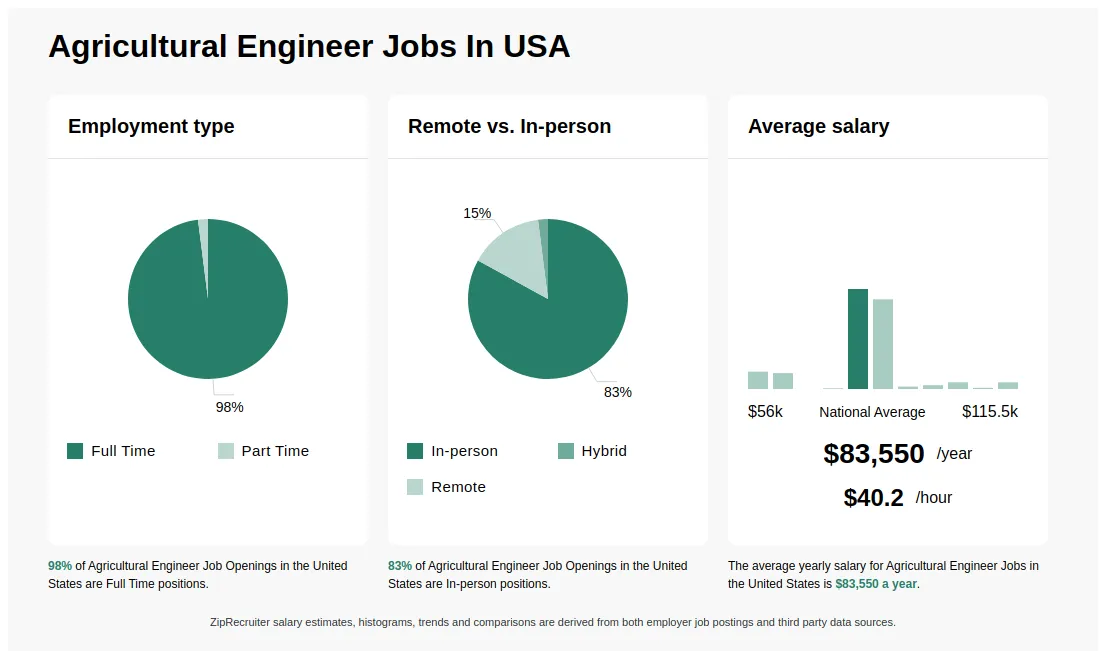
As of Jun 9, 2026, the average yearly pay for agricultural engineer in the United States is $83,550.00, according to ZipRecruiter salary data. Most workers in this role earn between $82,500.00 and $83,000.00 per year, depending on experience, location, and employer.

What are some common challenges Agricultural Engineers face when implementing new technologies on farms?

Agricultural Engineers often encounter challenges such as limited budgets, resistance to change from farmers, and the need to adapt solutions to diverse climate and soil conditions. They must balance innovative designs with practical usability and cost-effectiveness, often working closely with farm owners and operators to ensure new systems are understood and maintained. Additionally, navigating regulatory requirements and environmental concerns requires strong problem-solving and communication skills.

What Do Agricultural Engineers Do?

Agricultural engineering is the design of equipment, structures, and farming systems for agricultural industries. As an agricultural engineer, your responsibilities may include the design of everything, from new harvesting tools, to grain storage facilities, to aquaculture systems. These duties include extensive use of CAD design software. You are also expected to manage agriculture projects. In some cases, agricultural engineers work with a team to ensure they complete projects on time. In addition, you must be able to resolve problems related to food production or equipment failure.


What are the key skills and qualifications needed to thrive as an Agricultural Engineer, and why are they important?

To thrive as an Agricultural Engineer, you need a solid background in engineering principles, biology, and mathematics, typically supported by a bachelor's degree in agricultural or biological engineering. Familiarity with CAD software, GIS technology, and possibly certifications like Professional Engineer (PE) licensure are commonly required. Strong problem-solving, teamwork, and communication skills distinguish top performers in this field. These skills are crucial for developing innovative, sustainable solutions to improve agricultural productivity and address environmental challenges.

What are agricultural engineers?

Agricultural engineers are professionals who apply engineering principles to solve problems related to agriculture, such as designing farming equipment, improving irrigation systems, and developing sustainable agricultural practices. They work on projects that enhance the efficiency and sustainability of food production, soil conservation, and resource management. Agricultural engineers may collaborate with farmers, agronomists, and environmental scientists to implement new technologies that increase productivity while minimizing environmental impact.

What is the difference between Agricultural Engineer vs Agricultural Technician?

AspectAgricultural EngineerAgricultural Technician
Required CredentialsBachelor's degree in agricultural engineering or related fieldAssociate's degree or certification in agricultural technology
Work EnvironmentDesigning systems, research labs, field projectsFieldwork, equipment operation, assisting engineers
Employer & Industry UsageResearch institutions, engineering firms, government agenciesFarms, agricultural companies, research labs

While both roles support agricultural development, Agricultural Engineers focus on designing and improving agricultural systems and infrastructure, requiring higher education. Agricultural Technicians assist with fieldwork and technical tasks, often with less formal education. Both are vital in advancing agricultural productivity but differ in responsibilities and credentials.

What cities are hiring for Agricultural Engineer jobs? Cities with the most Agricultural Engineer job openings:
What are the most commonly searched types of Agricultural Engineer jobs? The most popular types of Agricultural Engineer jobs are:
Who are the top companies hiring for Agricultural Engineer jobs? The top employers for Agricultural Engineer jobs are:
What states have the most Agricultural Engineer jobs? States with the most job openings for Agricultural Engineer jobs include:
Infographic showing various Agricultural Engineer job openings in the United States as of May 2026, with employment types broken down into 96% Full Time, 1% Part Time, and 3% Contract. Highlights an 94% Physical, 1% Hybrid, and 5% Remote job distribution, with an average salary of $83,550 per year, or $40.2 per hour.

$35 - $50/hr

Full-time

Posted 6 days ago


Job description

Summary
Provost & Pritchard is seeking a Agricultural Engineer to join our agricultural and environmental consulting team in Visalia, California.
This position offers the opportunity to work on meaningful projects at the intersection of agriculture, water quality, irrigation, nutrient management, salinity, wastewater management, and environmental consulting throughout Central California. Clients include growers, dairies, wineries, food processors, agricultural organizations, nonprofits, and public agencies.
We are looking for someone that wants to support California agriculture and water resources management through practical, effective, and data-driven solutions.
Responsibilities
  • Support agricultural water quality and environmental compliance programs such as the California Irrigated Lands Regulatory Program (ILRP).
  • Support groundwater and surface water quality monitoring programs.
  • Analyze and interpret agricultural, soil, irrigation, nutrient, and environmental data.
  • Prepare technical reports, regulatory deliverables, data summaries, visualizations, and trend analyses.
  • Evaluate and support improved agricultural management practices to protect water quality.
  • Support grower education and outreach efforts.
  • Assist with irrigation, nutrient, salinity, and wastewater management planning.
  • Support wastewater, land application, and beneficial reuse projects.
  • Conduct field sampling and site investigations involving soil, water, wastewater, crops, ponds, wells, and vadose zones.
  • Evaluate soil-water, nutrient, and salt balances using Microsoft Excel and programming tools.
  • Prepareregulatorymonitoring reports andpermittingdocuments, including Reports of Waste Discharge.
  • Assist with field investigations involving soil infiltration and permeability testing.
  • Assist with agronomic field trials, fate and transport projects, and other specialized soil, land use, and agricultural consulting projects.
  • Assist with projects related to agricultural grants, the Sustainable Groundwater Management Act (SGMA), Central Valley Salinity Alternatives for Long-Term Sustainability (CV-SALTS), stormwater management, sediment and erosion control, and TMDL implementation.

Qualifications
  • Bachelor's degree in Soil Science, Environmental Science, Agricultural Engineering, or a related field required.
  • Strong interest in a career in agriculture, soil science, irrigation, and water quality.
  • Excellent technical writing, communication, and organizational skills.
  • Experience or interest in environmental consulting, regulatory compliance, and project management.
  • Some experience in data analysis and data QAQC.
  • Experienced with Microsoft Office 365, especially Excel, Word, and PowerPoint.
  • Strong initiative, attention to detail, and ability to work independently and collaboratively.
  • Preferred Qualifications
  • Master's degree in Soil Science, Environmental Science, Agricultural Engineering, or a related field.
  • Knowledge of California agricultural, environmental, and wastewater regulations, including the Central Valley ILRP, Central Coast Ag Order 4.0, SGMA, CV-SALTS, Winery General Order, and others.
  • Experience with tools such as GIS, R/RStudio, Python, remote sensing, data analysis and visualization, and related AI tools.
  • Familiarity with irrigation, evapotranspiration, nutrient management, salinity management, and/or soil-water balances and hydrologic modeling.
  • Experience in environmental statistics, analytical laboratory methods, and data QA/QC procedures.

Professional Development
Although not required, Provost & Pritchard supports professional development toward credentials such as Certified Professional Soil Scientist (CPSS), Certified Crop Adviser (CCA), Professional Engineer (PE), Professional Geologist (PG), and others.
Why Join Provost & Pritchard
Join a collaborative, employee-owned firm where your work supports California agriculture, water resources, and environmental sustainability. You will have the opportunity to build technical expertise, work on diverse projects, and grow your career with mentorship and support.