1

Aerospace Engineer Internship Jobs (NOW HIRING)

Mechanical/Aerospace System Engineer Location: White Oak, MD Function/Branch: Engineering / Tunnel ... internship. * Experience using PTC Creo CAD software. * Experience performing Finite Element ...

Mechanical/Aerospace System Engineer Location: White Oak, MD Function/Branch: Engineering / Tunnel ... internship. * Experience using PTC Creo CAD software. * Experience performing Finite Element ...

Apply Early

Mechanical/Aerospace System Engineer Location: White Oak, MD Function/Branch: Engineering / Tunnel ... internship. * Experience using PTC Creo CAD software. * Experience performing Finite Element ...

Apply Early

Mechanical/Aerospace System Engineer Location: White Oak, MD Function/Branch: Engineering / Tunnel ... internship. * Experience using PTC Creo CAD software. * Experience performing Finite Element ...

next page

Showing results 1-20

Aerospace Engineer Internship information

See salary details

$11

$19

$29

How much do aerospace engineer internship jobs pay per hour?

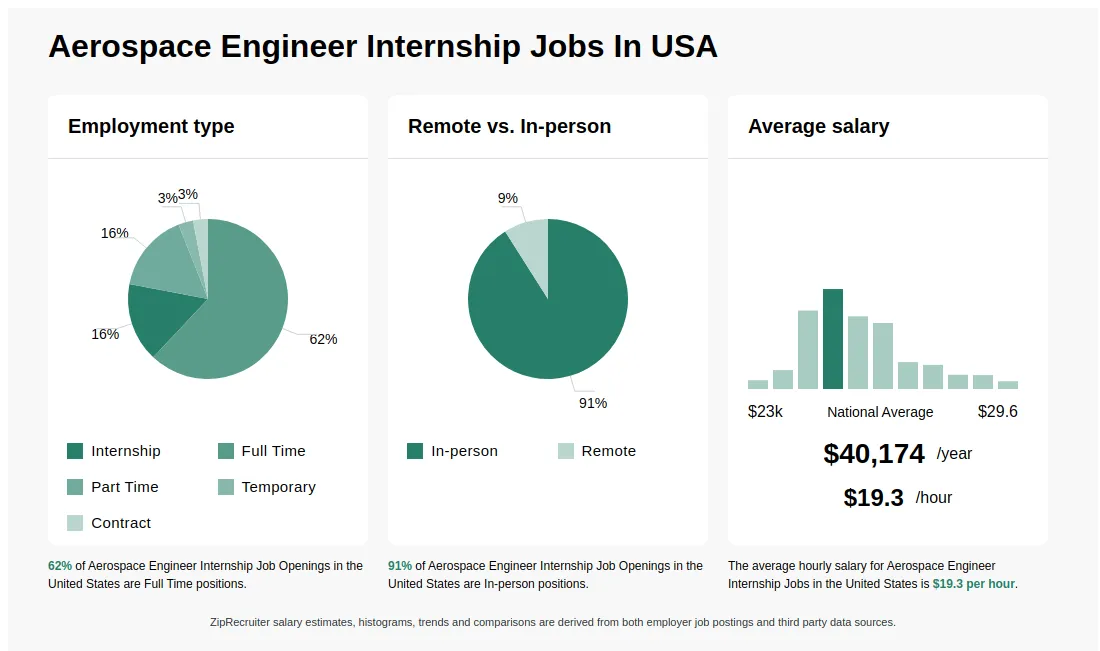
As of Jul 4, 2026, the average hourly pay for aerospace engineer internship in the United States is $19.31, according to ZipRecruiter salary data. Most workers in this role earn between $16.11 and $20.91 per hour, depending on experience, location, and employer.

What are the key skills and qualifications needed to thrive as an Aerospace Engineer Intern, and why are they important?

To thrive as an Aerospace Engineer Intern, you need a solid grasp of engineering fundamentals, mathematics, and physics, typically supported by coursework in aerospace or mechanical engineering. Familiarity with CAD software, simulation tools like MATLAB or ANSYS, and basic programming skills are commonly expected. Strong analytical thinking, teamwork, and effective communication set standout interns apart. These skills enable interns to contribute meaningfully to complex projects, solve technical problems, and collaborate efficiently within engineering teams.

What do aerospace engineer interns do?

Aerospace engineer interns assist in designing, testing, and analyzing aircraft, spacecraft, and related systems. They often work with CAD software, perform simulations, and support engineering teams on projects, gaining practical experience in aerospace design and development.

What are aerospace engineer internships?

Aerospace engineer internships are temporary positions that allow students or recent graduates to gain practical experience working in the aerospace industry. Interns typically assist with projects related to the design, development, testing, and production of aircraft, spacecraft, satellites, or missiles. These internships help participants apply classroom knowledge to real-world engineering challenges, develop technical and teamwork skills, and build professional networks. Internships can be paid or unpaid and usually last for a summer or a semester.

Is 3.3 a good GPA for aerospace engineering?

A 3.3 GPA for an aerospace engineering internship is generally considered acceptable, especially if complemented by strong technical skills, relevant projects, and extracurricular activities. Many employers value practical experience and problem-solving abilities alongside GPA, so demonstrating proficiency in tools like CAD or MATLAB can enhance your application.

What is the difference between Aerospace Engineer Internship vs Aerospace Engineer?

AspectAerospace Engineer InternshipAerospace Engineer
Required CredentialsTypically pursuing or recent graduate with a bachelor's or master's in aerospace or related engineeringBachelor's or higher degree in aerospace or mechanical engineering, often with professional licensure
Work EnvironmentInternship programs in aerospace companies, labs, or research centersFull-time professional roles in aerospace manufacturing, design, or research facilities
Employer & Industry UsageInternship positions offered by aerospace firms, government agencies, or research institutionsFull-time aerospace engineering roles in commercial, defense, or space industries

In summary, an Aerospace Engineer Internship is a temporary, entry-level position designed for students or recent graduates to gain industry experience, while an Aerospace Engineer is a full-time professional role requiring a degree and offering ongoing responsibilities in aerospace design, analysis, and development.

Is SpaceX still hiring interns?

SpaceX regularly offers internship opportunities for students in engineering, manufacturing, and business fields, including roles for aerospace engineering interns. Internship availability varies by season and project needs, so interested candidates should check the SpaceX careers page for current openings and application deadlines.

What Are the Qualifications to Get an Aerospace Engineer Internship?

The qualifications to get an aerospace engineer internship for vary, depending on the specific position which you are interested in and company guidelines. To obtain an aerospace engineer internship during your undergraduate studies, you usually need to have completed two to three years of schooling to be eligible. In addition to having a strong fundamental knowledge of aerospace engineering, aerodynamics, and other engineering principles, an intern should also have strong technical skills, including familiarity with computer programming and AutoCAD. Recent graduates need similar capabilities, and some internships require you to have a minimum GPA. Strong interpersonal communication skills, being a multitasker, and having strong attention to detail are qualities that employers look for when selecting interns.

What types of projects or tasks can I expect to work on during an Aerospace Engineer Internship?

As an Aerospace Engineer Intern, you will likely be involved in supporting ongoing projects such as designing components, conducting simulations, assisting with prototype testing, or analyzing data from flight or wind tunnel tests. Interns often collaborate with engineers from various disciplines, gaining exposure to both the technical and project management aspects of aerospace development. You'll also participate in team meetings and may have opportunities to present your findings or contribute to project documentation. The work environment is typically team-oriented and fast-paced, offering valuable hands-on experience and networking opportunities for future career growth.

Can I make 200k as an aerospace engineer?

Earning a $200,000 salary as an aerospace engineer is possible but typically requires extensive experience, advanced skills, and working in high-paying sectors such as defense or aerospace management. Entry-level salaries usually range from $70,000 to $100,000, with higher earnings achievable through specialization, leadership roles, or working in certain geographic regions. Certifications and a strong track record can also contribute to higher compensation.
What cities are hiring for Aerospace Engineer Internship jobs? Cities with the most Aerospace Engineer Internship job openings:
What are the most commonly searched types of Aerospace Engineer jobs? The most popular types of Aerospace Engineer jobs are:
What states have the most Aerospace Engineer Internship jobs? States with the most job openings for Aerospace Engineer Internship jobs include:
Infographic showing various Aerospace Engineer Internship job openings in the United States as of June 2026, with employment types broken down into 1% Internship, 90% Full Time, 6% Part Time, 1% Temporary, 1% Contract, and 1% Nights. Highlights an 95% Physical, 2% Hybrid, and 3% Remote job distribution, with an average salary of $40,174 per year, or $19.3 per hour.
Guidance, Navigation, & Control (GNC) Engineer II

Guidance, Navigation, & Control (GNC) Engineer II

CesiumAstro

Westminster, CO

Full-time

Posted 9 days ago

Be an early applicant


Job description

Please Note: To conform with the United States Government Space Technology Export Regulations, the applicant must be a U.S. citizen, lawful permanent resident of the U.S., conditional resident, asylee or refugee (protected individuals as defined by 8 U.S.C. 1324b(a)(3)), or eligible to obtain the required authorizations from the U.S. Department of State.
 
At CesiumAstro, we are developers and pioneers of out-of-the-box communication systems for satellites, UAVs, launch vehicles, and other space and airborne platforms. We take pride in our dynamic and cross-functional work environment, which allows us to learn, develop, and engage across our organization. If you are looking for hands-on, interactive, and autonomous work, CesiumAstro is the place for you. We are actively seeking passionate, collaborative, energetic, and forward-thinking individuals to join our team.

We are looking to add a GNC Engineer II to our team.  If you enjoy working in a startup environment and are passionate about developing systems for leading-edge spacecraft, and aerospace communication systems, we would like to hear from you. 
 
In this position, you will work on a small team in the design and analysis of GNC systems for CesiumAstro satellites and payloads. You will be responsible for Guidance, Navigation, and Control through all stages of design, integration, test, and operations. As such, you will perform trade studies, participate in design reviews, create models, and complete simulations and system testing.  You will build, test, and fly hardware. 
 
As a CesiumAstro spacecraft team member, you will work on a small team to develop satellites and put them in orbit.  Being in a startup, you can expect significant portions of your time to be spent contributing to company-critical projects outside your area of expertise.
KEY REQUIREMENTS:
  • Master of Science (MS), or Doctorate (Ph.D.) degree in Aerospace Engineering from an accredited university or institution 
  • 2 years of internship, research, or industry experience in satellite attitude and orbit systems 
  • Expertise in attitude estimation, guidance, and control; coordinate frame transformations; linear algebra; and non-linear systems 
  • Experience with multiple spaceflight missions from concept to operations 
  • Experience in low earth orbit satellites 
  • Experience with post-CDR test failures and on-orbit failures that guide your design and test philosophies 
  • Experience with successful and unsuccessful recovery from on-orbit failures 
  • Experience in conceptualization, architecture design, requirements specification, design, test, and operations of various GNC architectures and components 
  • Familiarity with space mission simulation tools such as STK, Basilisk, GMAT, or FreeFlyer 
  • Experience defining spacecraft trajectories and orbital requirements 
  • Fluency with Python and C++, or other modeling languages 
  • Familiarity with spacecraft mission design including events, pointing modes, maneuver planning, and operations 
  • Excellent written and verbal communication skills 
PREFERRED EXPERIENCE:
  • CubeSat and SmallSat experience 
  • Hands-on experience with spacecraft instrumentation, subsystems, and test labs 
  • Experience with multiple mission simulation and flight architectures which drives your vision for the next generation of space software 
  • Experience in LEO, MEO, GEO, and deep space satellites 
  • Experience with communications satellites 
CesiumAstro considers several factors when extending an offer, including but not limited to, the role and associated responsibilities, a candidate’s work experience, education/training, and key skills.  Full-time employment offers include company stock options and a generous benefits package including health, dental, vision, HSA, FSA, life, disability and retirement plans.  
 
CesiumAstro is an Equal Opportunity employer.  All qualified applicants will receive consideration for employment without regard to race, color, religion, sex, national origin, disability, protected Veteran Status, or any other characteristic protected by applicable federal, state, or local law.
 
Please note: CesiumAstro does not accept unsolicited resumes from contract agencies or search firms. Any unsolicited resumes submitted to our website or to CesiumAstro team members will be considered property of CesiumAstro, and we will not be obligated to pay any referral fees.

We may use artificial intelligence (AI) tools to support parts of the hiring process, such as reviewing applications, analyzing resumes, or assessing responses and identifying potential inconsistencies or verification signals in application materials based on available information. These tools assist our recruitment team but do not replace human judgment. Final hiring decisions are ultimately made by humans. If you would like more information about how your data is processed, please contact us.