1

Aboriginal Jobs (NOW HIRING)

$34.93 - $36.09/hr

Aboriginal or Torres Strait Islander applicants must demonstrate Aboriginal or Torres Strait Islander status in addition to addressing the selection criteria. About the Opportunity As an ...

New

$66.36 - $67.97/hr

Facilitate collaboration between health services, child protection agencies, Aboriginal organisations and community partners. * Provide supervision, mentoring and professional support to clinicians.

$33.59 - $35.84/hr

The Central Coast is home to one of the fastest growing Aboriginal and Torres Strait Islander communities in NSW. To provide culturally safe, responsive care, we are committed to building a workforce ...

$35.84 - $36.96/hr

Aboriginal and Torres Strait Islander applicants can access support through the Stepping Up initiative, which provides guidance on the NSW Health recruitment process. You're also welcome to reach out ...

$43.46 - $57.88/hr

Preference will be given to applicants of Aboriginal descent. Exemption is claimed under Section 21 of the Anti-Discrimination Act 1977. We are Just the place to grow your career and be part of a ...

Support Worker

Murray, UT

$14.75 - $19.25/hr

Understanding of mental health, recovery, confidentiality, workplace safety and the needs of Aboriginal and multicultural communities. Desired Criteria * Certificate III or above in Mental Health ...

next page

Showing results 1-20

Aboriginal information

See salary details

$8

$26

$61

How much do aboriginal jobs pay per hour?

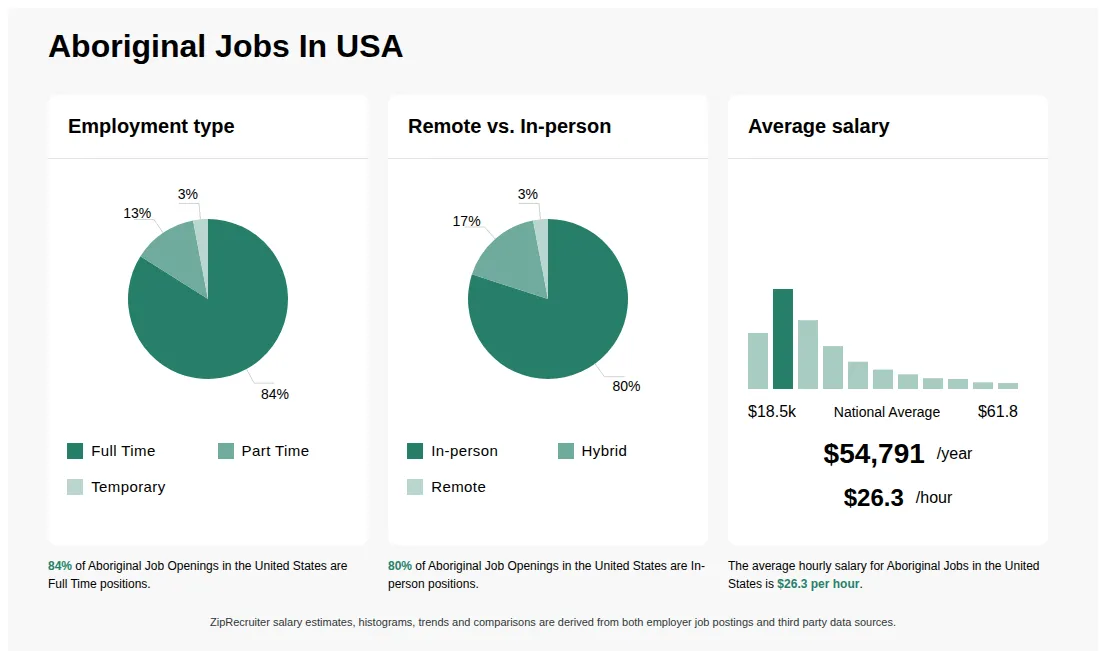
As of Sep 14, 2026, the average hourly pay for aboriginal in the United States is $26.34, according to ZipRecruiter salary data. Most workers in this role earn between $15.14 and $30.77 per hour, depending on experience, location, and employer.

What is an aboriginal?

Aboriginal jobs refer to employment opportunities that are either specifically designated for Aboriginal and Torres Strait Islander peoples or involve working with Indigenous communities in Australia. These roles can be found in various sectors such as education, healthcare, community services, government, and cultural organizations. They often focus on supporting, representing, or advancing the interests of Aboriginal peoples, and may require cultural knowledge or connections to Indigenous communities.

What are the key skills and qualifications needed to thrive as an Aboriginal Liaison Officer?

To thrive as an Aboriginal Liaison Officer, you typically need a deep understanding of Aboriginal culture and communities, relevant tertiary qualifications in social work or community services, and experience working with Indigenous populations. Familiarity with case management systems, government policy frameworks, and cultural competency training is essential. Strong interpersonal skills, cultural sensitivity, and effective communication make individuals stand out in this role. These skills are important to build trust, advocate effectively, and bridge gaps between Aboriginal communities and service providers.

What are some common challenges faced by Aboriginal Liaison Officers when working with both Indigenous communities and non-Indigenous organizations?

Aboriginal Liaison Officers often navigate complex challenges, such as bridging cultural differences and ensuring clear communication between Indigenous communities and non-Indigenous organizations. They may need to advocate for culturally appropriate practices, address misunderstandings, and help build trust among stakeholders. Successfully managing these dynamics requires strong interpersonal skills and a deep understanding of both community values and organizational policies. Many officers find that ongoing professional development and cultural competency training are essential for overcoming these challenges and fostering positive collaboration.

What is the difference between Aboriginal vs Interpreter?

AspectAboriginalInterpreter
Required CredentialsCommunity knowledge, cultural trainingLanguage proficiency, certification
Work EnvironmentCommunity centers, cultural sitesLegal, medical, government settings
Employer & IndustryIndigenous organizations, cultural institutionsLegal firms, healthcare, government agencies

Aboriginal roles focus on cultural knowledge and community engagement, while interpreters specialize in language translation across various professional settings. Both roles may require specific training, but their primary functions and work environments differ significantly.

What cities are hiring for Aboriginal jobs?

Cities with the most Aboriginal job openings:

What states have the most Aboriginal jobs?

States with the most job openings for Aboriginal jobs include:

Infographic showing various Aboriginal job openings in the United States as of August 2026, with employment types broken down into 85% Full Time, 13% Part Time, 1% Temporary, and 1% Contract. Highlights an 92% Physical, 6% Hybrid, and 2% Remote job distribution, with an average salary of $54,791 per year, or $26.3 per hour.

Aboriginal Health Worker - Transition to Practice Aboriginal Health Worker

Orange, CA • On-site

$67K - $97K/yr

Full-time

This job post has expired today. Applications are no longer accepted.


Job description

Employment Type: Temporary Full Time (up to 17 Sept 2027) 
Position Classification: Aboriginal Health Worker
Remuneration: $67,612.00 - $97,730.00 pa (+ superannuation + salary packaging options) 
Location: Orange, NSW - Find out more
Hours Per Week: 38 - Job Share may be considered 
Applications Close: 14 Sept 2026 - 11:59pm

Aboriginal Health Worker - Transition to Practice Aboriginal Health Worker 
Orange Health Service 

About the role

Make a meaningful difference in the health and wellbeing of Aboriginal and Torres Strait Islander communities in Orange.

Join the Orange Health Service Social Work Department as an Aboriginal Health Worker and help ensure Aboriginal and Torres Strait Islander patients, carers and families receive culturally safe, respectful and responsive care.

We're looking for someone with strong communication and interpersonal skills, experience in health or community services, and a passion for improving health outcomes. You'll work collaboratively with a dedicated team while building your professional skills and contributing to quality improvement and better patient care.

This role also supports you to complete a Certificate IV in Aboriginal and/or Torres Strait Islander Primary Health Care (Practice).

Located in the beautiful Central West of NSW, Orange offers the best of rural living alongside the culture, services and opportunities of a vibrant regional city.

Make an impact. Shape the future. Join Western NSW Local Health District.


Helping you move to Western NSW 
The Welcome Experience is a free NSW Government service supporting workers (and their families) who have accepted a job with Western NSW LHD in most locations. The service helps with housing, schooling, partner work and community connections. Find out more at https://www.nsw.gov.au/regional-and-primary-industries/makethemove/welcome-experience
To find out more about the role click to view the Position Description
A career with Western NSW means you can challenge yourself, make an impact and shape the future of rural health. To explore the benefits of a career in our Local Health District, visit the WNSWLHD website

To apply for this role:

         Click 'Apply'

         Create a profile in the Recruitment & Onboarding (ROB) System or sign in using your existing login

         Upload your current resume

         Answer the selection criteria


Role-related enquiries: Please contact Brad Haines, Head of Department on 0483 177 293 or at Brad.haines@health.nsw.gov.au for more information.
Additional information for applicants:

        This is an identified position in accordance with Section 14 (d) of the Anti-Discrimination Act 1977- only suitably qualified Aboriginal people are eligible for this position and are encouraged to apply. For more information, visit Anti-Discrimination Act 1977.

        All suitably qualified Aboriginal people are encouraged to apply for this position. This is a targeted position under GSE Rule 26. Where possible, affirmative action will be applied to support employment of eligible persons.

       This recruitment may be used to create an Eligibility List for similar roles in the future.

        Western NSW LHD can provide reasonable adjustments in the workplace. Applicants who provide information on an injury, health condition, or disability in their pre-employment forms will receive a functional assessment from our Risk Management Unit (RMU). This review will consider the applicant's needs and what reasonable adjustments and workplace supports are available to support their employment journey. 

         Western NSW LHD is committed to the safety and wellbeing of every child in our care. All staff in WNSWLHD are required to provide a safe and supportive environment for children, while working to protect them from harm and abuse. For more information on the Child Safety Standards, visit: NSW Government - Office of Children's Guardian

         Western NSW is committed to creating a safe and accessible workplace that promotes diversity, inclusion and belonging. As a vibrant and diverse region, rich in community and culture, we welcome applications from all people to build a respectful workplace dedicated to delivering the best health outcomes for our community.

         To find out more about the remuneration and conditions, visit NSW Public Health System Awards

         For more information, visit a Guide to Employment with WNSWLHD   

#JobsForMob