1

Biostatistics Jobs (NOW HIRING)

Provides leadership within biostatistics function to develop and execute statistical strategy, design and analyses for clinical trials in all phases. Applies sound statistical methodology to meet ...

Act as the biostatistics expert and leader, serve as primary statistical representative for cross-functional teams, including clinical, evidence generation, and asset teams, and communicate plans and ...

Biostatistics Senior Manager What you will do Let's do this. Let's change the world. In this vital role you will achieve results through detailed goal setting, accountability measures, effective ...

Provides leadership within biostatistics function to develop and execute statistical strategy, design and analyses for clinical trials in all phases. Applies sound statistical methodology to meet ...

Director, Biostatistics

Boston, MA ยท On-site

$190K - $260K/yr

The Director of Biostatistics builds and maintains strong collaborations with other teams across the organization such as Medical Science, Research and Data Science. Responsibilities: * Build and ...

Showing results 21-40

biostatistics information

See salary details

$14

$49

$79

How much do biostatistics jobs pay per hour?

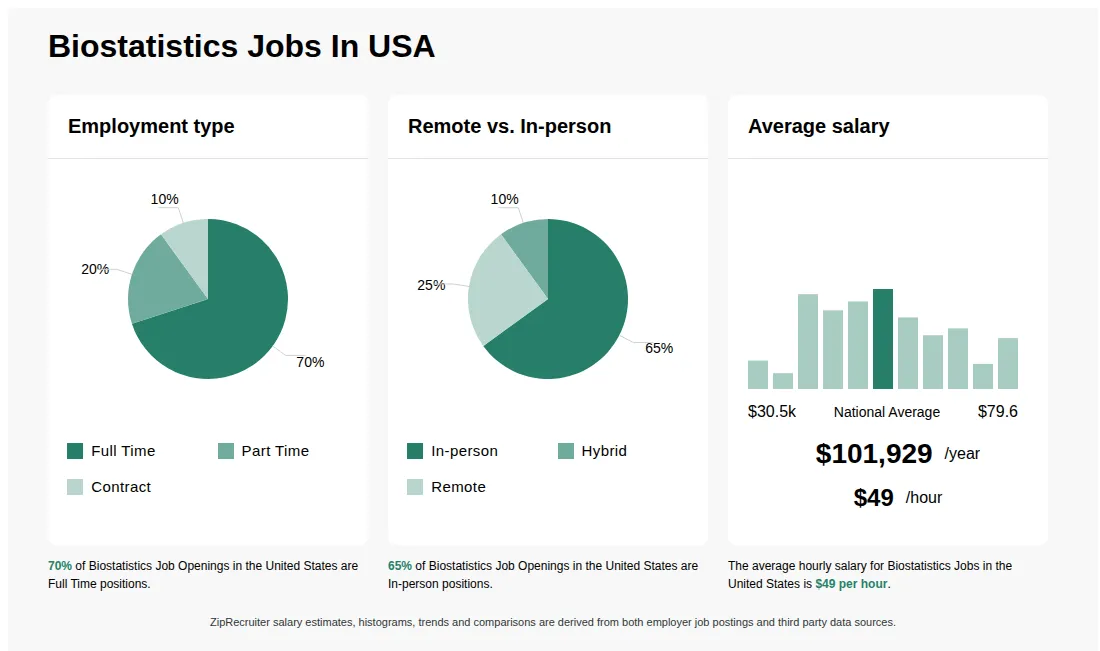
As of Sep 7, 2026, the average hourly pay for biostatistics in the United States is $49.00, according to ZipRecruiter salary data. Most workers in this role earn between $34.38 and $61.54 per hour, depending on experience, location, and employer.

What does a biostatistician do?

A biostatistician applies statistical methods to analyze and interpret data in healthcare, medicine, and public health. They design studies, collect and analyze data, and draw conclusions that inform medical research, clinical trials, and policy decisions. Their work helps identify health trends, evaluate treatments, and improve patient outcomes. Biostatisticians often collaborate with scientists, doctors, and researchers to ensure studies are statistically sound and meaningful.

What are the key skills and qualifications needed to thrive as a biostatistician?

To thrive in Biostatistics, you need a strong background in statistics, mathematics, and data analysis, typically supported by a degree in biostatistics, statistics, or a related field. Proficiency with statistical software such as SAS, R, or Python and familiarity with data management systems is essential, and advanced certifications can be advantageous. Outstanding problem-solving skills, attention to detail, and effective communication are valuable soft skills in this role. These qualifications are crucial for ensuring rigorous data analysis, reliable research findings, and productive collaboration within scientific and healthcare teams.

What are some common challenges biostatisticians face in their day-to-day work?

Biostatisticians often deal with complex datasets that can be incomplete, messy, or require extensive cleaning before analysis, which can be time-consuming and require meticulous attention to detail. Balancing multiple projects with tight deadlines and adapting statistical methods to suit various study designs or research questions are also common challenges. Additionally, clear communication with non-technical colleagues, such as clinicians or researchers, is essential to ensure that statistical results are understood and applied appropriately. Overcoming these challenges provides valuable learning experiences and contributes to the development of strong analytical and collaborative skills.

Are biostatistics in high demand?

Biostatistics is a growing field with strong demand in healthcare, pharmaceuticals, and research organizations due to the increasing need for data analysis in clinical trials and public health. Professionals with skills in statistical software and a solid understanding of biology are highly sought after, and employment opportunities are expected to continue expanding.

Does biostatistics pay well?

Biostatistics is generally a well-paying field, with median salaries often exceeding those of many other health-related roles. Salaries vary based on experience, education, and location, and professionals with advanced degrees and statistical software skills tend to earn higher wages.

Is biostatistics a good career?

Biostatistics is a growing field that involves applying statistical methods to health and medical research. It offers opportunities in academia, government, and industry, often requiring strong analytical skills and knowledge of statistical software. The demand for biostatisticians is expected to increase with advancements in healthcare and clinical research.

What careers use biostatistics?

Biostatistics is used in careers such as epidemiologists, clinical trial statisticians, public health analysts, and research scientists. These roles involve designing studies, analyzing health data, and supporting medical research, often requiring proficiency with statistical software like SAS or R.

What cities are hiring for Biostatistics jobs?

Cities with the most Biostatistics job openings:

What are the most commonly searched types of Biostatistics jobs?

The most popular types of Biostatistics jobs are:

What states have the most Biostatistics jobs?

States with the most job openings for Biostatistics jobs include:

Infographic showing various Biostatistics job openings in the United States as of August 2026, with employment types broken down into 77% Full Time, 22% Part Time, and 1% Contract. Highlights an 63% Physical, 4% Hybrid, and 33% Remote job distribution, with an average salary of $101,929 per year, or $49 per hour.

Biostatistics Specialist (Remote | $120 -$170/hr)

Synthires

Oxnard, CA โ€ข On-site

$120 - $170/hr

Other

Posted 5 days ago


Job description


Biostatistician


Position: Biostatistician


Type: Contract


Compensation: $120โ€“$170/hour


Location: Remote


About the Opportunity

This opportunity is for experienced Biostatisticians with expertise in biostatistics, clinical research, statistical modeling, study design, data analysis, and regulatory standards to contribute to advanced AI research and evaluation projects.

In this role, you'll apply your expertise to evaluate complex statistical analyses, clinical research methodologies, study designs, and AI-generated scientific outputs. Your work will help improve the accuracy, reasoning, and analytical capabilities of next-generation AI systems.

No prior AI experience is required. Your biostatistical expertise, methodological rigor, clinical interpretation, and regulatory knowledge are the primary qualifications for success in this role.

Responsibilities

  • Evaluate AI-generated biostatistical analyses, clinical research outputs, and statistical methodologies for accuracy and scientific rigor.
  • Apply expertise in study design, hypothesis testing, regression analysis, survival analysis, and statistical modeling.
  • Analyze clinical trial data, observational studies, epidemiological data, and healthcare datasets.
  • Review experimental designs, statistical analysis plans, endpoints, sample size calculations, and data interpretation.
  • Assess the appropriateness of statistical methods, assumptions, models, and analytical approaches.
  • Identify methodological errors, statistical inconsistencies, biases, and potential limitations in analyses.
  • Translate complex biostatistical concepts and research findings into clear, structured documentation for AI training and evaluation.
  • Apply professional judgment to ensure methodological rigor, clinical relevance, regulatory sensitivity, and statistical accuracy.

Required Qualifications

  • Master's degree or higher in Biostatistics, Statistics, Epidemiology, Public Health, Mathematics, or a related quantitative discipline.
  • Strong experience in biostatistical analysis, clinical research, healthcare research, or pharmaceutical research.
  • Expertise in statistical modeling, hypothesis testing, regression analysis, survival analysis, and experimental design.
  • Experience analyzing clinical trials, observational studies, or real-world healthcare data.
  • Proficiency in statistical software such as R, SAS, Python, SPSS, or Stata.
  • Strong understanding of clinical research methodologies, data interpretation, and statistical reporting.
  • Excellent analytical, problem-solving, written, and verbal communication skills.
  • Ability to work independently in a fully remote environment.

Preferred Qualifications

  • PhD in Biostatistics, Statistics, Epidemiology, Public Health, or a related field.
  • Experience working with clinical trials, pharmaceutical research, medical research, or regulatory submissions.
  • Familiarity with FDA, EMA, ICH, GCP, or other relevant regulatory guidelines.
  • Experience developing statistical analysis plans, clinical study protocols, or research evaluation frameworks.
  • Experience with machine learning, healthcare analytics, AI model evaluation, or scientific data annotation.
  • Experience collaborating with cross-functional, clinical, research, or remote teams.

Compensation

  • Competitive compensation of $120โ€“$170/hour.
  • Weekly payments.
  • Independent contractor engagement.

Application Process

  1. Easy Apply on LinkedIn
  2. Check Email for Next Steps
  3. Participate in Resume Evaluation & Interview Stage