1

Alligator Jobs (NOW HIRING)

... alligator cameo Adult-focused practice A team that actually supports you instead of piling random work onto your desk Room to scale your income however aggressively you want (this bag is expandable ...

Utilizes all yard operating equipment including: shag truck, forklifts, skid steer, wheel loader, stationary baler, stationary shear, alligator shear as necessary * Performs basic maintenance on the ...

$348K/yr

Additional options include the Colonial Quarter, the Alligator Farm, and Fort Mose Historic State Park, providing a varied mix of cultural and natural experiences throughout the area. About the ...

Laborer

Poplar Bluff, MO · On-site

$14.75 - $18/hr

Operate small equipment such as a forklift, skid steer, alligator shear and balers. * Identify, separate, and clean up scrap material using various hand tools. * Perform daily inspections on ...

Warren Bridge over Alligator River. As a Construction Inspector with RK&K you will perform complex and routine inspections on materials, processes, safety, and documentation to ensure construction ...

General Laborer

Warren, MI

$15 - $18.75/hr

Perform tasks involving physical labor using tools, including but not limited to standard hand tools, torch, bander, chop saw, alligator shear, saw zall, and wire snips. * Identify scrap including ...

General Laborer

Salt Lake City, UT · On-site

$15.50 - $19.25/hr

Perform tasks involving physical labor using tools, including but not limited to standard hand tools, torch, bander, chop saw, alligator shear, sawzall, and wire snips. * Identifyscrapincludingthe ...

General Labor

Cleveland, OH · On-site

$17 - $24/hr

Perform tasks involving physical labor using tools, including but not limited to standard hand tools, torch, bander, chop saw, alligator shear, sawzall, and wire snips. * Identifyscrapincludingthe ...

Showing results 41-60

alligator information

See salary details

$22

$25

$27

How much do alligator jobs pay per hour?

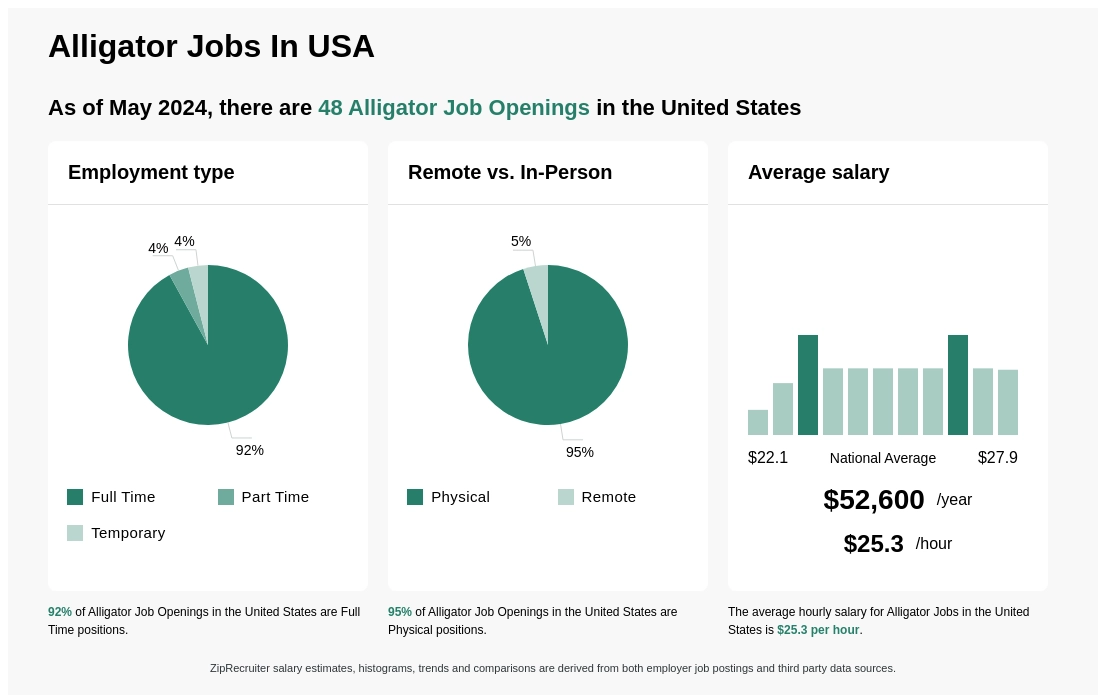
As of Aug 24, 2026, the average hourly pay for alligator in the United States is $25.29, according to ZipRecruiter salary data. Most workers in this role earn between $23.80 and $26.68 per hour, depending on experience, location, and employer.

What are the key skills and qualifications needed to thrive as an alligator biologist?

To thrive as an Alligator Biologist, you need a strong background in wildlife biology, ecology, and zoology, often supported by a relevant degree. Familiarity with GPS tracking, wildlife survey methods, and data analysis software is typically required. Exceptional observational skills, problem-solving abilities, and effective communication make someone stand out in this field. These skills ensure accurate research, effective conservation efforts, and safe collaboration with both wildlife and colleagues.

What are the common challenges faced by alligator handlers in a wildlife conservation setting?

Alligator handlers often face unique challenges such as ensuring safety while working closely with these large reptiles, maintaining proper habitats to support their health, and managing stress for both the animals and the handlers during routine checkups or relocations. Teamwork and clear communication are essential, as handlers frequently collaborate with veterinarians, researchers, and other wildlife staff. Staying up to date with best practices in animal care and understanding alligator behavior are also crucial for a safe and effective work environment.

What is the difference between Alligator vs Crocodile?

AspectAlligatorCrocodile
Required credentialsWildlife conservation or zoology degree, permits for handlingSimilar credentials, often with additional certifications for handling dangerous animals
Work environmentZoos, wildlife reserves, research facilitiesWild habitats, zoos, research centers
Industry usageWildlife conservation, zoology, educationWildlife management, research, conservation

Alligators and crocodiles share many similarities but differ mainly in habitat, physical features, and behavior. Alligators are typically found in freshwater environments and have broader, U-shaped snouts, while crocodiles prefer saltwater habitats and have pointed, V-shaped snouts. Both roles require similar credentials and are used in wildlife conservation and research settings. Understanding these differences helps in accurate identification and appropriate handling in professional contexts.

What cities are hiring for Alligator jobs?

Cities with the most Alligator job openings:

What are the most commonly searched types of Alligator jobs?

The most popular types of Alligator jobs are:

What states have the most Alligator jobs?

States with the most job openings for Alligator jobs include:

Infographic showing various Alligator job openings in the United States as of August 2026, with employment types broken down into 5% Locum Tenens, 91% Full Time, 2% Part Time, and 2% Contract. Highlights an 100% Physical job distribution, with an average salary of $52,600 per year, or $25.3 per hour.

$14.25 - $18/hr

Full-time

Medical, Dental, Vision, Life

Posted 17 days ago


Job description

The General Laborer is responsible for performing the foundational production support functions that enable safe, efficient, and continuous operation of the department they're assigned to.

All associates hired as General Laborers have multiple paths to career advancement, regardless of the department they're assigned to. 

Complete benefits package provided to all full-time employees at Franklin Industries. 

Minimum Qualifications

Required

  • High School Diploma, GED, or equivalent preferred.
  • Ability to safely work in a heavy industrial manufacturing environment.
  • Ability to read and follow written and verbal instructions.
  • Basic mathematical and counting skills.
  • Strong work ethic and dependability.
  • Ability to work independently and as part of a team.
  • Ability to perform physically demanding work throughout the shift.

Preferred

  • Manufacturing or industrial experience.
  • Experience working around overhead cranes or material handling equipment.
  • Experience operating hand tools and basic cutting equipment.
  • Mechanical aptitude.
  • Experience working around hot steel.

Duties and Responsibilities

Safety

  • Follow all company safety policies, procedures, and work instructions.
  • Wear required personal protective equipment (PPE).
  • Maintain awareness of overhead crane, tow motor, and production traffic.
  • Identify and report unsafe conditions and equipment concerns.
  • Follow safe rigging, lifting, and material handling practices.
  • Participate in required safety meetings and training.

Mill Production Support

During normal mill production:

  • Perform chain hooking and unhooking operations.
  • Guide overhead crane lifts safely.
  • Straighten production piles using department procedures.
  • Move material between production areas.
  • Wire and band finished lifts.
  • Maintain proper material flow throughout the department.
  • Support uninterrupted mill production.

Downtime Operations

During production interruptions or scheduled downtime:

  • Cut scrap using the alligator shear.
  • Torch cut cobbles and mill scrap.
  • Process salvage material using approved cut-off equipment.
  • Sort SILT posts into required bundle quantities.
  • Assist with cleanup and recovery activities.
  • Support maintenance and production personnel as assigned.

Material Handling

  • Maintain organized material storage areas.
  • Stack and stage material safely.
  • Remove scrap and debris from production areas.
  • Assist with loading and unloading activities as directed.
  • Support efficient movement of materials throughout the department.

Production Operations

  • Safely operate assigned production equipment.
  • Follow production schedules and work order requirements.
  • Maintain production flow and operational efficiency.
  • Load and unload material into and out of equipment.
  • Perform production activities according to established procedures.
  • Support departmental production goals.

Product Quality

  • Inspect products throughout the production process.
  • Verify products meet quality requirements and customer specifications.
  • Identify defects and nonconforming material.
  • Remove defective product from production flow when required.
  • Communicate quality concerns promptly.
  • Maintain accurate product counts.

Tail Press Operations

When assigned to tail press duties:

  • Inspect finished material.
  • Count finished production accurately.
  • Bundle material according to specifications.
  • Tag finished bundles accurately.
  • Remove defective material from production flow.
  • Prepare finished products for inventory storage or shipment.

Documentation

  • Read and interpret work orders.
  • Complete production records accurately.
  • Complete tooling reports accurately.
  • Record production quantities and downtime information as required.
  • Communicate production issues through proper reporting channels.

Equipment Operation

Operate assigned equipment safely, including:

  • Alligator Shear
  • Abrasive Cut-Off Saw
  • Torches
  • Pneumatic Banding Equipment
  • Wire Cutters
  • Material Handling Equipment (as trained and authorized)

Perform basic inspections and report equipment concerns promptly.

Housekeeping

  • Maintain clean and organized work areas.
  • Remove scrap, debris, and unnecessary materials.
  • Support Franklin Industries' housekeeping and 3S initiatives.
  • Maintain orderly storage of tools and equipment.

Communication and Teamwork

  • Communicate effectively with:
    • Lead Shearman
    • Shears Assistant Manager
    • Mill Personnel
    • Tow Motor Operators
    • Overhead Crane Operators
    • Other Production Associates
  • Support cross-training and departmental flexibility.
  • Assist coworkers as operational needs require.
  • Participate in departmental meetings and training activities.

Continuous Improvement

  • Participate in Lean and continuous improvement initiatives.
  • Identify opportunities to improve safety, productivity, housekeeping, and material flow.
  • Support implementation of approved improvements.

Other Duties

  • Perform duties in other departments as assigned.
  • Participate in special projects.
  • Perform other duties as assigned.

Success Factors

Successful General Labor Associates consistently demonstrate:

Care - Commitment to safety, material quality, and operational support.

Passion - Ownership of production support activities and departmental success.

Respect - Professional communication and teamwork.

Learn - Continuous development of department knowledge and skills.

Integrity - Accountability, dependability, and consistency.

Teamwork - Support of departmental and company objectives.

Additional competencies include:

  • Material Handling
  • Situational Awareness
  • Rigging and Crane Safety
  • Attention to Detail
  • Reliability
  • Communication
  • Adaptability
  • Housekeeping
  • Work Ethic

Physical Demands

The physical requirements described below represent those required to successfully perform the essential functions of this position.

The associate must be able to:

  • Stand and walk for extended periods.
  • Frequently bend, kneel, crouch, twist, reach, push, and pull.
  • Frequently lift and carry up to 50 pounds.
  • Perform repetitive material handling tasks.
  • Use hand tools and cutting equipment safely.
  • Work safely around moving equipment, suspended loads, and hot material.
  • Maintain situational awareness in a fast-paced manufacturing environment.

Reasonable accommodations may be made to enable qualified individuals with disabilities to perform the essential functions of the position.

Working Conditions

  • Safety-sensitive position.
  • Heavy industrial manufacturing environment.
  • Exposure to moving machinery, overhead cranes, tow motors, and suspended loads.
  • Exposure to heat, noise, vibration, dust, fumes, and changing temperatures.
  • Indoor and outdoor working conditions.
  • Required use of PPE including hard hat, safety glasses, hearing protection, gloves, sleeves, and safety footwear.

Performance Standards

Performance will be evaluated using the following criteria:

Safety

  • Compliance with safety standards and procedures.
  • Safe material handling and crane support.

Production Support

  • Effective support of uninterrupted mill operations.
  • Responsiveness to changing production demands.

Material Handling

  • Safe and accurate movement of materials.
  • Proper pile organization and bundle handling.

Downtime Productivity

  • Effective use of downtime to complete assigned support activities.
  • Timely completion of scrap and salvage processing.

Housekeeping

  • Maintenance of clean and organized work areas.

Communication and Teamwork

  • Cooperation with coworkers and leadership.
  • Professional communication.

Attendance

  • Dependability and punctuality.

Training and Development

Within 90 days of employment, associates are expected to:

  • Demonstrate competency performing chain hooking operations.
  • Demonstrate competency performing pile straightening operations.
  • Demonstrate competency processing scrap and salvage material.
  • Demonstrate understanding of Production Shears safety requirements.
  • Demonstrate competency supporting mill production and downtime activities.
  • Perform assigned duties independently with minimal supervision.

Machines/Equipment used for Position:

  • Overhead Cranes (guiding operations)
  • Chains and Rigging Equipment
  • Pneumatic Banders and Crimpers
  • Wire Cutters and Band Cutters
  • Alligator Shear
  • Abrasive Cut-Off Saw
  • Oxy-Fuel Torch
  • Rakes
  • Tow Motors (as trained and authorized)
  • Hand Tools
  • Material Blocking Equipment
  • Tail Press Equipment
  • Stock Shear
  • Niagara Press
  • 90-Ton Presses
  • 250-Ton Press
  • Paint Line Equipment
  • Jib Cranes
  • Measuring Devices
  • Hand Tools
  • Grinders

EXPECTED HOURS - Between 40 and 58 per week

TYPICAL SCHEDULE - varies, depending on which department you're hired into. 

  • 5/6 AM until 3/4 PM, Monday-Friday
  • 5/6 AM until Noon/2PM on Saturdays (when needed)

STARTING PAY - Typically $17.00/hour (OT is paid at 1.5x pay after 40 hours). New employees are eligible for merit raises and more cross training opportunities after passing their 90-day probationary period.

The following incentives are also available:

  • Bonus and production incentives
  • Referral bonuses
  • Paid holidays

BENEFITS - available on the first of the month, following 60 days of employment

  • Medical Insurance
  • Dental Insurance
  • Vision Insurance
  • $15 K Life Insurance paid for by company
  • Short and Long-Term Disability Insurances
  • Other benefits also offered

ABOUT FRANKLIN INDUSTRIES

In 1901, Franklin Rolling Mill & Foundry Company was founded in Franklin, PA. Right in the middle of Steel Country, Franklin Industries is less than two hours from Pittsburgh, where Andrew Carnegie's steel empire ruled the steel industry in the early 20th century.

We're another two hours from Johnstown, PA, where the first steel rails for the railroad (our raw material) were made. Steel rails linked Chicago and New York together with high capacity rails creating America's manufacturing powerhouse.

Our families have made an honest living in quality manufacturing for generations and are proud to continue that great tradition.

NON-DISCRIMINATION STATEMENT

It is the policy of Franklin Industries to provide equal employment opportunities without regard to race, color, religion, sex, national origin, age, disability, marital status, veteran status, sexual orientation, genetic information, or any other protected characteristic under applicable law.