Zoological Manager * Full-Time * Requisition #: ZOOLO001763 Description Location: Saint Louis Zoo located in St. Louis, Missouri Directly Reports to: Curator of Herpetology & Aquatics Classification:
New
Zoological Manager * Full-Time * Requisition #: ZOOLO001763 Description Location: Saint Louis Zoo located in St. Louis, Missouri Directly Reports to: Curator of Herpetology & Aquatics Classification:
New
Zoological Manager * Full-Time * Requisition #: ZOOLO001763 Description Location: Saint Louis Zoo located in St. Louis, Missouri Directly Reports to: Curator of Herpetology & Aquatics Classification:
New
Manhattan, NY · On-site
$120K - $130K/yr
Posting Details Position Information Position Title Assistant Curator/Assistant Professor, Invertebrate Zoology Department Invertebrate Zoology - 011 Classification Title Position Summary The ...
New
Manhattan, NY · On-site
$120K - $130K/yr
Posting Details Position Information Position Title Assistant Curator/Assistant Professor, Invertebrate Zoology Department Invertebrate Zoology - 011 Classification Title Position Summary The ...
New
Minimum of 12 months (2,080 hours) professional zoological experience * Senior:Minimum of 2.5 years (5,200 hours) professional zoological experience * Senior 1:Minimum of 5 years (10,400 hours ...
Minimum of 12 months (2,080 hours) professional zoological experience * Senior:Minimum of 2.5 years (5,200 hours) professional zoological experience * Senior 1:Minimum of 5 years (10,400 hours ...
Zoological Assistants work with a team of colleagues, including Animal Care Specialists under the direction of a Curator and Zoo Director, all of whom are responsible for excellence in the care and ...
Zoological Assistants work with a team of colleagues, including Animal Care Specialists under the direction of a Curator and Zoo Director, all of whom are responsible for excellence in the care and ...
Busch, AR · On-site
$14/hr
This role supports training sessions for a wide variety of zoological animal areas and programs. You will perform daily husbandry tasks, including administering vitamins and medications as directed ...
Busch, AR · On-site
$14/hr
This role supports training sessions for a wide variety of zoological animal areas and programs. You will perform daily husbandry tasks, including administering vitamins and medications as directed ...
$12.77 - $22/hr
Compensation Range - $12.77 - $22.00 USD The Zoological Specialist, Associate is responsible for providing consistent care and training of the collection of all assigned animals at the Highland ...
$12.77 - $22/hr
Compensation Range - $12.77 - $22.00 USD The Zoological Specialist, Associate is responsible for providing consistent care and training of the collection of all assigned animals at the Highland ...
Williamsburg, VA · On-site
$12.77 - $22/hr
Compensation Range - $12.77 - $22.00 USD The Zoological Specialist, Associate is responsible for providing consistent care and training of the collection of all assigned animals at the Highland ...
Williamsburg, VA · On-site
$12.77 - $22/hr
Compensation Range - $12.77 - $22.00 USD The Zoological Specialist, Associate is responsible for providing consistent care and training of the collection of all assigned animals at the Highland ...
Dallas, TX · On-site
$15.50 - $21/hr
Description JOB SUMMARY This is an entry-level position, on-call position in animal care, following established protocols to provide outstanding animal care for species in the section: food ...
Dallas, TX · On-site
$15.50 - $21/hr
Description JOB SUMMARY This is an entry-level position, on-call position in animal care, following established protocols to provide outstanding animal care for species in the section: food ...
Exempt Job Summary The Adjunct Instructor, Zoology/Biology is a part-time, non-benefited position responsible for developing and delivering engaging course content. This position facilitates learning ...
Exempt Job Summary The Adjunct Instructor, Zoology/Biology is a part-time, non-benefited position responsible for developing and delivering engaging course content. This position facilitates learning ...
Assistant Professor, Biology (Organismal Zoology) The School of Natural Sciences at Black Hills State University invites applicants for a full-time, tenure-track, Assistant Professor position in ...
Assistant Professor, Biology (Organismal Zoology) The School of Natural Sciences at Black Hills State University invites applicants for a full-time, tenure-track, Assistant Professor position in ...
Wildt Zoological Medicine Fellowship Fossil Rim Wildlife Center is pleased to offer a one yearlong David E. Wildt Zoological Medicine Fellowship for graduate veterinarians interested in pursuing a ...
Wildt Zoological Medicine Fellowship Fossil Rim Wildlife Center is pleased to offer a one yearlong David E. Wildt Zoological Medicine Fellowship for graduate veterinarians interested in pursuing a ...
Yakima, WA · On-site +1
$74K - $97K/yr
Degree with major in wildlife biology, zoology, or botany that included at least 30 semester hours of course work in biological science and 15 semester hours in the physical, mathematical, and earth ...
New
Yakima, WA · On-site +1
$74K - $97K/yr
Degree with major in wildlife biology, zoology, or botany that included at least 30 semester hours of course work in biological science and 15 semester hours in the physical, mathematical, and earth ...
New
Pittsburgh, PA · On-site
$15/hr
The employee communicates effectively both verbally and in writing with superiors, colleagues, and individuals inside and outside the Zoological Society. * Relationships with Others: The employee ...
Quick apply
Pittsburgh, PA · On-site
$15/hr
The employee communicates effectively both verbally and in writing with superiors, colleagues, and individuals inside and outside the Zoological Society. * Relationships with Others: The employee ...
Yakima, WA · On-site
$74K/yr
Degree with major in wildlife biology, zoology, or botany that included at least 30 semester hours of course work in biological science and 15 semester hours in the physical, mathematical, and earth ...
New
Yakima, WA · On-site
$74K/yr
Degree with major in wildlife biology, zoology, or botany that included at least 30 semester hours of course work in biological science and 15 semester hours in the physical, mathematical, and earth ...
New
$15.50 - $21/hr
JOB SUMMARY This is an entry-level position, on-call position in animal care, following established protocols to provide outstanding animal care for species in the section: food preparation, feeding ...
$15.50 - $21/hr
JOB SUMMARY This is an entry-level position, on-call position in animal care, following established protocols to provide outstanding animal care for species in the section: food preparation, feeding ...
Follow all husbandry, training, and safety protocols for specified zoological area(s) including all necessary standard operating procedures and emergency response procedures. * Ensure excellent guest ...
Follow all husbandry, training, and safety protocols for specified zoological area(s) including all necessary standard operating procedures and emergency response procedures. * Ensure excellent guest ...
Follow all husbandry, training, and safety protocols for specified zoological area(s) including all necessary standard operating procedures and emergency response procedures. * Ensure excellent guest ...
Follow all husbandry, training, and safety protocols for specified zoological area(s) including all necessary standard operating procedures and emergency response procedures. * Ensure excellent guest ...
Yakima, WA · On-site
$74K/yr
Degree with major in wildlife biology, zoology, or botany that included at least 30 semester hours of course work in biological science and 15 semester hours in the physical, mathematical, and earth ...
New
Yakima, WA · On-site
$74K/yr
Degree with major in wildlife biology, zoology, or botany that included at least 30 semester hours of course work in biological science and 15 semester hours in the physical, mathematical, and earth ...
New
Job Summary The Adjunct Instructor, Zoology/Biology is a part-time, non-benefited position responsible for developing and delivering engaging course content. This position facilitates learning ...
Job Summary The Adjunct Instructor, Zoology/Biology is a part-time, non-benefited position responsible for developing and delivering engaging course content. This position facilitates learning ...
Wildt Zoological Medicine Fellowship Fossil Rim Wildlife Center is pleased to offer a one yearlong David E. Wildt Zoological Medicine Fellowship for graduate veterinarians interested in pursuing a ...
Wildt Zoological Medicine Fellowship Fossil Rim Wildlife Center is pleased to offer a one yearlong David E. Wildt Zoological Medicine Fellowship for graduate veterinarians interested in pursuing a ...
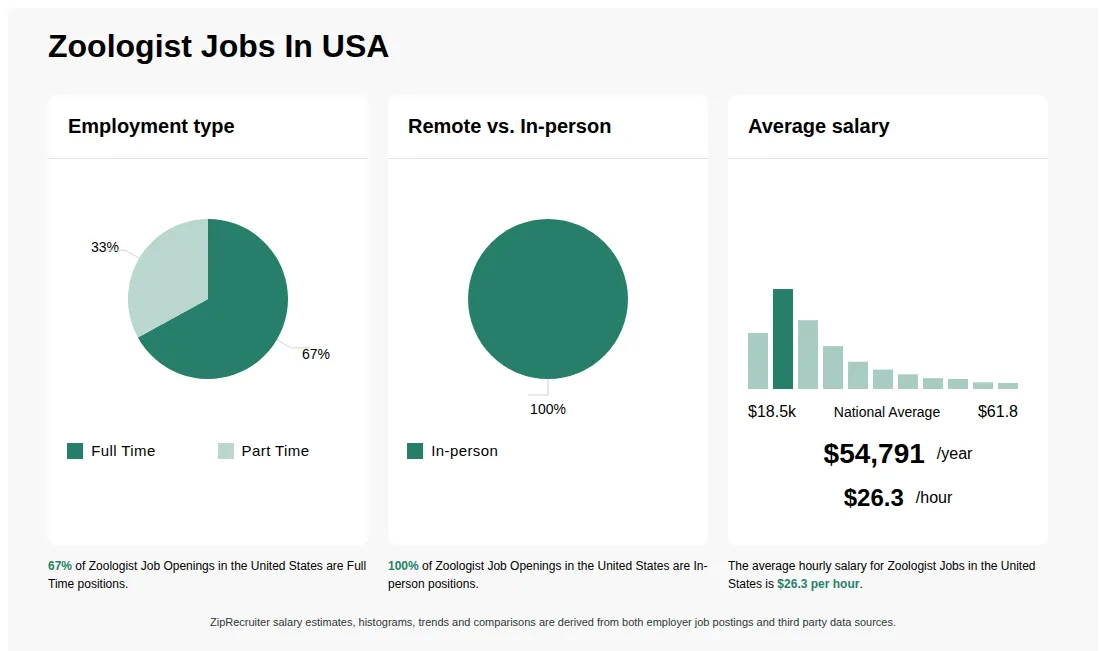
$8.89 - $13.70
16% of jobs
$15.17 is the 25th percentile. Wages below this are outliers.
$13.70 - $18.51
29% of jobs
The median wage is $19.71 / hr.
$18.51 - $23.32
19% of jobs
$27.58 is the 75th percentile. Wages above this are outliers.
$23.32 - $28.13
12% of jobs
$28.13 - $32.93
8% of jobs
$32.93 - $37.74
5% of jobs
$37.74 - $42.55
4% of jobs
$42.55 - $47.36
2% of jobs
$47.36 - $52.16
2% of jobs
$52.16 - $56.97
1% of jobs
$56.97 - $61.78
1% of jobs
$8
$26
$61
Zoologists are scientists who study animals. Most Zoologists split their time between lab or office work and fieldwork. Fieldwork allows them to study and gather data like migration patterns, reproduction statistics, and observe interactions of the animals with their environment. Lab and office work is needed to process and document results. They monitor things like the animals’ health and nutrition, often taking blood samples to learn about parasites, diseases, and the animal’s genetics. In addition to all this, Zoologists will also write papers, reports, and academic material on their work.
| Aspect | Zoologist | Wildlife Biologist |
|---|---|---|
| Required Credentials | Bachelor's or higher in zoology, biology, or related field | Bachelor's or higher in biology, ecology, or related field |
| Work Environment | Zoos, research labs, universities, fieldwork | Field research, conservation areas, national parks |
| Employer & Industry | Zoos, research institutions, universities | Government agencies, conservation organizations, research institutes |
| Common Search & Comparison | Yes | Yes |
Both zoologists and wildlife biologists study animals, but zoologists often focus on specific species or groups in controlled environments like zoos or labs, while wildlife biologists primarily conduct field research to understand animals in their natural habitats. The roles overlap in education and research, but their work settings and focus areas differ.
Cities with the most Zoologist job openings:
The most popular types of Zoologist jobs are:
The top employers for Zoologist jobs are:
States with the most job openings for Zoologist jobs include:
For Zoologist jobs, the most frequently searched job titles are:
Saint Louis, MO • On-site
Other
Posted 3 days ago
New
Posted on September 3, 2026
LocationsLocation: Saint Louis Zoo located in St. Louis, Missouri
Directly Reports to: Curator of Herpetology & Aquatics
Classification: Exempt
Position Summary: The Saint Louis Zoo is seeking exceptional candidates for the position of Zoological Manager of Herpetology & Aquatics, reporting to the Curator of Herpetology & Aquatics to manage the day to day operations of our Stingrays at Caribbean Cove marine habitat, assist the Ron and Karen Goellner Center for Hellbender Conservation, and additional duties associated with the Zoo’s Herpetology and Aquatics Department. This will be a working Manager position, with applicant working animal care routines regularly.
Competitive candidates must be critical thinkers who conduct themselves in a manner conducive to a stimulating, productive, and positive work culture. The Zoological Manager must be an effective communicator who leads an innovative and passionate team of keepers to perform at their highest level. Applicants must have strong emotional intelligence, patience, and positive outlook. The candidate will develop this position to achieve the highest standards of animal care, team excellence, professional satisfaction, and exceptional guest engagement.
The successful candidate will have a very strong background and expertise in herpetological and aquatics management, with an emphasis in elasmobranchs, aquatic systems, and preference for experience working with Cryptobranchid salamanders.
Must be capable of managing a large and diverse collection, associated facilities, and leading a large animal care team. This position reports directly to the Curator of Herpetology & Aquatics and works closely with the Curator and other department Zoological Manager to implement protocols, collection planning, conservation initiatives, and guest engagement strategies. This candidate will oversee the day-to-day operations of a large public, interactive habitat housing four species of elasmobranchs and must demonstrate substantial experience with ambassador animals, public interaction programs, and delivering safe, meaningful, and high-quality guest experiences.
This position will also assist with the Saint Louis Zoo’s WildCare Institute Ron and Karen Goellner Center for Hellbender Conservation and will collaborate closely with external partners on this project. The successful candidate will support the Zoo’s mission and serve as an active leader in operationalizing the Zoo’s values (Community, Creativity, Integrity, Openness, and Life-Work Balance) and three guiding keys (Animals Always, Operational Excellence, and People Matter).
ResponsibilitiesThe employee frequently is required to stand, sit and walk for long periods. The employee must frequently lift and/or move up to 25 pounds and occasionally lift and/or move up to 50 pounds. Must be able to work in hot and cold conditions. Applicants must be able to scuba dive and snorkel in zoo habitats as well as in the field.
Work ScheduleDays off will be either Friday-Saturday or Sunday-Monday. Ability to work a flexible schedule, on holidays, and evenings for animal procedures and events will be necessary at times. Will need to have the ability to work onsite in inclement weather.
About the Saint Louis ZooThe world-renowned Saint Louis Zoo is dedicated to saving species and bringing people and wildlife together. Home to over 16,000 animals, many of which are endangered. Entry is free every day for everyone, an important part of our commitment to people and animals – always.
Learn more at: https://stlzoo.org/
About St. Louis, MoFrom Explore St. Louis: “Urban explorer, outdoor adventurer, aficionado of family fun – no matter your travel persona, you’ll find plenty to do in St. Louis. The city is brimming with free, world-class attractions and boasts an arts-and-culture scene that’s second to none. Plus, fans of fresh air will be surprised and delighted by our flourishing public parks, miles of trails and exhilarating waterways. Sprinkle in a bit of our secret sauce – the warmth and hospitality of the residents – and you’ll discover that St. Louis dishes up undeniably epic travel experiences. Don’t take our word for it, though. Come and see for yourself.” Learn more at https://explorestlouis.com/
Education RequiredBachelors or better.
Equal Opportunity Employer
This employer is required to notify all applicants of their rights pursuant to federal employment laws. For further information, please review the Know Your Rights notice from the Department of Labor.




