1

Web Performance Engineer Jobs (NOW HIRING)

Web Engineer - X

Palo Alto, CA · On-site

$180K - $440K/yr

... of web performance and innovation. You have the ability to thrive in a fast-paced environment ... Uphold engineering excellence via testing, monitoring, deployment, and secure data handling.

We are seeking a skilled and detail-oriented Web Developer to design, build, and maintain modern ... Understanding of responsive design, cross-browser compatibility, and web performance * Strong ...

Enterprise Solutions, Web Development, Data Warehousing, Systems Integration, IT Security, Storage ... Job Title: Sr. Performance Engineer (with Retail Domain and Rational Performance Testing experience ...

Web Engineer - X

Palo Alto, CA · On-site

$180K - $440K/yr

ABOUT THE ROLE: We're looking for exceptional Fullstack / Web Engineers that can work across the ... Proven track record of optimizing applications for performance, security, and offline functionality.

ABOUT THE ROLE: We're looking for exceptional Fullstack / Web Engineers that can work across the ... Proven track record of optimizing applications for performance, security, and offline functionality.

Web Engineering Lead Location: Downtown Miami, FL - Onsite 4 days/week (must be onsite from Day 1) ... Architect scalable, accessible, and high-performance web applications. * Drive adoption of modern ...

Web Producer III Location : Palo Alto, CA - Open to Remote Duration : 6 Months+ Schedule Notes ... performance (you dont need to be an engineer, but you can speak their language). * Experience ...

next page

Showing results 1-20

Web Performance Engineer information

See salary details

$11

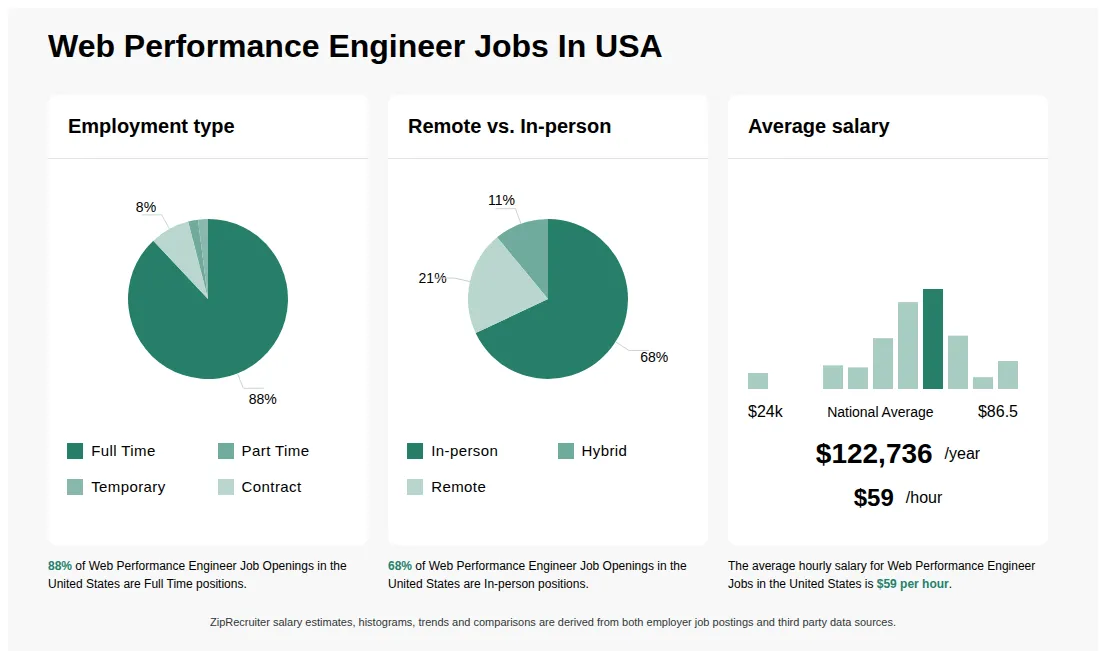
$59

$86

How much do web performance engineer jobs pay per hour?

As of Jun 22, 2026, the average hourly pay for web performance engineer in the United States is $59.01, according to ZipRecruiter salary data. Most workers in this role earn between $51.20 and $66.83 per hour, depending on experience, location, and employer.

What does a Web Performance Engineer do?

A Web Performance Engineer specializes in optimizing the speed, responsiveness, and overall performance of websites and web applications. They analyze site metrics, identify bottlenecks, and implement solutions such as code optimizations, efficient asset loading, and server-side improvements. Their goal is to ensure users have a fast and seamless experience, which can positively impact user engagement and search rankings. Web Performance Engineers often work closely with developers, designers, and DevOps teams to address performance issues throughout the development lifecycle.

What are some common challenges Web Performance Engineers face when optimizing large-scale websites?

Web Performance Engineers often encounter challenges such as balancing performance improvements with maintaining site functionality, addressing bottlenecks in both front-end and back-end systems, and ensuring that optimizations do not negatively impact user experience. Working with legacy codebases or third-party scripts can further complicate the process, requiring creative solutions and strong collaboration with development, QA, and DevOps teams. Staying current with evolving web technologies and performance measurement tools is also essential to continuously drive improvements.

What is the difference between Web Performance Engineer vs Web Developer?

AspectWeb Performance EngineerWeb Developer
Primary FocusOptimizing website speed and performanceBuilding and maintaining website features and functionality
Skills & CertificationsPerformance testing, web optimization, coding skills, certifications like Google Analytics or LighthouseProgramming languages, front-end/back-end development, frameworks
Work EnvironmentPerformance testing labs, development teams, QA environmentsDevelopment teams, project management, design teams
Industry UsageTech, e-commerce, media, any online service prioritizing speedAll industries with web presence, including tech, retail, finance

While both roles work closely within web development teams, Web Performance Engineers specialize in optimizing website speed and efficiency, whereas Web Developers focus on creating and maintaining website features. Understanding these differences helps organizations assign the right talent for performance versus development tasks.

What are the key skills and qualifications needed to thrive as a Web Performance Engineer, and why are they important?

To thrive as a Web Performance Engineer, you need expertise in front-end and back-end web technologies, knowledge of web performance optimization strategies, and a relevant degree in computer science or a related field. Familiarity with tools such as Lighthouse, WebPageTest, Chrome DevTools, and content delivery networks (CDNs) is crucial, and certifications like Google Mobile Web Specialist can be advantageous. Strong problem-solving skills, attention to detail, and effective communication help you collaborate with development teams and present findings clearly. These skills and qualities are essential to ensure websites run efficiently, deliver excellent user experiences, and meet business objectives.
More about Web Performance Engineer jobs
What job categories do people searching Web Performance Engineer jobs look for? The top searched job categories for Web Performance Engineer jobs are:

Job description

Role#1Performance Engineer
Location: Remote
Job Type: Contract
Skills required.
  • Strong Scripting skills in Performance testing tools like JMeter/Load runner.
  • Strong knowledge of HTTP and other Web Protocols. Ability to script tests, by getting into the protocol details

• Proficient in API/UI performance testing with JMeter/Blazemeter/Grafana
• Sound knowledge in API virtualization concepts
• Proficient in On prem vs Cloud( AWS) performance testing strategies
• Hands on experience in APM tools like Dynatrace/NewRelic/AppDynamics
• Good knowledge in analyzing performance logs using ELK/Splunk
• Strong analyzing/data mining skills using SQL.
• Experience on Kafka/messaging performance testing will be an added advantage.
• Strong in performance engineering concepts and CPU/Memory bottleneck analysis.
• Experience with Financial Services industry external facing /Internal Applications and microservices
Responsibilities :
• Identify Performance testing Objectives/Strategy and define non-functional requirements by working with key business and IT users and project stakeholders.
• Understand application usage models from relevant stakeholders and analyzing existing production load patterns.
• Identify and recommend Performance testing tools to be used to meet client requirements as they grow the number of concurrent users.
• Participate in design and architecture reviews.
• Develop required infrastructure including performance simulators, test bench components, analysis tools and capacity planning.
• Derive workload models appropriately scaled to the performance test environment.
• Work with multiple product teams to design, create, execute, and report on capacity, scalability, stability, and stress tests.
• Create Performance Test scripts that are robust and maintainable.
• Conduct various performance tests and schedule timeframes with key business and IT resources to monitor, witness and support the performance test analysis.
• Analyze test results and publish meaningful, pragmatic performance test metrics and results (including defects) for action by the application and infrastructure owners for remediation and repair.
• Partner with technical teams to facilitate troubleshooting of performance issues.
• Identify and receive approval for Performance Test conditions by working with key project stakeholders.