Position will include direct supervisory responsibility of staff to include hiring decisions ... Keep current on transportation engineering trends and developments to recommend changes in program ...
Position will include direct supervisory responsibility of staff to include hiring decisions ... Keep current on transportation engineering trends and developments to recommend changes in program ...

Transportation Engineering Director
Indianapolis, IN · Hybrid
$210K - $230K/yr
Transportation Engineering Director, P.E. - Indiana Market Leader Transportation & Infrastructure ... Location, Travel, and Work Arrangement This position is based in GAI's Fishers, Indiana office on a ...
Transportation Engineering Director
Indianapolis, IN · Hybrid
$210K - $230K/yr
Transportation Engineering Director, P.E. - Indiana Market Leader Transportation & Infrastructure ... Location, Travel, and Work Arrangement This position is based in GAI's Fishers, Indiana office on a ...

... track faculty position to support the curriculum and research efforts of the department in the areas of Transportation Engineering and Systems. Rank and tenure will be determined based on the ...
... track faculty position to support the curriculum and research efforts of the department in the areas of Transportation Engineering and Systems. Rank and tenure will be determined based on the ...

Position Summary McCormick Taylor is seeking a Transportation Engineering Lead to join our Transportation Department in our Pittsburgh office, offering a flexible and hybrid work environment. The ...
Position Summary McCormick Taylor is seeking a Transportation Engineering Lead to join our Transportation Department in our Pittsburgh office, offering a flexible and hybrid work environment. The ...

As Transportation Engineering Team Lead, you will develop engineers and Project Managers ... Why This Role This position offers the opportunity to: * Lead and develop a team of transportation ...
As Transportation Engineering Team Lead, you will develop engineers and Project Managers ... Why This Role This position offers the opportunity to: * Lead and develop a team of transportation ...
As Transportation Engineering Team Lead, you will develop engineers and Project Managers ... Why This Role This position offers the opportunity to: * Lead and develop a team of transportation ...
As Transportation Engineering Team Lead, you will develop engineers and Project Managers ... Why This Role This position offers the opportunity to: * Lead and develop a team of transportation ...

Transportation Engineering Intern
$20 - $30/hr
Ardurra is seeking a Transportation Engineering Intern to join our team in Seattle, WA. Primary ... The expected hourly range for this position is $20/hr to $30/hr. Why Ardurra? While Ardurra offers ...
Quick apply
Transportation Engineering Intern
$20 - $30/hr
Ardurra is seeking a Transportation Engineering Intern to join our team in Seattle, WA. Primary ... The expected hourly range for this position is $20/hr to $30/hr. Why Ardurra? While Ardurra offers ...
Transportation Engineering Intern
$20 - $30/hr
Ardurra is seeking a Transportation Engineering Intern to join our team in Olympia, WA. Primary ... The expected hourly range for this position is $20/hr to $30/hr. Why Ardurra? While Ardurra offers ...
Quick apply
Transportation Engineering Intern
$20 - $30/hr
Ardurra is seeking a Transportation Engineering Intern to join our team in Olympia, WA. Primary ... The expected hourly range for this position is $20/hr to $30/hr. Why Ardurra? While Ardurra offers ...
Transportation Engineering Director
Indianapolis, IN · On-site
$210K - $230K/yr
Transportation Engineering Director, P.E. - Indiana Market Leader Transportation & Infrastructure ... Location, Travel, and Work Arrangement This position is based in GAI's Fishers, Indiana office on a ...
Transportation Engineering Director
Indianapolis, IN · On-site
$210K - $230K/yr
Transportation Engineering Director, P.E. - Indiana Market Leader Transportation & Infrastructure ... Location, Travel, and Work Arrangement This position is based in GAI's Fishers, Indiana office on a ...

Transportation Engineering Intern
Minneapolis, MN · On-site
$25/hr
As a Transportation Engineering Intern, you'll have the opportunity to contribute to real-world ... The pay rate for this position is expected to be $25.00 per hour, depending on experience and ...
Quick apply
Transportation Engineering Intern
Minneapolis, MN · On-site
$25/hr
As a Transportation Engineering Intern, you'll have the opportunity to contribute to real-world ... The pay rate for this position is expected to be $25.00 per hour, depending on experience and ...

Transportation - Engineering Designer
Draper, UT · Hybrid
$70K - $105K/yr
New multiuse trail projects This position offers handson learning across project types and phases ... * 2+ years of civil engineering experience, preferably in transportation or roadway design
Transportation - Engineering Designer
Draper, UT · Hybrid
$70K - $105K/yr
New multiuse trail projects This position offers handson learning across project types and phases ... * 2+ years of civil engineering experience, preferably in transportation or roadway design
Transportation Engineering Intern
$20 - $30/hr
Ardurra is seeking a Transportation Engineering Intern to join our team in Everett, WA. Primary ... The expected hourly range for this position is $20hr to $30/hr. Why Ardurra? While Ardurra offers ...
Quick apply
Transportation Engineering Intern
$20 - $30/hr
Ardurra is seeking a Transportation Engineering Intern to join our team in Everett, WA. Primary ... The expected hourly range for this position is $20hr to $30/hr. Why Ardurra? While Ardurra offers ...

Transportation Engineering Intern
Seattle, WA · On-site
$20 - $30/hr
Ardurra is seeking a Transportation Engineering Intern to join our team in Seattle, WA. Primary ... The expected hourly range for this position is $20/hr to $30/hr. Why Ardurra? While Ardurra offers ...
Transportation Engineering Intern
Seattle, WA · On-site
$20 - $30/hr
Ardurra is seeking a Transportation Engineering Intern to join our team in Seattle, WA. Primary ... The expected hourly range for this position is $20/hr to $30/hr. Why Ardurra? While Ardurra offers ...

... transportation, and water resources engineering. Civil engineering faculty strive to deliver ... All qualified candidates will receive consideration for the position applied for without regard to ...
... transportation, and water resources engineering. Civil engineering faculty strive to deliver ... All qualified candidates will receive consideration for the position applied for without regard to ...
Transportation Engineering Intern
$20 - $30/hr
Ardurra is seeking a Transportation Engineering Intern to join our team in Wenatchee, WA. Primary ... The expected hourly range for this position is $20/hr to $30/hr. Why Ardurra? While Ardurra offers ...
Quick apply
Transportation Engineering Intern
$20 - $30/hr
Ardurra is seeking a Transportation Engineering Intern to join our team in Wenatchee, WA. Primary ... The expected hourly range for this position is $20/hr to $30/hr. Why Ardurra? While Ardurra offers ...
Transportation - Engineering Designer
Draper, UT · On-site
$70K - $105K/yr
New multi-use trail projects This position offers hands-on learning across project types and phases ... civil engineering experience, preferably in transportation or roadway design * Proficiency with ...
Transportation - Engineering Designer
Draper, UT · On-site
$70K - $105K/yr
New multi-use trail projects This position offers hands-on learning across project types and phases ... civil engineering experience, preferably in transportation or roadway design * Proficiency with ...
Transportation Engineering Intern
Olympia, WA · On-site
$20 - $30/hr
Ardurra is seeking a Transportation Engineering Intern to join our team in Olympia, WA. Primary ... The expected hourly range for this position is $20/hr to $30/hr. Why Ardurra? While Ardurra offers ...
Transportation Engineering Intern
Olympia, WA · On-site
$20 - $30/hr
Ardurra is seeking a Transportation Engineering Intern to join our team in Olympia, WA. Primary ... The expected hourly range for this position is $20/hr to $30/hr. Why Ardurra? While Ardurra offers ...
Transportation Engineering Intern
Wenatchee, WA · On-site
$20 - $30/hr
Ardurra is seeking a Transportation Engineering Intern to join our team in Wenatchee, WA. Primary ... The expected hourly range for this position is $20/hr to $30/hr. Why Ardurra? While Ardurra offers ...
Transportation Engineering Intern
Wenatchee, WA · On-site
$20 - $30/hr
Ardurra is seeking a Transportation Engineering Intern to join our team in Wenatchee, WA. Primary ... The expected hourly range for this position is $20/hr to $30/hr. Why Ardurra? While Ardurra offers ...

Academic Affairs - Faculty Opening Date: 03/06/2025 Position Summary Located 45 minutes from the ... Physics and Engineering. CSM is looking for dynamic individuals who can implement the comprehensive ...
Academic Affairs - Faculty Opening Date: 03/06/2025 Position Summary Located 45 minutes from the ... Physics and Engineering. CSM is looking for dynamic individuals who can implement the comprehensive ...
... transportation, and water resources engineering. Civil engineering faculty strive to deliver ... All qualified candidates will receive consideration for the position applied for without regard to ...
... transportation, and water resources engineering. Civil engineering faculty strive to deliver ... All qualified candidates will receive consideration for the position applied for without regard to ...
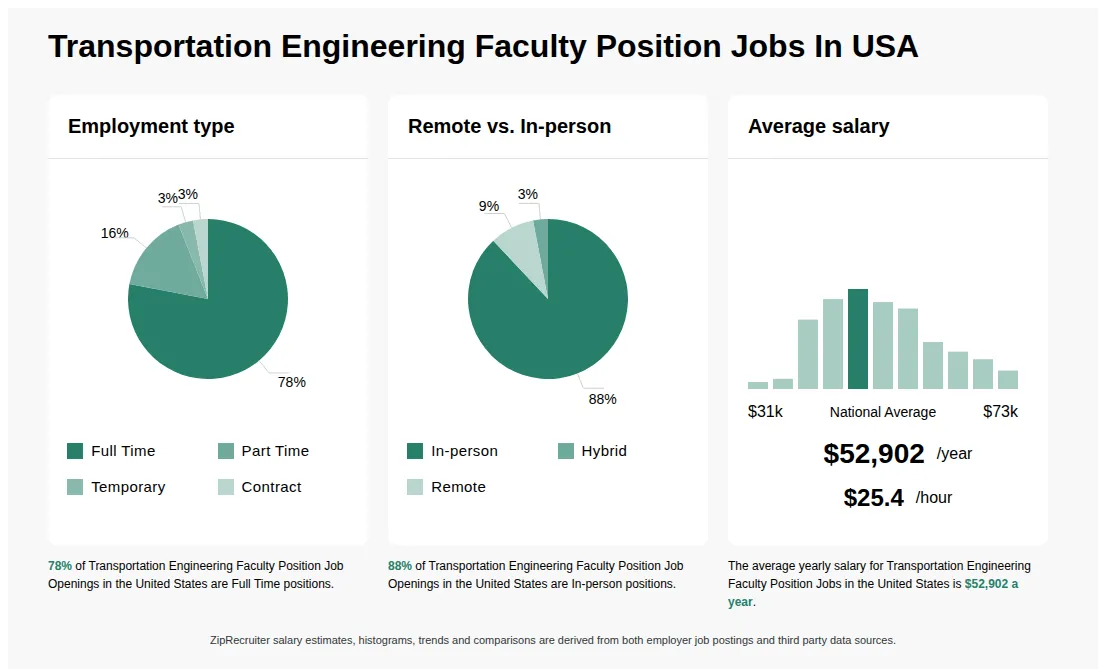
Transportation Engineering Faculty Position information
See salary details
$31K - $34.8K
1% of jobs
$34.8K - $38.6K
1% of jobs
$38.6K - $42.5K
13% of jobs
$45K is the 25th percentile. Wages below this are outliers.
$42.5K - $46.3K
16% of jobs
$46.3K - $50.1K
18% of jobs
The median wage is $50.6K / yr.
$50.1K - $53.9K
16% of jobs
$57.1K is the 75th percentile. Wages above this are outliers.
$53.9K - $57.7K
14% of jobs
$57.7K - $61.5K
8% of jobs
$61.5K - $65.4K
6% of jobs
$65.4K - $69.2K
5% of jobs
$69.2K - $73K
3% of jobs
$31K
$52.9K
$73K
How much do transportation engineering faculty position jobs pay per year?
As of Sep 14, 2026, the average yearly pay for transportation engineering faculty position in the United States is $52,902.00, according to ZipRecruiter salary data. Most workers in this role earn between $45,000.00 and $58,500.00 per year, depending on experience, location, and employer.
What is a transportation engineering faculty position?
Transportation Engineering Faculty Positions are academic roles at colleges or universities where individuals teach, conduct research, and provide service in the field of transportation engineering. Faculty members often instruct undergraduate and graduate courses, supervise student research, and publish scholarly work on topics like traffic flow, infrastructure design, and transportation systems. These positions typically require a doctoral degree in civil or transportation engineering and may involve collaborating with industry or government agencies. Faculty are also expected to contribute to curriculum development and serve on academic committees. The role combines education, research, and professional engagement to advance knowledge and practice in transportation engineering.
What are the typical responsibilities of a transportation engineering faculty member beyond teaching?
In addition to teaching undergraduate and graduate courses, Transportation Engineering faculty members are often involved in conducting research, securing grant funding, and publishing scholarly work. They may supervise graduate students, collaborate with industry partners or government agencies on transportation projects, and participate in university service such as committee work. Balancing these responsibilities can be challenging, but it provides opportunities for professional growth, networking, and contributing to advancements in the field.
What are the key skills and qualifications needed to thrive as a transportation engineering faculty member?
To thrive as a Transportation Engineering Faculty member, you need an advanced degree (typically a Ph.D.) in civil or transportation engineering, a strong research background, and teaching experience. Familiarity with transportation modeling software, statistical analysis tools, and experience in grant writing or publication are highly valuable. Excellent communication, mentorship, and collaboration skills help in engaging students and working effectively within academic and industry networks. These competencies ensure impactful teaching, meaningful research contributions, and successful academic service in a competitive university environment.
What is the difference between Transportation Engineering Faculty Position vs Transportation Engineer?
| Aspect | Transportation Engineering Faculty Position | Transportation Engineer |
|---|---|---|
| Required Credentials | Ph.D. or master's in transportation engineering or related field; academic credentials | Bachelor's or master's in civil or transportation engineering; professional licensure optional |
| Work Environment | Academic setting, teaching, research, publishing | Design, analysis, project management in transportation projects |
| Employer & Industry Usage | Universities, research institutions | Government agencies, consulting firms, construction companies |
| Common Search & Comparison | Academic roles, research focus | Practical engineering, project implementation |
The main difference between a Transportation Engineering Faculty Position and a Transportation Engineer lies in their work environment and focus. Faculty positions are primarily academic, emphasizing teaching and research, often requiring advanced degrees. Transportation Engineers work in practical settings, focusing on designing and managing transportation projects. Both roles are essential in the transportation industry but serve different career paths and objectives.
What states have the most Transportation Engineering Faculty Position jobs?
States with the most job openings for Transportation Engineering Faculty Position jobs include:
What are popular job titles related to Transportation Engineering Faculty Position jobs?
For Transportation Engineering Faculty Position jobs, the most frequently searched job titles are:

Transportation Engineering Director
West Palm Beach, FL • On-site
Bowman Consulting Group, Ltd.
• Engineering Professional Services • 1 - 10 employees1 - 10 employees
Full-time
Medical, Dental, Vision, Life, Retirement, PTO
Re-posted 16 days ago
Job description
Short Description
Bowman has an opportunity for a Transportation Engineering Director to join our team in West Palm Beach, FL.
At Bowman, we believe in creating opportunities for aspiring people to thrive and achieve ambitious goals. That's why a career at Bowman is more than a job. It is an opportunity to be part of a diverse and engaged community of professionals, to be treated as a respected and valued member of a motivated team and to be empowered to do exceptional work that advances the best interest of everyone involved. We recognize the importance of creating a work environment that is both rewarding to our employees and supportive of our unwavering commitment to provide unparalleled service to our clients.
Purpose
Responsible for the Transportation function of assigned business unit.
Responsibilities
Leadership and Direction
At the Operational and Company Level
Do the Work
Success Metrics and Competencies
Qualifications
About Bowman
Are you ready to build a career that makes a lasting impact? At Bowman, our people are at the center of everything we do. We're committed to creating an environment where employees can thrive both personally and professionally, while helping to shape the infrastructure of tomorrow.
A career at Bowman means being part of a collaborative, forward-thinking organization where innovation, inclusion, and growth are encouraged at every level. We offer competitive compensation, a supportive work environment, and benefits designed to help our employees succeed.
Our comprehensive benefits package includes:
Eligibility for certain benefits may vary based on position, location, and employment status.
Physical Demands and Working Environment
#LI-TD1
Job Description Disclaimer
Note: While this job description is intended to be an accurate reflection of the job requirements, it is not designed to cover or contain a comprehensive listing of activities, duties or responsibilities that are required of the employee for this job. Management reserves the right to modify, add, or remove duties from particular jobs and to assign other duties as necessary at any time with or without notice.
Bowman is proud to be an Equal Opportunity Employer committed to fostering a diverse and inclusive workplace where all employees feel valued and respected. All qualified applicants will receive consideration for employment without regard to race, color, religion, sex, sexual orientation, gender identity, national origin, disability or protected veteran status. For our EEO Policy Statement, please click here. If you'd like more information on your EEO rights under the law, please click here.
Bowman has an obligation to provide and maintain a safe, healthy, and productive environment for its employees and clients. We are committed to maintaining a drug and alcohol-free workplace.
If you have any questions about the application process, please email recruiting@bowman.com.
Bowman has an opportunity for a Transportation Engineering Director to join our team in West Palm Beach, FL.
At Bowman, we believe in creating opportunities for aspiring people to thrive and achieve ambitious goals. That's why a career at Bowman is more than a job. It is an opportunity to be part of a diverse and engaged community of professionals, to be treated as a respected and valued member of a motivated team and to be empowered to do exceptional work that advances the best interest of everyone involved. We recognize the importance of creating a work environment that is both rewarding to our employees and supportive of our unwavering commitment to provide unparalleled service to our clients.
Purpose
Responsible for the Transportation function of assigned business unit.
Responsibilities
Leadership and Direction
- Perform work under very limited guidance requiring the need to exercise independent judgement and discretion on a continual basis.
- Position will include direct supervisory responsibility of staff to include hiring decisions, direction and delegation of work assignments, performance and evaluation, training and development, employee relations and disciplinary issues, compensation, and termination decisions.
- Provide oversight and direction of department or business unit including strategy, budgeting, staff, and deliverables.
- Guide management team of Team Leads and Project Managers in the direction, management and supervision of transportation engineering team.
At the Operational and Company Level
- Lead the administrative, technical, and management techniques applied on projects throughout the department/team to ensure consistently successful completion, on time and within budget.
- Develop processes and provide input on achieving company and office operational excellence while growing region and office.
- Continually market the firm's capabilities to establish new clients and enhance relationships.
Do the Work
- Interact with clients, prepare new contract proposals, change orders, and attend project meetings.
- Lead and manage current project teams from bid until completion, while looking to obtain future business and performing own project duties.
- Mentor and direct junior staff, coordinate with project managers, and be responsible for goal setting and performance management of engineering team.
- Provide work assignments and review performance to ensure the efficient, cost-effective utilization of staff.
- Keep current on transportation engineering trends and developments to recommend changes in program or design methods.
Success Metrics and Competencies
- Professional attitude and appearance.
- Strong leadership skills.
- Ability to lead & develop an engineering and project management team.
- Ability to work both independently and within a collaborative team environment.
- Self-reliance and ability to operate independently with limited direction.
- Ability to effectively manage multiple time-sensitive tasks.
- Ability to manage competing demands and establish priorities.
- Flexibility, tact, and excellent interpersonal skills.
- Effective verbal and written communication skills.
- Ability to effectively communicate with all levels of the organization and external partners.
- Effective working relationship with internal leaders and peers, as well as external clients.
- Commitment to working in partnership with others inside and outside the organization.
- High degree of discretion and ability to manage highly confidential information.
- Highly motivated and problem-solving attitude with a strong work ethic.
- Strong sense of urgency in responding to constituents.
- Commitment to promoting the reputation of the company through quality of work.
- Aspirations to grow professionally and advance within the company.
- Strong data analysis and interpretation skills.
- Basic understanding of financial reports and metrics.
- Strong marketing/business development skills and mindset.
- Commitment to driving profitability and growth.
- Commitment to becoming a "citizen" of the broader organization, breaking down barriers and silos.
Qualifications
- Bachelor's degree in civil engineering or related field required.
- Fifteen or more (15+) years of professional consulting and/or related DOT or transportation design experience to include a minimum of five (5) years project management experience.
- Professional Engineer (PE) Registration required.
- Professional Transportation Operations Engineer (PTOE) required.
- Demonstrated technical experience with a wide range of transportation projects and experience serving clients required.
- Experience with processing transportation studies and designs in relevant counties/municipalities required.
- Thorough understanding of municipal and DOT codes and regulations required.
- Valid state driver's license and ability to successfully pass a motor vehicle check or reliable form of transportation to/from the office and/or project site strongly preferred.
About Bowman
Are you ready to build a career that makes a lasting impact? At Bowman, our people are at the center of everything we do. We're committed to creating an environment where employees can thrive both personally and professionally, while helping to shape the infrastructure of tomorrow.
A career at Bowman means being part of a collaborative, forward-thinking organization where innovation, inclusion, and growth are encouraged at every level. We offer competitive compensation, a supportive work environment, and benefits designed to help our employees succeed.
Our comprehensive benefits package includes:
- Medical, dental, vision, life, and disability insurance
- 401(k) retirement savings plan with company match
- Paid time off, sick leave, and paid holidays
- Tuition reimbursement and professional development support
- Discretionary bonuses and other performance-based incentives
- Employee Assistance Program (EAP), wellness initiatives, and employee discounts
Eligibility for certain benefits may vary based on position, location, and employment status.
Physical Demands and Working Environment
- May be eligible for hybrid or remote work arrangements.
- Primarily indoor professional office environment which may include bright/dim light, noise, fumes, odors, and traffic.
- Mobility around an office environment.
- Frequent and prolonged use of standard office equipment such as computers, phones, photocopiers, filing cabinets and fax machines.
- Occasional outdoor work environment which may include adverse weather conditions, varying temperatures, excessive noise, and/or potential hazards.
- Mobility around a job/construction site to include walking, bending, crawling, climbing, squatting, or kneeling and wearing of required Personal Protective Equipment (PPE).
- Primarily local travel during the business day, although some out-of-the-area and overnight travel may be required according to the needs of the business.
- Occasional lifting or carrying up to 20 pounds.
- Occasional pushing or pulling up to 20 pounds.
- Occasional reaching outward or above shoulder.
#LI-TD1
Job Description Disclaimer
Note: While this job description is intended to be an accurate reflection of the job requirements, it is not designed to cover or contain a comprehensive listing of activities, duties or responsibilities that are required of the employee for this job. Management reserves the right to modify, add, or remove duties from particular jobs and to assign other duties as necessary at any time with or without notice.
Bowman is proud to be an Equal Opportunity Employer committed to fostering a diverse and inclusive workplace where all employees feel valued and respected. All qualified applicants will receive consideration for employment without regard to race, color, religion, sex, sexual orientation, gender identity, national origin, disability or protected veteran status. For our EEO Policy Statement, please click here. If you'd like more information on your EEO rights under the law, please click here.
Bowman has an obligation to provide and maintain a safe, healthy, and productive environment for its employees and clients. We are committed to maintaining a drug and alcohol-free workplace.
If you have any questions about the application process, please email recruiting@bowman.com.

About BOWMAN CONSULTING GROUP
Sourced by ZipRecruiter
Industry
Engineering professional services
Company size
1 - 10 Employees
Headquarters location
Leesburg, VA, US