1

Tcs Data Analytics Jobs (NOW HIRING)

Solution Architect

Edison, NJ · On-site

$64 - $84.25/hr

The role involves engaging with key stakeholders to shape Cloud Data & Analytics strategy and ... TCS positioning with customers and build business for TCS • Develop Point of views, solution ...

Obtain and analyze declaration data from brokers; identify risks and opportunities. Classification ... The TCS has a relevant university degree or higher, supplemented by relevant professional training.

Data Engineer

Nashua, NH · On-site

$115K - $138K/yr

The Data Engineer will work closely with the IS Lead, Data Analyst, Business Analyst, corporate IT, implementation partners, functional data owners, and the AI Solutions & Automation team. The role ...

next page

Showing results 1-20

Tcs Data Analytics information

See salary details

$46K

$165K

$243.5K

How much do tcs data analytics jobs pay per year?

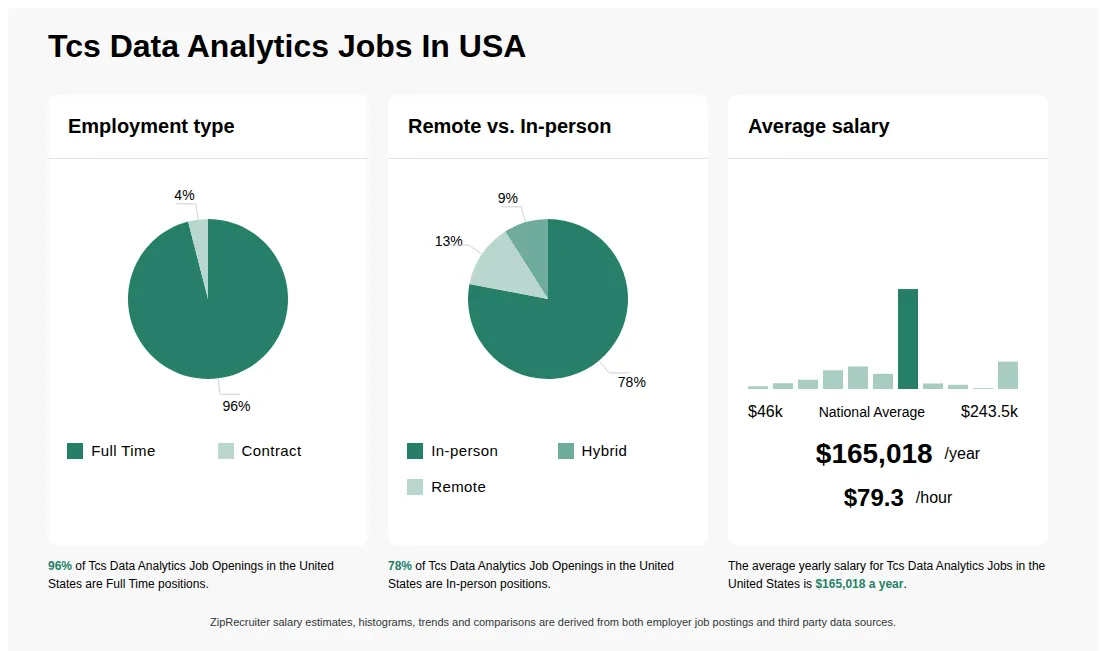
As of Jul 13, 2026, the average yearly pay for tcs data analytics in the United States is $165,018.00, according to ZipRecruiter salary data. Most workers in this role earn between $133,500.00 and $170,000.00 per year, depending on experience, location, and employer.

What are the typical collaboration patterns for a Data Analytics professional at TCS?

As a Data Analytics professional at TCS, you will frequently collaborate with cross-functional teams, including business analysts, domain experts, and software developers. Your role often involves translating business requirements into analytical solutions, presenting insights to stakeholders, and working closely with project managers to ensure timely delivery. Effective communication and teamwork are crucial, as you'll participate in regular meetings, share findings, and coordinate with both onsite and offshore teams. This collaborative environment fosters continuous learning and broadens your exposure to various industries and technologies.

What are the key skills and qualifications needed to thrive as a TCS Data Analytics professional, and why are they important?

To thrive as a TCS Data Analytics professional, you need strong analytical abilities, proficiency in statistics, and a solid educational background in computer science, mathematics, or related fields. Familiarity with data analytics tools like Python, R, SQL, Tableau, and experience with big data platforms such as Hadoop or Spark, along with relevant certifications, is often required. Excellent problem-solving skills, effective communication, and the ability to work collaboratively in teams distinguish top performers. These skills and qualities are essential for extracting actionable insights from complex data, driving business decisions, and delivering value to clients.

What is TCS Data Analytics?

TCS Data Analytics refers to the suite of data analysis services provided by Tata Consultancy Services (TCS), a global IT services and consulting company. These services help organizations collect, process, and analyze large volumes of data to extract actionable insights and drive better business decisions. TCS Data Analytics covers areas such as big data, predictive analytics, business intelligence, and advanced machine learning solutions across various industries. The goal is to enable clients to harness the power of data for innovation, efficiency, and competitive advantage.

What is the difference between Tcs Data Analytics vs Data Analyst?

AspectTcs Data AnalyticsData Analyst
Required CredentialsBachelor's degree in IT, Computer Science, or related fields; certifications like CAP, Microsoft Certified Data AnalystBachelor's degree in relevant fields; certifications like Microsoft Data Analyst Associate
Work EnvironmentCorporate offices, IT firms, consulting companiesBusiness organizations, consulting firms, tech companies
Employer & Industry UsageIT services, consulting, telecom, bankingFinance, marketing, healthcare, retail

While Tcs Data Analytics roles focus on implementing analytics solutions within large organizations and often involve working with TCS-specific tools and projects, Data Analysts typically perform data collection, cleaning, and analysis to support business decision-making across various industries. Both roles require similar skills but differ in scope and organizational context.

More about Tcs Data Analytics jobs
What states have the most Tcs Data Analytics jobs? States with the most job openings for Tcs Data Analytics jobs include:
Infographic showing various Tcs Data Analytics job openings in the United States as of July 2026, with employment types broken down into 1% Internship, 94% Full Time, 3% Part Time, and 2% Contract. Highlights an 79% Physical, 5% Hybrid, and 16% Remote job distribution, with an average salary of $165,018 per year, or $79.3 per hour.
Sr Google Cloud Platform Data Product Owner - Phoenix, AZ (Onsite) - 6 months

Sr Google Cloud Platform Data Product Owner - Phoenix, AZ (Onsite) - 6 months

Advent Global Solutions, Inc.

Phoenix, AZ • On-site

$47/hr

Other

This job post has expired today. Applications are no longer accepted.


Job description

Role: Sr Google Cloud Platform Data Product Owner
Location: Phoenix, AZ (Onsite)

Duration: 6 months

Implementation: TCS

CTC Rate: $47/hr | W2 Rate: $44/hr

Role Overview

Senior Data Product Owner with a strong data analytics background. This role requires 10+ years of experience in Product Ownership or Data Product Management, with hands-on experience in data ingestion frameworks, Google Cloud Platform BigQuery, and cloud platforms. The candidate will define and drive the vision, roadmap, and strategy for data products while working cross-functionally within Agile/Scrum teams.

Required Skills & Experience

  • Bachelor''''''''''''''''s degree in Business, Computer Science, Information Systems, Data Analytics, Statistics, Engineering, or a related field.
  • 10+ years of experience in Product Ownership, Product Management, Business Analysis, or Data Product Management.
  • Strong understanding of Agile/Scrum methodologies.
  • Experience working with data warehouses, data lakes, and cloud platforms.
  • Hands-on experience with Google Cloud Platform BigQuery.
  • Hands-on experience with data ingestion frameworks, data controls, and related operational considerations.
  • Proficiency in SQL and data analysis.
  • Experience with BI and visualization tools such as Power BI, Tableau, Looker, or similar.
  • Strong stakeholder management and communication skills.
  • Ability to translate complex business requirements into technical solutions.

Responsibilities

Product Strategy & Vision

  • Define and communicate the vision, roadmap, and strategy for data products.
  • Align product objectives with business goals and data strategy.
  • Identify opportunities to leverage data for business growth, operational efficiency, and customer experience improvement.

Backlog Management

  • Create, maintain, and prioritize the product backlog.
  • Develop user stories, acceptance criteria, and functional requirements.
  • Ensure backlog items are well-defined and ready for development.

Stakeholder Management

  • Collaborate with business leaders, analysts, data engineers, data scientists, and technical teams.
  • Gather and prioritize business requirements from multiple stakeholders.
  • Facilitate workshops and requirement-gathering sessions.

Data Product Development

  • Lead the development of dashboards, reporting platforms, data pipelines, data marts, machine learning products, and self-service analytics solutions.
  • Define KPIs, metrics, and success criteria for data products.
  • Ensure data quality, governance, and compliance requirements are incorporated into product development.

Agile Delivery

  • Act as Product Owner within Agile/Scrum teams.
  • Participate in sprint planning, backlog refinement, reviews, and retrospectives.
  • Make prioritization decisions to maximize business value.

Data Analysis & Insights

  • Analyze business processes and identify opportunities for optimization through data.
  • Interpret analytical findings and translate them into actionable business recommendations.
  • Monitor product performance and user adoption using data-driven metrics.