1

Semiconductor Equipment Engineer Jobs (NOW HIRING)

... core semiconductor fabrication equipment. Tool families include Anneal, Deposition, Etch, and ... The Equipment Engineer is responsible for performing preventative and corrective maintenance ...

NY · On-site

$122.80 - $184.20/hr

The Semiconductor Equipment Engineer will lead and manage engineering projects such as equipment layout, cleanroom construction and installation of semiconductor equipment along with the daily ...

NY · On-site

$122.80 - $184.20/hr

The Semiconductor Equipment Engineer will lead and manage engineering projects such as equipment layout, cleanroom construction and installation of semiconductor equipment along with the daily ...

next page

Showing results 1-20

Semiconductor Equipment Engineer information

See salary details

$19

$48

$66

How much do semiconductor equipment engineer jobs pay per hour?

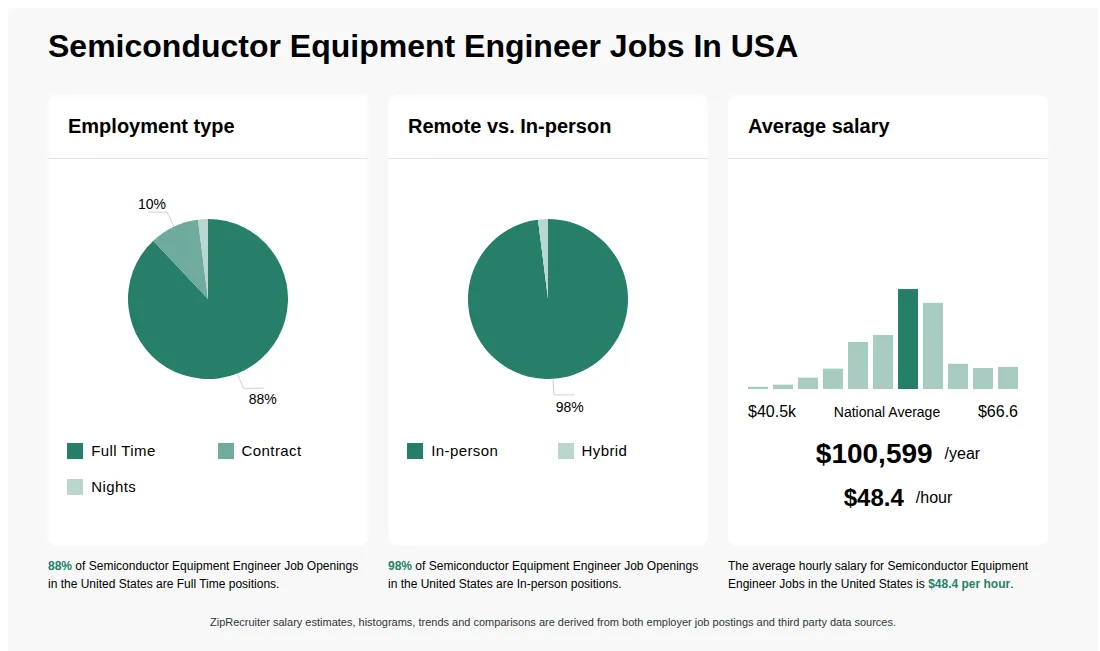
As of Sep 4, 2026, the average hourly pay for semiconductor equipment engineer in the United States is $48.36, according to ZipRecruiter salary data. Most workers in this role earn between $42.31 and $52.88 per hour, depending on experience, location, and employer.

What does a semiconductor equipment engineer do?

A Semiconductor Equipment Engineer is responsible for maintaining, troubleshooting, and optimizing manufacturing equipment used in semiconductor fabrication. They ensure machines operate efficiently, minimize downtime, and comply with industry standards. Their role involves performing preventive maintenance, diagnosing technical issues, and collaborating with process engineers to improve production quality. Additionally, they may assist in upgrading equipment and implementing new technologies to enhance manufacturing processes.

What are the key skills and qualifications needed to thrive as a semiconductor equipment engineer?

To thrive as a Semiconductor Equipment Engineer, you need a solid background in electrical engineering, mechanical engineering, or a related field, complemented by experience in semiconductor manufacturing processes. Familiarity with semiconductor fabrication tools such as photolithography, etching, or deposition equipment, as well as knowledge of maintenance software and equipment certifications (like SEMI S2/S8), is crucial. Strong problem-solving skills, attention to detail, and effective communication abilities set exceptional candidates apart. These capabilities are essential for ensuring optimal equipment performance, minimizing downtime, and collaborating effectively in high-tech manufacturing environments.


What are some common challenges faced by semiconductor equipment engineers on a daily basis?

Semiconductor Equipment Engineers often encounter challenges such as troubleshooting unexpected equipment malfunctions, maintaining strict production schedules, and ensuring compliance with industry safety and quality standards. The highly technical and fast-paced environment means you'll frequently collaborate with process engineers, technicians, and operators to resolve issues quickly and efficiently. Balancing preventative maintenance with urgent repairs can require strong time management and adaptability. Overcoming these challenges is key to supporting smooth semiconductor manufacturing operations and maintaining high product yield.

Are semiconductor equipment engineers paid well?

Semiconductor equipment engineers typically earn competitive salaries due to their specialized skills in maintaining and troubleshooting complex manufacturing tools. Compensation varies by experience, location, and company size but generally reflects the technical expertise required in the industry. Many roles also include benefits such as bonuses and opportunities for career advancement.
More about Semiconductor Equipment Engineer jobs

What cities are hiring for Semiconductor Equipment Engineer jobs?

Cities with the most Semiconductor Equipment Engineer job openings:

What states have the most Semiconductor Equipment Engineer jobs?

States with the most job openings for Semiconductor Equipment Engineer jobs include:

Infographic showing various Semiconductor Equipment Engineer job openings in the United States as of August 2026, with employment types broken down into 1% As Needed, 79% Full Time, 16% Part Time, 1% Temporary, 2% Contract, and 1% Nights. Highlights an 98% Physical, and 2% Remote job distribution, with an average salary of $100,599 per year, or $48.4 per hour.

Semiconductor Equipment Engineer

Prattwhitney

Andover, MA • On-site

$80 - $110/hr

Other

This job post has expired 1 day ago. Applications are no longer accepted.


Pratt & Whitney rating

8.7

Company rating: 8.7 out of 10

Based on 157 frontline employees who took The Breakroom Quiz

16th of 72 rated aerospace companies


Job description

Semiconductor Equipment Support Engineer

Location: Andover, Massachusetts (AR2 Plymouth Building, 362 Lowell St).

Job Summary

Raytheon is hiring a hands‑on engineer to support wafer‑fab manufacturing, focusing on Atomic Layer Deposition (ALD) and nitride dielectric deposition tools.

Responsibilities
  • Primary equipment owner for ALD and nitride deposition tools, ensuring uptime, performance, and continuous improvement.
  • Develop and optimize processes for thin‑film uniformity, repeatability, step coverage, defect reduction, and device reliability.
  • Lead troubleshooting, root‑cause analysis, and cross‑module interactions for tool performance issues.
  • Partner with Manufacturing Operations, Process Engineering, and Quality to ensure stable production performance and rapid issue resolution.
  • Work with equipment vendors on upgrades, maintenance strategies, installation of new hardware, and capabilities.
  • Create preventative maintenance plans, equipment health metrics, and tool documentation.
  • Support factory capacity planning, cycle‑time reduction initiatives, and yield improvements.
  • Execute experiments using DOE methodology and provide data analysis and reporting.
  • Ensure all equipment meets safety, facilities, and compliance requirements.
Qualifications
  • Degree in STEM and a minimum of 5 years of relevant experience.
  • Experience maintaining, troubleshooting, and repairing semiconductor manufacturing equipment.
  • Familiarity with SEMI 10 semiconductor standards and equipment manuals/schematics.
  • Fundamental understanding of SPC controls and ability to implement SPC plans on equipment.
  • Experience with predictive maintenance, SPC controls using FDC software.
  • Hands‑on equipment maintenance/engineering experience in ALD or nitride systems.
  • Ability to document work, produce detailed pass‑downs and preventive maintenance instructions.
  • Knowledge of thin‑film metrology (ellipsometry, XRR, TEM, XPS, FTIR).
  • Background in high‑reliability aerospace or defense semiconductor manufacturing.
  • Experience implementing tool upgrades, retrofits, and continuous‑improvement projects.
  • Proficiency in MS Office.
  • Excellent communication and cross‑functional collaboration skills.
  • Experience in semiconductor equipment engineering, vacuum, plasma, thermal, and control‑system troubleshooting.
  • Familiarity with SPC, FDC, and data‑driven monitoring tools.
  • Ability to work in a cleanroom environment supporting a dynamic production setting.
  • Self‑starter, able to work independently and lead multidisciplinary teams.
Legal Notice

RTX is an Equal Opportunity Employer. All qualified applicants will receive consideration for employment without regard to race, color, religion, sex, sexual orientation, gender identity, national origin, age, disability, or veteran status.

#J-18808-Ljbffr

What Pratt & Whitney employees say

Pay

Benefits

Hours and flexibility

Workplace

Get the full story on Breakroom


Pratt & Whitney logo

About Pratt & Whitney

Sourced by ZipRecruiter

Pratt & Whitney has a long history of leadership and innovation in the field of aviation propulsion. Our story begins in the 1920s and has flourished throughout the decades. We have continuously transformed and reinvented our businesses to offer superior products and services to our customers. In 1925, the Pratt & Whitney Aircraft Company was founded by Frederick B. Rentschler, pioneer of the air-cooled radial engine design which enabled unprecedented power-to-weight ratio. Its first engine, the R-1340 Wasp engine, transformed military and commercial aviation and is still in use today. In 1928, the Canadian division of the Pratt & Whitney Aircraft Company was established. In 1944, Pratt & Whitney began its gas turbine and jet propulsion initiative. The company constructed a wind tunnel, laboratory and engineering center to support our allies’ efforts in World War II. In 1945, wartime production included more than 300,000 Pratt & Whitney engines, touted by service members as extremely dependable – a legacy that continues today. From there, Pratt & Whitney continued to design and innovate more powerful, agile, and reliable engines becoming a leader in the aerospace industry. Today, Pratt & Whitney has more than 85,000 engines in service and more than 16,000 customers worldwide.

Industry

Engineering professional services

Company size

10,000+ Employees

Headquarters location

East Hartford, CT, US