1

Security Cooperation Jobs (NOW HIRING)

Call for Security Cooperation CVs

Arlington, VA · On-site

$20.25 - $26.25/hr

S. Department of War (DoW) security cooperation and institutional support efforts. We welcome experienced professionals at all levels to submit their CVs for consideration. These opportunities ...

next page

Showing results 1-20

Security Cooperation information

See salary details

$12

$18

$24

How much do security cooperation jobs pay per hour?

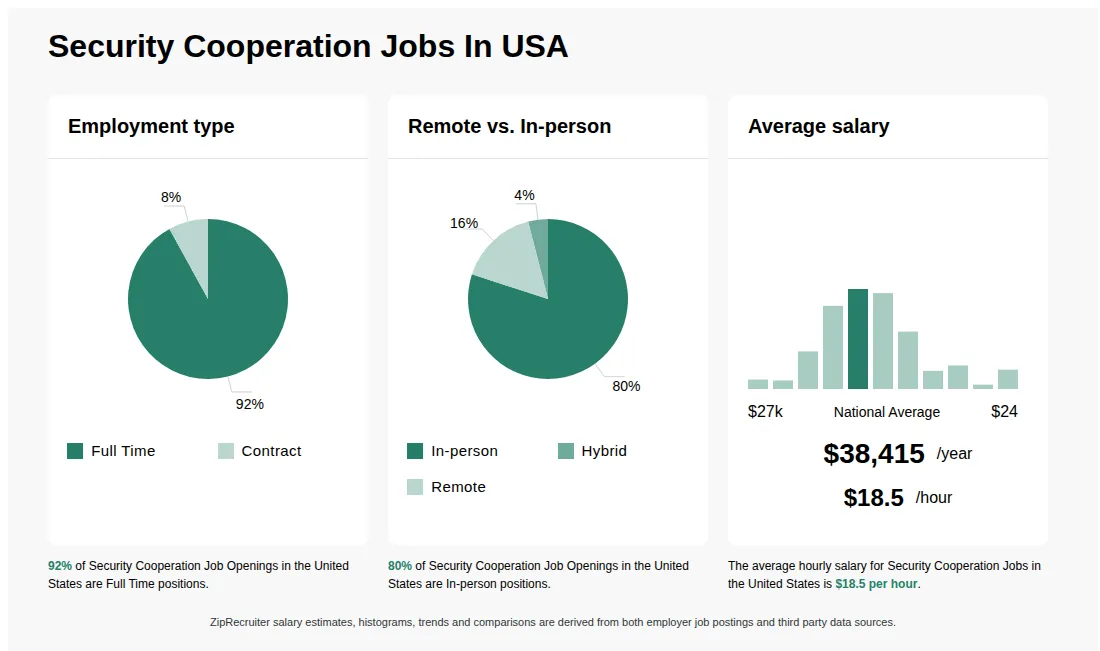
As of Jul 14, 2026, the average hourly pay for security cooperation in the United States is $18.47, according to ZipRecruiter salary data. Most workers in this role earn between $16.83 and $19.23 per hour, depending on experience, location, and employer.

What is security cooperation?

Security cooperation refers to activities undertaken by governments, particularly defense and military organizations, to build relationships and enhance the capabilities of partner nations. These activities can include training, joint exercises, military sales, and information sharing to promote mutual security interests and regional stability. Security cooperation helps foster alliances, increase interoperability among forces, and address shared security challenges such as terrorism, transnational crime, and humanitarian crises.

What are the key skills and qualifications needed to thrive in Security Cooperation, and why are they important?

To excel in Security Cooperation, professionals typically need a solid background in international relations, defense policy, and cross-cultural communication, often supported by relevant degrees or military experience. Familiarity with tools like the Security Cooperation Information Portal (SCIP), foreign military sales (FMS) processes, and certifications such as the Defense Institute of Security Cooperation Studies (DISCS) are common requirements. Strong interpersonal skills, adaptability, and diplomatic acumen help build trust and effective partnerships with foreign counterparts. These abilities ensure successful collaboration, compliance with regulations, and the achievement of mutual security objectives.

What are some common challenges faced by professionals working in Security Cooperation roles?

Professionals in Security Cooperation often navigate complex, multi-national environments where aligning the priorities of different stakeholders—such as host nations, U.S. agencies, and allied partners—can be challenging. They must manage sensitive information, coordinate logistics for joint training or equipment transfers, and ensure compliance with evolving regulations and policies. Effective communication, cultural awareness, and adaptability are crucial, as daily responsibilities can shift rapidly based on global events or policy changes. Collaboration across military, diplomatic, and civilian sectors is frequent, requiring a proactive and solution-oriented mindset.

What is the difference between Security Cooperation vs Security Analyst?

AspectSecurity CooperationSecurity Analyst
Required credentialsOften requires security clearance, military or government certificationsTypically requires security clearance, cybersecurity or IT certifications
Work environmentGovernment agencies, defense contractors, international organizationsCorporate, government, or cybersecurity firms
Employer and industry usagePrimarily in defense, foreign policy, and international security sectorsIn cybersecurity, risk management, and information security sectors

Security Cooperation involves managing international security programs and collaborations, often within government or defense sectors. Security Analysts focus on protecting information systems and analyzing security threats within organizations. While both roles require security clearances and related certifications, Security Cooperation emphasizes diplomatic and strategic aspects, whereas Security Analysts concentrate on cybersecurity and threat mitigation.

More about Security Cooperation jobs
What cities are hiring for Security Cooperation jobs? Cities with the most Security Cooperation job openings:
What states have the most Security Cooperation jobs? States with the most job openings for Security Cooperation jobs include:
Infographic showing various Security Cooperation job openings in the United States as of July 2026, with employment types broken down into 2% As Needed, 76% Full Time, 20% Part Time, 1% Temporary, and 1% Contract. Highlights an 97% Physical, 1% Hybrid, and 2% Remote job distribution, with an average salary of $38,415 per year, or $18.5 per hour.

Theater Security Cooperation Subject Matter Expert

Bowhead / UIC Technical Services

Colorado Springs, CO • On-site

$15.75 - $19.25/hr

Other

Posted 13 days ago


Job description

Overview THEATER SECURITY COOPERATION SUBJECT MATTER EXPERT (J35): Bowhead seeks a Theater Security Cooperation (TSC) Subject Matter Expert (SME) to provide expert level services in support of USNORTHCOM J35 missions. The SME will support detailed planning for deliberate and crisis events, mission analysis, and Joint Understanding of the Operational Environment analysis for contingency and crisis operations. The SME is required to accomplish expert analytical planning using system perspective of operational environment in the USNORTHCOM area of responsibility. The candidate will focus on developing planning products for events in support of operational and tactical level forces for TSC missions. Responsibilities Coordinate preparation of the environment information and standardized products across the staff Analyze relevant political, military, economic, social, information, and infrastructure variables to help describe the impact of the operational environment on mission accomplishment Review TSC operations within the Global Theater Security Cooperation Management Information System (G-TSCMIS), to include DOD and NORAD and USNORTHCOM (N&NC) policy issues Provide recommendations for planning, concept development, and analysis in support of operations and policies Coordinate TSC assessment efforts with subordinate commands and other interagency partners Provide quarterly analysis and assessment of TSC activity within USNORTHCOM AOR, including G-TSCMIS statistical reporting data Develop briefing slides for NC/J3 led or co-led TSC boards, conferences, meetings, and workshops Support coordination of agendas and attendees Analyze information to support USNORTHCOM Doctrine, Organization, Training, Material, Leadership, Personnel and Facilities (DOTMLPF) Provide strategic analyses of USNORTHCOM's TSC operations and partner nations operational capability development within the AOR Incorporate Effects Based Approach (EBA) into planning and operations to include the efforts of the national intelligence community, Inter-Agency partners, law enforcement and counter-intelligence agencies, relevant Combatant Commands (COCOMs), and USNORTHCOM staff elements, components, and subordinate organizations Analyze data that supports the Command's assessment process and provide written recommendation on status and improvement Support the USNORTHCOM Future Operations Center (FOC) during crisis or exercise events Qualifications Bachelors degree or five (5) years experience as a cleared Defense Contractor or Military/Government working in corporate and government environments. Requires a minimum of three (3) years Theater Security Cooperation experience. Experience using G-TSCMIS. Intermediate-to-advanced level skills in Microsoft Office software suite Word, Excel, Outlook, and PowerPoint. Ability to communicate effectively with all levels of employees and outside contacts. Strong interpersonal skills and good judgment with the ability to work alone or as part of a team. Physical Demands: Must be able to lift up to 25 pounds Must be able to stand and walk for prolonged amounts of time Must be able to twist, bend, and squat periodically SECURITY CLEARANCE REQUIRED: Must currently hold an active security clearance at the Top Secret / SCI level. US Citizenship is a requirement for Secret clearance at this location. #LI-MN1