1

Security Cooperation Jobs (NOW HIRING)

$18.25 - $21/hr

SECURITY COOPERATION INSTRUCTOR/SME Type: Full-Time Location: Joint Base McGuire-Dix-Lakehurst (JBMDL), NJ Travel: 10% **Contingent Upon Award** Position Summary: The Security Cooperation Instructor ...

$18.25 - $20.75/hr

SECURITY COOPERATION INSTRUCTOR/SME Type: Full-Time Location: Joint Base McGuire-Dix-Lakehurst (JBMDL), NJ Travel: 10% **Contingent Upon Award** Position Summary: The Security Cooperation Instructor ...

BlueForce Inc. is seeking a Security Cooperation Instructor in support of the United States Air Force Expeditionary Center at Joint Base McGuire-Dix-Lakehurst, NJ. *Position is subject to contract ...

Security Cooperation (SC) Analyst Please note: This position is contingent upon the award of a contract. We will provide updates on the status of the contract and next steps during the hiring process.

Security Cooperation (SC) Analyst Please note: This position is contingent upon the award of a contract. We will provide updates on the status of the contract and next steps during the hiring process.

next page

Showing results 1-20

Security Cooperation information

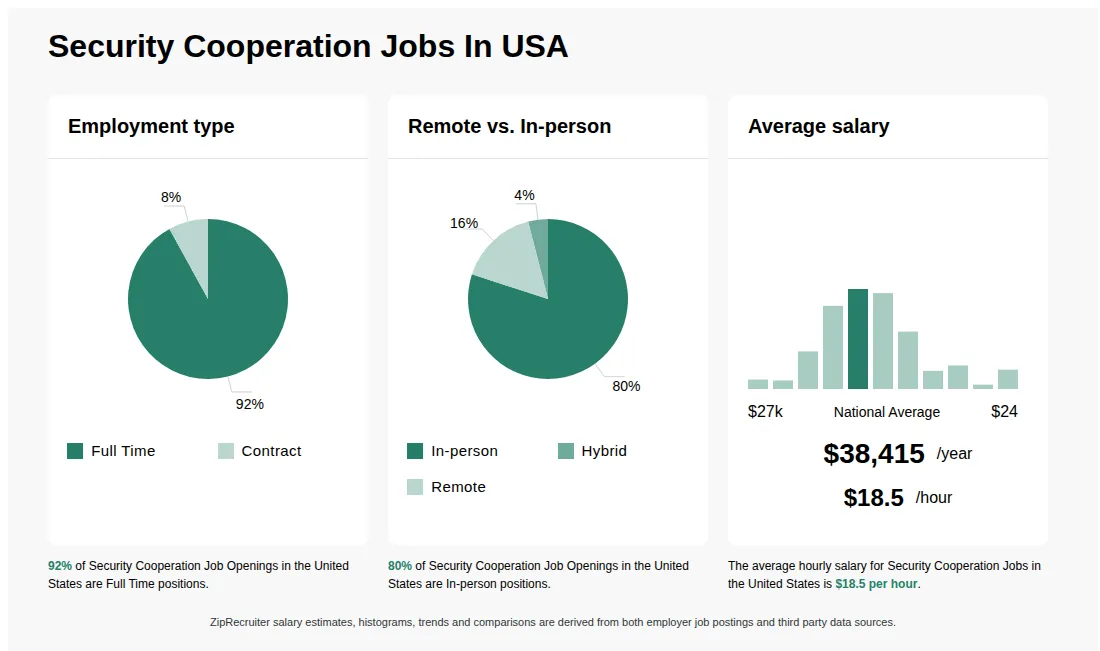
See salary details

$12

$18

$24

How much do security cooperation jobs pay per hour?

As of May 30, 2026, the average hourly pay for security cooperation in the United States is $18.47, according to ZipRecruiter salary data. Most workers in this role earn between $16.83 and $19.23 per hour, depending on experience, location, and employer.

What are the key skills and qualifications needed to thrive in Security Cooperation, and why are they important?

To excel in Security Cooperation, professionals typically need a solid background in international relations, defense policy, and cross-cultural communication, often supported by relevant degrees or military experience. Familiarity with tools like the Security Cooperation Information Portal (SCIP), foreign military sales (FMS) processes, and certifications such as the Defense Institute of Security Cooperation Studies (DISCS) are common requirements. Strong interpersonal skills, adaptability, and diplomatic acumen help build trust and effective partnerships with foreign counterparts. These abilities ensure successful collaboration, compliance with regulations, and the achievement of mutual security objectives.

What are some common challenges faced by professionals working in Security Cooperation roles?

Professionals in Security Cooperation often navigate complex, multi-national environments where aligning the priorities of different stakeholders—such as host nations, U.S. agencies, and allied partners—can be challenging. They must manage sensitive information, coordinate logistics for joint training or equipment transfers, and ensure compliance with evolving regulations and policies. Effective communication, cultural awareness, and adaptability are crucial, as daily responsibilities can shift rapidly based on global events or policy changes. Collaboration across military, diplomatic, and civilian sectors is frequent, requiring a proactive and solution-oriented mindset.

What is security cooperation?

Security cooperation refers to activities undertaken by governments, particularly defense and military organizations, to build relationships and enhance the capabilities of partner nations. These activities can include training, joint exercises, military sales, and information sharing to promote mutual security interests and regional stability. Security cooperation helps foster alliances, increase interoperability among forces, and address shared security challenges such as terrorism, transnational crime, and humanitarian crises.

What is the difference between Security Cooperation vs Security Analyst?

AspectSecurity CooperationSecurity Analyst
Required credentialsOften requires security clearance, military or government certificationsTypically requires security clearance, cybersecurity or IT certifications
Work environmentGovernment agencies, defense contractors, international organizationsCorporate, government, or cybersecurity firms
Employer and industry usagePrimarily in defense, foreign policy, and international security sectorsIn cybersecurity, risk management, and information security sectors

Security Cooperation involves managing international security programs and collaborations, often within government or defense sectors. Security Analysts focus on protecting information systems and analyzing security threats within organizations. While both roles require security clearances and related certifications, Security Cooperation emphasizes diplomatic and strategic aspects, whereas Security Analysts concentrate on cybersecurity and threat mitigation.

More about Security Cooperation jobs
What cities are hiring for Security Cooperation jobs? Cities with the most Security Cooperation job openings:
What states have the most Security Cooperation jobs? States with the most job openings for Security Cooperation jobs include:

Security Cooperation Instructor / SME

EEC Solutions

Trenton, NJ • On-site

$115K - $140K/yr

Full-time

Posted 4 hours ago


Job description

EEC Solutions is looking for a Security Cooperation Instructor / SME to support a possible upcoming contract at at Joint Base McGuire-Dix-Lakehurst (JB MDL), NJ.

Note: We are seeking resumes for a proposal opportunity. This position is contingent upon contract award. Candidates currently living in a HubZone designated area are encouraged to apply. Only the candidates who meet the minimum qualifications will be considered.

Position Description:

Serves as the primary SME and instructor for Security Cooperation (SC) and Security Assistance topics within the Air Advisor Academic curriculum. Develops and delivers instruction on SC frameworks, FMF/FMS processes, legal authorities, foreign disclosure, contracting basics, and theater campaign planning.

Essential Duties and Responsibilities:
  • Provide instruction and evaluations on Security Cooperation, Security Assistance, FMF/FMS process, funding and legal authorities (Title 10 & 22), contracting/quality assurance basics, Foreign Disclosure rules, Theater Campaign Planning, Theater Security Cooperation Plans, and Country Plans.
  • Teach subjects including, but not limited to: Joint and Combined Planning, SC/Security Assistance, Foreign Disclosure Awareness, Legal Awareness, SFA Mission Analysis and Planning, Introduction to Resolute Support and other Contingencies, Theater Guidance, Aviation Enterprise Development, and Systems Thinking.
  • Liaison with AMC/IA, AFSAT, SAF/IA, Air Force Geographic Component Commands, MAJCOMs, CNAFs, other services, and functional commands to ensure curriculum relevance.
  • Develop, update, revise, and deliver curriculum and courseware IAW USAF EOSestablished policy.
  • Complete USAF EOS instructional methods course; maintain 180 hours of instruction within first year; maintain satisfactory or above on Government evaluations.
  • Serve as SME focal point; assist with other disciplines as directed by the Site Manager.
  • Prepare classroom and materials; begin lessons on time; conduct evaluations per syllabi.
  • Minimum Qualifications:
  • Master's degree from an accredited college or university.
  • Deployed as a Military Advisor, PAS Officer, RAS Officer, FAO, PRT member, attaché, or Security Cooperation Officer (or equivalent advisory role).
  • Completion of Air Command and Staff College, Senior NCO Academy, or sister service school equivalent (inresidence or by correspondence).
  • Must be able to obtain and maintain a Secret security clearance; CAC required within two weeks of start date.
  • Verification of advisory deployment and SC/SA background required.