1

Science Museum Jobs (NOW HIRING)

Be a part of something great at Science Museum of Minnesota. We exist to turn on the science and inspire learning, inform policy and improve lives. We envision a world in which all people have the ...

Provides onsite and offsite educational programs for scheduled groups in the natural science and/or historical area(s) which incorporate the mission and philosophy of the Museum. Part-time, as needed ...

Provides onsite and offsite educational programs for scheduled groups in the natural science and/or historical area(s) which incorporate the mission and philosophy of the Museum. Part-time, as needed ...

next page

Showing results 1-20

Science Museum information

See salary details

$12

$22

$33

How much do science museum jobs pay per hour?

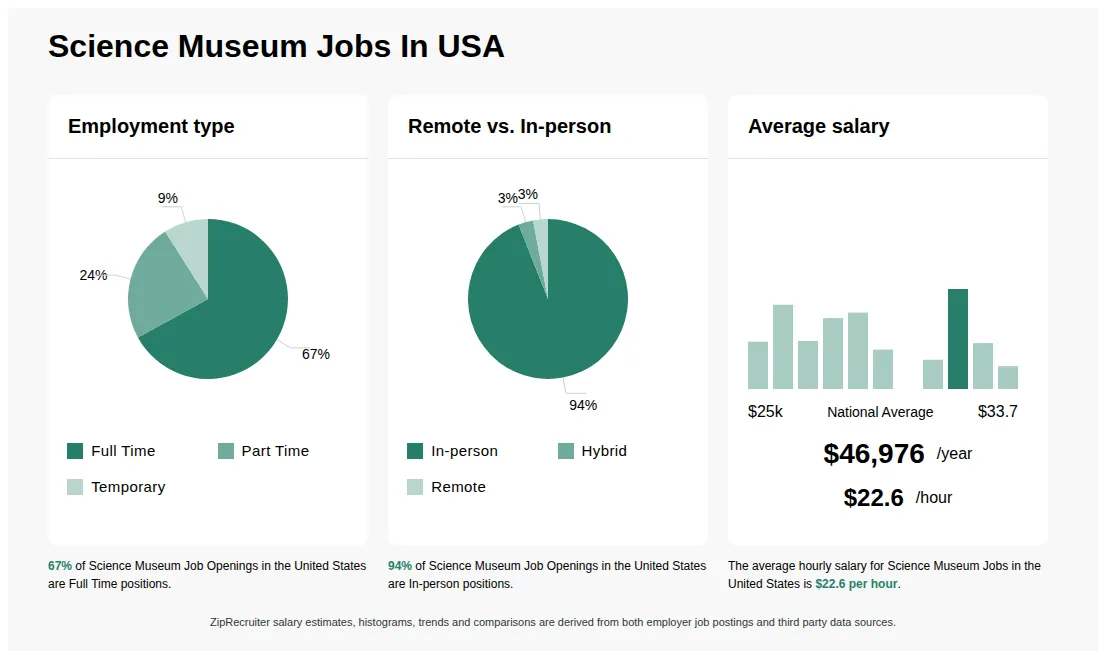
As of Jun 13, 2026, the average hourly pay for science museum in the United States is $22.58, according to ZipRecruiter salary data. Most workers in this role earn between $16.35 and $28.37 per hour, depending on experience, location, and employer.

What are the key skills and qualifications needed to thrive as a Science Museum Educator, and why are they important?

To thrive as a Science Museum Educator, you need a strong background in science education, public engagement, and often a degree in a scientific field or education. Familiarity with educational technology, exhibit design software, and museum management systems is typically required. Excellent communication, creativity, and enthusiasm for learning help educators engage diverse audiences and foster curiosity. These skills ensure effective science communication, memorable visitor experiences, and the promotion of lifelong learning.

What is the difference between Science Museum vs Science Educator?

AspectScience MuseumScience Educator
CredentialsTypically requires a degree in science, education, or museum studiesRequires a background in science or education, often with teaching certifications
Work EnvironmentPublic museums, exhibits, and interactive displaysClassrooms, workshops, and outreach programs within or outside museums
Employer & IndustryMuseums, science centers, cultural institutionsEducational institutions, museums, science centers
Common Search & ComparisonOften compared for roles involving public engagement and exhibit managementCompared for roles focused on education delivery and visitor interaction

The main difference is that a Science Museum is an institution that houses exhibits and collections, while a Science Educator is a professional who teaches and engages visitors or students about science within or outside such institutions. Both roles require science knowledge, but the museum focuses on curation and display, whereas the educator emphasizes teaching and outreach.

What are some common challenges faced by professionals working in a science museum, and how can they be addressed?

Professionals in science museums often encounter challenges such as engaging diverse audiences, keeping exhibits up-to-date with current scientific advances, and balancing educational goals with visitor entertainment. Addressing these challenges involves ongoing professional development, collaborating closely with educators and scientists, and actively seeking visitor feedback to improve exhibit design and programming. Teamwork and adaptability are key, as museum staff frequently work cross-functionally to create interactive, accessible, and impactful experiences for all visitors.

What Are the Qualifications to Work in a Science Museum?

The qualifications to work in a science museum depend largely on your specific responsibilities. If you are a curator or researcher, you need to have a background in science and training or an advanced degree in museum studies to coordinate exhibits properly. Development aids and associates should have a bachelor’s degree in finance, business administration, or a closely related field. Security guards and tour guides may only need a high school diploma. Jobs at science museums also require strong verbal communication skills and an interest in science and education.

What is a simple definition of science?

A science museum staff member understands that science is the systematic study of the natural world through observation, experimentation, and evidence. It involves using tools like microscopes and laboratories to explore phenomena and develop explanations based on facts. Science helps us understand how things work and advances technology and knowledge.

Who is the most loved scientist?

The most loved scientist is often considered to be Albert Einstein, known for his contributions to physics and his iconic personality. Many people admire scientists who have made significant discoveries and communicate their work effectively. In a science museum context, engaging visitors with popular scientists can inspire interest in science careers.

What are science museums?

Science museums are institutions dedicated to educating the public about science and technology through interactive exhibits, hands-on activities, and educational programs. These museums often feature displays on topics such as physics, biology, chemistry, and earth sciences, making complex concepts accessible and engaging for visitors of all ages. Science museums play a crucial role in inspiring curiosity and fostering a deeper understanding of the scientific world.

What are the 7 types of science?

The seven main types of science are physics, chemistry, biology, earth science, astronomy, social sciences, and formal sciences like mathematics and logic. Science roles at a museum may involve understanding these fields to develop exhibits or educational programs, often requiring relevant knowledge or background in these areas.

What are Brian May's contributions to science and astronomy?

Brian May, the guitarist of Queen, is also an astrophysicist who earned a PhD in astrophysics and has contributed to research on zodiacal dust and planetary nebulae. He co-founded the Astrophysics Group at Imperial College London and has published scientific papers, combining his music career with active involvement in astronomy outreach and education.
What cities are hiring for Science Museum jobs? Cities with the most Science Museum job openings:
What are the most commonly searched types of Science Museum jobs? The most popular types of Science Museum jobs are:
What states have the most Science Museum jobs? States with the most job openings for Science Museum jobs include:
Infographic showing various Science Museum job openings in the United States as of June 2026, with employment types broken down into 1% As Needed, 96% Full Time, and 3% Contract. Highlights an 99% Physical, and 1% Remote job distribution, with an average salary of $46,976 per year, or $22.6 per hour.
Director of Outreach and Community Partnerships

Director of Outreach and Community Partnerships

Science Museum Oklahoma

Oklahoma City, OK

$68K - $78K/yr

Other

Posted 14 days ago


Science Museum Oklahoma rating

6.0

Company rating: 6.0 out of 10

Based on 8 frontline employees who took The Breakroom Quiz

16th of 26 rated museums


Job description

Description

  The Director of Outreach and Community Partnerships is responsible for leading Science Museum Oklahoma's statewide outreach initiatives, community engagement efforts, and partnership-driven educational experiences. This position oversees the development, implementation, and evaluation of high-quality STEAM programming designed to expand access to inquiry-based science experiences both within the museum and throughout communities across the state.


The Director serves as a strategic leader in building and maintaining partnerships with schools, educators, community organizations, and other stakeholders to strengthen Science Museum Oklahoma's role as a trusted educational resource and community partner. This position is responsible for guiding outreach programming, curriculum development, educator workshops, school programming, partnership initiatives, and community-centered events. The Director ensures educational quality, safety standards, and alignment with the museum's mission, strategic goals, and community needs. 

  • Provide strategic leadership and operational oversight for department programming, partnerships, initiatives, and staff.
  • Coordinate hiring, scheduling, motivating, training, coaching, evaluating, disciplining, and terminating department staff.
  • Lead the development, review, implementation, and evaluation of curriculum, outreach programming, educator workshops, school programs, and community engagement initiatives.
  • Build and maintain strong partnerships with schools, libraries, informal learning organizations, community organizations, and statewide stakeholders.
  • Identify opportunities to expand access to Science Museum Oklahoma programming through strategic partnerships and outreach initiatives.
  • Support the planning and implementation of special events, conferences, adult programming, and partnership initiatives that strengthen community engagement and organizational visibility.
  • Ensure educational integrity, scientific accuracy, mission alignment, and inquiry-based learning practices across all outreach and educational experiences.
  • Use program evaluation data, audience feedback, and community needs assessments to inform continuous improvement and strategic planning.
  • Responsible for developing, managing, and adhering to departmental budgets, outreach resources, and operational logistics
  • Maintain outreach operational procedures and best safety practices for off-site programming and demonstrations.
  • Collaborate with community organizations and museum departments to develop and support meaningful mission-aligned experiences for diverse audiences.
  • Pursue innovative and creative opportunities to increase statewide engagement and educational impact.
  • Professionally represent Science Museum Oklahoma and its mission.
  • Support additional museum initiatives as assigned to spark curiosity and promote discovery learning experiences

Requirements

Minimum Qualifications

  • Bachelor's degree in education, museum studies, nonprofit leadership, or STEAM-related field
  • Five (5) or more years of experience in formal or informal education, educational programming, outreach initiatives, standards-aligned curriculum and professional development, or community engagement
  • Three (3) or more years of supervisory or management experience
  • Three (3) or more years of experience in building collaborative partnerships with schools, organizations, businesses, or community stakeholders

Preferred Qualifications

  • Master's degree in education, museum studies, nonprofit leadership, or STEAM-related field
  • Oklahoma educator or principal certification, or equivalent certification from another state
  • Understanding of best practices associated with inquiry-based learning, education pedagogy, program evaluation practices, and accessibility
  • Experience managing departmental budgets and operational logistics

Availability Requirements

  • Ability to work a flexible schedule including evenings, weekends, and holidays as needed
  • Ability to travel throughout Oklahoma for outreach programming, partnership meetings, conferences, and events


Knowledge, Skills, and Abilities

  • Experience with informal or formal education programming, outreach initiatives, and community engagement strategies. 
  • Strong leadership skills with experience managing and developing teams.
  • Experience building collaborative partnerships with schools, organizations, businesses, and community stakeholders.
  • Knowledge of inquiry learning techniques, curriculum development, educator professional development, and best practices in formal and informal STEAM education.
  • Experience developing and implementing educational programming for diverse audiences and learning environments.
  • Ability to think strategically while effectively managing operational details and logistics.
  • Excellent verbal and written communication skills, including strong editing abilities.
  • Strong organizational, project management, and problem-solving skills.
  • Ability to work independently and collaborating effectively across departments and with external partners.
  • Comfortable engaging audiences of all ages in energetic and interactive educational experiences.
  • Be kind, approachable, confident, and open to correction.
  • Computer proficiency including Microsoft Office applications. 


Working Conditions

This position works in an active and busy children's museum setting.

  • Work involves frequent sitting, standing and walking for long periods of time.
  • Requires working on a computer for long periods of time
  • Work involves crawling, climbing and crouching 
  • Work may include occasional pushing, pulling, lifting, and carrying objects weighing up to 40 pounds.

This position requires the employee to drive for business purposes in either their own vehicle or a vehicle provided by SMO. Employees that drive for business purposes must be able to pass a Motor Vehicle Records check, and provide proof of insurance and a valid license to drive on an annual basis.


The physical demands described here are representative of those that must be met by an employee to successfully perform the essential functions of this job. Reasonable accommodations may be made to enable individuals with disabilities to perform the essential functions.


This position has been designated as a safety sensitive position. Safety sensitive positions include job duties that could affect the health and safety of the employee or others.  


Working Relationships

This position has direct supervisory responsibilities over Outreach and Community Partnerships team members. This position must maintain positive working relationships with leadership, employees, applicants, vendors, and the general public.


Introductory Period

This position has been designated with a 90-day Introductory Period. The Introductory Period gives you time to fully learn your new role and adapt to your new work environment. It gives the Museum time to provide training, feedback and performance review. Prior to the end of the 90-days your supervisor will conduct a review of your overall performance and behavior to determine if you need a performance improvement plan, extra training, or if you are already working at full performance. Participation in, or completion of the Introductory Period does not impact your "at-will" employment relationship with Science Museum Oklahoma. You or the Museum may still terminate your employment at any time and for any reason, with or without cause. The Introductory Period also does not affect the benefits that you are offered as a regular (FT/PT) employee at the Museum. The 90-day Introductory Period simply gives both you and Science Museum Oklahoma an opportunity for learning, training, feedback and performance review.