... saturation diving using SCUBA, surface supplied and mixed gas systems, and rebreathers; operate and supervise hyperbaric chamber treatments; plan and conduct demolition; maintain and repair ...
... saturation diving using SCUBA, surface supplied and mixed gas systems, and rebreathers; operate and supervise hyperbaric chamber treatments; plan and conduct demolition; maintain and repair ...
... saturation diving using SCUBA, surface supplied and mixed gas systems, and rebreathers; operate and supervise hyperbaric chamber treatments; plan and conduct demolition; maintain and repair ...
... saturation diving using SCUBA, surface supplied and mixed gas systems, and rebreathers; operate and supervise hyperbaric chamber treatments; plan and conduct demolition; maintain and repair ...
... saturation diving using SCUBA, surface supplied and mixed gas systems, and rebreathers; operate and supervise hyperbaric chamber treatments; plan and conduct demolition; maintain and repair ...
... saturation diving using SCUBA, surface supplied and mixed gas systems, and rebreathers; operate and supervise hyperbaric chamber treatments; plan and conduct demolition; maintain and repair ...
... saturation diving using SCUBA, surface supplied and mixed gas systems, and rebreathers; operate and supervise hyperbaric chamber treatments; plan and conduct demolition; maintain and repair ...
... saturation diving using SCUBA, surface supplied and mixed gas systems, and rebreathers; operate and supervise hyperbaric chamber treatments; plan and conduct demolition; maintain and repair ...
... saturation diving using SCUBA, surface supplied and mixed gas systems, and rebreathers; operate and supervise hyperbaric chamber treatments; plan and conduct demolition; maintain and repair ...
... saturation diving using SCUBA, surface supplied and mixed gas systems, and rebreathers; operate and supervise hyperbaric chamber treatments; plan and conduct demolition; maintain and repair ...
... saturation diving using SCUBA, surface supplied and mixed gas systems, and rebreathers; operate and supervise hyperbaric chamber treatments; plan and conduct demolition; maintain and repair ...
... saturation diving using SCUBA, surface supplied and mixed gas systems, and rebreathers; operate and supervise hyperbaric chamber treatments; plan and conduct demolition; maintain and repair ...
... saturation diving using SCUBA, surface supplied and mixed gas systems, and rebreathers; operate and supervise hyperbaric chamber treatments; plan and conduct demolition; maintain and repair ...
... saturation diving using SCUBA, surface supplied and mixed gas systems, and rebreathers; operate and supervise hyperbaric chamber treatments; plan and conduct demolition; maintain and repair ...
... saturation diving using SCUBA, surface supplied and mixed gas systems, and rebreathers; operate and supervise hyperbaric chamber treatments; plan and conduct demolition; maintain and repair ...
... saturation diving using SCUBA, surface supplied and mixed gas systems, and rebreathers; operate and supervise hyperbaric chamber treatments; plan and conduct demolition; maintain and repair ...
... saturation diving using SCUBA, surface supplied and mixed gas systems, and rebreathers; operate and supervise hyperbaric chamber treatments; plan and conduct demolition; maintain and repair ...
... saturation diving using SCUBA, surface supplied and mixed gas systems, and rebreathers; operate and supervise hyperbaric chamber treatments; plan and conduct demolition; maintain and repair ...
... saturation diving using SCUBA, surface supplied and mixed gas systems, and rebreathers; operate and supervise hyperbaric chamber treatments; plan and conduct demolition; maintain and repair ...
... saturation diving using SCUBA, surface supplied and mixed gas systems, and rebreathers; operate and supervise hyperbaric chamber treatments; plan and conduct demolition; maintain and repair ...
... saturation diving using SCUBA, surface supplied and mixed gas systems, and rebreathers; operate and supervise hyperbaric chamber treatments; plan and conduct demolition; maintain and repair ...
... saturation diving using SCUBA, surface supplied and mixed gas systems, and rebreathers; operate and supervise hyperbaric chamber treatments; plan and conduct demolition; maintain and repair ...
... saturation diving using SCUBA, surface supplied and mixed gas systems, and rebreathers; operate and supervise hyperbaric chamber treatments; plan and conduct demolition; maintain and repair ...
... saturation diving using SCUBA, surface supplied and mixed gas systems, and rebreathers; operate and supervise hyperbaric chamber treatments; plan and conduct demolition; maintain and repair ...
... saturation diving using SCUBA, surface supplied and mixed gas systems, and rebreathers; operate and supervise hyperbaric chamber treatments; plan and conduct demolition; maintain and repair ...
... saturation diving using SCUBA, surface supplied and mixed gas systems, and rebreathers; operate and supervise hyperbaric chamber treatments; plan and conduct demolition; maintain and repair ...
... saturation diving using SCUBA, surface supplied and mixed gas systems, and rebreathers; operate and supervise hyperbaric chamber treatments; plan and conduct demolition; maintain and repair ...
... saturation diving using SCUBA, surface supplied and mixed gas systems, and rebreathers; operate and supervise hyperbaric chamber treatments; plan and conduct demolition; maintain and repair ...
... saturation diving using SCUBA, surface supplied and mixed gas systems, and rebreathers; operate and supervise hyperbaric chamber treatments; plan and conduct demolition; maintain and repair ...
... saturation diving using SCUBA, surface supplied and mixed gas systems, and rebreathers; operate and supervise hyperbaric chamber treatments; plan and conduct demolition; maintain and repair ...
... saturation diving using SCUBA, surface supplied and mixed gas systems, and rebreathers; operate and supervise hyperbaric chamber treatments; plan and conduct demolition; maintain and repair ...
... saturation diving using SCUBA, surface supplied and mixed gas systems, and rebreathers; operate and supervise hyperbaric chamber treatments; plan and conduct demolition; maintain and repair ...
... saturation diving using SCUBA, surface supplied and mixed gas systems, and rebreathers; operate and supervise hyperbaric chamber treatments; plan and conduct demolition; maintain and repair ...
... saturation diving using SCUBA, surface supplied and mixed gas systems, and rebreathers; operate and supervise hyperbaric chamber treatments; plan and conduct demolition; maintain and repair ...
... saturation diving using SCUBA, surface supplied and mixed gas systems, and rebreathers; operate and supervise hyperbaric chamber treatments; plan and conduct demolition; maintain and repair ...
... saturation diving using SCUBA, surface supplied and mixed gas systems, and rebreathers; operate and supervise hyperbaric chamber treatments; plan and conduct demolition; maintain and repair ...
... saturation diving using SCUBA, surface supplied and mixed gas systems, and rebreathers; operate and supervise hyperbaric chamber treatments; plan and conduct demolition; maintain and repair ...
... saturation diving using SCUBA, surface supplied and mixed gas systems, and rebreathers; operate and supervise hyperbaric chamber treatments; plan and conduct demolition; maintain and repair ...
... saturation diving using SCUBA, surface supplied and mixed gas systems, and rebreathers; operate and supervise hyperbaric chamber treatments; plan and conduct demolition; maintain and repair ...
... saturation diving using SCUBA, surface supplied and mixed gas systems, and rebreathers; operate and supervise hyperbaric chamber treatments; plan and conduct demolition; maintain and repair ...
Saturation Diving information
See salary details
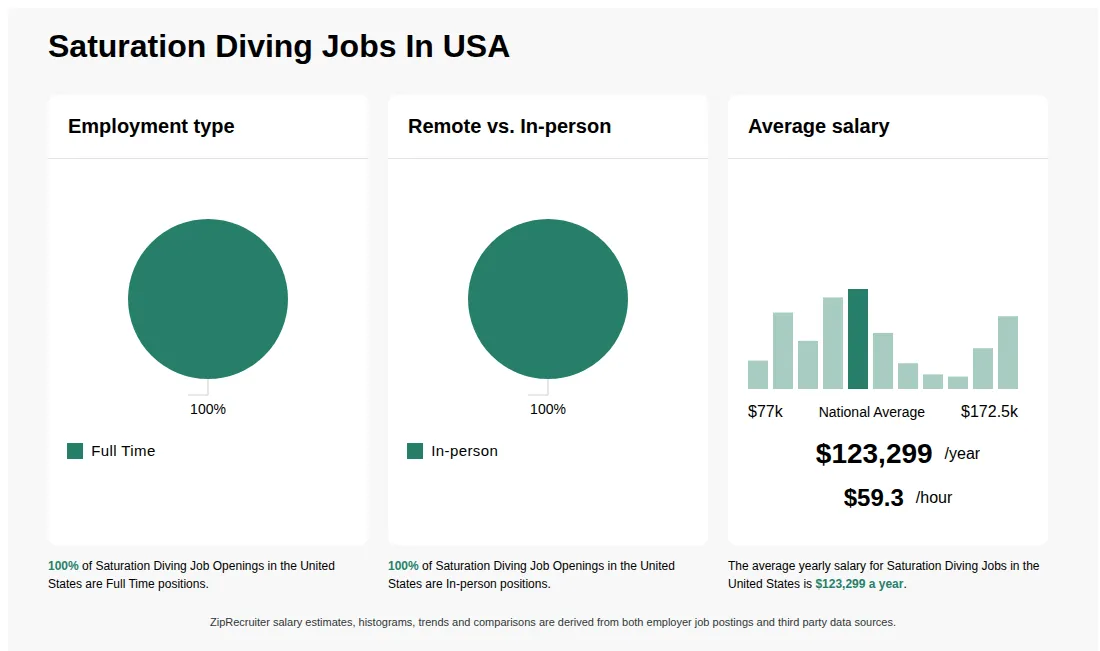
$77K - $85.7K
5% of jobs
$85.7K - $94.4K
14% of jobs
$100.6K is the 25th percentile. Wages below this are outliers.
$94.4K - $103K
8% of jobs
$103K - $111.7K
17% of jobs
The median wage is $114.5K / yr.
$111.7K - $120.4K
18% of jobs
$120.4K - $129.1K
9% of jobs
$136.1K is the 75th percentile. Wages above this are outliers.
$129.1K - $137.8K
4% of jobs
$137.8K - $146.5K
2% of jobs
$146.5K - $155.1K
2% of jobs
$155.1K - $163.8K
7% of jobs
$163.8K - $172.5K
13% of jobs
$77K
$123.3K
$172.5K
How much do saturation diving jobs pay per year?
As of Sep 7, 2026, the average yearly pay for saturation diving in the United States is $123,299.00, according to ZipRecruiter salary data. Most workers in this role earn between $101,500.00 and $151,500.00 per year, depending on experience, location, and employer.
What is saturation diving?
A Saturation Diving job involves working deep underwater for extended periods, typically in offshore oil and gas industries. Divers live in a pressurized environment, allowing their bodies to become saturated with inert gases, preventing the need for frequent decompression. They are transported to the work site via a diving bell and perform tasks like repairing pipelines, welding, and conducting inspections. The job requires specialized training, physical fitness, and the ability to handle high-pressure environments. Due to its demanding nature, saturation diving is one of the most highly paid and challenging professions in commercial diving.
What are the key skills and qualifications needed to thrive in saturation diving?
To thrive as a Saturation Diver, you need exceptional physical fitness, underwater technical skills, and formal commercial diving certification such as IMCA or ADCI. Proficiency in operating complex diving equipment, life-support systems, and submersible tools is essential, along with knowledge of dive tables and decompression protocols. Strong teamwork, problem-solving abilities, and adaptability are crucial soft skills in this high-risk environment. These competencies are vital to ensure safety, effective underwater operations, and collaborative work during extended periods in pressurized habitats.
What are the typical work schedules like for saturation divers, and how does this affect work-life balance?
Saturation divers commonly work on a rotation schedule, such as spending 2–4 weeks offshore living in a pressurized chamber, followed by several weeks off. During their time on the job, divers operate in shifts to ensure round-the-clock coverage for critical underwater tasks, which may include welding, inspections, and repairs on subsea infrastructure. The unique living and working conditions foster strong camaraderie among the dive team but can be physically and mentally demanding. While the time off offers lengthy rest periods, the extended absences from home require strong personal and family support systems. Understanding this schedule can help you plan for both the challenges and the benefits of work-life balance in saturation diving.
How hard is it to get a job as a saturation diver?
Getting a job as a saturation diver requires extensive training, including commercial diving certifications and experience in underwater operations. The profession is highly competitive due to the specialized skills, physical demands, and safety requirements involved.
Is there a demand for saturation divers?
Saturation diving is a specialized field with steady demand in the offshore oil and gas industry, underwater construction, and salvage operations. Jobs require advanced certifications, physical fitness, and experience, and demand can fluctuate with industry activity levels and technological advancements.
More about Saturation Diving jobs
What cities are hiring for Saturation Diving jobs?
Cities with the most Saturation Diving job openings:
What are the most commonly searched types of Saturation Diving jobs?
The most popular types of Saturation Diving jobs are:
What states have the most Saturation Diving jobs?
States with the most job openings for Saturation Diving jobs include:
What job categories do people searching Saturation Diving jobs look for?
The top searched job categories for Saturation Diving jobs are:

Full-time
Medical, Dental, Vision, Retirement
This job post has expired 2 days ago. Applications are no longer accepted.
United States Navy rating

6.4
Based on 380 frontline employees who took The Breakroom Quiz
42nd of 49 rated military and defense
Job description
Job Title: Aircrew Rescue Swimmer & Navy Diver
Category / Component: Enlisted • Active
Overview
Join an elite community that operates in the air and under the sea as an enlisted aircrew member and Navy diver, performing helicopter sea rescues and underwater search, salvage, repair, and demolition to support carrier and expeditionary strike groups, mine countermeasures, special operations, and joint partners worldwide.
Key Responsibilities
Operate as enlisted aircrew during flight operations; perform helicopter sea rescues and provide advanced first aid; execute underwater search, salvage, harbor clearance, and security missions; inspect, cut, weld, and repair ships and submarines; conduct deep and saturation diving using SCUBA, surface supplied and mixed gas systems, and rebreathers; operate and supervise hyperbaric chamber treatments; plan and conduct demolition; maintain and repair specialized flight, survival, and diving equipment while managing records and readiness.
What to Expect
Highly physical, safety critical missions with rigorous performance standards; frequent operations in demanding environments such as heavy seas, cold and low visibility waters, flight lines, ship decks, and austere field sites; continuous training and qualification sustainment, with rapid shifts between precise technical tasks and field operations; small team culture that requires attention to detail, calm under pressure, and strong leadership potential.
Work Environment
Worldwide assignments at sea and ashore with aviation squadrons, fleet replacement units, and expeditionary detachments; work in flight operations areas, rescue training pools, ocean training sites, dive lockers, recompression chambers, shipyards, ranges, and forward locations; frequent work aboard carriers and auxiliaries, on piers and flight decks, and alongside joint and interagency partners.
Pathways, Training & Advancement
Recruit Training followed by Naval Aircrew Candidate School in Pensacola; Rescue Swimmer preparatory and Rescue Swimmer School for those in that specialty; Class A School in an assigned aircrew rating pipeline such as AWF, AWO, AWR, AWS, or AWV; Fleet Replacement Squadron training and survival, evasion, resistance, and escape instruction; ongoing qualification and advanced training in diving, rescue, and mission systems throughout the career.
Enlist under an advanced technical field or Warrior Challenge style contract that specifies the aircrew, rescue swimmer, or diver training pipeline; qualified Fleet Sailors may volunteer and request conversion into aircrew or diving roles after screening, physical testing, and command endorsement.
Qualifications
All Navy jobs require meeting general enlistment or commissioning standards, which typically include:
- Eligibility to serve in the United States Navy, which may involve United States citizenship or other legal residency and work status, depending on the program and current law and policy
- A high school diploma or equivalent for enlisted positions, and a bachelor’s or qualifying professional degree for officer positions
- Meeting age limits that vary by program and are set in law and Navy policy. Some communities have more restrictive age ranges
- Meeting medical, vision, and dental standards, including body composition and physical fitness requirements, with some jobs requiring more demanding standards
- Meeting character and conduct standards, including background screening
- Achieving required test scores for your program, such as the Armed Services Vocational Aptitude Battery for enlisted roles or officer qualification tests for officer programs
- Eligibility for a security clearance when required for your rating or designator
- Additional qualifications can include specific skills, education, licensure, or experience that are unique to a job or community and will be reviewed with you by a recruiter.
Additional qualifications for this job may include:
United States citizenship and eligibility for at least a Secret clearance; strong swimming ability, comfort in open water, and excellent overall physical condition; ability to pass an aviation flight physical for aircrew duties and a diving medical exam with Undersea or Diving Medical Officer approval; meeting Physical Fitness Assessment standards and passing the Physical Screening Test that includes timed swims, runs, and calisthenics; meeting age limits that are typically more restrictive than general enlistment standards.
Education
Education benefits are available through standard Navy programs such as Tuition Assistance, the Post-9/11 GI Bill, ACE-recommended college credit for Navy training, Navy COOL-funded certifications, USMAP apprenticeships, and other Navy College Program opportunities. Specific options depend on the Sailor’s status, training, and current Navy policy.
Pay, Benefits & Service
Pay, benefits, and service commitments follow standard Navy Active and/or Reserve policies for this type of role, including basic pay, allowances when eligible, health coverage, and retirement options. Exact entitlements, special pays, and service obligations depend on program, component, years of service, and current law and Navy guidance.
Incentives
Incentives such as bonuses, special pays, and loan repayment may be available at times for specific ratings or communities, but they change frequently and cannot be guaranteed. Applicants must confirm current incentives and eligibility with an official Navy recruiter or authoritative Navy source.
Notes and Disclaimers
This description is a general overview of typical duties, training, and opportunities in this community. It does not replace official Navy instructions, policies, or contracts and does not guarantee specific assignments, training, incentives, or outcomes. Actual opportunities depend on Navy needs, individual performance, screening results, and current law and policy.
What United States Navy employees say
Pay
Benefits
Hours and flexibility
Workplace
Get the full story on Breakroom

About US Navy
Sourced by ZipRecruiter
Industry
National security, national security and international affairs, public safety statistics centers and offices, guided missile and space vehicle manufacturing and public administration
Company size
10,000+ Employees
Headquarters location
Washington, DC, US