1

Reservoir Simulation Jobs (NOW HIRING)

Contribute to reservoir characterization and simulation efforts, including building and running static and simulation models, in support of development planning. * Collaborate with geoscience ...

Showing results 41-60

Reservoir Simulation information

See salary details

$39K

$123.4K

$190.5K

How much do reservoir simulation jobs pay per year?

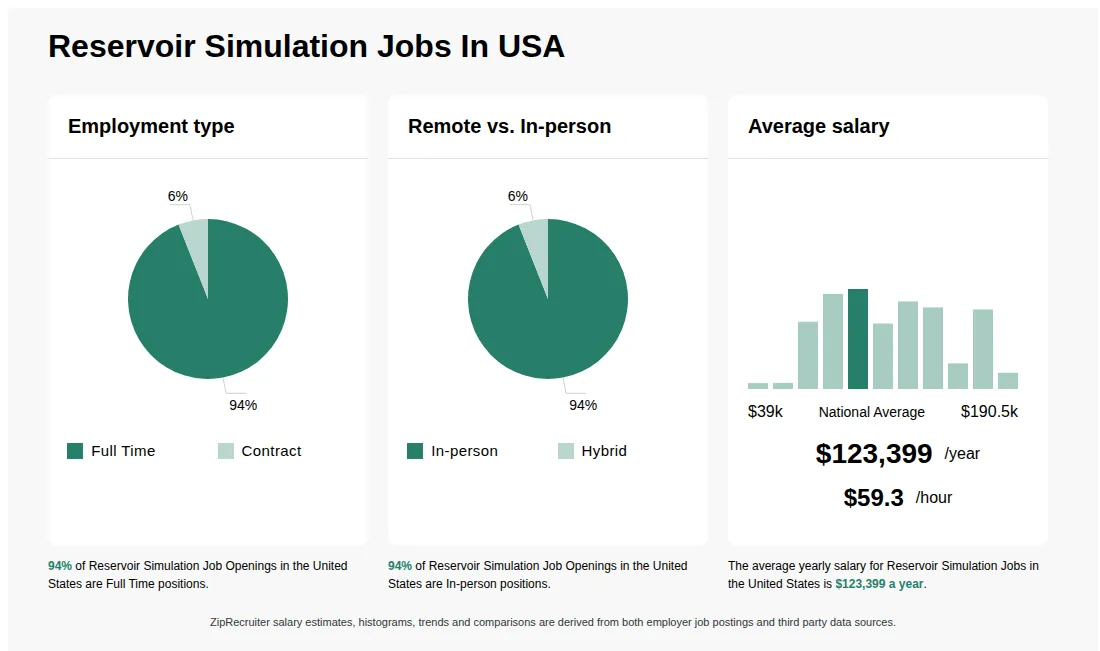
As of Sep 4, 2026, the average yearly pay for reservoir simulation in the United States is $123,399.00, according to ZipRecruiter salary data. Most workers in this role earn between $92,000.00 and $146,500.00 per year, depending on experience, location, and employer.

What is reservoir simulation?

Reservoir simulation is the process of using computer models to represent and predict the behavior of fluids (such as oil, gas, and water) within a reservoir underground. These simulations help engineers understand how a reservoir will respond to various extraction methods over time. By using data from geological, petrophysical, and production sources, reservoir simulation aids in optimizing production strategies and maximizing recovery while minimizing costs and risks.

What are the key skills and qualifications needed to thrive as a reservoir simulation engineer?

To thrive as a Reservoir Simulation Engineer, you need a solid background in petroleum engineering or related fields, with expertise in fluid dynamics, reservoir modeling, and data analysis. Proficiency with specialized simulation software such as Eclipse, CMG, or Petrel, as well as familiarity with programming languages like Python or MATLAB, is typically required. Strong problem-solving abilities, attention to detail, and effective communication skills help convey complex technical results to diverse teams. These skills are vital for accurately predicting reservoir performance, optimizing production strategies, and supporting informed decision-making in oil and gas operations.

What are some common challenges faced by reservoir simulation engineers, and how can they be addressed?

Reservoir simulation engineers often face challenges such as managing incomplete or uncertain subsurface data, integrating multidisciplinary inputs, and ensuring model accuracy for reliable forecasting. Addressing these challenges involves close collaboration with geologists, petrophysicists, and production engineers to validate assumptions and update models as new data becomes available. Regular calibration and validation of simulation models with actual production data, as well as ongoing training in the latest simulation software, also help enhance reliability and performance in this role.

What is the difference between Reservoir Simulation vs Reservoir Engineer?

AspectReservoir SimulationReservoir Engineer
Primary FocusDeveloping computer models to predict reservoir behaviorAnalyzing reservoir data to optimize production
Required SkillsPetroleum engineering, reservoir modeling, software proficiencyReservoir analysis, production forecasting, data interpretation
Work EnvironmentEngineering teams, software development, simulation labsField operations, data analysis, project planning
CertificationsPetroleum Engineering degree, software certificationsPetroleum Engineering degree, professional licenses

Reservoir Simulation involves creating models to predict reservoir performance, while Reservoir Engineers analyze data to optimize extraction. Both roles require petroleum engineering knowledge but focus on different aspects of reservoir management.

Is reservoir simulation a good career?

Reservoir simulation is a specialized field within the oil and gas industry that involves modeling subsurface reservoirs to optimize extraction. It requires strong skills in geology, petroleum engineering, and software tools like Eclipse or CMG. The career offers opportunities in exploration, production, and consulting, often with competitive salaries and the need for continuous technical learning.
More about Reservoir Simulation jobs

What cities are hiring for Reservoir Simulation jobs?

Cities with the most Reservoir Simulation job openings:

What states have the most Reservoir Simulation jobs?

States with the most job openings for Reservoir Simulation jobs include:

What job categories do people searching Reservoir Simulation jobs look for?

The top searched job categories for Reservoir Simulation jobs are:

Infographic showing various Reservoir Simulation job openings in the United States as of August 2026, with employment types broken down into 85% Full Time, 13% Part Time, and 2% Contract. Highlights an 84% Physical, 4% Hybrid, and 12% Remote job distribution, with an average salary of $123,399 per year, or $59.3 per hour.

Reservoir Engineer, Well Stimulation Support

Stanford Climate Ventures

Golden, CO โ€ข On-site

$115 - $180/hr

Other

Medical, Dental, Vision, Life, Retirement, PTO

Posted 11 days ago


Key responsibilities

  • Lead stimulation data collection planning and analyze real-time data to inform design changes.

  • Interpret stimulation data and analyze production, injection, and offset well data to support completion design decisions.

  • Conduct analysis of field data, collaborate with teams on model optimization, and support reservoir management strategies.


Job description

Description

The Well Stimulation Support Reservoir Engineer will lead the interface between the reservoir engineering and completions engineering/operations teams. Responsibilities include: well completion and stimulation treatment design, planning, and evaluation, reservoir engineering analysis to support completions design decisions and improve capital efficiency across Fervoโ€™s growing project portfolio, and planning, executing, and analyzing technology and completions design trials. Note that due to the operational nature of this role, flexibility to accommodate occasional calls outside standard working hours is expected. This position will report to the Asset Reservoir Engineering Lead in the Geoblock Factory.

Job Type

Full-time

Responsibilities Data Analysis & Interpretation
  • Interpret stimulation data (e.g., step-down tests and ISIPs) to inform completion design recommendations
  • Analyze production and injection data, including pressure transient data, rate-transient data, diagnostic fracture injection test (DFIT) data, and tracers
  • Analyze offset well data during stimulation operations
  • Conduct uncertainty quantification studies for reservoir field diagnostic tests and well performance
Field Operations Support
  • Lead stimulation data collection planning, and analyze real-time data to inform design changes
  • Lead lookbacks and reviews of stimulation, well, and reservoir performance to support short learning cycles and completion design updates
  • Develop and implement data acquisition, stimulation trials, and well testing programs for Fervo field projects; develop well testing procedures and analyze field data
Optimization, Reservoir Simulation & Forecasting
  • Provide analysis of field data and collaborate with cross functional teams to conduct model optimization studies, driving well enhancements for future development
  • Support reservoir management strategies and development plans with analysis of field data
  • Provide input into economic modeling in support of asset plans and development scenarios
  • Prepare comprehensive technical evaluations with recommendations
  • Participate in industry meetings and conferences
Qualifications Required
  • Bachelorโ€™s degree (or higher) in engineering
  • 3+ years of engineering experience in hydraulic fracturing in the unconventional oil and gas or geothermal industries
  • 1+ years of field experience in oil and gas, geothermal, or similar operations
  • Knowledge of geomechanics and thermodynamics
  • Knowledge of techniques related to multistage hydraulic fracturing in horizontal wells, including perforation design, cluster spacing, stage sequencing, fluid and proppant loading, etc.
  • Experience in treatment and pressure data evaluation and troubleshooting
  • Experience in data analytics with Spotfire or Power BI
  • Willing to travel up to 20% for fieldwork and occasional visits to other Fervo offices.
  • Able to accommodate occasional calls related to operations outside of normal business hours
Preferred
  • Proficient in Python programming for data analysis
  • Experience in well intervention techniques such as workovers, coil tubing, wireline, and snubbing
  • Experience in executing and evaluating trials of new technology or designs
  • Experience with project management and developing technical analysis in support of asset development and engineering design decisions
Compensation & Benefits
  • medical
  • dental
  • vision
  • life
  • short-term and long-term disability
  • flexible paid time off
  • paid parental leave
  • incentive stock options program
  • bonus incentive program
  • 401(k) plan with an employer match

Fervo provides a comprehensive suite of benefits including medical, dental, vision, life, short-term and long-term disability, flexible paid time off, and paid parental leave. Additionally, Fervo offers an incentive stock options program, a bonus incentive program, and a 401(k) plan with an employer match.

Expected Salary: $115,000 -$180,000 based on Colorado locality, pay in other locations may vary.

Fervo Energy reserves the right to ultimately pay more or less than the posted range and offer other compensation, depending on circumstances not related to an applicantโ€™s sex or other status protected by local, state, or federal law.

#J-18808-Ljbffr