Geotechnical Engineer
Anchorage, AK · On-site +1
Ability to travel for field work in remote areas, sometimes in adverse conditions but always with ... wilderness. Whether you're drawn to skiing, fishing, hiking, or simply a quieter pace of life ...
Anchorage, AK · On-site +1
Ability to travel for field work in remote areas, sometimes in adverse conditions but always with ... wilderness. Whether you're drawn to skiing, fishing, hiking, or simply a quieter pace of life ...
Anchorage, AK · On-site +1
Ability to travel for field work in remote areas, sometimes in adverse conditions but always with ... wilderness. Whether you're drawn to skiing, fishing, hiking, or simply a quieter pace of life ...
Anchorage, AK · On-site +1
Ability to occasionally travel for field work in remote areas throughout Alaska. Travel in other ... wilderness. Whether you're drawn to skiing, fishing, hiking, or simply a quieter pace of life ...
Anchorage, AK · On-site +1
Ability to occasionally travel for field work in remote areas throughout Alaska. Travel in other ... wilderness. Whether you're drawn to skiing, fishing, hiking, or simply a quieter pace of life ...
$104K - $135K/yr
The area is remote with limited social amenities. Accessing a map on Google Earth is recommended ... Katmai has 4.7 million acres of wilderness, 500 miles of coastline, endless opportunities for ...
$104K - $135K/yr
The area is remote with limited social amenities. Accessing a map on Google Earth is recommended ... Katmai has 4.7 million acres of wilderness, 500 miles of coastline, endless opportunities for ...
World Aquaculture Society Employment Service - Other Job Sites List - World Aquaculture Society E...
$16.25 - $19.75/hr
GH is a rural facility accessible by vehicle with a remote, off-grid release and collection site, Crosswinds, located in a backcountry/wilderness setting. Typical transport to GH is provided via ...
World Aquaculture Society Employment Service - Other Job Sites List - World Aquaculture Society E...
$16.25 - $19.75/hr
GH is a rural facility accessible by vehicle with a remote, off-grid release and collection site, Crosswinds, located in a backcountry/wilderness setting. Typical transport to GH is provided via ...
Fairbanks, AK · On-site +1
May include remote destinations in the Alaskan wilderness. Must have ability to travel utilizing a variety of transportation modes including small engine aircraft, ATVs, etc. * Other duties as ...
Quick apply
Fairbanks, AK · On-site +1
May include remote destinations in the Alaskan wilderness. Must have ability to travel utilizing a variety of transportation modes including small engine aircraft, ATVs, etc. * Other duties as ...
Fairbanks, AK · On-site +1
May include remote destinations in the Alaskan wilderness. Must have ability to travel utilizing a variety of transportation modes including small engine aircraft, ATVs, etc. * Other duties as ...
Fairbanks, AK · On-site +1
May include remote destinations in the Alaskan wilderness. Must have ability to travel utilizing a variety of transportation modes including small engine aircraft, ATVs, etc. * Other duties as ...
Anchorage, AK · On-site +1
Hybrid or remote work possible for the right candidate Our Anchorage office also values a collegial ... wilderness. Whether you're drawn to skiing, fishing, hiking, or simply a quieter pace of life ...
Anchorage, AK · On-site +1
Hybrid or remote work possible for the right candidate Our Anchorage office also values a collegial ... wilderness. Whether you're drawn to skiing, fishing, hiking, or simply a quieter pace of life ...
Hybrid or remote work possible for the right candidate Our Anchorage office also values a collegial ... wilderness. Whether you're drawn to skiing, fishing, hiking, or simply a quieter pace of life ...
Hybrid or remote work possible for the right candidate Our Anchorage office also values a collegial ... wilderness. Whether you're drawn to skiing, fishing, hiking, or simply a quieter pace of life ...
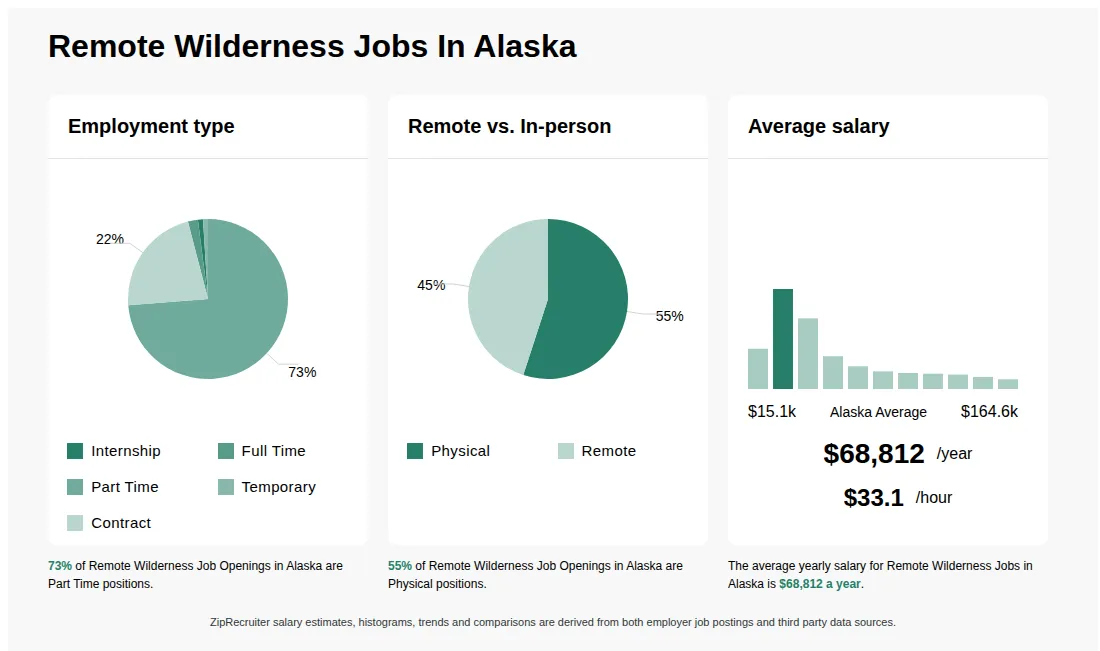
$15.1K - $28.7K
11% of jobs
$35K is the 25th percentile. Wages below this are outliers.
$28.7K - $42.3K
29% of jobs
The median wage is $48.4K / yr.
$42.3K - $55.9K
21% of jobs
$55.9K - $69.5K
9% of jobs
$78.5K is the 75th percentile. Wages above this are outliers.
$69.5K - $83.1K
6% of jobs
$83.1K - $96.7K
5% of jobs
$96.7K - $110.3K
4% of jobs
$110.3K - $123.9K
4% of jobs
$123.9K - $137.4K
4% of jobs
$137.4K - $151K
3% of jobs
$151K - $164.6K
2% of jobs
$15.1K
$68.8K
$164.6K
Remote wilderness jobs involve leading groups of tourists, adventurers, or students to rural places. In this type of position, you typically work in a wilderness setting, but your duties vary depending on the location and type of expedition. If you work as a wilderness instructor, for instance, you teach survival skills such as wilderness navigation to students. As a guide, you may lead hunters, fishers, or climbers to specific locations. If you work with private clients, your responsibilities depend on their requirements. As a wilderness outfitter, you plan trips and obtain equipment and supplies necessary for travel in a rural setting. You may also coordinate with support staff via radio during your expedition.
| Aspect | Remote Wilderness | Remote Forest Technician |
|---|---|---|
| Required Credentials | Environmental or outdoor certifications, wilderness survival training | Forestry or environmental science degrees, certifications in GIS or surveying |
| Work Environment | Remote, rugged outdoor settings, wilderness areas | Forests, conservation sites, remote or semi-remote forest locations |
| Employer & Industry Usage | Conservation organizations, outdoor adventure companies, government agencies | Forestry services, environmental consulting firms, government forestry departments |
Remote Wilderness and Remote Forest Technicians both work outdoors in natural settings, but Remote Wilderness roles focus on wilderness preservation and survival skills, while Remote Forest Technicians specialize in forest management, surveying, and conservation tasks. The choice depends on your certifications and preferred work environment.
For Remote Wilderness jobs in Alaska, the most frequently searched job titles are:
The top searched job categories for Remote Wilderness jobs in Alaska are:
Cities in Alaska with the most Remote Wilderness job openings:

Full-time
Medical, Dental, Vision, Life, Retirement, PTO
Re-posted 28 days ago
Are you a recent or upcoming bachelor's-level civil engineering grad with a passion for geotechnical work? Join our growing geotechnical group supporting civil engineering projects throughout Alaska.
What You Will Do:
Qualifications:
Benefits, Perks, and Office Culture:
PND offers one of the strongest employee benefit packages in the industry, including:
Our Anchorage office also values a collegial, connected workplace culture, including biweekly office donuts and bagels and monthly catered all-office meetings, and opportunities to participate in community activities.
Why Anchorage?
Anchorage is Alaska's hub: big enough for modern amenities, yet minutes from mountains, coastline, and wilderness. Whether you're drawn to skiing, fishing, hiking, or simply a quieter pace of life, Anchorage offers a rare blend of career and lifestyle.
PND Engineers is an Equal Opportunity Employer.

Sourced by ZipRecruiter
Civil engineering construction
51 - 200 Employees
Anchorage, AK, US
1979