2

Remote Storage Engineer Jobs (NOW HIRING)

The Storage Engineer, Junior supports the operation of enterprise storage systems that serve virtual machines, databases, and file services in a secure government environment. This role assists ...

Infrastructure Engineer (Storage)

New York, NY ยท On-site +1

$117K - $154K/yr

This role can work hybrid out of one of our US-based hubs (Seattle, NYC, or SF) or fully remote ... Engineering, and Platform teams to integrate storage into the broader platform * Contribute to ...

next page

Showing results 1-20

Remote Storage Engineer information

See salary details

$10

$56

$83

How much do remote storage engineer jobs pay per hour?

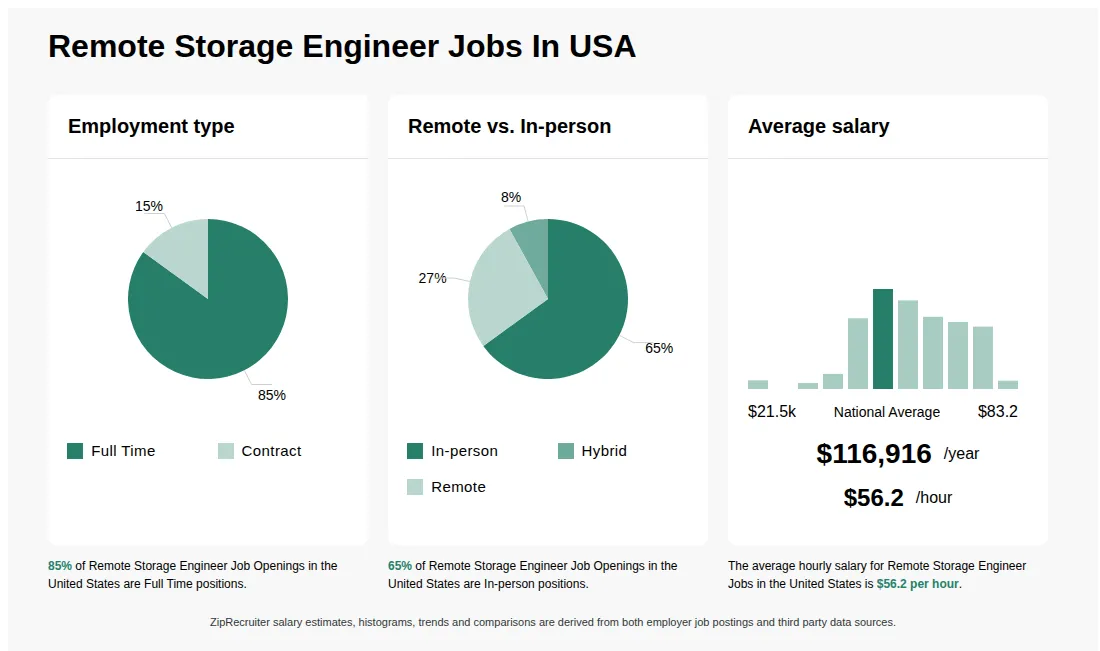
As of Jun 16, 2026, the average hourly pay for remote storage engineer in the United States is $56.21, according to ZipRecruiter salary data. Most workers in this role earn between $46.63 and $66.35 per hour, depending on experience, location, and employer.

What is a Remote Storage Engineer?

A Remote Storage Engineer is an IT professional who specializes in designing, implementing, and managing data storage solutions for organizations while working remotely. Their responsibilities include configuring storage systems, troubleshooting storage-related issues, ensuring data security, and optimizing storage performance. They often work with technologies such as cloud storage, SAN (Storage Area Network), and NAS (Network Attached Storage). Remote Storage Engineers play a crucial role in maintaining data integrity and accessibility, especially for businesses with distributed or cloud-based infrastructure.

What are the key skills and qualifications needed to thrive as a Remote Storage Engineer, and why are they important?

To thrive as a Remote Storage Engineer, you need strong expertise in storage technologies, data management, and backup solutions, typically backed by a degree in computer science or a related field. Familiarity with systems like SAN/NAS, cloud storage platforms (e.g., AWS, Azure), and certifications such as CompTIA Storage+ or vendor-specific credentials are highly valued. Excellent problem-solving, communication, and self-management skills help you address issues efficiently while collaborating across remote teams. These skills and qualities ensure robust data availability, security, and seamless support for distributed enterprise environments.

What is the difference between Remote Storage Engineer vs Cloud Storage Administrator?

AspectRemote Storage EngineerCloud Storage Administrator
Required CredentialsIT certifications, storage-specific certifications (e.g., SNIA, CompTIA Storage+)Cloud platform certifications (e.g., AWS, Azure, Google Cloud)
Work EnvironmentData centers, remote offices, or cloud environmentsCloud platforms, remote or on-premises
Employer & Industry UsageIT companies, data centers, cloud providersCloud service providers, enterprises using cloud storage
Common Search & Comparison IntentUnderstanding storage infrastructure rolesManaging and optimizing cloud storage solutions

The main difference is that Remote Storage Engineers focus on designing, implementing, and maintaining storage systems across various environments, including data centers and cloud platforms. Cloud Storage Administrators primarily manage and optimize storage within cloud platforms like AWS or Azure. Both roles require storage knowledge, but their focus and certifications differ based on the environment they work in.

What Does a Remote Storage Engineer Do?

As a remote storage engineer, you work from home to design and maintain information storage systems for clients. In this virtual position, your duties involve creating a database infrastructure that meets the needs of each client with whom you work. Part of your job involves assessing the specific needs of the client and designing appropriate solutions. You build or configure software, hardware, or cloud-computing systems, and you provide support and training for the employees who use the system. Other responsibilities include making updates, backing up data, and building and monitoring the network that connects to the data storage system.


How do Remote Storage Engineers typically collaborate with on-site IT teams to resolve storage issues?

Remote Storage Engineers frequently work closely with on-site IT teams to diagnose and resolve storage-related incidents. This collaboration often involves remote access to systems, regular video or conference calls, and utilizing ticketing systems to track progress. Strong communication skills are essential, as Remote Storage Engineers must clearly document troubleshooting steps and coordinate actions, sometimes even guiding on-site staff through physical hardware checks or replacements. This teamwork ensures efficient resolution of issues despite physical distance.
What cities are hiring for Remote Storage Engineer jobs? Cities with the most Remote Storage Engineer job openings:
What are the most commonly searched types of Storage Engineer jobs? The most popular types of Storage Engineer jobs are:
What states have the most Remote Storage Engineer jobs? States with the most job openings for Remote Storage Engineer jobs include:
What job categories do people searching Remote Storage Engineer jobs look for? The top searched job categories for Remote Storage Engineer jobs are:
Systems Engineer- UNIX/Linux (DevOps, Storage, CATIA & ENOVIA)

Systems Engineer- UNIX/Linux (DevOps, Storage, CATIA & ENOVIA)

Quantum World Technologies Inc

Arlington, VA โ€ข Remote

Full-time

Posted 15 days ago


Job description

Job Title: UNIX/Linux Systems Engineer (DevOps, Storage, CATIA & ENOVIA)

Location: Remote

Hire Type: Full-time

Experience: 10-15 years

Role Summary:

We are seeking a skilled UNIX/Linux Systems Engineer with 10โ€“15 years of experience in UNIX administration, development, DevOps, and enterprise PLM/CAD environments. The ideal candidate is a proactive team player with a strong foundation in system support, automation, storage technologies, and hands-on experience with CATIA and ENOVIA platforms.

Key Responsibilities

  • Provide advanced support for UNIX (AIX, Linux, FreeBSD) systems, focusing on storage, network drivers, and enterprise PLM/CAD applications.
  • Collaborate with customers and development teams to troubleshoot and resolve technical issues, including those related to CATIA and ENOVIA environments.
  • Develop and maintain automation tools using Shell, AWK, Java, and Perl to improve engineering workflows.
  • Analyze system failures and develop scripts/tools to accelerate problem resolution.
  • Support and enhance diagnostic programs for network and storage troubleshooting.
  • Deliver technical training and mentorship on scripting, debugging, and PLM/CAD best practices to team members.
  • Debug and resolve defects in storage drivers and PLM/CAD integrations, documenting solutions and best practices.
  • Use source code control systems for tracking changes and managing bug fixes.
  • Participate in on-call rotations for critical system support.
  • Employ kernel debuggers (AIX KDB, GDB) for analyzing system crashes and stack traces.
  • Support high-availability solutions, storage array integrations, and enterprise PLM/CAD deployments.
  • Develop and execute functional verification tests for system software and PLM/CAD integrations.
  • Provide customer support for network administration, including TCP/IP, NFS, DNS, FTP, SSH, and performance troubleshooting.
  • Administration and Maintenance: Manage the installation, configuration, deployment, and maintenance of the CATIA V5 software across all client workstations and servers. This includes setting up the global environment (CATEnv) and managing shared resources.
  • Standardization and Configuration: Run CATIA in admin mode to define, manage, and lock company-wide design standards (e.g., drafting standards, dimensions, annotations, and styles) to enforce consistency across all projects.
  • Performance Tuning and Optimization: Monitor and tune the performance of the CATIA V5 environment, especially when working with large data files and assemblies, to ensure end-user efficiency.

Required Skills & Qualifications

  • 10โ€“15 years of hands-on experience with UNIX (AIX, FreeBSD, Linux) administration and development.
  • Proficiency in scripting and programming languages: Shell (KSH/BASH), AWK, C, Java, Perl.
  • Strong understanding of TCP/IP networking, NETBIOS, and network troubleshooting tools.
  • Experience with enterprise storage arrays and high-availability solutions.
  • Demonstrated ability to automate system diagnostics and reporting.
  • Familiarity with source code control and bug tracking systems.
  • Strong analytical and problem-solving skills with a customer-focused mindset.
  • Ability to mentor and train junior team members.
  • Hands-on experience with CATIA and ENOVIA platforms, including installation, configuration, integration, and support in enterprise environments.

Preferred Experience

  • Experience supporting mission-critical UNIX systems in enterprise environments.
  • Development and support of device drivers (disk, fiber channel, USB) in C.
  • Exposure to DevOps practices and cloud-based technologies.
  • Background in functional and automated testing for system software.
  • Professional training in UNIX internals, storage arrays, or programming languages.
  • Experience with PLM/CAD system upgrades, migrations, and user support.

Education & Certifications

  • Bachelorโ€™s degree in Computer Science, Information Technology, or related field (or equivalent experience).
  • Relevant professional certifications or training in UNIX, storage, programming, CATIA, or ENOVIA are a plus.