2

Remote Physical Therapy Reviewer Jobs (NOW HIRING)

The physical therapy assistant provides physical therapy services under the direction of the ... In person speech, Telephone, Other remote speech and other sounds. Clarity of Vision: * For near ...

Clinical Reviewer, DPT

$95K - $105K/yr

We are looking for a Doctor of Physical Therapy (DPT) who has expertise in Physical Therapy to ... Fully remote opportunity with about x% travel Medical, dental, vision, life, disability insurance ...

Showing results 41-60

Remote Physical Therapy Reviewer information

See salary details

$1.1K

$1.9K

$2.5K

How much do remote physical therapy reviewer jobs pay per week?

As of Sep 7, 2026, the average weekly pay for remote physical therapy reviewer in the United States is $1,859.52, according to ZipRecruiter salary data. Most workers in this role earn between $1,596.15 and $2,067.31 per week, depending on experience, location, and employer.

What is a remote physical therapy reviewer?

A Remote Physical Therapy Reviewer is a licensed physical therapist who evaluates and reviews physical therapy treatment plans and documentation from a remote location, often for insurance companies or healthcare organizations. Their primary role is to ensure that proposed treatments are medically necessary, evidence-based, and meet established guidelines. They review patient records, assess appropriateness of care, and may provide recommendations or determinations regarding coverage. This position typically requires strong clinical knowledge, attention to detail, and the ability to interpret medical documentation. Working remotely allows for flexibility while still contributing to patient care quality and healthcare cost management.

What does a remote physical therapy reviewer do?

As a remote physical therapy reviewer, your job is to work from home to review the results of physical therapy (PT) for each client. This is a non-clinical position that has little or no direct interaction with patients, but it does involve reviewing each case to determine the level of service that is necessary, any unique medical needs that need consideration, and whether or not it qualifies for insurance coverage. Remote physical therapy reviewers work almost exclusively for insurance companies to help determine eligibility.


What are the key skills and qualifications needed to thrive as a remote physical therapy reviewer?

To thrive as a Remote Physical Therapy Reviewer, you need a valid physical therapy license, strong clinical expertise, and experience in reviewing therapy documentation. Familiarity with electronic medical records (EMR), utilization management software, and knowledge of insurance guidelines or medical necessity criteria is essential. Attention to detail, critical thinking, and clear written communication are vital soft skills for evaluating treatment plans and collaborating with providers. These skills ensure accurate and timely reviews that support quality patient care while adhering to regulatory and payer requirements.

What are some common challenges faced by remote physical therapy reviewers, and how can they be addressed?

Remote Physical Therapy Reviewers often encounter challenges such as interpreting documentation without in-person contact and ensuring clear communication with providers. To address these, it's important to develop strong written communication skills and stay up-to-date with clinical guidelines. Collaborating regularly with team members and using secure digital platforms helps maintain accuracy and efficiency when reviewing treatment plans. Additionally, proactively seeking clarification from providers and participating in ongoing training can further enhance effectiveness in this role.

What is the difference between Remote Physical Therapy Reviewer vs Remote Physical Therapy Consultant?

AspectRemote Physical Therapy ReviewerRemote Physical Therapy Consultant
CredentialsLicensed Physical Therapist (PT)Licensed Physical Therapist (PT)
Work EnvironmentReviewing medical records, insurance claims, and documentation remotelyProviding expert advice, treatment plans, and recommendations remotely
Employer & Industry UsageInsurance companies, healthcare agencies, legal firmsHealthcare organizations, clinics, private practices
Search & Comparison IntentUnderstanding review roles, credential requirements, and remote workSeeking expert consultation, advice, or remote clinical guidance

The main difference is that a Remote Physical Therapy Reviewer primarily evaluates medical documentation and insurance claims, while a Remote Physical Therapy Consultant offers expert advice and treatment recommendations remotely. Both roles require a licensed PT and involve remote work, but their focus and responsibilities differ based on the employer's needs.

What cities are hiring for Remote Physical Therapy Reviewer jobs?

Cities with the most Remote Physical Therapy Reviewer job openings:

What are the most commonly searched types of Physical Therapy Reviewer jobs?

The most popular types of Physical Therapy Reviewer jobs are:

What states have the most Remote Physical Therapy Reviewer jobs?

States with the most job openings for Remote Physical Therapy Reviewer jobs include:

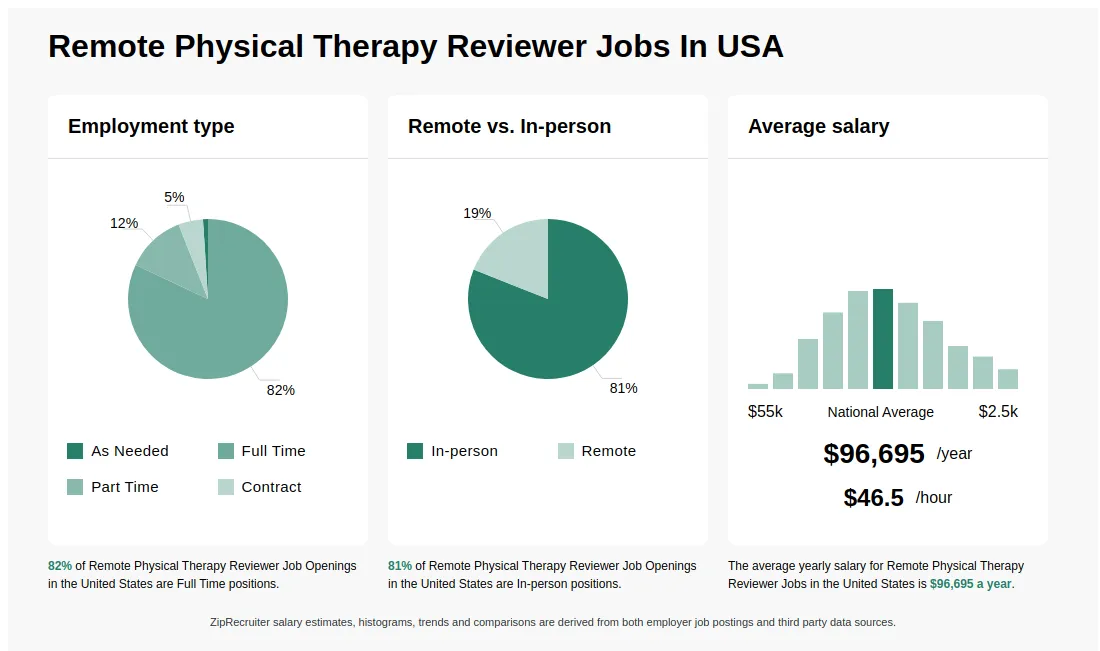
Infographic showing various Remote Physical Therapy Reviewer job openings in the United States as of August 2026, with employment types broken down into 75% Full Time, 20% Part Time, and 5% Contract. Highlights an 100% Remote job distribution, with an average salary of $96,695 per year, or $46.5 per hour.

Physical Therapy Assistant (Full Time)

The Holmstad

Remote

$29.77 - $40.98/hr

Full-time

Medical, Dental, Vision, Life, Retirement, PTO

Re-posted 24 days ago


Job description

We Are Inspired to Serve. Join us!The physical therapy assistant provides physical therapy services under the direction of the physical therapist and according to the physician's plan of care.

ESSENTIAL RESPONSIBILITIES:

  • Provides direct physical therapy according to directions of physical therapist and in accordance with the physician's plan of care.
  • Treats patient to relieve pain, develop or restore function, and maintain maximum performance.
  • Directs and aids patients in active and passive therapeutic exercises, muscle reeducation gait and functional training, transfer activities and prosthetic training.
  • Utilizes physical agents, including but not limited to heat, cold, water, light, electricity, ultrasound and massage.
  • Observes and reports to the physical therapists and the organization personnel the patients reaction to treatment and any changes in patients condition.
  • Instructs patients in care and use of wheelchairs, branches, crutches, canes and prosthetic or orthotic devices.
  • Maintains necessary records, clinical notes and conference notes which will be incorporated into the patients clinical record in prescribed time frames.
  • Participates in organization home care team members meetings and Inservice education program.

EDUCATION AND WORK EXPERIENCE:

  • Required Degree: Bachelor's Degree in Physical Therapy approved by an accredited organization.
  • Preferred Degree: N/A
  • Certificate(s): PT License and CPR certification, if required by state
  • Experience: 1+ Years

KNOWLEDGE, SKILLS, AND ABILITY:

  • Ability to show compassion and understanding.
  • Ability to record patients information, document their progress and report results of treatment to the physical therapist.
  • Ability to follow direction and help physical therapist manage multiple patients by assisting during sessions.
  • Strong communication, interpersonal, attention to detail and time management skills.
  • Knowledge of basic PT/medical terminology, confidentiality and HIPAA laws.

PHYSICAL REQUIREMENTS:

  • Ability to stand, sit, talk, reach, stoop, kneel, and use hands and fingers to operate a computer, telephone, and keyboard.
  • Ability to lift, carry, push, and/or pull light to moderate amounts of weight up to 100 lbs.
  • Ability to operate various equipment base on department.
  • The ability to hear, understand, and distinguish speech and/or other sounds (e.g., machinery alarms, medical codes or alarms. Four hearing requirements listed: In person speech, Telephone, Other remote speech and other sounds.

Clarity of Vision:

  • For near visual acuity Clarity of vision at approximately 20 inches or less (i.e., working with small objects or reading small print), including use of computers.
  • For far visual acuity, Clarity of vision at 20 feet or more. This is not just the ability to see a person or object, but the ability to recognize features as well.
  • For peripheral vision, observing an area that can be seen up and down or to right or left while eyes are fixed on a given point.

Compensation Pay Range:

$29.77 - $40.98 per hour

Reasonable Pay Estimate

A reasonable estimate of the pay range for this position is $29.77 - $40.98 per hour. There are numerous factors taken into consideration in determining the actual offered rate of pay, including but not limited to: job-related qualifications, experience, skills, education, geographic location, and consideration of internal and external equity.

For full time employees, we offer a generous benefits package that includes:

  • Medical, dental and vision insurance

  • Employer paid group term life and disability

  • Paid Time Off (PTO) & six paid holidays

  • 403(b) with a 3% employer match

  • Fitness center use at most facilities.

  • Various voluntary benefits:

    • Life, AD&D

    • Tuition assistance and scholarships

    • Employee assistance program

    • Legal services, home/auto insurance, discount purchasing program

    • Pet Insurance

For more information about Covenant Living and CovenantCare at Home, please visit www.covliving.org or www.covenantcareathome.org.

Covenant Living and CovenantCare Home Health and Hospice are equal opportunity employers. All qualified applicants will receive consideration for employment without regard to race, color, sex, sexual orientation, gender identity or expression, religion, national origin or ancestry, age, disability, marital status, pregnancy, protected veteran status, protected genetic information, or any other characteristics protected by local laws, regulations, or ordinances.