2

Remote Marine Science Jobs (NOW HIRING)

Scientific Programmer

Silver Spring, MD · On-site +1

$78K - $100K/yr

Must have a Bachelor's degree in GIS, Remote Sensing, Marine Science, Engineering, Biology, Oceanography, or related field. * 5+ years of related experience. * Software development experience ...

Master's degree in data science, computer science, marine biology, or related field, OR Bachelor ... Remote * Must be willing to relocate if needed. Contact: If you would like to apply for this ...

Masters degree in data science, computer science, marine biology, or related field, OR Bachelors ... Remote * Must be willing to relocate if needed. Contact: If you would like to apply for this ...

The Marine Fleet Coordinator acts as the most senior professional mariner on Station, and as such ... 150 science and technical events across three geographically remote research stations; McMurdo ...

Our work is performed by our professional staff, scientists and engineers at remote sites, embedded ... Oversee delivery of complex environmental compliance, planning, and marine sciences programs ...

next page

Showing results 1-20

Remote Marine Science information

See salary details

$119K

$127.5K

$155.5K

How much do remote marine science jobs pay per year?

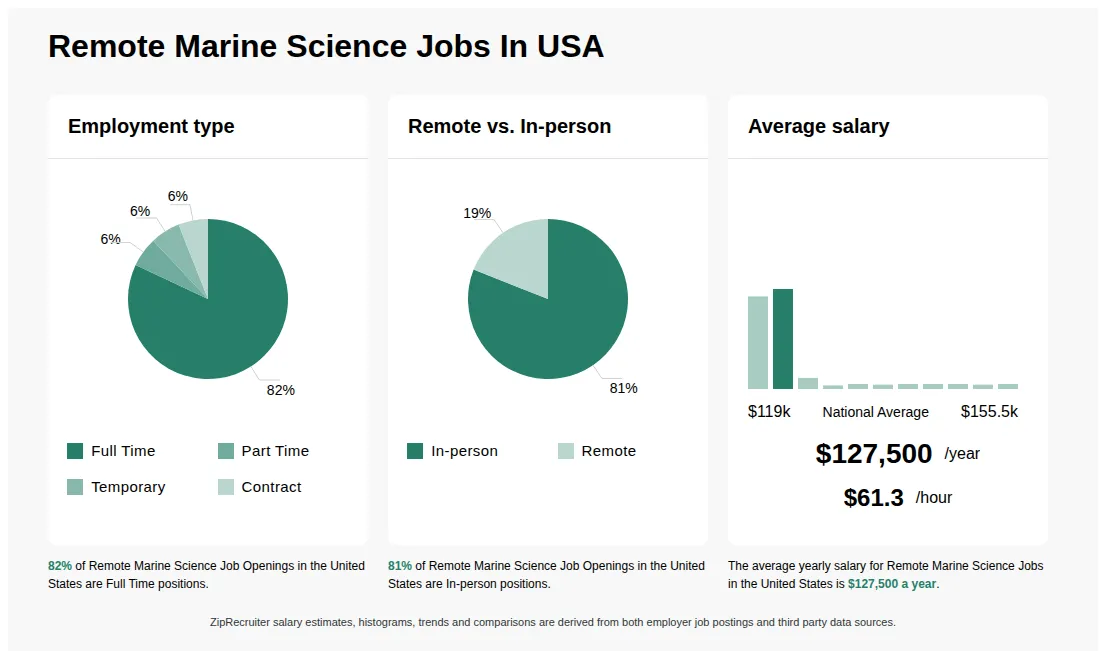
As of Jul 26, 2026, the average yearly pay for remote marine science in the United States is $127,500.00, according to ZipRecruiter salary data. Most workers in this role earn between $121,500.00 and $125,000.00 per year, depending on experience, location, and employer.

What is a Remote Marine Science job?

A Remote Marine Science job involves conducting research, data analysis, and conservation efforts related to oceanography, marine biology, and environmental science from a remote location. These roles often include tasks such as analyzing satellite data, developing models, reviewing literature, or coordinating conservation projects using digital tools. Remote marine scientists may work for universities, government agencies, environmental organizations, or private companies. While fieldwork may be limited, collaboration with in-person researchers and the use of remote sensing technologies are common.

What are some typical challenges faced by remote marine science professionals, and how can they be addressed?

Remote marine science professionals often encounter challenges related to limited field site access, reliance on digital communication, and occasional difficulties collaborating across different time zones or disciplines. To address these, it's important to develop strong organizational habits, leverage virtual collaboration tools, and maintain proactive communication with your team. Employers may provide training in specialized software and facilitate regular meetings to keep remote staff aligned and supported. Adaptability and resourcefulness also play a key role in ensuring field data quality and project success. By building effective routines and staying connected with colleagues, you can thrive in this dynamic and impactful field.

What are the key skills and qualifications needed to thrive in the Remote Marine Science position, and why are they important?

To excel in Remote Marine Science, you need a background in marine biology or oceanography, strong analytical skills, and expertise in data interpretation, often supported by an advanced degree. Familiarity with remote sensing tools, GIS software, satellite data analysis, and certifications such as SCUBA or drone piloting may be required. Excellent communication, self-motivation, and problem-solving abilities are important soft skills for success in remote collaborations. These competencies ensure effective research, accurate data collection, and productive teamwork despite the challenges of working from a distance.

More about Remote Marine Science jobs
What cities are hiring for Remote Marine Science jobs? Cities with the most Remote Marine Science job openings:
What are the most commonly searched types of Marine Science jobs? The most popular types of Marine Science jobs are:
What states have the most Remote Marine Science jobs? States with the most job openings for Remote Marine Science jobs include:
Infographic showing various Remote Marine Science job openings in the United States as of July 2026, with employment types broken down into 98% Full Time, and 2% Part Time. Highlights an 98% Physical, 1% Hybrid, and 1% Remote job distribution, with an average salary of $127,500 per year, or $61.3 per hour.

Science and Conservation Associate

Laguna Ocean Foundation

Laguna Beach, CA • Remote

Part-time

Posted 17 days ago


Job description

Science and Conservation Associate

Location: Laguna Beach, California
Organization: Laguna Ocean Foundation (LOF)
Status: Part-time (Contingent upon funding)

About Laguna Ocean Foundation

The Laguna Ocean Foundation (LOF) is a nonprofit dedicated to protecting and restoring Laguna Beach’s coastal ecosystems through science, education, conservation, and community engagement. Working with universities, government agencies, and community partners, LOF is advancing innovative coastal monitoring by integrating field ecology with drones, GIS, machine learning, environmental DNA (eDNA), and citizen science.

Position Summary

LOF seeks a motivated Science and Conservation Associate to support the technical foundation of its research and conservation programs. This position transforms field observations into high-quality geospatial data that inform ecological monitoring, restoration, conservation planning, and public education across Laguna Beach’s Marine Protected Areas.

The Associate will manage geospatial workflows—from drone and underwater ROV surveys through machine-learning analysis, GIS integration, habitat mapping, and scientific visualization. Working closely with LOF biologists, university researchers, GIS specialists, and interns, the Associate will help build one of California’s most comprehensive long-term coastal spatial datasets while supporting scientific publications, grant-funded research, StoryMaps, and emerging conservation technologies.

Position contingent upon funding.

Primary Responsibilities

Remote Sensing & Field Operations

● Conduct drone surveys under FAA Part 107 regulations.

● Operate underwater ROVs to document marine habitats.

● Coordinate field logistics, equipment, permits, and data collection.

GIS & Spatial Analysis

● Process drone imagery into ortho-mosaics and elevation models.

● Maintain GIS databases and produce habitat, species, and change-detection maps.

● Integrate remote sensing with biological field data.

Artificial Intelligence & Data Science

● Develop and apply machine-learning models for habitat and species classification.

● Improve classification workflows and support Python-based geospatial automation.

Research & Communication

● Collaborate with scientists and partner institutions on applied conservation research.

● Assist with scientific publications, technical reports, grant proposals, and conference presentations.

● Develop Story-Maps, dashboards, and visual products that communicate science to diverse audiences.

Training & Program Support

● Mentor interns and volunteers in GIS, drone operations, and data collection.

● Help establish standardized monitoring and data management protocols.

Required Qualifications

● Bachelor’s degree in GIS, Geography, Environmental Science, Marine Science, Engineering, Computer Science, Data Science, Ecology, or related field (or equivalent experience).

● At least one year of experience in remote sensing, GIS, spatial analysis, or environmental monitoring.

● Proficiency with ArcGIS Pro and/or QGIS.

● Experience with Python for geospatial analysis or machine learning.

● Experience processing drone imagery using photogrammetry.

● Familiarity with image classification or computer vision workflows.

● Knowledge of geospatial data management and reproducible workflows.

● FAA Part 107 certification (or ability to obtain).

● Excellent organizational, communication, and technical writing skills.

Preferred Qualifications

● Experience in coastal or marine ecosystems.

● Underwater ROV experience.

● Familiarity with eDNA, ecological monitoring, or conservation research.

● Experience working with universities, government agencies, or nonprofits.

● Grant writing or peer-reviewed publication experience.

● Experience with ArcGIS Online, StoryMaps, Dashboards, or web GIS.

● Knowledge of TensorFlow, PyTorch, Detectron2, or similar frameworks.

● Experience with cloud-based geospatial workflows.

Please send your resume and cover letter to: Please send in your material by July 31 to info@lagunaoceanfoundation.org

E04JI800ui4140992ms