2

Remote Linux Jobs (NOW HIRING)

Group Details The Linux engineering team are responsible for Tradeweb's Linux runtime environment ... Tradeweb Technology jobs are fully remote. The Tradeweb Technology hub is in our Jersey City office ...

... 500 stipend for remote office setup in first year + $400 each following year * Internet ... Company paid Wellable subscription Join Vultr Vultr is seeking a Linux Systems Administrator to ...

next page

Showing results 1-20

Remote Linux information

See salary details

$36

$55

$71

How much do remote linux jobs pay per hour?

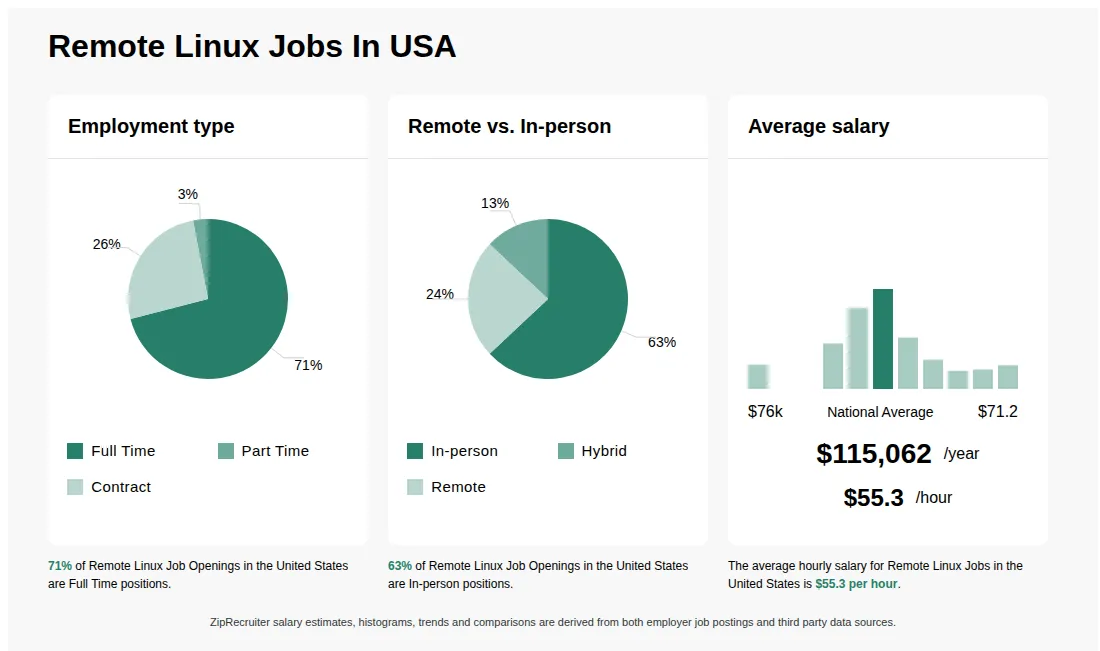
As of Jul 15, 2026, the average hourly pay for remote linux in the United States is $55.32, according to ZipRecruiter salary data. Most workers in this role earn between $50.24 and $59.38 per hour, depending on experience, location, and employer.

What kinds of projects or daily tasks can I expect as a Remote Linux professional?

As a Remote Linux professional, your daily tasks may include server provisioning, managing user accounts, monitoring system health, deploying software updates, and troubleshooting network or application issues. You may also work on automation projects using scripting languages or configuration management tools to streamline system operations. Collaboration is often virtual, so you'll join regular meetings, coordinate with development or DevOps teams, and document processes or incidents thoroughly. Depending on your employer, you may participate in on-call rotations or respond to urgent incidents to ensure uptime and security. This variety of responsibilities provides both technical challenges and opportunities for skill development in a dynamic environment.

What is a Remote Linux job?

A Remote Linux job involves managing, maintaining, and troubleshooting Linux-based systems from a remote location. Professionals in these roles may work as system administrators, DevOps engineers, or cloud engineers, ensuring server uptime, security, and performance. Common tasks include configuring servers, automating processes, and deploying applications. These jobs require expertise in Linux command-line tools, scripting languages, and networking. Many companies hire remote Linux professionals to support cloud environments, web servers, and enterprise systems.

What are the key skills and qualifications needed to thrive in the Remote Linux position, and why are they important?

To thrive in a Remote Linux role, you need a strong understanding of Linux system administration, shell scripting, networking concepts, and troubleshooting skills, often supported by a degree in computer science or relevant certifications such as CompTIA Linux+ or RHCSA. Proficiency with configuration management tools (like Ansible or Puppet), remote monitoring solutions, and cloud platforms is commonly required. Strong communication, self-motivation, and problem-solving abilities are key soft skills that help remote professionals excel. These skills ensure reliable system performance, efficient collaboration with distributed teams, and successful problem resolution in remote environments.

More about Remote Linux jobs
What cities are hiring for Remote Linux jobs? Cities with the most Remote Linux job openings:
What are the most commonly searched types of Linux jobs? The most popular types of Linux jobs are:
What states have the most Remote Linux jobs? States with the most job openings for Remote Linux jobs include:
Infographic showing various Remote Linux job openings in the United States as of July 2026, with employment types broken down into 100% Full Time. Highlights an 100% Remote job distribution, with an average salary of $115,062 per year, or $55.3 per hour.
NIH - Linux Systems Administrator / Systems Engineer

NIH - Linux Systems Administrator / Systems Engineer

cFocus Software Incorporated

Bethesda, MD โ€ข On-site, Remote

Full-time

Posted 13 days ago


Job description

cFocus Software seeks a Linux Systems Administrator / Systems Engineer to join our program supporting the National Institutes of Health (NIH). This position is fully remote. This position requires a Public Trust or the ability to obtain a public trust clearance.
Qualifications:
  • Public Trust Clearance
  • B.S. Computer Science, Information Technology, or a related field
  • 5+ years of Linux systems administration and systems engineering experience.
  • Experience administering enterprise Linux environments.
  • Experience supporting cybersecurity infrastructure or Continuous Monitoring programs.
  • Experience performing Linux security hardening and patch management.
  • Experience supporting Federal or enterprise IT environments.
  • Preferred certifications: RHCSA, RHCE, LPIC-2, LPIC-3, Linux+

Duties:
  • Install, configure, administer, and maintain Red Hat Enterprise Linux (RHEL), Rocky Linux, Oracle Linux, Ubuntu, and other enterprise Linux operating systems.
  • Perform lifecycle management of Linux servers supporting enterprise cybersecurity platforms.
  • Configure system services, storage, networking, authentication, and security controls.
  • Perform operating system hardening in accordance with DISA STIGs, CIS Benchmarks, and NIH security requirements.
  • Manage user accounts, privileged access, and authentication services.
  • Maintain system availability while minimizing operational downtime.
  • Operating and maintaining Linux infrastructure supporting CDM scanning capabilities.
  • Supporting continuous asset discovery and inventory management.
  • Maintaining configuration monitoring capabilities.
  • Supporting vulnerability management operations.
  • Monitoring enterprise security posture across on-premises and cloud environments.
  • Supporting NIH's transition to an Ongoing Authorization (OA) security model.
  • Working with technical points of contact to mature CDM capabilities throughout the enterprise.
  • Ensuring continuous visibility into managed systems and security configurations.
  • Engineer, deploy, configure, and optimize Linux server environments supporting cybersecurity operations.
  • Build secure server images and standardized Linux baselines.
  • Automate system administration tasks using scripting and configuration management tools.
  • Support virtualization and cloud-hosted Linux environments.
  • Integrate Linux servers with enterprise identity and authentication services.
  • Perform capacity planning, system tuning, and performance optimization.