
Linguist III Location: Remote Top 3 must-have HARD skills: 1 Native fluency in French/Italian 2 Experience with language annotation or other forms of data markup and tagging 3 Experience with ...
Linguist III Location: Remote Top 3 must-have HARD skills: 1 Native fluency in French/Italian 2 Experience with language annotation or other forms of data markup and tagging 3 Experience with ...

Linguist
Redmond, WA · Remote
$40/hr
Remote - West Coast preferred Experience: 0-3 years Education: PhD in Linguistics required Employment: Contract Position Overview We are seeking a Linguist / AI Research Linguist with a strong ...
Linguist
Redmond, WA · Remote
$40/hr
Remote - West Coast preferred Experience: 0-3 years Education: PhD in Linguistics required Employment: Contract Position Overview We are seeking a Linguist / AI Research Linguist with a strong ...

Linguist III
PR · Remote
US - NY - Remote Duration:8 months Job Title: Linguist lII (FAIR) Main duties: Perform linguistic analyses on large datasets. Perform linguistic error analysis of AI model outputs, determining what ...
Linguist III
PR · Remote
US - NY - Remote Duration:8 months Job Title: Linguist lII (FAIR) Main duties: Perform linguistic analyses on large datasets. Perform linguistic error analysis of AI model outputs, determining what ...
Dutch Bilingual Expert - Remote
Miami, FL · Remote
$30 - $65/hr
Remote Job Overview We are seeking Dutch Bilingual Experts to contribute to a global language and ... In this role, you will evaluate AI-generated Dutch speech, assess linguistic accuracy and ...
Quick apply
Dutch Bilingual Expert - Remote
Miami, FL · Remote
$30 - $65/hr
Remote Job Overview We are seeking Dutch Bilingual Experts to contribute to a global language and ... In this role, you will evaluate AI-generated Dutch speech, assess linguistic accuracy and ...
Dutch Bilingual Expert - Remote
New York, NY · Remote
$30 - $65/hr
Remote Job Overview We are seeking Dutch Bilingual Experts to contribute to a global language and ... In this role, you will evaluate AI-generated Dutch speech, assess linguistic accuracy and ...
Quick apply
Dutch Bilingual Expert - Remote
New York, NY · Remote
$30 - $65/hr
Remote Job Overview We are seeking Dutch Bilingual Experts to contribute to a global language and ... In this role, you will evaluate AI-generated Dutch speech, assess linguistic accuracy and ...
Dutch Bilingual Expert - Remote
Boston, MA · Remote
$30 - $65/hr
Remote Job Overview We are seeking Dutch Bilingual Experts to contribute to a global language and ... In this role, you will evaluate AI-generated Dutch speech, assess linguistic accuracy and ...
Quick apply
Dutch Bilingual Expert - Remote
Boston, MA · Remote
$30 - $65/hr
Remote Job Overview We are seeking Dutch Bilingual Experts to contribute to a global language and ... In this role, you will evaluate AI-generated Dutch speech, assess linguistic accuracy and ...
Dutch Bilingual Expert - Remote
San Francisco, CA · Remote
$30 - $65/hr
Remote Job Overview We are seeking Dutch Bilingual Experts to contribute to a global language and ... In this role, you will evaluate AI-generated Dutch speech, assess linguistic accuracy and ...
Quick apply
Dutch Bilingual Expert - Remote
San Francisco, CA · Remote
$30 - $65/hr
Remote Job Overview We are seeking Dutch Bilingual Experts to contribute to a global language and ... In this role, you will evaluate AI-generated Dutch speech, assess linguistic accuracy and ...
Remote Job Overview We are seeking Dutch Bilingual Experts to contribute to a global language and ... In this role, you will evaluate AI-generated Dutch speech, assess linguistic accuracy and ...
Quick apply
Remote Job Overview We are seeking Dutch Bilingual Experts to contribute to a global language and ... In this role, you will evaluate AI-generated Dutch speech, assess linguistic accuracy and ...
Dutch Bilingual Expert - Remote
Los Angeles, CA · Remote
$30 - $65/hr
Remote Job Overview We are seeking Dutch Bilingual Experts to contribute to a global language and ... In this role, you will evaluate AI-generated Dutch speech, assess linguistic accuracy and ...
Quick apply
Dutch Bilingual Expert - Remote
Los Angeles, CA · Remote
$30 - $65/hr
Remote Job Overview We are seeking Dutch Bilingual Experts to contribute to a global language and ... In this role, you will evaluate AI-generated Dutch speech, assess linguistic accuracy and ...
Dutch Bilingual Expert - Remote
Los Angeles, CA · Remote
$30 - $65/hr
Remote Job Overview We are seeking Dutch Bilingual Experts to contribute to a global language and ... In this role, you will evaluate AI-generated Dutch speech, assess linguistic accuracy and ...
Quick apply
Dutch Bilingual Expert - Remote
Los Angeles, CA · Remote
$30 - $65/hr
Remote Job Overview We are seeking Dutch Bilingual Experts to contribute to a global language and ... In this role, you will evaluate AI-generated Dutch speech, assess linguistic accuracy and ...
Dutch Bilingual Expert - Remote
Chicago, IL · Remote
$30 - $65/hr
Remote Job Overview We are seeking Dutch Bilingual Experts to contribute to a global language and ... In this role, you will evaluate AI-generated Dutch speech, assess linguistic accuracy and ...
Quick apply
Dutch Bilingual Expert - Remote
Chicago, IL · Remote
$30 - $65/hr
Remote Job Overview We are seeking Dutch Bilingual Experts to contribute to a global language and ... In this role, you will evaluate AI-generated Dutch speech, assess linguistic accuracy and ...
Dutch Bilingual Expert - Remote
Atlanta, GA · Remote
$30 - $65/hr
Remote Job Overview We are seeking Dutch Bilingual Experts to contribute to a global language and ... In this role, you will evaluate AI-generated Dutch speech, assess linguistic accuracy and ...
Quick apply
Dutch Bilingual Expert - Remote
Atlanta, GA · Remote
$30 - $65/hr
Remote Job Overview We are seeking Dutch Bilingual Experts to contribute to a global language and ... In this role, you will evaluate AI-generated Dutch speech, assess linguistic accuracy and ...
Dutch Bilingual Expert - Remote
Austin, TX · Remote
$30 - $65/hr
Remote Job Overview We are seeking Dutch Bilingual Experts to contribute to a global language and ... In this role, you will evaluate AI-generated Dutch speech, assess linguistic accuracy and ...
Quick apply
Dutch Bilingual Expert - Remote
Austin, TX · Remote
$30 - $65/hr
Remote Job Overview We are seeking Dutch Bilingual Experts to contribute to a global language and ... In this role, you will evaluate AI-generated Dutch speech, assess linguistic accuracy and ...
Dutch Bilingual Expert - Remote
Seattle, WA · Remote
$30 - $65/hr
Remote Job Overview We are seeking Dutch Bilingual Experts to contribute to a global language and ... In this role, you will evaluate AI-generated Dutch speech, assess linguistic accuracy and ...
Quick apply
Dutch Bilingual Expert - Remote
Seattle, WA · Remote
$30 - $65/hr
Remote Job Overview We are seeking Dutch Bilingual Experts to contribute to a global language and ... In this role, you will evaluate AI-generated Dutch speech, assess linguistic accuracy and ...
Dutch Bilingual Expert - Remote
Seattle, WA · Remote
$30 - $65/hr
Remote Job Overview We are seeking Dutch Bilingual Experts to contribute to a global language and ... In this role, you will evaluate AI-generated Dutch speech, assess linguistic accuracy and ...
Quick apply
Dutch Bilingual Expert - Remote
Seattle, WA · Remote
$30 - $65/hr
Remote Job Overview We are seeking Dutch Bilingual Experts to contribute to a global language and ... In this role, you will evaluate AI-generated Dutch speech, assess linguistic accuracy and ...
Dutch Bilingual Expert - Remote
Phoenix, NY · Remote
$30 - $65/hr
Remote Job Overview We are seeking Dutch Bilingual Experts to contribute to a global language and ... In this role, you will evaluate AI-generated Dutch speech, assess linguistic accuracy and ...
Quick apply
Dutch Bilingual Expert - Remote
Phoenix, NY · Remote
$30 - $65/hr
Remote Job Overview We are seeking Dutch Bilingual Experts to contribute to a global language and ... In this role, you will evaluate AI-generated Dutch speech, assess linguistic accuracy and ...
Dutch Bilingual Expert - Remote
Philadelphia, PA · Remote
$30 - $65/hr
Remote Job Overview We are seeking Dutch Bilingual Experts to contribute to a global language and ... In this role, you will evaluate AI-generated Dutch speech, assess linguistic accuracy and ...
Quick apply
Dutch Bilingual Expert - Remote
Philadelphia, PA · Remote
$30 - $65/hr
Remote Job Overview We are seeking Dutch Bilingual Experts to contribute to a global language and ... In this role, you will evaluate AI-generated Dutch speech, assess linguistic accuracy and ...
Dutch Bilingual Expert - Remote
San Jose, CA · Remote
$30 - $65/hr
Remote Job Overview We are seeking Dutch Bilingual Experts to contribute to a global language and ... In this role, you will evaluate AI-generated Dutch speech, assess linguistic accuracy and ...
Quick apply
Dutch Bilingual Expert - Remote
San Jose, CA · Remote
$30 - $65/hr
Remote Job Overview We are seeking Dutch Bilingual Experts to contribute to a global language and ... In this role, you will evaluate AI-generated Dutch speech, assess linguistic accuracy and ...
Dutch Bilingual Expert - Remote
Houston, TX · Remote
$30 - $65/hr
Remote Job Overview We are seeking Dutch Bilingual Experts to contribute to a global language and ... In this role, you will evaluate AI-generated Dutch speech, assess linguistic accuracy and ...
Quick apply
Dutch Bilingual Expert - Remote
Houston, TX · Remote
$30 - $65/hr
Remote Job Overview We are seeking Dutch Bilingual Experts to contribute to a global language and ... In this role, you will evaluate AI-generated Dutch speech, assess linguistic accuracy and ...
Dutch Bilingual Expert - Remote
Palo Alto, CA · Remote
$30 - $65/hr
Remote Job Overview We are seeking Dutch Bilingual Experts to contribute to a global language and ... In this role, you will evaluate AI-generated Dutch speech, assess linguistic accuracy and ...
Quick apply
Dutch Bilingual Expert - Remote
Palo Alto, CA · Remote
$30 - $65/hr
Remote Job Overview We are seeking Dutch Bilingual Experts to contribute to a global language and ... In this role, you will evaluate AI-generated Dutch speech, assess linguistic accuracy and ...
Remote Linguist information
See salary details
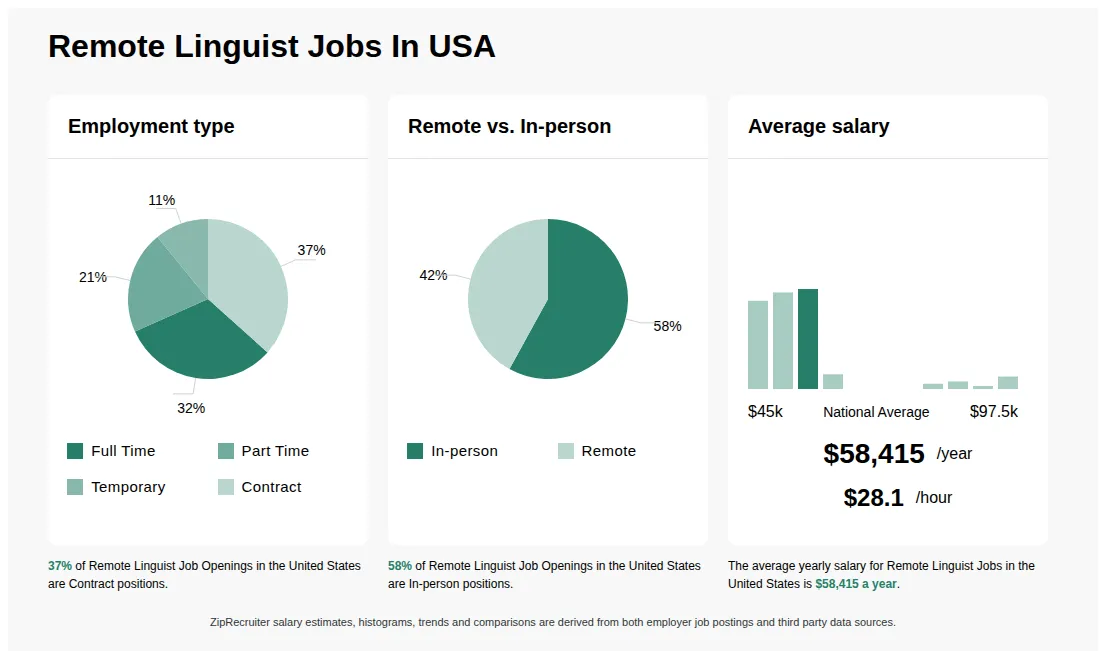
$49.4K is the 25th percentile. Wages below this are outliers.
$45K - $49.8K
27% of jobs
The median wage is $53.3K / yr.
$49.8K - $54.5K
31% of jobs
$57.1K is the 75th percentile. Wages above this are outliers.
$54.5K - $59.3K
32% of jobs
$59.3K - $64.1K
4% of jobs
$64.1K - $68.9K
0% of jobs
$68.9K - $73.6K
0% of jobs
$73.6K - $78.4K
0% of jobs
$78.4K - $83.2K
1% of jobs
$83.2K - $88K
2% of jobs
$88K - $92.7K
0% of jobs
$92.7K - $97.5K
3% of jobs
$45K
$58.4K
$97.5K
How much do remote linguist jobs pay per year?
As of Sep 4, 2026, the average yearly pay for remote linguist in the United States is $58,415.00, according to ZipRecruiter salary data. Most workers in this role earn between $49,500.00 and $58,000.00 per year, depending on experience, location, and employer.
What is a remote linguist?
A Remote Linguist is a language professional who works from a remote location, often from home, providing language-related services such as translation, transcription, localization, or linguistic analysis. They use digital tools to communicate and collaborate with clients or teams across the globe. Remote Linguists may specialize in one or more languages and fields, such as legal, medical, or technical language. This role requires strong language proficiency, cultural understanding, and the ability to work independently using online platforms.
What does a remote linguist do?
The job duties of a remote linguist include working to study, analyze, or translate a language or languages, usually focusing on the spoken word. As a remote worker, you may work from home on a freelance basis with different clients on multiple projects or for one employer. Your responsibilities may include working to interpret from one language to another or analyzing the usage of languages. Employers hire linguists to prepare legal or business documents or translate for government or law enforcement purposes. Other linguists use their skills to perform translations or research for academic reasons, and some specialize in sign language.
What are the key skills and qualifications needed to thrive as a remote linguist, and why are they important?
To thrive as a Remote Linguist, you need advanced proficiency in at least two languages, strong knowledge of linguistics, and a relevant degree such as linguistics or translation studies. Familiarity with computer-assisted translation (CAT) tools, localization platforms, and transcription software is typically required. Excellent attention to detail, cultural sensitivity, and strong written and verbal communication skills help distinguish top performers in this field. These skills are crucial for producing accurate, contextually appropriate translations and effectively collaborating across diverse, often virtual, teams.
How does a remote linguist typically collaborate with cross-functional teams and manage communication challenges?
As a remote linguist, you’ll often work closely with translators, localization project managers, engineers, and quality assurance specialists. Effective communication is essential, and most teams use collaboration tools like Slack, Zoom, and shared document platforms to stay connected. One common challenge is ensuring linguistic consistency and clarity across distributed teams and time zones, so proactive communication and detailed documentation are key. Regular check-ins, virtual meetings, and clear project guidelines help remote linguists stay aligned with team objectives and project timelines.
What is the difference between Remote Linguist vs Remote Translator?
| Aspect | Remote Linguist | Remote Translator |
|---|---|---|
| Credentials | Language proficiency, certifications (e.g., ATA certification), specialized knowledge | Language proficiency, certifications (e.g., ATA certification), specialized knowledge |
| Work Environment | Home office, flexible hours, project-based | Home office, flexible hours, project-based |
| Industry Usage | Translation, localization, interpretation | Translation, localization |
| Common Search Intent | Remote Linguist vs Remote Translator |
Both Remote Linguists and Remote Translators require similar credentials and work in remote, flexible environments within the translation and localization industry. The main difference is that Remote Linguists may also include interpretation and linguistic analysis, while Remote Translators focus primarily on written translation tasks.
More about Remote Linguist jobs
What cities are hiring for Remote Linguist jobs?
Cities with the most Remote Linguist job openings:
What are the most commonly searched types of Linguist jobs?
The most popular types of Linguist jobs are:
What states have the most Remote Linguist jobs?
States with the most job openings for Remote Linguist jobs include:
What job categories do people searching Remote Linguist jobs look for?
The top searched job categories for Remote Linguist jobs are:
Job description
Job Details: Linguist III
Location: Remote
Top 3 must-have HARD skills:
1 Native fluency in French/Italian
2 Experience with language annotation or other forms of data markup and tagging
3 Experience with programming and data analysis with languages and platforms such as Python and SQL with intermediate fluency.
Good to have skills:
Experience in building semantic ontologies, semantic relation frameworks, voice assistance or AI.
Comfortable working in a fast paced, highly collaborative, dynamic work environment
advanced degree preferred" is good enough, which include both master and phd.
Disqualifiers - Years of experience: 2-4 years of experience.
Key performance measurements: Project completion and deliverables.
Degrees or certifications: Master's degree in general Linguistics or Linguistics with an emphasis on Romance languages, Computational Linguistics, Speech Science, or related field REQUIRED.
• Master's degree in general Linguistics or Linguistics with an emphasis on Romance languages, Computational Linguistics, Speech Science, or related field
• Two (2) or more years of experience in Linguistics, Language Technologies, or NLP
• Native fluency in Mexican Spanish
• Knowledge of syntax, semantics, pragmatics, sociolinguistics, corpus linguistics, and other areas of linguistics
• Experience with database queries and data analysis processes (i.e. SQL, spreadsheets, R, Unix, or others)
• Experience with language annotation or other forms of data markup and tagging
• Experience working with speech and text data in multiple languages
• Excellent communication skills both verbal and written
Preferred Qualifications
• PhD in Linguistics or Romance languages, language technologies, computational linguistics, speech science, or related field
• Experience in building semantic ontologies and semantic relation frameworks
• Experience with statistical language modeling
• Comfortable working in a fast paced, highly collaborative, dynamic work environment
• Strong organizational skills and detail oriented
Location: Remote
Top 3 must-have HARD skills:
1 Native fluency in French/Italian
2 Experience with language annotation or other forms of data markup and tagging
3 Experience with programming and data analysis with languages and platforms such as Python and SQL with intermediate fluency.
Good to have skills:
Experience in building semantic ontologies, semantic relation frameworks, voice assistance or AI.
Comfortable working in a fast paced, highly collaborative, dynamic work environment
advanced degree preferred" is good enough, which include both master and phd.
Disqualifiers - Years of experience: 2-4 years of experience.
Key performance measurements: Project completion and deliverables.
Degrees or certifications: Master's degree in general Linguistics or Linguistics with an emphasis on Romance languages, Computational Linguistics, Speech Science, or related field REQUIRED.
• Master's degree in general Linguistics or Linguistics with an emphasis on Romance languages, Computational Linguistics, Speech Science, or related field
• Two (2) or more years of experience in Linguistics, Language Technologies, or NLP
• Native fluency in Mexican Spanish
• Knowledge of syntax, semantics, pragmatics, sociolinguistics, corpus linguistics, and other areas of linguistics
• Experience with database queries and data analysis processes (i.e. SQL, spreadsheets, R, Unix, or others)
• Experience with language annotation or other forms of data markup and tagging
• Experience working with speech and text data in multiple languages
• Excellent communication skills both verbal and written
Preferred Qualifications
• PhD in Linguistics or Romance languages, language technologies, computational linguistics, speech science, or related field
• Experience in building semantic ontologies and semantic relation frameworks
• Experience with statistical language modeling
• Comfortable working in a fast paced, highly collaborative, dynamic work environment
• Strong organizational skills and detail oriented

About Apex Informatics
Sourced by ZipRecruiter
Industry
It services
Company size
1 - 10 Employees
Headquarters location
Omaha, NE, US
Year founded
2014