2

Remote Coding Internship Jobs (NOW HIRING)

Remote Type : Full Time : We are seeking a motivated Junior Software Engineer to join our team in ... Write clean, efficient, and well-documented code. * Troubleshoot and debug software issues to ...

Join the DoD's AI Revolution

Vienna, VA ยท Remote

$80K - $150K/yr

If you have a background or training in coding and a passion for service, we want you to join the team! About the Role: During your remote Skillbridge internship at Knexus, you will continue to serve ...

You will write code across our web stack-front-end in Angular/TypeScript, back-end in PHP and Go-on ... This is a fully remote, US-based role working closely with a global, bilingual (English-Chinese ...

Junior Fullstack Developer

Texas City, TX ยท Remote

$57K - $74K/yr

Remote (United States) Job Type: Part-Time / Contract About Latech Apps Latech Apps develops modern ... Participate in testing and code reviews. Required Skills Basic knowledge of HTML, CSS, and ...

Developer - DTAI Intern

New York, NY ยท On-site +1

$21 - $27.50/hr

Interns selected for this track will gain hands-on experience working on analytics automation ... code repositories dashboards or technical presentations - Support development of data pipelines ...

Remote (EST Work Hours) Duration: 12 Months to start with Rate Range: Upto $80/hr W2 or $88/hr C2C ... Qualifications: * 5+ years of non-internship front-end engineering experience. * Strong hands-on ...

Be Seen First

... internship work that you can talk through * Hands-on coding experience in Python, JavaScript ... Flexible, remote-friendly work culture with a focus on results * Competitive compensation and ...

next page

Showing results 1-20

Remote Coding Internship information

See salary details

$9

$17

$23

How much do remote coding internship jobs pay per hour?

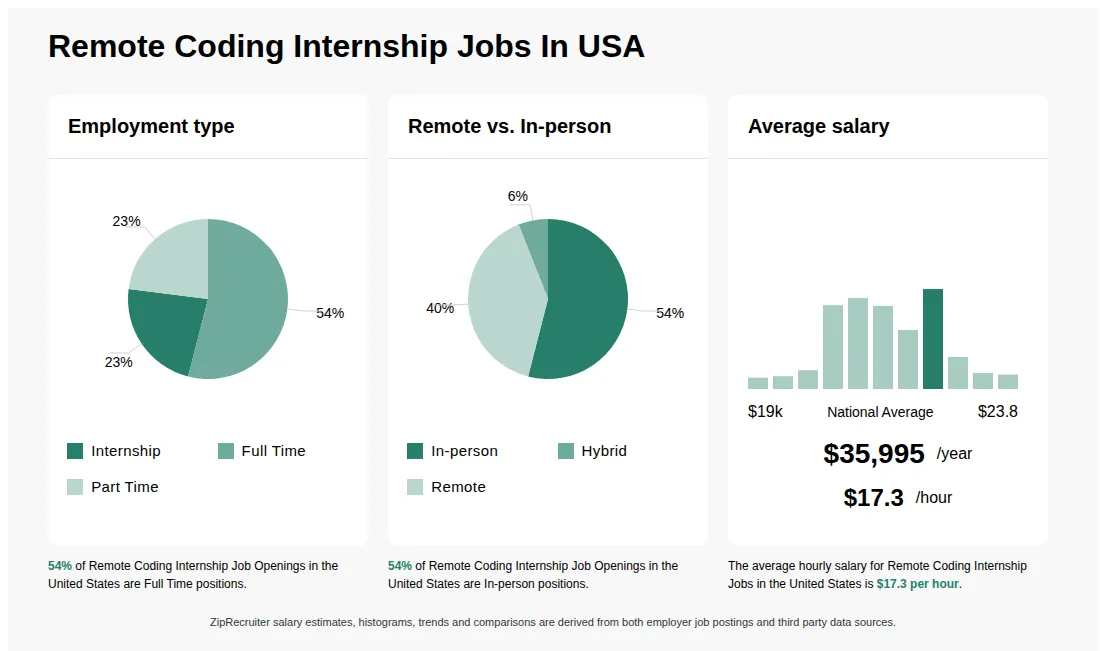
As of Jun 25, 2026, the average hourly pay for remote coding internship in the United States is $17.31, according to ZipRecruiter salary data. Most workers in this role earn between $14.42 and $19.23 per hour, depending on experience, location, and employer.

What are some common challenges faced during a remote coding internship, and how can I overcome them?

Remote coding internships often present challenges such as limited face-to-face collaboration, staying motivated without in-person supervision, and navigating unfamiliar tools or codebases. To succeed, it's important to proactively communicate with your team, regularly ask for feedback, and create a structured daily routine. Utilizing collaboration tools like Slack or GitHub and participating in virtual meetings can help you stay engaged and build strong professional relationships. Seeking mentorship and not hesitating to ask questions will also help you grow and overcome obstacles more efficiently.

What is a remote coding internship?

A remote coding internship is a work experience opportunity where interns learn and perform programming or software development tasks for a company or organization from a remote location, typically from home. These internships provide hands-on experience in coding, collaborating with teams online, and working on real-world projects, all while communicating and submitting work virtually. Remote coding internships are ideal for students or recent graduates seeking flexibility and the chance to build their technical skills without needing to relocate.

What are the key skills and qualifications needed to thrive as a Remote Coding Intern, and why are they important?

To succeed as a Remote Coding Intern, foundational programming skills in languages like Python, Java, or JavaScript and a relevant educational background in computer science or a related field are essential. Familiarity with version control systems (such as Git), basic debugging tools, and online collaboration platforms like GitHub or Slack is typically required. Strong self-motivation, effective communication, and the ability to work independently make candidates stand out in this remote setting. These skills are crucial for delivering quality code, collaborating with distributed teams, and adapting to the unique challenges of remote work.
What are the most commonly searched types of Remote Coding jobs? The most popular types of Remote Coding jobs are:
Infographic showing various Remote Coding Internship job openings in the United States as of June 2026, with employment types broken down into 7% Internship, 72% Full Time, and 21% Part Time. Highlights an 90% Physical, 1% Hybrid, and 9% Remote job distribution, with an average salary of $35,995 per year, or $17.3 per hour.

Energy and Climate Modeling Student Employee

Electric Power Research Institute, Inc.

Washington, DC โ€ข On-site, Remote

$31 - $36/hr

Part-time

Medical, Retirement, PTO

Posted 4 days ago


Job description

Job Title:Energy and Climate Modeling Student EmployeeLocation:Palo Alto, CA, Remote/Home Based, Washington, D.C.Job Summary and Description:

This student internship opportunity is with the Energy Systems and Climate Analysis (ESCA) Group at EPRI (http://esca.epri.com), a team of leading earth scientists, climate economists, and energy system analysts. In this role, you will contribute to two teams within ESCA. With the Energy Systems Analysis team, you will support a literature review and comparison of recent modeling studies assessing the system-level impacts of 24/7 carbon-free electricity (CFE) procurement relative to business-as-usual approaches. You will use your knowledge of energy systems models to compare outputs between models including emissions, system costs, and technology deployment, and support the preparation of a technical report/peer reviewed paper. With the Climate Resilience Analysis team, you will support research on robust planning against climate extremes, exploring alternative planning and decision approaches that take deep uncertainties into account regarding future climate risk and power system evolution.


This student internship is designed for an advanced graduate student with demonstrated energy modeling and coding skills with applied experience with weather and climate data products.


The ESCA team offers the opportunity to work with established experts in a stimulating and innovative research environment to tackle some of today's most pressing societal challenges - energy and climate change - in collaboration with electric companies and government entities.


You can choose to work remote, in one of EPRI's offices, or a mix of the two. Internship timeframe is flexible with a target of at least 3 months duration. Hours can be flexibly arranged around coursework or teaching loads, ranging from 6 hours (part-time) to 40 hours (full-time) per week.

Internship Qualifications:

  • Graduate student in climate sciences, environmental engineering, energy resources, or a related field; preference for current PhD students.

  • Experience coding and using electricity capacity expansion models and multi-sector energy economy models

  • Excellent research and writing skills; strong oral communications skills; ability to present complex information in a clear and concise manner.

  • A positive attitude, comfortable working both collaboratively and independently.

The hourly rate range for Student positions are:

  • Undergraduate: $16-29 per hour

  • Masters: $27-33 per hour

  • Ph.D: $31-36 per hour

These ranges are an estimate, and the actual hourly rate may vary based on various factors, including without limitation applicant's education, experience, skills, and abilities, as well as internal equity and alignment with market data. The hourly rate may also be adjusted based on applicant's geographic location.

As an EPRI Student, you will not participate in EPRI's Benefit Programs which includes health insurance, retirement benefits, vacation, sick leave (except as set required by law) and holiday pay. However, as a Student employee you are eligible for the benefits of Social Security, State Disability Insurance, and Workers' Compensation Insurance.

For Student positions which require one to relocate to an EPRI office. Relocation assistance is not provided and the student will be responsible for covering all relocation costs/expenses.

EPRI participates in E-Verify, an online system operated jointly by the Department of Homeland Security and the Social Security Administration (SSA). EPRI uses the system to check the work status of new hires by comparing information from the employee's I-9 form against SSA and Department of Homeland Security databases.

EPRI is an equal opportunity employer. EEO/AA/M/F/VETS/Disabled

Together . . . Shaping the Future of Energy.

www.epri.com