1

Python Automation Testing Jobs (NOW HIRING)

Proficiency in Java, Python, or JavaScript for automation scripting * Experience with BDD frameworks (Cucumber, TestNG, JUnit) * Hands-on knowledge of API testing and backend validation * Experience ...

MTS 4: Automation Testing

San Jose, CA · On-site

$52.75 - $69.50/hr

The Opportunity Are you a skilled automation testing engineer who thrives on developing efficient ... Develop and enhance the QA automation framework, built with python. Build tools and orchestration ...

The experienced Test Automation Engineer with experience in Automation Projects in a Developer ... Minimum of 5 years of experience in Java and/or Python * Minimum of 3 years of work experience in ...

The experienced Test Automation Engineer with experience in Automation Projects in a Developer ... Minimum of 5 years of experience in Java and/or Python * Minimum of 3 years of work experience in ...

Hands on experience with SQL and Unix along with shell/perl/python scripting. * Knowledge of FIX ... automation scripts for BVT, FVT and regression testing solutions for Continuous Integration ...

Hands on experience with SQL and Unix along with shell/perl/python scripting. * Knowledge of FIX ... automation scripts for BVT, FVT and regression testing solutions for Continuous Integration ...

Selenium Automation Tester

Pennington, NJ · On-site

$46.50 - $61.25/hr

C. is seeking an experienced professional focused on automation testing using Selenium and RAFT ... Java or Python • Experience in database testing and automating DB scripts • Good understanding ...

next page

Showing results 1-20

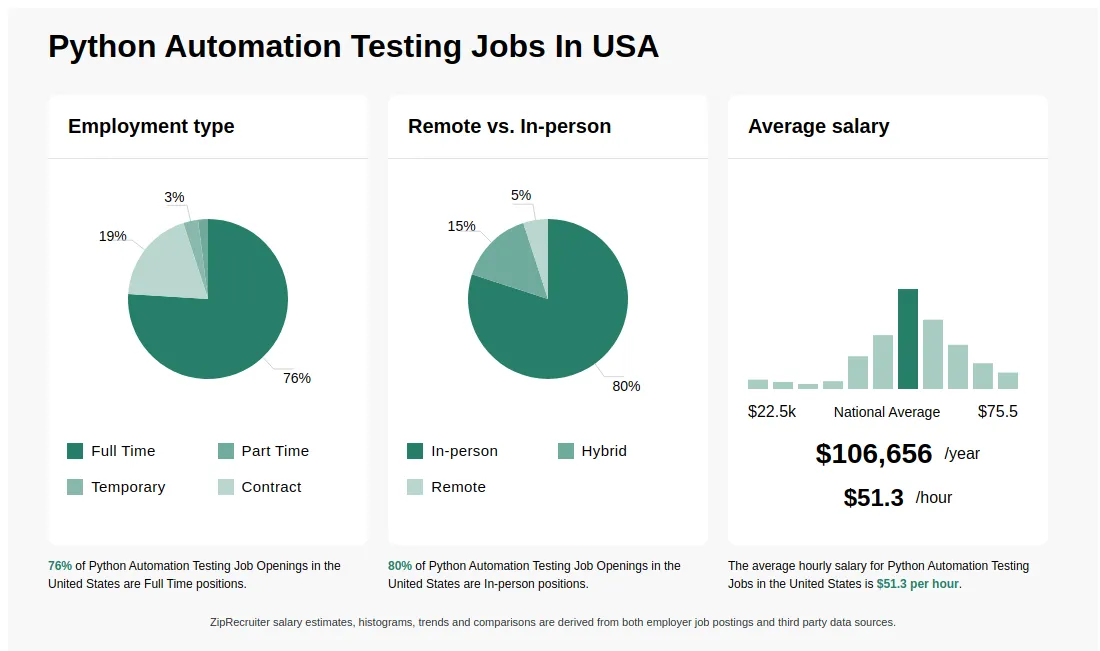
Python Automation Testing information

See salary details

$10

$51

$75

How much do python automation testing jobs pay per hour?

As of Jun 3, 2026, the average hourly pay for python automation testing in the United States is $51.28, according to ZipRecruiter salary data. Most workers in this role earn between $44.23 and $58.41 per hour, depending on experience, location, and employer.

What are the key skills and qualifications needed to thrive as a Python Automation Testing professional, and why are they important?

To thrive as a Python Automation Testing professional, you need strong proficiency in Python programming, knowledge of software testing methodologies, and experience with test automation frameworks, often supported by a degree in computer science or a related field. Familiarity with tools such as Selenium, PyTest, Jenkins, and version control systems like Git is typically required, along with certifications like ISTQB being advantageous. Analytical thinking, attention to detail, and effective communication skills help testers identify issues, collaborate with teams, and document findings clearly. These competencies ensure the creation of reliable, maintainable automated tests that improve software quality and streamline development cycles.

What are some common challenges faced in a Python Automation Testing role, and how can they be addressed?

One common challenge in Python Automation Testing is maintaining test scripts as applications evolve, which can lead to flaky tests or outdated scripts. To address this, it's important to implement modular and reusable code, and regularly review and refactor test cases. Collaborating closely with developers and participating in code reviews can also help testers anticipate changes and adapt their tests proactively. Additionally, integrating robust reporting and logging mechanisms helps quickly identify and resolve issues, ensuring the reliability of the automated test suite.

What is Python Automation Testing?

Python Automation Testing refers to the process of using Python programming language to write scripts that automatically test software applications. These scripts can validate functionality, performance, and reliability of software, reducing the need for manual testing and speeding up the development cycle. Python is popular for automation testing because of its readability, extensive libraries like Selenium and PyTest, and strong community support. Automation tests can be integrated into continuous integration pipelines to ensure consistent quality across software releases.

What is the difference between Python Automation Testing vs Manual Software Testing?

AspectPython Automation TestingManual Software Testing
Required SkillsPython programming, automation tools, scriptingTest case execution, attention to detail, communication
Work EnvironmentAutomated testing frameworks, scripting environmentsTest labs, user environments, manual execution
Industry UsageSoftware development, QA teams, continuous integrationInitial testing phases, exploratory testing, user acceptance

Python Automation Testing involves writing scripts to automate test cases, increasing efficiency and repeatability. Manual Software Testing requires testers to execute test cases manually, focusing on exploratory and usability aspects. Both roles are essential in software quality assurance, but Python Automation Testing emphasizes automation skills, while manual testing emphasizes detailed test execution and observation.

More about Python Automation Testing jobs
What cities are hiring for Python Automation Testing jobs? Cities with the most Python Automation Testing job openings:
What states have the most Python Automation Testing jobs? States with the most job openings for Python Automation Testing jobs include:
Python automation engineers with fixed income experience.

Python automation engineers with fixed income experience.

RIT Solutions

Manhattan, NY

$120/hr

Other

Posted 19 days ago


Job description

Python Automation Engineers With Fixed Income Experience

Location: Charlotte, NC- 2 DAYS ONSITE

Interviews: Virtual

The meeting focused on intake requirements for four mid-level Python automation engineers to support QA automation in a fixed income sales and trading platform environment. While final approval is still pending, the main roadblock has been removed, and approval is expected within 1–2 weeks. The team plans to begin sourcing candidates now so they can move quickly once approved. The roles require strong Python skills plus deep recent fixed income/swaps domain expertise, as the hires will assess and potentially rebuild dysfunctional UI and API automation suites tied to the internal Polaris platform.

The most important differentiator is recent hands-on fixed income experience. Candidates who have been out of the space for 1.5–2 years are unlikely to be a fit. H1B candidates are not being considered.

Existing and future frameworks are Python-based. Technical screening will use CoderPad. Interview test includes writing a Python program and troubleshooting/debugging a pre-made program. Technical test is about 1 hour. After approval, the interview process will include an automation architect technical review and final screening by hiring manager and colleague. No in-person final interview currently planned.

Rob said the 4 automation engineer openings are not yet approved, but he expects approval in 1-2 weeks; the prior blocker was removed, and a new stakeholder/backfill started this week. The roles support SNBC's fixed income sales/trading platform "Polaris" (homegrown, similar to Murex/Calypso/Sophis) and require strong Python plus deep fixed income/swaps domain expertise; candidates who do not know the products will not be hired.

Required product knowledge includes interest rate swaps/vanilla, caps/floors, cap straddles, butterfly swaps, curve swaps, European swaptions, Bermudians, swap straddles, basis swaps, collars, cross-currency, mark-to-market basis swaps, swap spreads, forward rate agreements, non-deliverable IRS/swaps, inflation swaps, global swaps, and index TRS.

The team's mandate is to assess and remediate a broken automation environment built over the last 12-18 months: about 500-600 UI automated test cases and roughly 10,000 API tests (effectively a few hundred unique tests with permutations). Rob said Polaris is "a disaster," with monthly releases followed by 6-8 patch releases fixing multiple production bugs because regression automation has major gaps.

Candidates must be currently immersed in fixed income derivatives/OTC products; Rob said people coming from adjacent areas like equities derivatives, or those out of the space for 1.5-2 years, are unlikely to succeed. He wants pedigree similar to hires Greg Szymanski and Chandra Komana, who came from Wells and worked on a similar sales/trading platform.

Position details: Charlotte-based, currently onsite Monday and Thursday minimum (likely to increase later), up to $120/hour, initially through Fieldglass for up to 18 months with possible conversion typically after about 9 months minimum; no H1B candidates. Interview process includes a ~1-hour Python CoderPad test (write a program + troubleshoot pre-made code), then review by the automation architect, followed by final screening with Rob and a colleague.

No roles have been officially approved yet. Approval is expected in about 1–2 weeks. A prior blocker has been removed, and leadership will brief the new stakeholder. Team wants to get a jump start on sourcing before formal approval.

Hiring for 4 automation engineers. Main responsibilities: review existing UI and API automation suites, determine whether current automation is salvageable, partially reusable, or should be fully replaced, analyze both UI automation framework and API automation framework, support a broader QA transformation effort.

Work is tied to Polaris, a homegrown internal platform for swaps trading. Platform quality is currently a major issue: monthly releases are followed by 6–8 patch releases, production bugs are slipping through due to automation gaps. Parallel workstreams are planned: manual testing improvements, automation suite remediation/rebuild.

Contract duration: up to 18 months, possible conversion to full-time, conversion discussions typically begin after 9 months. Location: Charlotte. Current in-office expectation: Monday and Thursday minimum. Team expects office attendance may increase in the future.

Candidate profile guidance: strong comparison profiles may come from similar sales and trading platform environments. Examples of comparable prior hires were shared for sourcing calibration. Relevant background may include firms such as Wells Fargo.

Key insights: domain expertise is more critical than pure technical strength. These are not standard automation roles; hires must be able to interpret complex fixed income products and testing scenarios. The automation team will function like a SWAT team, quickly taking ownership of the existing automation repo and deciding how to remediate it. Current API test volume is large (~10,000 tests) but many are permutations of a smaller core set. There are approximately 500–600 UI automated test cases to review.

Decisions made: begin candidate sourcing immediately ahead of formal approval. Target candidates with Python automation experience, recent fixed income/swaps expertise, ability to evaluate and triage existing automation frameworks. Use CoderPad-based Python assessment as part of the screening process. Submit candidates first through resumes/profiles and write-ups; move them into Fieldglass once narrowed for interview alignment.

Next steps: hiring manager/leadership meet with the new stakeholder and push for approval of the 4 roles. Expected timeline: within 1–2 weeks. Recruiting team start sourcing candidates immediately. Focus on profiles with Python automation, fixed income/swaps knowledge, recent relevant domain immersion. Review backgrounds similar to the example hires shared. Recruiting team and hiring manager once approval is granted, align selected candidates to the appropriate Fieldglass requisitions. Begin technical screening and interview process quickly. Hiring team run technical assessments through CoderPad. Conduct final screening after technical review.