1

Protein Chemistry Jobs (NOW HIRING)

Understanding of protein chemistry and post-translational modifications. Who We Are Serving customers since 2004, Eagle offers the highest quality in preparation testing for sterility, bacterial ...

Lecturer - Chemistry

Boise, ID · On-site

$56K - $61K/yr

... and protein chemistry, and polymer chemistry. Our faculty members participate in transdisciplinary programs and mentor M.S. and Ph.D. students in transdisciplinary programs including Materials ...

Scientist, Bioconjugation

Waltham, MA · On-site

$115K - $140K/yr

This role applies expertise in bioconjugation chemistry, protein purification, oligonucleotide conjugation, and analytical characterization to solve scientific and technical challenges. Prior ...

Understanding of protein chemistry and post-translational modifications. Who We Are Serving customers since 2004, Eagle offers the highest quality in preparation testing for sterility, bacterial ...

General knowledge of biochemistry, protein chemistry or other related discipline. Hands on experience in basic bio conjugation reactions (maleimide/thiol, etc.) and purification techniques is ...

Showing results 21-40

Protein Chemistry information

See salary details

$13

$22

$32

How much do protein chemistry jobs pay per hour?

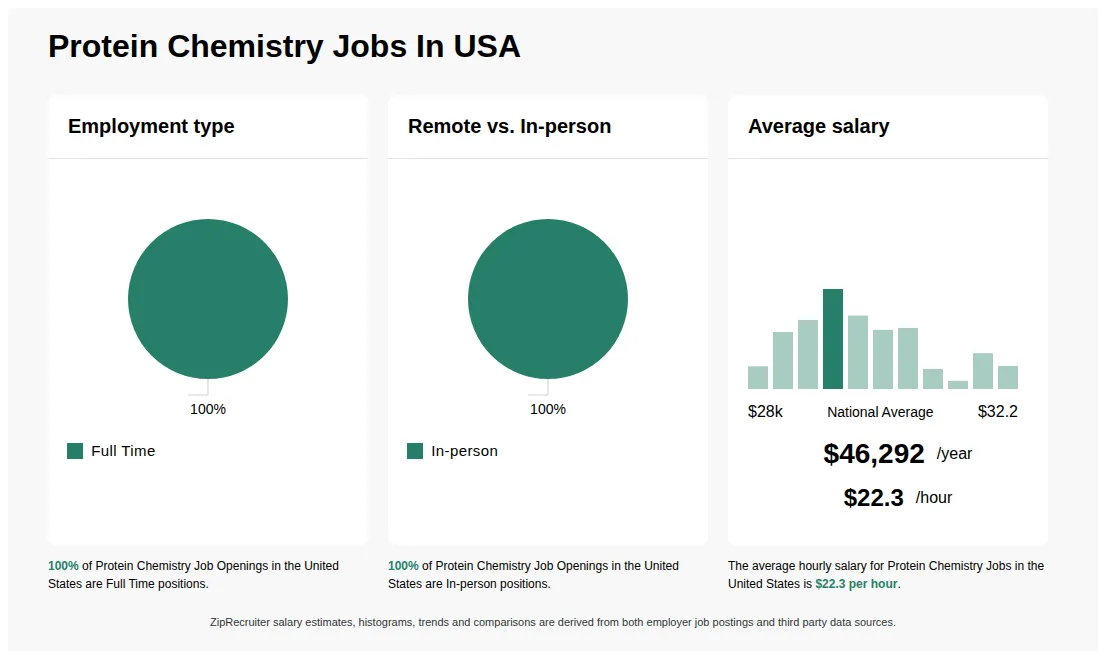
As of Sep 3, 2026, the average hourly pay for protein chemistry in the United States is $22.26, according to ZipRecruiter salary data. Most workers in this role earn between $18.27 and $24.52 per hour, depending on experience, location, and employer.

What is protein chemistry?

Protein chemistry is the branch of biochemistry that focuses on the study of proteins, including their structure, function, and interactions. It involves analyzing the physical and chemical properties of proteins, understanding how they are synthesized and degraded in cells, and exploring their roles in biological processes. Protein chemists use various techniques such as chromatography, electrophoresis, and spectroscopy to characterize proteins, which is essential for fields like drug development, biotechnology, and disease research.

What are the key skills and qualifications needed to thrive as a protein chemist?

To thrive as a Protein Chemist, you need a strong background in biochemistry, molecular biology, and analytical techniques, typically supported by at least a bachelor's or master's degree in a related field. Familiarity with chromatography, mass spectrometry, protein purification systems, and relevant software such as Prism or Bioinformatics tools is essential. Attention to detail, problem-solving ability, and effective communication are important soft skills that set candidates apart. These skills and qualifications are crucial for designing experiments, analyzing data accurately, and collaborating with interdisciplinary teams in research or pharmaceutical environments.

What are some common challenges faced by protein chemists in optimizing protein purification processes?

Protein chemists often encounter challenges such as low protein yield, maintaining protein stability, and preventing aggregation during purification. Selecting the right purification techniques and buffers is crucial, as proteins can be sensitive to changes in pH, temperature, and salt concentrations. Additionally, troubleshooting contamination or degradation issues requires a strong understanding of both the protein of interest and the available analytical methods. Collaboration with colleagues in molecular biology or biophysics can also play a key role in overcoming these challenges and optimizing protocols.

What is the difference between Protein Chemistry vs Biochemist?

AspectProtein ChemistryBiochemist
Required CredentialsBachelor's or Master's in Chemistry, Biochemistry, or related fieldsBachelor's or Master's in Biochemistry, Chemistry, or related fields
Work EnvironmentLaboratories focused on protein analysis, drug development, or structural studiesResearch labs, healthcare, or academic settings studying biological processes
Industry UsagePharmaceuticals, biotech, research institutionsHealthcare, research, academia, biotech

Protein Chemists specialize in studying protein structures, functions, and interactions, often focusing on protein purification and analysis. Biochemists have a broader scope, exploring various biological molecules and processes. While both roles require similar educational backgrounds and often work in overlapping environments, Protein Chemists focus more specifically on proteins, whereas Biochemists study a wide range of biological chemistry topics.

What does a protein chemist do?

A protein chemist studies the structure, function, and interactions of proteins using techniques like spectroscopy and chromatography. They often work in laboratories, developing experiments to understand protein behavior, and may be involved in drug development, biotechnology, or research environments.
More about Protein Chemistry jobs

What are the most commonly searched types of Protein Chemistry jobs?

The most popular types of Protein Chemistry jobs are:

What states have the most Protein Chemistry jobs?

States with the most job openings for Protein Chemistry jobs include:

Infographic showing various Protein Chemistry job openings in the United States as of August 2026, with employment types broken down into 1% As Needed, 71% Full Time, 25% Part Time, 1% Temporary, and 2% Contract. Highlights an 87% Physical, 1% Hybrid, and 12% Remote job distribution, with an average salary of $46,292 per year, or $22.3 per hour.

Postdoctoral Researcher (Chemistry)

Amherst College

Amherst, VA

$63K - $65K/yr

Full-time

Posted 24 days ago


Amherst College rating

8.3

Company rating: 8.3 out of 10

Based on 7 frontline employees who took The Breakroom Quiz

128th of 628 rated colleges and universities


Job description

Amherst has taken a leadership role among highly selective liberal arts colleges and universities in successfully diversifying the racial, socio-economic, and geographic profile of its student body. The College is similarly committed to enriching its educational experience and its culture through the diversity of its faculty, administration and staff.

Job Description:

Amherst College invites applications for the Post-Doctoral Research Assistant (Chemistry) position. The Post-Doctoral Research Assistant (Chemistry) is a full-time, fixed-term (2-year) position. The expected salary range for this job opportunity is: $63,000 - $65,000 per year.


The salary offered will vary based on a number of factors, including but not limited to relevant education, training, and experience, tenure status, and other nondiscriminatory business considerations. Amherst College is pleased to provide a comprehensive, highly competitive benefits package that meets the needs of staff and faculty and their families. Click here for Benefits Information.


This position is a full-time, limited-term, post-doctoral research assistant in the Marcus lab (MLab) with a flexible start date as early as January 1, 2027. The primary responsibilities will involve executing and publishing independent research, partnering with current Amherst College undergraduates to help move forward their thesis research projects, and training new undergraduate research students. The position will last for two years (24 months) with the opportunity for renewal.


The MLab is dedicated to studying the biophysical and biochemical consequences of protein evolution, with a specialty in p-loop NTPase mechanisms. We employ both wet lab and computational approaches to understand the 'rules' underpinning protein-protein interaction selectivity and allosteric regulation. We also have a growing interest in understanding how generative AI interfaces with evolutionary patterns to make predictions of protein structures. An ideal candidate would be comfortable not only bringing their own techniques to our lab but also learning new approaches to answer fundamental questions about protein chemistry.


Summary of Responsibilities:


Lab-Based Biochemical and Biophysical Research


- Research will be dependent on the candidate's skillset and interests


Data Analysis and Scientific Writing


- Utilize modern computational approaches to biochemical and biophysical data analysis (such as bioinformatic pipelines and Python-based data analysis packages)

- Complete literature review

- Contribute to the writing of research articles and grants submitted by the lab


Lab Organization and Maintenance


- Provide mentorship and training in the lab for our staff of undergraduate researchers

- Maintain a clean and safe lab space


Qualifications:


Required


- PhD in Biochemistry, Chemistry, or related field

- Must have at least three years of experience executing supervised biochemical research

- Demonstrated interest in carrying out independent research

- Excellent organizational skills as well as strong verbal and written communication

- Ability to work collaboratively and the desire to train and support undergraduate students with various levels of research experience

- Successful completion of required reference and background checks

- An acceptable criminal offender records information (CORI) check


Preferred


- Candidates are preferred to have demonstrated experience in at least two of these techniques:

- Molecular cloning at large scale and plasmid design

- Familiarity with E. coli-based reporter assays

- Next-Generation Sequencing (NGS) sample preparation and data analysis

- Protein purification via FPLC

- Enzymatic and biophysical assays (such as kinetic assays, ITC, etc)

- Computational tools, such as molecular dynamics and machine learning (ex. AlphaFold, ESMFold)


Interested candidates are asked to submit a resume and cover letter online at https://amherst.wd5.myworkdayjobs.com/Amherst_Jobs. Please be sure to upload all requested documents prior to clicking Submit. Applications cannot be revised once submitted. (Current employees and students should apply by clicking on the Jobs Hub icon from their Workday home screen.) Review of applications will begin immediately and will continue until the position is filled. Amherst College is committed to an inclusive hiring process and will provide reasonable accommodations for candidates throughout the application and interview process upon request.


It is unlawful in Massachusetts to require or administer a lie detector test as a condition of employment or continued employment. An employer who violates this law shall be subject to criminal penalties and civil liability.


What Amherst College employees say

Pay

Benefits

Hours and flexibility

Workplace

Get the full story on Breakroom