Senior Scientist - Placenta Biology
$97K - $132.60K/yr
Work closely with tissue engineering, hydrogel, and perfusion teams to translate biological insight ... with postdoctoral experience, or 7+ years of relevant industry or academic experience
$97K - $132.60K/yr
Work closely with tissue engineering, hydrogel, and perfusion teams to translate biological insight ... with postdoctoral experience, or 7+ years of relevant industry or academic experience
$97K - $132.60K/yr
Work closely with tissue engineering, hydrogel, and perfusion teams to translate biological insight ... with postdoctoral experience, or 7+ years of relevant industry or academic experience
$49.80K - $67.60K/yr
... postdoctoral fellow to study the association between cutting-edge biomarkers of skin health span ... and tissue engineering . In this role, the candidate will lead independent projects focused on ...
$49.80K - $67.60K/yr
... postdoctoral fellow to study the association between cutting-edge biomarkers of skin health span ... and tissue engineering . In this role, the candidate will lead independent projects focused on ...
Portland, OR · On-site
$97K - $132.60K/yr
Work closely with tissue engineering, hydrogel, and perfusion teams to translate biological insight ... with postdoctoral experience, or 7+ years of relevant industry or academic experience
Portland, OR · On-site
$97K - $132.60K/yr
Work closely with tissue engineering, hydrogel, and perfusion teams to translate biological insight ... with postdoctoral experience, or 7+ years of relevant industry or academic experience
Rochester, MN · On-site
$49.80K - $67.60K/yr
... postdoctoral fellow to study the association between cutting-edge biomarkers of skin health span ... and tissue engineering . In this role, the candidate will lead independent projects focused on ...
Rochester, MN · On-site
$49.80K - $67.60K/yr
... postdoctoral fellow to study the association between cutting-edge biomarkers of skin health span ... and tissue engineering . In this role, the candidate will lead independent projects focused on ...
$49.80K - $67.60K/yr
... postdoctoral fellow to study the association between cutting-edge biomarkers of skin health span ... and tissue engineering . In this role, the candidate will lead independent projects focused on ...
$49.80K - $67.60K/yr
... postdoctoral fellow to study the association between cutting-edge biomarkers of skin health span ... and tissue engineering . In this role, the candidate will lead independent projects focused on ...
The postdoc will have access to: * Advanced histology and tissue pathology workflows * High-resolution and confocal microscopy * Genetically engineered mouse models of inflammation and cancer
The postdoc will have access to: * Advanced histology and tissue pathology workflows * High-resolution and confocal microscopy * Genetically engineered mouse models of inflammation and cancer
The postdoc will have access to: * Advanced histology and tissue pathology workflows * High-resolution and confocal microscopy * Genetically engineered mouse models of inflammation and cancer
The postdoc will have access to: * Advanced histology and tissue pathology workflows * High-resolution and confocal microscopy * Genetically engineered mouse models of inflammation and cancer
The postdoc will have access to: * Advanced histology and tissue pathology workflows * High-resolution and confocal microscopy * Genetically engineered mouse models of inflammation and cancer
The postdoc will have access to: * Advanced histology and tissue pathology workflows * High-resolution and confocal microscopy * Genetically engineered mouse models of inflammation and cancer
$52.90K - $71.80K/yr
AstraZeneca's Postdoc Program is for self-motivated individuals looking to deliver exciting ... About the role Overview You will use your biomaterials/tissue engineering expertise to develop a ...
$52.90K - $71.80K/yr
AstraZeneca's Postdoc Program is for self-motivated individuals looking to deliver exciting ... About the role Overview You will use your biomaterials/tissue engineering expertise to develop a ...
New York, NY · On-site
$62.50K - $70K/yr
Qualifications Candidates should have a PhD in neuro cell biology, tissue engineering or a related field. We welcome applicants with recent PhDs and individuals seeking additional postdoctoral ...
New York, NY · On-site
$62.50K - $70K/yr
Qualifications Candidates should have a PhD in neuro cell biology, tissue engineering or a related field. We welcome applicants with recent PhDs and individuals seeking additional postdoctoral ...
Pittsburgh, PA · On-site
$47.60K - $64.60K/yr
... tissue engineering. The successful Candidate will work under the mentorship of Asim Ejaz, Ph.D., to ... The postdoctoral fellow will be expected to take scientific ownership of one or more independent ...
Pittsburgh, PA · On-site
$47.60K - $64.60K/yr
... tissue engineering. The successful Candidate will work under the mentorship of Asim Ejaz, Ph.D., to ... The postdoctoral fellow will be expected to take scientific ownership of one or more independent ...
$55.50K - $75.30K/yr
AstraZeneca's Postdoc Program is for self-motivated individuals looking to deliver exciting ... About the role Overview You will use your biomaterials/tissue engineering expertise to develop a ...
$55.50K - $75.30K/yr
AstraZeneca's Postdoc Program is for self-motivated individuals looking to deliver exciting ... About the role Overview You will use your biomaterials/tissue engineering expertise to develop a ...
San Francisco, CA · On-site
$107.80K - $147.30K/yr
... postdoctoral training in biotechnology, therapeutics, tissue engineering, or related fields. * Demonstrated record of scientific achievement through high-impact publications, patents, awards, or ...
San Francisco, CA · On-site
$107.80K - $147.30K/yr
... postdoctoral training in biotechnology, therapeutics, tissue engineering, or related fields. * Demonstrated record of scientific achievement through high-impact publications, patents, awards, or ...
Gaithersburg, MD · On-site
$52.90K - $71.80K/yr
AstraZeneca's Postdoc Program is for self-motivated individuals looking to deliver exciting ... About the role Overview You will use your biomaterials/tissue engineering expertise to develop a ...
Gaithersburg, MD · On-site
$52.90K - $71.80K/yr
AstraZeneca's Postdoc Program is for self-motivated individuals looking to deliver exciting ... About the role Overview You will use your biomaterials/tissue engineering expertise to develop a ...
Cambridge, MA · On-site
$50K - $70K/yr
... postdoctoral research associate. This is a 1-year position with an opportunity to be extended ... tissue engineering, mechanical design, materials science, and biology. • Conduct cell culture ...
Cambridge, MA · On-site
$50K - $70K/yr
... postdoctoral research associate. This is a 1-year position with an opportunity to be extended ... tissue engineering, mechanical design, materials science, and biology. • Conduct cell culture ...
Villanova, PA · On-site
$105.90K/yr
Postdoctoral Researcher - College of Engineering Position Type: Faculty Location: Villanova, PA ... Michele Marcolongo on new molecular/biomaterial chemistries to optimize connective tissue repair ...
Villanova, PA · On-site
$105.90K/yr
Postdoctoral Researcher - College of Engineering Position Type: Faculty Location: Villanova, PA ... Michele Marcolongo on new molecular/biomaterial chemistries to optimize connective tissue repair ...
Villanova, PA · On-site
$105.90K/yr
Postdoctoral Researcher - College of Engineering Position Type: Faculty Location: Villanova, PA ... Michele Marcolongo on new molecular/biomaterial chemistries to optimize connective tissue repair ...
Villanova, PA · On-site
$105.90K/yr
Postdoctoral Researcher - College of Engineering Position Type: Faculty Location: Villanova, PA ... Michele Marcolongo on new molecular/biomaterial chemistries to optimize connective tissue repair ...
... tissue engineering, "smart" biomaterials, cell-based assays, western blotting, qPCR, ELISA, and ... Preferred Qualifications Previous postdoctoral research experience preferred. Conditions of ...
... tissue engineering, "smart" biomaterials, cell-based assays, western blotting, qPCR, ELISA, and ... Preferred Qualifications Previous postdoctoral research experience preferred. Conditions of ...
Postdoctoral Scholar - Benoit Lab Job no: 536301 Work type: Faculty - Other Location: Eugene, OR ... The specific project is focused on developing a next-generation tissue-engineered periosteum (TEP ...
Postdoctoral Scholar - Benoit Lab Job no: 536301 Work type: Faculty - Other Location: Eugene, OR ... The specific project is focused on developing a next-generation tissue-engineered periosteum (TEP ...
Postdoctoral Scholar - Benoit Lab Apply now Job no: 536301 Work type: Faculty - Other Location ... The specific project is focused on developing a next-generation tissue-engineered periosteum (TEP ...
Postdoctoral Scholar - Benoit Lab Apply now Job no: 536301 Work type: Faculty - Other Location ... The specific project is focused on developing a next-generation tissue-engineered periosteum (TEP ...
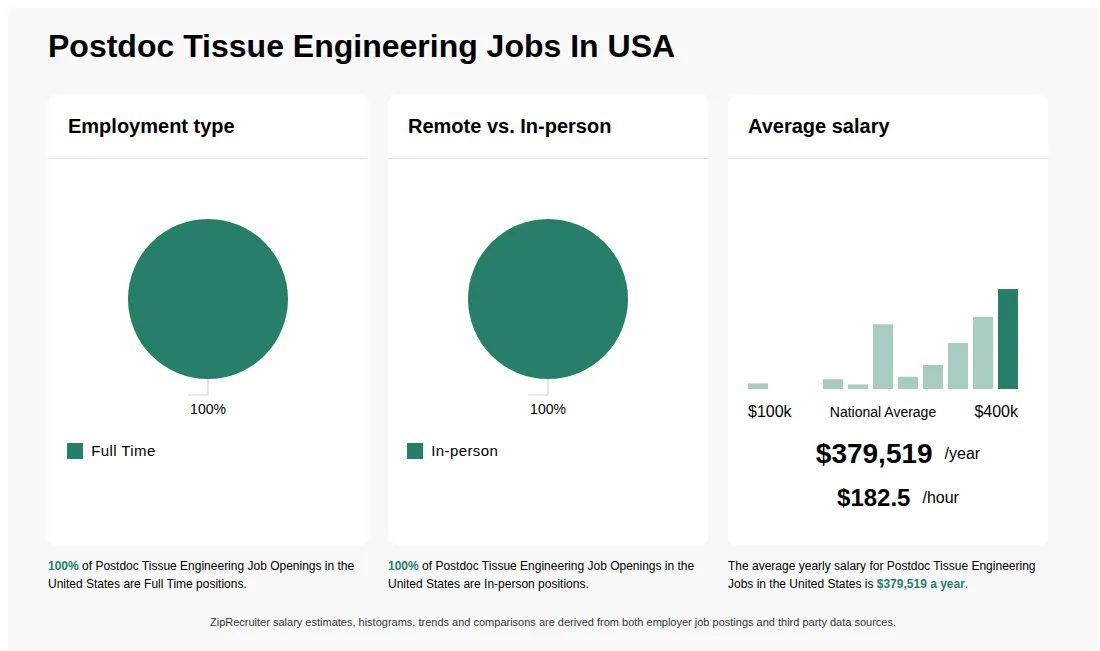
$100K - $127.3K
1% of jobs
$127.3K - $154.5K
0% of jobs
$154.5K - $181.8K
0% of jobs
$181.8K - $209.1K
2% of jobs
$209.1K - $236.4K
1% of jobs
$236.4K - $263.6K
20% of jobs
$272.7K is the 25th percentile. Wages below this are outliers.
$263.6K - $290.9K
3% of jobs
$290.9K - $318.2K
7% of jobs
$318.2K - $345.5K
14% of jobs
The median wage is $348.1K / yr.
$345.5K - $372.7K
22% of jobs
$377.4K is the 75th percentile. Wages above this are outliers.
$372.7K - $400K
30% of jobs
$100K
$400K
$97K - $132.60K/yr
Full-time
Medical, Dental, Vision, Retirement, PTO
Posted 20 days ago
e184 Artificial Womb is a biotechnology research company dedicated to advancing ectogenesis - the ability to support human development outside the body - to expand reproductive freedom and redefine what is possible in medicine. Our mission is to remove the biological constraints that limit who can safely carry a pregnancy, enabling new pathways to parenthood for individuals facing medical risk, infertility, or physiological barriers to gestation.
We operate at the intersection of biology, engineering, and computational science, building integrated platforms that combine advanced tissue models, adaptive culture systems, and automated experimental workflows to understand and recreate the conditions required for healthy human gestation beyond the uterus.
Role overviewAs a Senior Scientist at e184 Artificial Womb, you will lead research focused on translating in vivo placental biology into experimentally tractable model systems that inform the development of functional placental platforms for ex utero gestation. Your work will center on applying mechanistic understanding of placental development, structure, and maternal-fetal exchange to guide the design and optimization of placental organoid and co-culture models capable of supporting perfusion and sustained fetal development.
You will drive experimental strategy from biological discovery through model validation, working closely with tissue engineers, biomaterials scientists, and perfusion engineers to integrate placental biology into engineered systems. This is a highly hands-on leadership role for a scientist with deep expertise in placental development who is excited to translate fundamental reproductive biology into next-generation experimental platforms within a fast-moving, interdisciplinary startup environment.
Translate in vivo placental biology: Apply knowledge of placental development, trophoblast differentiation, and maternal-fetal exchange to define biological requirements for engineered placental systems.
Develop placental organoid models: Establish and optimize placental organoid and co-culture systems that recapitulate structural, cellular, and signaling features of developing placenta.
Guide functional platform development: Inform the design of perfusion-compatible models that enable nutrient, gas, and signaling exchange required for sustained fetal development.
Characterize placental structure and function: Use imaging, histology, molecular profiling, and functional assays to evaluate trophoblast differentiation, vascular interactions, and transport capacity.
Define developmental signaling environments: Identify molecular pathways and extracellular cues that regulate placental maturation and integrate findings into experimental platform design.
Drive interdisciplinary collaboration: Work closely with tissue engineering, hydrogel, and perfusion teams to translate biological insight into engineered solutions supporting long-term development.
PhD in Placenta Biology, Developmental Biology, Reproductive Biology, Cell Biology, or a related field with postdoctoral experience, or 7+ years of relevant industry or academic experience
Demonstrated expertise in placental development and trophoblast biology
Strong understanding of maternal-fetal interface biology and placental physiology
Hands-on experience with mammalian cell culture and placental model systems
Experience designing and executing independent experimental research programs
Familiarity with histological and molecular approaches for studying placental development
Ability to lead complex interdisciplinary research efforts
Strong organizational and documentation skills
Comfort working in a fast-paced, iterative startup environment
Experience developing or working with placental organoids or advanced in vitro placental models
Expertise in trophoblast stem cell biology and differentiation
Experience studying placental vascularization or nutrient transport mechanisms
Hands-on histology experience, including tissue processing, sectioning, staining, and microscopy-based analysis
Experience with transcriptomic, single-cell, or spatial omics approaches in developmental systems
Familiarity with perfusion or microphysiological culture platforms
Experience translating in vivo biological findings into engineered or experimental systems
Prior startup or early-stage technology development experience
Unrivaled impact: Your work directly enables technology that transforms human fertility and reproductive medicine.
Full-spectrum growth: Gain exposure to the entire lifecycle of discovery. From screening to mechanistic validation.
Best of both worlds: Experience the creative chaos of an early-stage startup with the stability of a well-capitalized company.
Elite collaboration: Work alongside a world-class team who are as driven as you are.
Competitive salary + equity participation is considered
State-of-the-art facility in Portland metro area
Comprehensive Medical, Dental, Vision, and 401(k) with company match
20 days PTO + 11 paid holidays