1

Postdoc Tissue Engineering Jobs (NOW HIRING)

PhD in Tissue Engineering, Bioengineering, Biomedical Engineering, Developmental Biology, or a related field with postdoctoral experience, or 7+ years of relevant industry or academic experience

Senior Scientist - Tissue Engineering

Portland, OR · On-site

$97K - $132.60K/yr

PhD in Tissue Engineering, Bioengineering, Biomedical Engineering, Developmental Biology, or a related field with postdoctoral experience, or 7+ years of relevant industry or academic experience

Postdoctoral Fellow

Baltimore, MD · On-site

$48.70K - $66.10K/yr

Stem cells, organoids, tissue engineering, and/or 3D bioprinting * Biomaterials for regenerative ... Postdoctoral fellows receive comprehensive benefits; see JHU Postdoctoral Fellow Benefits Overview ...

Postdoctoral Fellow, Live Tissue Omics

Chicago, IL · On-site

$50.50K - $68.50K/yr

The Opportunity Biohub Chicago seeks outstanding early-career scientists and engineers to join its ... Quantitative Live Tissue Transcriptomics platform as a Postdoctoral Research Scholar in ...

The Ozbolat Laboratoryin Penn State's College of Engineering has multiple openings for Postdoctoral Scholars in the field of bioprinting, tissue engineering, and regenerative medicine. The successful ...

next page

Showing results 1-20

Postdoc Tissue Engineering information

See salary details

$100K

$400K

How much do postdoc tissue engineering jobs pay per year?

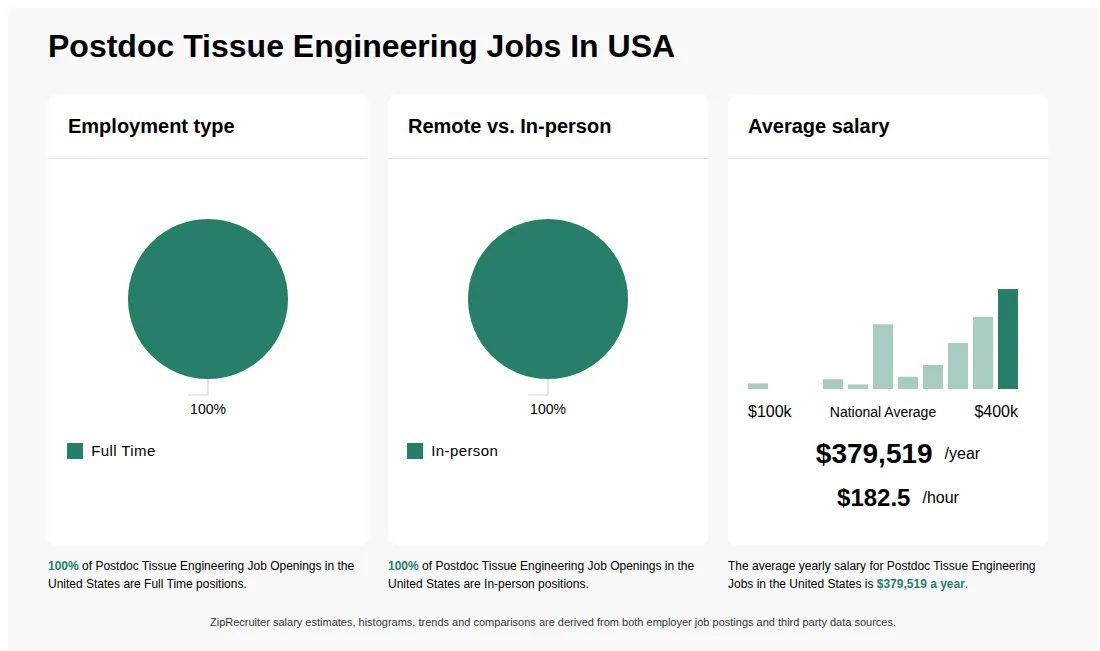
As of May 29, 2026, the average yearly pay for postdoc tissue engineering in the United States is $379,519.00, according to ZipRecruiter salary data. Most workers in this role earn between $400,000.00 and $400,000.00 per year, depending on experience, location, and employer.

What are the key skills and qualifications needed to thrive as a Postdoc in Tissue Engineering, and why are they important?

To thrive as a Postdoc in Tissue Engineering, you need a Ph.D. in biomedical engineering, materials science, or a related field, with strong expertise in cell biology, biomaterials, and experimental design. Proficiency in laboratory techniques such as cell culture, 3D bioprinting, microscopy, and data analysis software like ImageJ and MATLAB is typically required. Critical thinking, problem-solving, and the ability to collaborate and communicate effectively are vital soft skills for this role. These skills and qualities are essential for advancing scientific research, publishing impactful findings, and driving innovation in regenerative medicine.

What are some common challenges faced by postdocs in tissue engineering, and how can they be addressed?

Postdocs in tissue engineering often encounter challenges such as balancing independent research with collaborative projects, securing funding for their work, and adapting to rapidly evolving technologies. Managing time effectively between lab experiments, manuscript writing, and grant applications is crucial. Building strong relationships with interdisciplinary teams—including biologists, engineers, and clinicians—can help overcome technical hurdles. Proactively seeking mentorship and networking opportunities also supports career development and helps navigate the transition to more senior academic or industry roles.

What are postdoc tissue engineering positions?

Postdoc tissue engineering positions are research-focused roles typically held by individuals who have recently earned their PhD in fields such as biomedical engineering, biology, or materials science. These positions involve conducting advanced research on developing and improving biological tissues for medical applications, such as regenerative medicine or organ replacement. Postdoctoral researchers work under the supervision of principal investigators, collaborate with interdisciplinary teams, publish findings, and may also help mentor graduate students. The experience gained during a postdoc is often essential for those pursuing academic, industry, or clinical research careers in tissue engineering.
Infographic showing various Postdoc Tissue Engineering job openings in the United States as of May 2026, with employment types broken down into 100% Full Time. Highlights an 100% In-person job distribution, with an average salary of $379,519 per year, or $182.5 per hour.

Senior Scientist - Tissue Engineering

e184

Portland, OR

$97K - $132.60K/yr

Full-time

Medical, Dental, Vision, Retirement, PTO

Posted 20 days ago


Job description

About us

e184 Artificial Womb is a biotechnology research company dedicated to advancing ectogenesis - the ability to support human development outside the body - to expand reproductive freedom and redefine what is possible in medicine. Our mission is to remove the biological constraints that limit who can safely carry a pregnancy, enabling new pathways to parenthood for individuals facing medical risk, infertility, or physiological barriers to gestation.

We operate at the intersection of biology, engineering, and computational science, building integrated platforms that combine advanced tissue models, adaptive culture systems, and automated experimental workflows to understand and recreate the conditions required for healthy human gestation beyond the uterus.

Role overview

As a Senior Scientist at e184 Artificial Womb, you will lead the development of engineered tissue systems designed to support placental development through controlled vascularization and maternal-fetal interface modeling. Your work will focus on building vascularized culture platforms that integrate trophoblast stem cell models, placental organoids, and endothelial cells to recreate the structural and signaling environments required for placental formation and function.

You will drive experimental strategy from system design through biological validation, working closely with developmental biologists, biomaterials scientists, and engineering teams to translate principles of tissue engineering into functional platforms for ex utero gestation. This is a highly hands-on leadership role for a scientist experienced in vascularized tissue models who is excited to work at the intersection of tissue engineering and developmental biology in a fast-moving startup environment where engineered systems directly enable biological discovery.
What youll do
  • Engineer vascularized tissue systems: Design and develop platforms that promote formation and maturation of engineered vasculature to support placental tissue development and function.

  • Build placental development models: Establish and optimize co-culture systems integrating trophoblast stem cells, placental organoids, and endothelial cells to model maternal-fetal interface biology.

  • Guide vascular patterning and function: Develop strategies to control angiogenesis, perfusion, and endothelial-trophoblast interactions that drive tissue organization and nutrient exchange.

  • Integrate biomaterials and perfusion systems: Collaborate with biomaterials and engineering teams to incorporate hydrogels, scaffolds, and perfusion interfaces that enable long-term tissue viability.

  • Characterize tissue structure and function: Apply imaging, histology, molecular profiling, and functional assays to evaluate vascular development, trophoblast differentiation, and placental maturation.

  • Drive iterative platform development: Translate biological outcomes into engineering improvements through rapid experimental iteration and cross-disciplinary collaboration.

Core requirements
  • PhD in Tissue Engineering, Bioengineering, Biomedical Engineering, Developmental Biology, or a related field with postdoctoral experience, or 7+ years of relevant industry or academic experience

  • Demonstrated expertise in tissue engineering and 3D culture system development

  • Experience engineering or studying vascularized tissues or angiogenesis in vitro

  • Hands-on experience with mammalian cell culture and complex co-culture systems

  • Strong understanding of endothelial biology and vascular development

  • Experience designing and executing independent experimental programs

  • Ability to lead technically complex projects in interdisciplinary environments

  • Strong organizational and documentation skills

  • Comfort working in a fast-paced, iterative startup environment

Youll stand out with
  • Experience working with trophoblast stem cells, placental organoids, or placental biology models

  • Expertise in vascular patterning, perfusion culture, or microvascular engineering

  • Experience integrating engineered tissues with biomaterials or hydrogel systems

  • Hands-on histology and advanced imaging experience for 3D tissue characterization

  • Experience with angiogenic signaling pathways and endothelial-epithelial interactions

  • Familiarity with microfluidic or perfusion-based tissue culture platforms

  • Experience translating engineered tissue models into functional biological systems

  • Prior startup or early-stage technology development experience

Why e184?
  • Unrivaled impact: Your work directly enables technology that transforms human fertility and reproductive medicine.

  • Full-spectrum growth: Gain exposure to the entire lifecycle of discovery. From screening to mechanistic validation.

  • Best of both worlds: Experience the creative chaos of an early-stage startup with the stability of a well-capitalized company.

  • Elite collaboration: Work alongside a world-class team who are as driven as you are.

What we offer
  • Competitive salary + equity participation is considered

  • State-of-the-art facility in Portland metro area

  • Comprehensive Medical, Dental, Vision, and 401(k) with company match

  • 20 days PTO + 11 paid holidays

We may use artificial intelligence (AI) tools to support parts of the hiring process, such as reviewing applications, analyzing resumes, or assessing responses. These tools assist our recruitment team but do not replace human judgment. Final hiring decisions are ultimately made by humans. If you would like more information about how your data is processed, please contact us.
apply for this job